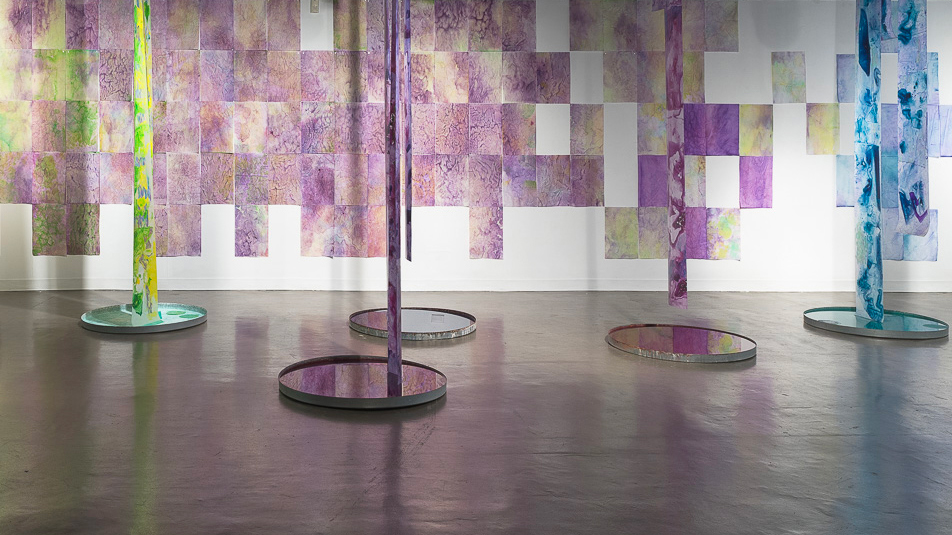
Floating names a state of suspension, between sinking and surviving, between grief and the body’s refusal to stop. In Keren Anavy’s landmark solo exhibition, Floating in Three Acts, this condition is both subject and structure. The exhibition is built the way floating feels: without firm ground, without clear direction, with the question of outcome left open.
The exhibition spans 2,500 square feet across three interconnected gallery spaces at the Amelie A. Wallace Gallery, SUNY, each distinct in character and linked by a path that winds downward through them. The architecture and the installations work together seamlessly to guide you. From the entry at the upper level, the two lower spaces are partially visible, glimpsed but not yet reachable. The artist offers generous cues. How you experience this work is your own.
The movement carries the echo of an ancient story: the descent from the garden of the living into what lies beneath. But this is not a journey toward death. It is a journey toward what death has not extinguished.
The garden is on the first level, and it announces itself with abundance. Mylar scrolls hang from the ceiling, their surfaces carrying lush, flowing ink — blues, purples, greens — that references lilies and hibiscus. The scrolls descend at different heights, some reaching the shallow circular vessels on the floor below, which hold pools of colored ink, concentrated, vivid, artificial. The effect is of a garden distilled to its essence, a symphony of colors channeled into geometric forms, unmistakably constructed. This is the idea of nature as a blueprint, albeit an intensely visceral one.
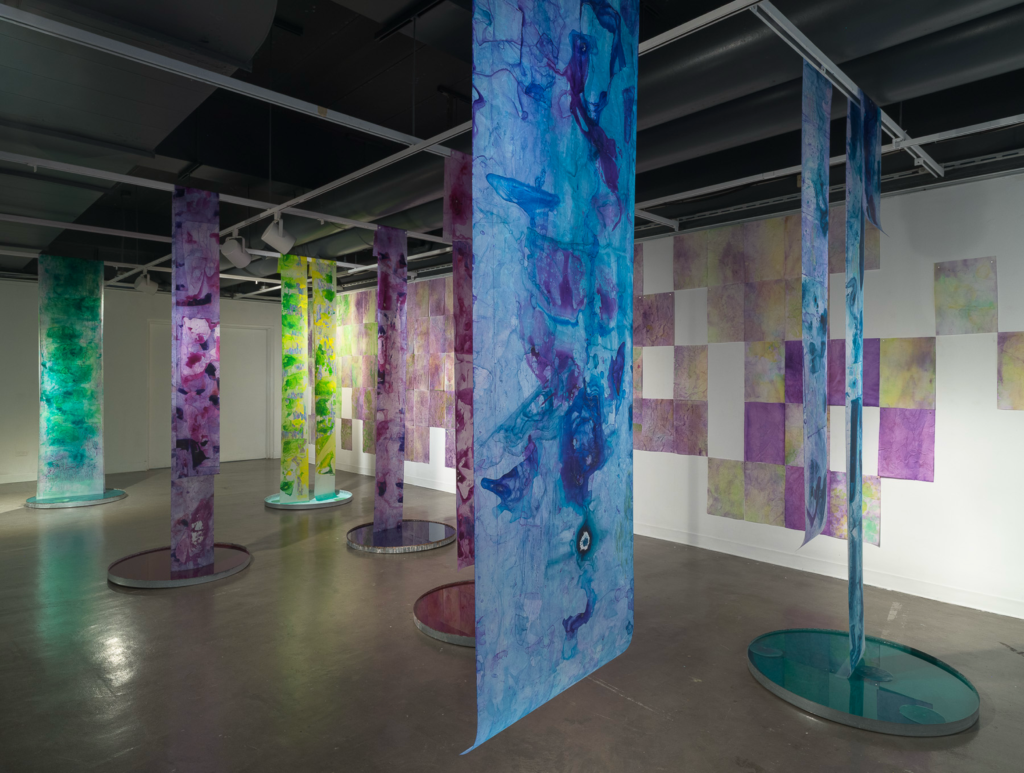
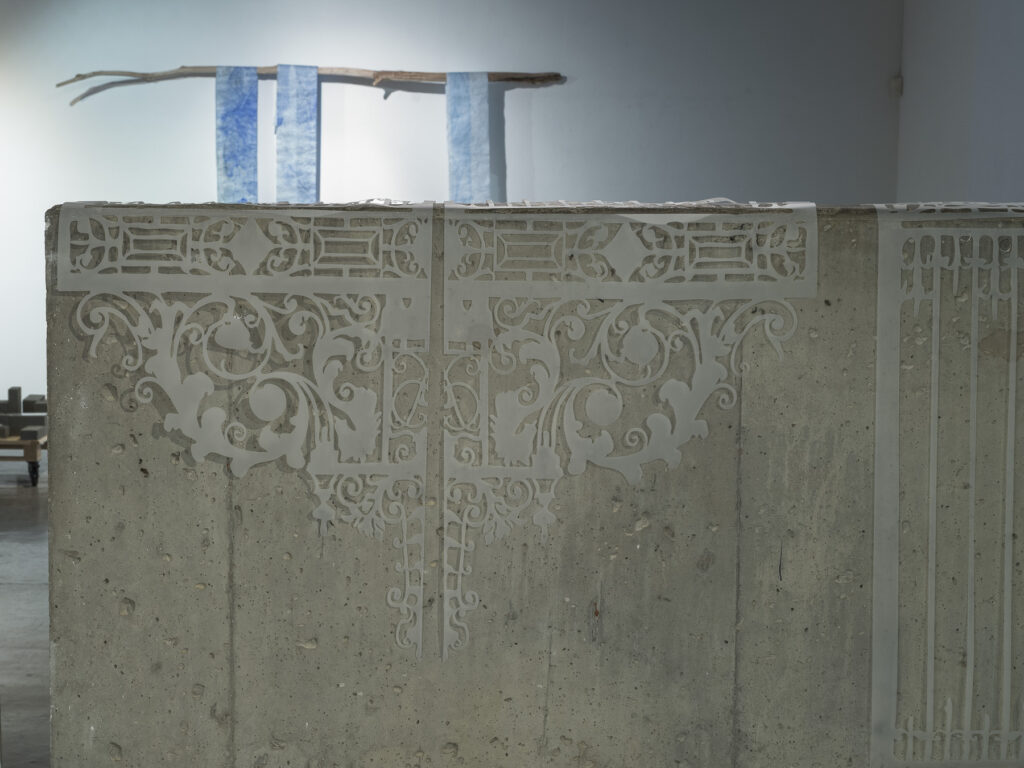
On the walls, mosaic-like ink drawings cluster together, creating the sense of a walled garden, an enclosed space. Along a concrete low wall, laser-cut mylar forms echo the elaborate iron gates of Old Westbury Gardens — intricate, architectural ornaments — a hinted gate overlooking what lies below. Through that same wall, the ocean below is already visible. The boundary between the living garden and what waits beneath it is present from the start.
Anavy has spent years researching gardens, their history, their symbolism, and the human desire to impose order on wildness. That research is felt here not as information but as longing. She comes from a dry landscape, and the lush, watered garden is not a given for her but a dream, a destination, something desired and earned. The garden in this exhibition carries that weight; it is Eden as much as it is Old Westbury, the fertile world as aspiration.
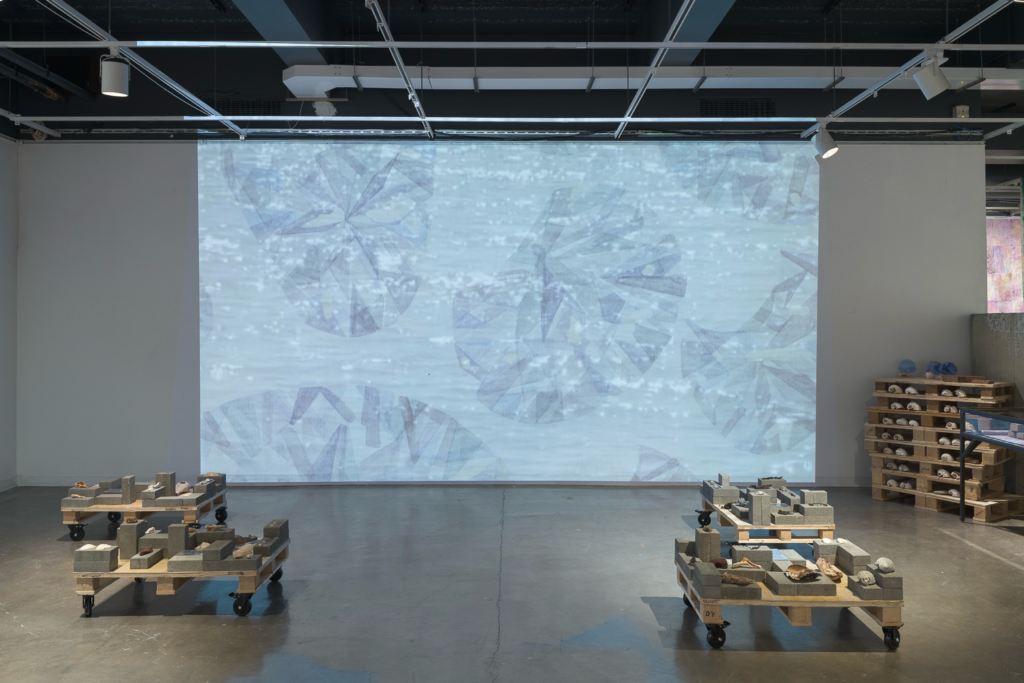
The ocean floor opens below. A devastating personal loss runs through the exhibition as an undercurrent, present without being stated. Here, the sound of waves comes from recordings by the artist’s late daughter. The work does not present itself as a memorial, yet it holds that function, carried and distilled through the processes of making. It remains accessible, inviting the viewer into it without fixing its meaning. Ocean Archipelago presents twelve wheeled platforms, each carrying objects gathered from shorelines over years, shells, coastal fragments, remnants of marine life, each one researched, each one held with the attention one gives to something still vital.
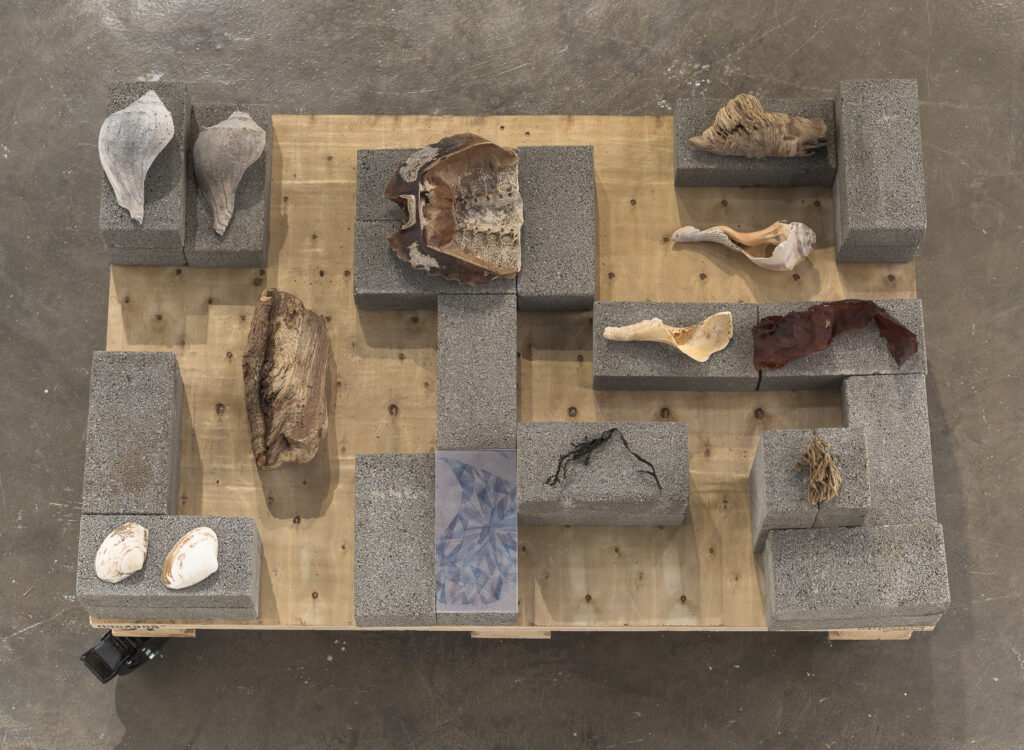
and colored pencils on transparent Mylar, Plexiglas, found naturals objects, concrete bricks, 26X39 inches.
Photo credit: JSP Art Photography
These are not relics of loss. They are evidence of life that has moved through time and taken other forms, present, still communicating. Anavy’s practice connects to Mark Dion’s long engagement with collecting from natural environments, but where Dion often deploys taxonomy as critique, Anavy is driven by wonder and by grief. This is the Orphic gesture at the heart of the exhibition: the artist descends into loss armed with painting, the way Orpheus descended into the underworld armed with song.
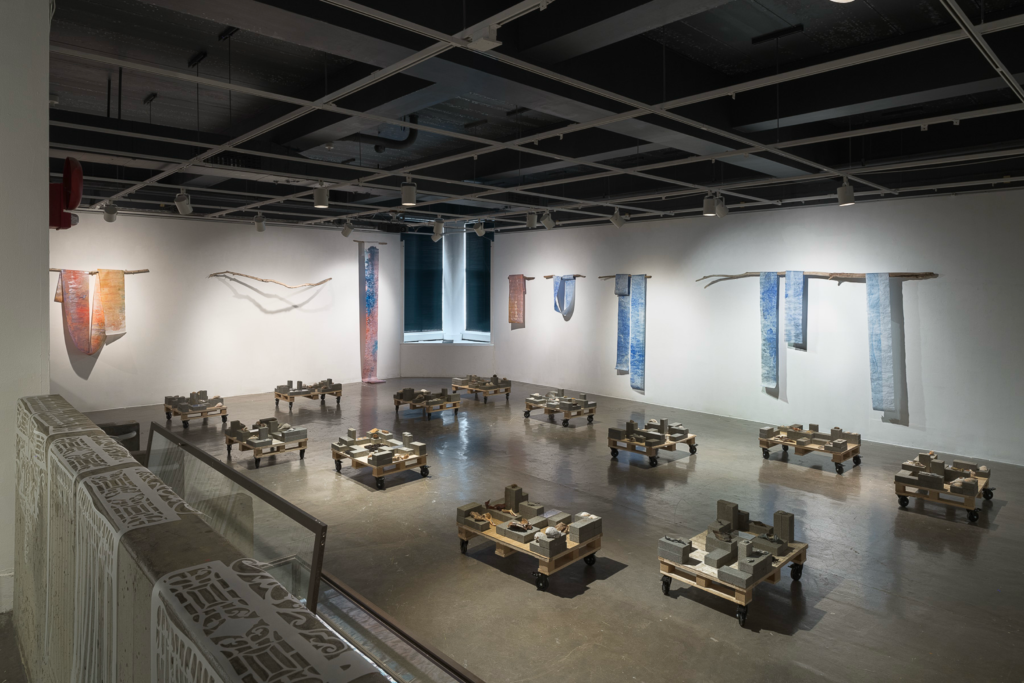
Art here is the instrument that makes the descent possible, the thing that allows you to go under and remain in conversation with what you find there. Each platform pairs gathered objects with her own ink drawings, the world as it is given, and the world as it is questioned. Art cannot match what the ocean produces. The impulse to reach toward it persists regardless. On the walls, the scroll paintings on rice paper, unfolding from wooden branches collected on the shore, make that conversation visible. Anavy saturates the paper with water, introduces ink, builds layer upon transparent layer, and waits. She follows the material rather than directing it. The results are dense, alive surfaces that hold color the way water holds light. There is a performative dimension in the scrolls. An element of performance, specifically a reference to Joan Jonas, is evident in Anavy’s video; both artists recognize that formal rigor and personal exposure are not opposing forces. The video, made with an iPhone (Jonas’s “permission”), includes a fragment of her submerging her drawing on paper in water, where the paper does its own work, sinking, floating, opening.
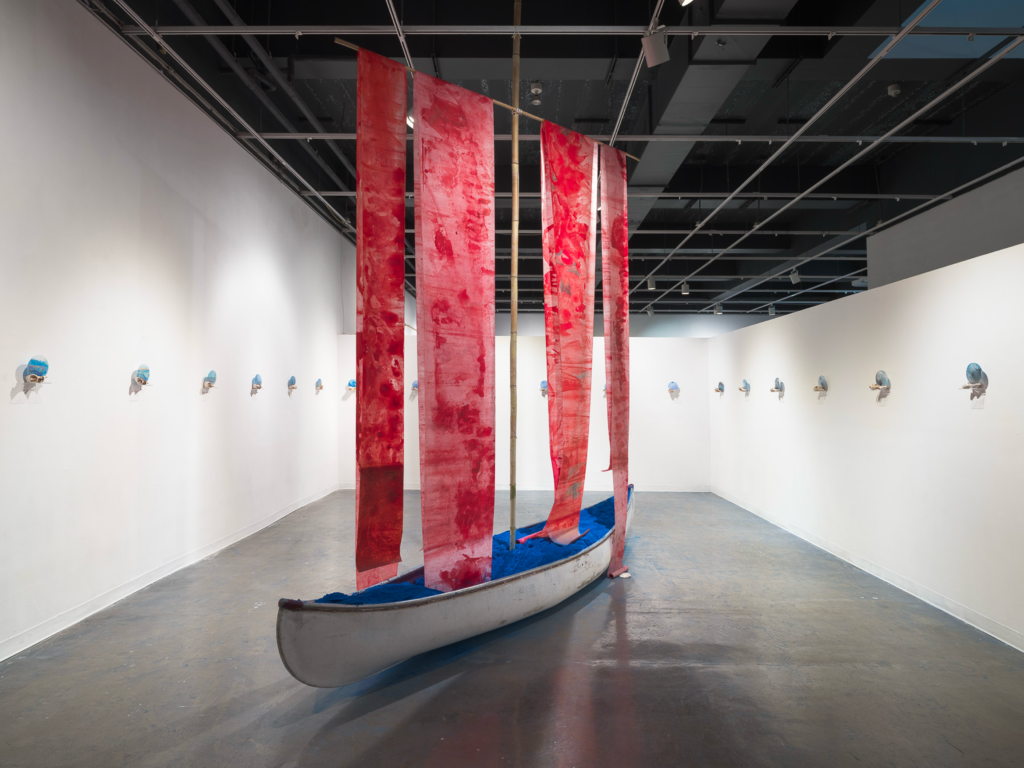
The lowest gallery holds a canoe, confined in a space too small for movement, filled with ultramarine blue powder. The weight of it is visible, but weight is not doom. This boat has sailed. The blue it carries is the blue of open water, of distance traveled, of a life lived at sea. Around it, blood-red sails hang in the still air, the red of hibiscus, of vitality, of the living world. And here the spatial logic of the exhibition opens into something genuinely strange: the canoe sits at the bottom of the building, yet a canoe belongs on the surface of water. Are we beneath it, looking up through the surface as through glass? Is the garden above the waterline, the sea below, and the canoe suspended between them? The question does not resolve, and should not.
The canoe is also a vessel of migration. Anavy has moved, from country to country, from one world to another, and the exhibition carries that history as an existential condition. To be an immigrant is to be permanently in transit, belonging fully to neither the place left behind nor the place arrived at. It is to float, untethered, carrying the memory of another world in your body. The canoe holds all of this. It is Charon’s vessel and a means of crossing the Styx. It is heavy, and it is ready. Where it is going remains open.
Floating in Three Acts at Amelie A. Wallace Gallery, SUNY, is on view with a live performance intervention by students of artist Marcela Torres on Thursday, April 30.
Curatorial Advising and Exhibition Text: Catherine Bernard, PhD
Keren Anavy: Floating in Three Acts at the Amelie A. Wallace Gallery, SUNY Old Westbury is supported in part by Artis through its exhibition grant initiative and is additionally sponsored by OW STEAM.
About the writer: Etty Yaniv is a Brooklyn-based artist, writer, curator, and founder of Art Spiel. She works in installation, painting, and mixed media, and has shown her art in exhibitions across the United States and abroad. Since 2018 she has published interviews and reviews through Art Spiel, often focusing on underrecognized voices and smaller venues. More about her art can be found at ettyyanivstudio.com and on Instagram @etty.yaniv