Entering the fourth floor of the Guggenheim, you are met with fields, mountains, lakes of the Bavarian Alps, daily objects, and people—bright, saturated colors held together by dark edges. The exhibition brings together landscapes, portraits, and still lifes, with a focus on Münter’s early Expressionist years alongside later paintings.
The artist was a central figure in Der Blaue Reiter (The Blue Rider), a Munich-based group in the early twentieth century founded by Wassily Kandinsky and Franz Marc that sought new forms of expression beyond naturalism, where simplification and contour became central problems of form. While Münter’s painting has sometimes been overshadowed by her professional and romantic association with Kandinsky, her role in shaping early modernist painting has been increasingly acknowledged—this exhibition itself is part of that effort. Münter’s early engagement with photography—begun during travels in the United States at the turn of the century—appears here alongside the paintings, at times suggesting affinities in framing and selection, though the two bodies of work are not always in close conversation.
In The Blue Lake (1934), green lawns slope into a patch of blue in the near ground, flanked by conifers and a feather-shaped soft green. A purple and pink mountain meets the same blue further back, and clouds gather on the horizon like sand dunes, their golden hue contrasting with a sky of shades of teal. The scene is simple, but it does not dissolve. What holds it are the black outlines: each object—the lake, the slope, the trees, the mountain, the clouds—is bordered by a dark edge. These edges are not uniform: sometimes they are thick and insistent; sometimes they thin out, almost eaten by the color patches they contain. The brushwork is also uneven: sometimes the gaps between the strokes remain visible, their darkness lighter and less insistent. There is something almost folkloric, even child-like, about them, but they also feel deliberate.

At first, I wondered whether these edges might have some basis in perception. The frame of the painting casts a shadow on the wall, producing a kind of outline around it. But in looking more closely, this explanation does not quite hold. If I extend my hand against the floor, I can tell my hand and the floor apart without any black outline: the difference comes from color, from texture, and from how light falls. These differences, however, are not always easily rendered in painting. In Münter’s work, forms are often rendered as flat areas of color, with little modeling to suggest depth or surface, and the boundary between things thus becomes less certain. Her outlines thus help the painting hold: instead of reproducing what we see, they establish what the painting needs in order to be seen as more than patches of color.
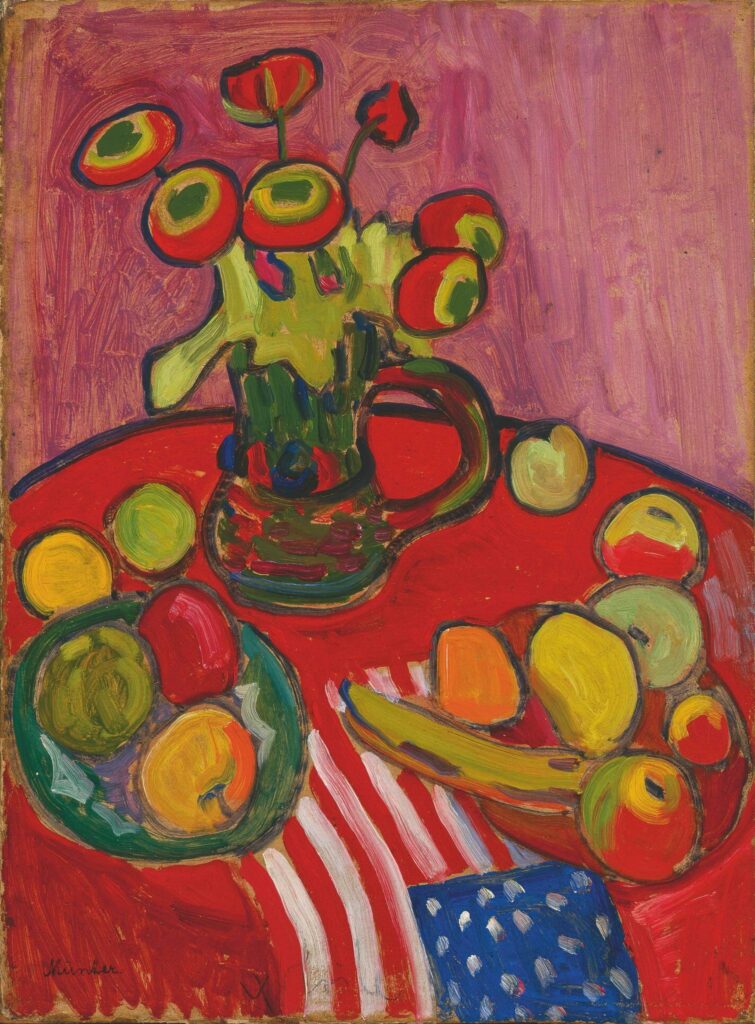
But looking across the exhibition, it is also clear that these outlines are not fixed in function. In Still Life, Red (1909), the red table, vase, and fruits are set against an ochre ground, but the outlines of these objects are not uniformly black but include blue and olive. The effect is noticeably different: less sharp contrast and smoother color gradation. The edge still separates, but more quietly, allowing the colors to relate rather than clash.
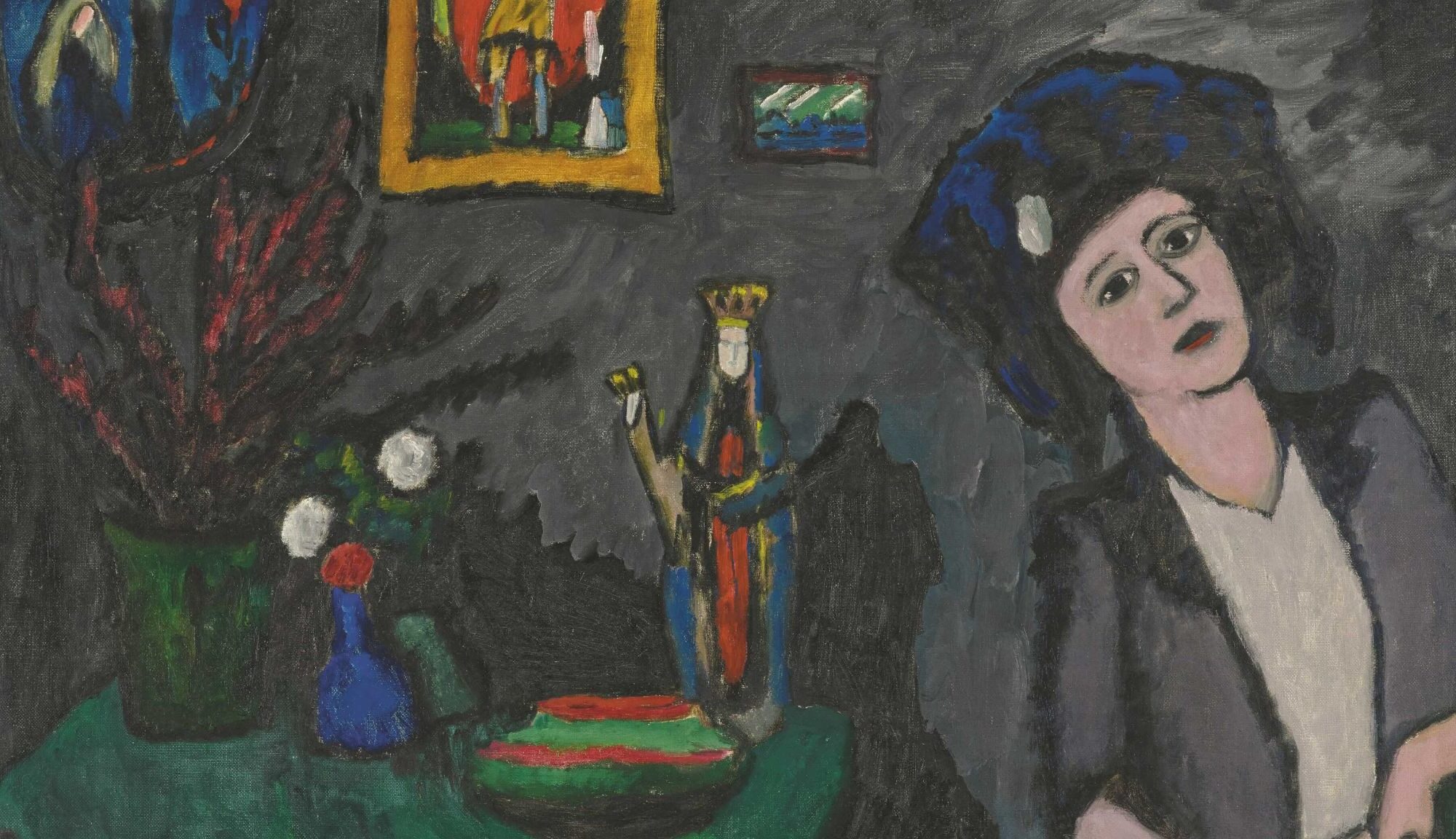
In Still Life with Figure I (Mrs. Simonovich) (1910), Mrs. Simonovich’s face—eyes, nose, and mouth—is rendered with thinner, more careful lines, still black, still outlining the features rather than rendering their texture, while the small figurine beside her, possibly drawing on folk or devotional forms, is rendered more abstractly, its facial features barely there. The difference is striking. It is not that one object is present and the other absent, but that they are not seen with the same intensity.
The black outlines, then, can be read less as a stylistic language and more as a selective device: while some forms are firmly enclosed, others are lightly traced, and still others are allowed to recede. Such variation suggests that the contour does more than stabilize the image—it registers where the artist’s attention settles and where it loosens. Münter herself pointed to folk art—particularly reverse-glass painting in the Staffelsee region, a local Bavarian tradition she encountered early on and continued to draw from throughout her career—with its “carefree simplification of forms and the strong colors with dark contours.” In reverse-glass painting, an image is rendered back-to-front through the glass, making modeling impossible. Contour and flat color are thus structural necessities for this type of painting, forcing the artist to think about how a surface holds together. In Münter’s work, this simplification becomes uneven: not everything is seen in the same way. That all objects in The Blue Lake are outlined gives the scene a more even distribution of attention, while the more selective outlining in Mrs. Simonovich narrows attention.
The dark contour was a modernist device—developed from cloisonné painting in Gauguin and the Nabis and carried into Fauvism (Derain, early Matisse) and taken up in different ways by painters around Münter, including Alexej von Jawlensky—but in Münter’s work, it appears uneven, less like a style and more like a shift in attention. The thick edge fixes a form in place; the thinner line touches it more lightly. This difference is particularly visible in the portraits. To revisit the image of Mrs. Simonovich, her face carries a weight that the surrounding objects do not. The figurine, though present, is visually secondary. The difference is perceptual before it is interpretive, discernible immediately by how it is handled.
The exhibition’s arrangement itself echoes this logic to some extent. Landscapes cluster around the years before and during WWI; photographs from her travels in the United States form one grouping, while still lifes and portraits form the other two. Whether this reflects curatorial intention or the contingencies of the artwork available is not entirely clear, but the segmentation does produce its own set of edges—divisions that separate bodies of work of the same artist into easy categories, guiding attention toward some connections while letting others fall away, the black-and-white photos in little conversation with her paintings of bold colors and dark outlines. If all her work were arranged linearly in chronology, what aspects of her life would be allowed to emerge, to be seen?
With all these thoughts, I left the exhibition with not only an impression of Münter’s colors but a more basic understanding: that the world does not come already divided into discrete objects, so the boundaries between objects have to be articulated. Sometimes this is done through color, sometimes through line, and whatever form it takes, the act of outlining demands attention. In Münter’s case, the contour remains visible as the mark of that articulation.
Gabriele Münter: Contours of a World, Guggenheim, 1071 Fifth Avenue, New York, NY 10128. On view through Apr 26, 2026. Every day, 10:30 am–5:30 pm.
About the writer: Hantian Zhang is a writer and data scientist based in San Francisco. His writing has appeared in Afterimage: The Journal of Media Arts and Cultural Criticism, AGNI, Prairie Schooner, West Branch, and elsewhere. @hantian_zhang