
Upon entering the exhibition at Latitude Gallery, you are greeted with a poem as a silent welcome, the cadence of the poem setting both the scene and the pace of the exhibition, titled A Room Rehearses its Own. In this exhibition, the paintings of Xiangjie Rebecca Wu piece together place, memory, and silence, with an impactful portrayal through both presence and absence.
The stanza in the poem that was most poignant for me, the most fitting, was-
Not to be reclaimed or re-entered
But to legitimize
Silence and distance
Distance of place, of time;
Bewildering accuracy of imagination and dream –
This stanza fully immerses me in the work and the memories that Wu presents to us. While the narrative isn’t linear, it is instead told by scenes, perhaps flashbacks, or foggy remembrances, and the paintings carry with them a cinematic feel. Time moves through them, pauses where it needs to, and lets the viewer feel the pull, the sensation of time’s duration.
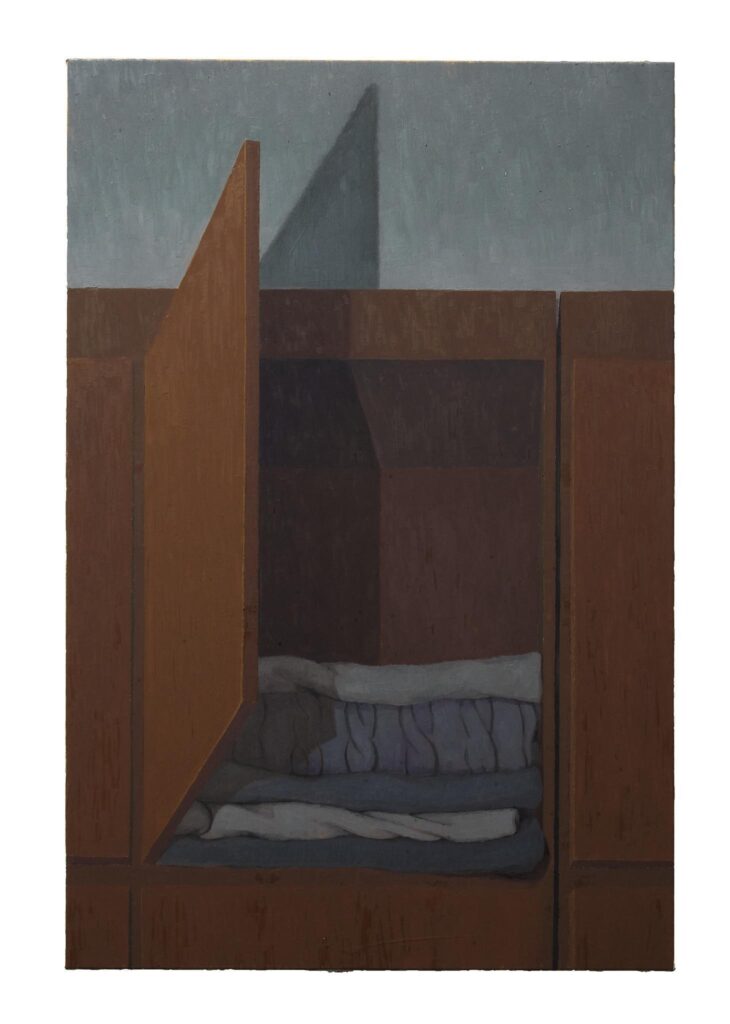
Wu’s images stem from memories- a collection of images gathered, recalled, and recreated. She paints the scene she remembers, the images she feels, and allows the viewer to feel it as well. When I walked through these pieces, I felt as if I stepped into a Yasujiro Ozu or an Andrei Tarkovsky film. Ozu came first to mind because many of his films deal with the home and everyday life, and the poignant nature of time and life inevitably moving forward. Many of his films had scenes where the small details mattered, the glint of a plate, the kitchen cabinet, or the steam insinuated from a now quiet tea kettle. Both Ozu and Wu expertly make us, as viewers, feel the weight and pull of time, where the present tells of the past as it continues forward simultaneously. Most of the scenes in the paintings, being devoid of figures, immerse us further as active participants within the work. Similar to the work titled Grey Cardigans, pictured below, of cardigans waiting to be worn, the absence is unmistakable, but the potential of something happening is inevitably there. The constant feeling of remembering a similar scene or scenario carries throughout the exhibition.
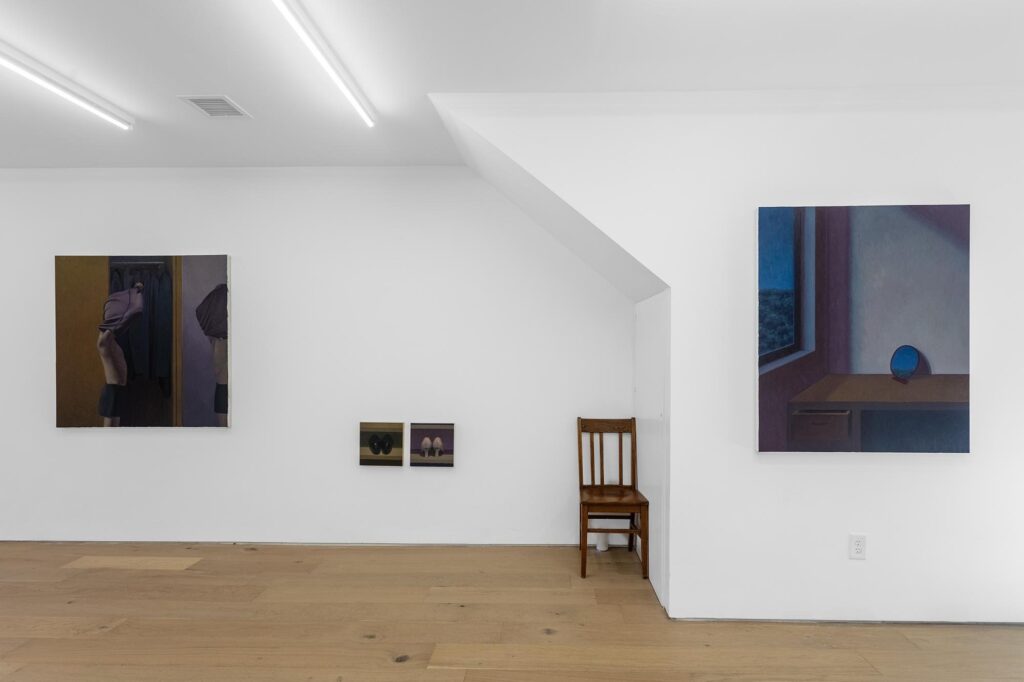
The entire installation of the show mirrors that of a home, a place of familiarity. Each painting is hung with great care, the placement intentional. Paintings of shoes are hung close to the floor beside a chair, as if inviting us to sit by it, to enter the piece itself by immersing ourselves in the motion and function of it, as if to possibly remove our own shoes and place them next to the others. Other pieces are hung at proper heights, to be felt: a drawer filled with marbles, where we can turn the corner and feel as if we were looking down into it, teapots on kitchen shelves hung just high enough for us to feel the height, being just above eye level, and the weight of the cast shadow Wu places upon them. The pieces and their placement become the props of the scene, the pieces of the memory that Wu intwines together to create a recollection- a scenario in which a memory originates.
The domestic space expands within the paintings, and the selected furniture items brought in to support the works subtly bring the memories to life. As I turn around the middle wall, the painting with the drawer of marbles becomes real and tactile. I can see a desk in front of me, the drawer open just like the painting. I can feel the sensation of the marbles moving as if I pulled the drawer open myself. The space invites me to become an active participant as much as Wu invites me to become the figure within the works. Other paintings depicting mirrors, windows, and doors expand the space and present the idea that there is more to this space than this rectangular showroom. Mirrors reflect what may be behind me in that recalled space, but I just don’t see it yet. The home is expanded, as it becomes more of a space to explore, doors and windows opening up into more and more memories- building upon each other as fragments find something to meld into.
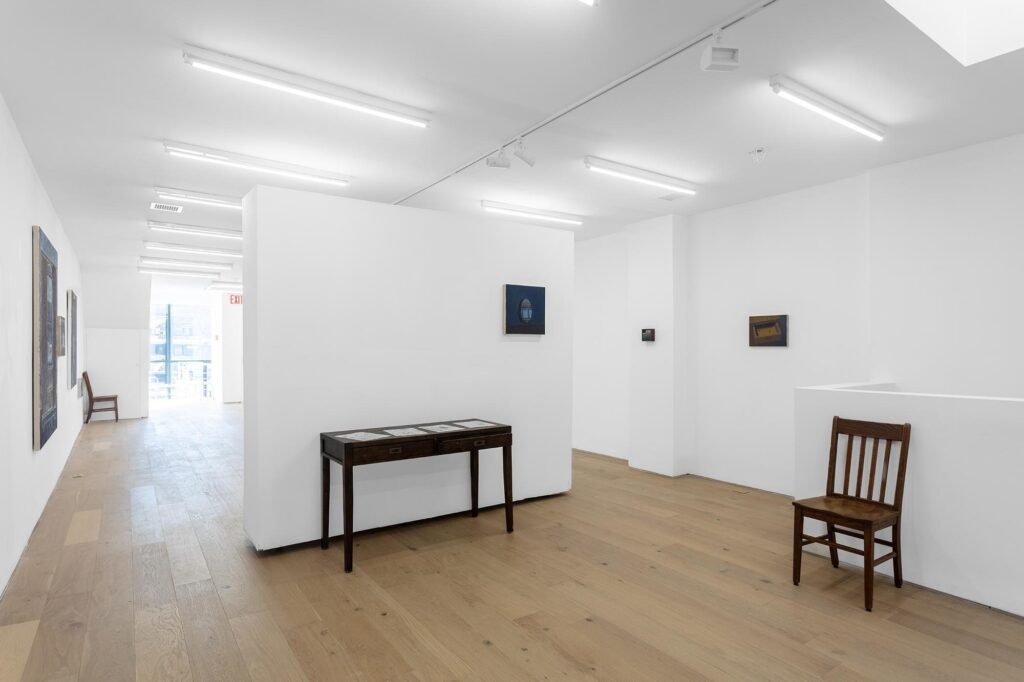
Installation Shot, A Room Rehearses its Own, Latitude Gallery. Photo courtesy of Latitude Gallery
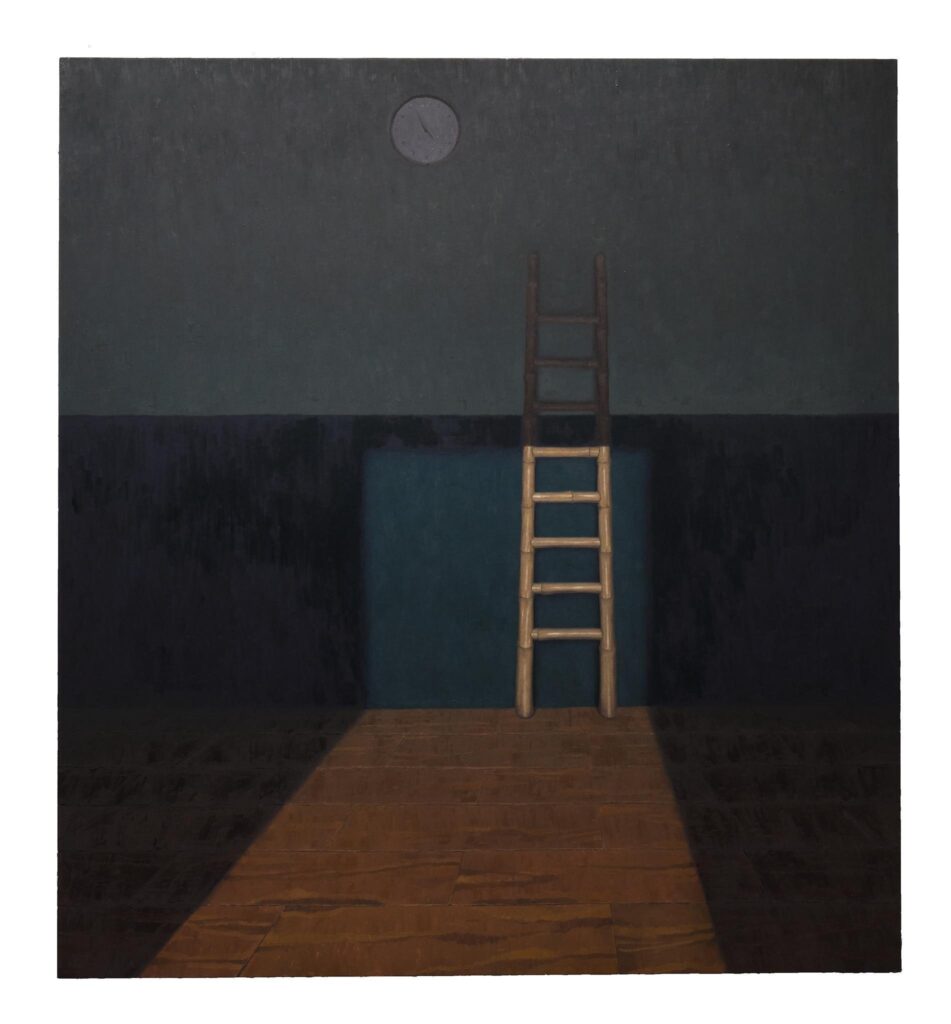
Wu expertly allows us to endure the pull of time and the inevitable movement forward. While the paintings and memories themselves pull us backward internally, externally, time pushes ever onward. Here is another resemblance to Ozu- with time and its inevitability. The clock included in the piece, in the far back of the room, titled Letter to Time, contains a bamboo ladder, leading upward into shadow. And the clock, paused on the canvas, is positioned like the moon, ever present, for us to feel the ticking. Wu places us perfectly to insinuate what the clock is doing, our senses activate, and we begin to hear it, and the feeling of it becomes ever more present, especially being placed above us, like time hanging over our heads. Wu’s care in the layout and considerations of space is impressive; a subtle move of an object speaks volumes, a placement of light or a cast shadow tells us the time of day, and these subtle details and decisions add more to the overall experience.
What I enjoy most about this exhibition is that its presence needs no explanation. Our presence with the works and in the space becomes our own explanation. The poem echoes in my mind again, seeing the paintings complementing it well-
I remember my childhood as a long wish to be elsewhere
This is the house; this must be
The childhood I had in mind
It doesn’t matter what house it is or whose childhood it may be; the memories come either way. The room created by the works in the gallery clarifies memory with striking precision. Through this process, memory is rebuilt and condensed into a tangible presence. Here, Tarkovsky steps in; while the scenes aren’t necessarily misty, they are dreamlike and atmospheric. The outdoor scenes under moonlight, especially the one titled Is That the Night We Lost 2, ” pull me into a sense of nostalgia. Reminding me of my own days of adventure in the woods or the backyard, always needing to be back by the time the streetlights turned on, I never got to play under a moonlit sky, but it seems beautiful and tranquil nonetheless.
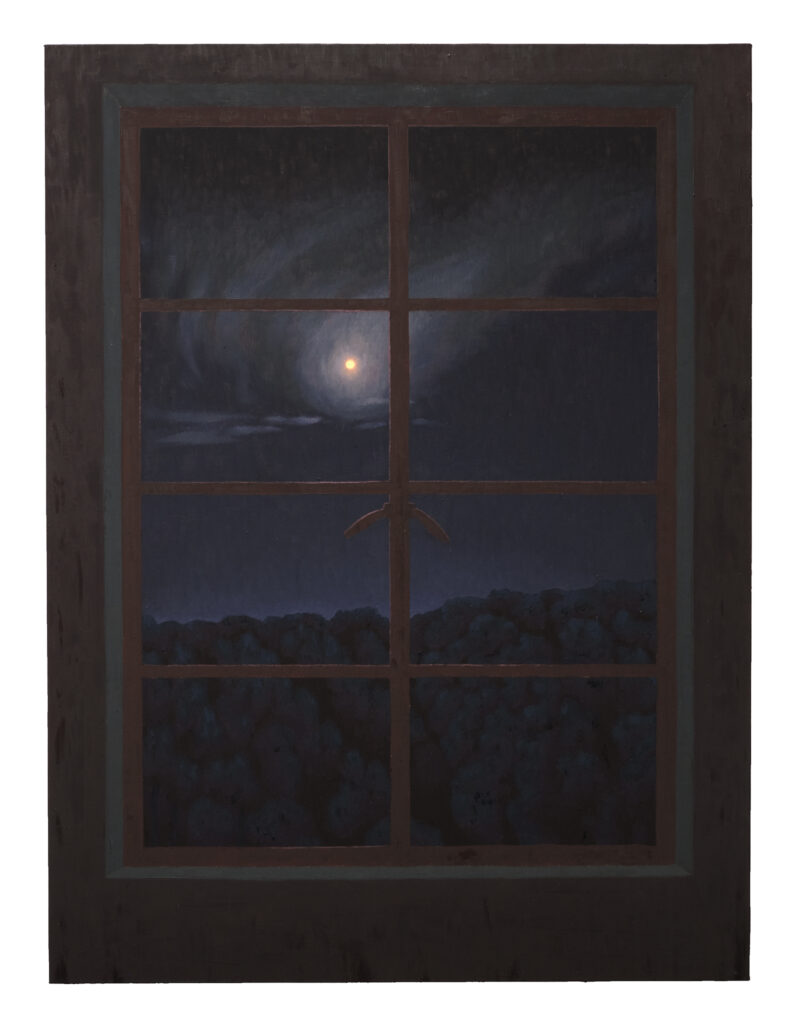
Wu does a wonderful job of creating and building a scene by choosing the right items with which to tell a story. This notion of building brings me back to an Andrei Tarkovsky comparison, while on the set of his film, The Sacrifice, he would build certain sets from mini houses or diorama setups, allowing the camera to view it from many different angles, a full immersion in the scene. Here, it mattered to Tarkovsky where the sun landed on the models, what kind of ground the models were sitting on, and what details he could build upon. In a way, this exhibition becomes not only a narrative or a poetic take on memory, but it also becomes a film set. Wu chooses what items to render in the paintings, what light best suits the composition, and she uses all of these details to create something she remembers, piecing it together so we can experience it as well. This exhibition was a much-needed place of solitude and recollection for me, the space and the works carry with it a calm aura, one that is intimate and perhaps private- but I am welcomed into the home either way, to experience the everyday routines and memories of someone else.
Latitude Gallery, A Room Rehearses its Own, Xiangjie Rebecca Wu, Curated by Xiaojing Zhu, 5 Lispenard Street, NY, NY. On view March 18 – April 26, 2026.
About the Writer: Taylor Bielecki lives in Gowanus, where her studio is, and works at Pratt Institute, where she earned her MFA. She also studied at Penn State, where she earned a BA in English and a BFA in Fine Arts. She finished as a finalist in the Kennedy Center’s VSA National Emerging Young Artist program for 2017, where she earned an award of Excellence. She has shown prints internationally in a print exchange in Australia and exhibitions in Dubai, India, and the Glasgow School of Art. She has also shown paintings internationally in Gallery 24N, PhilaMOCA’s juried exhibitions in Philadelphia, Pa., Perry Lawson Fine Art in Nyack, NY, BWAC in Red Hook, and IW Gallery in Brooklyn. Taylor works for Two Coats of Paint, TUSSLE Magazine, and has joined Art Spiel as a contributing writer. @Taylor.Bielecki