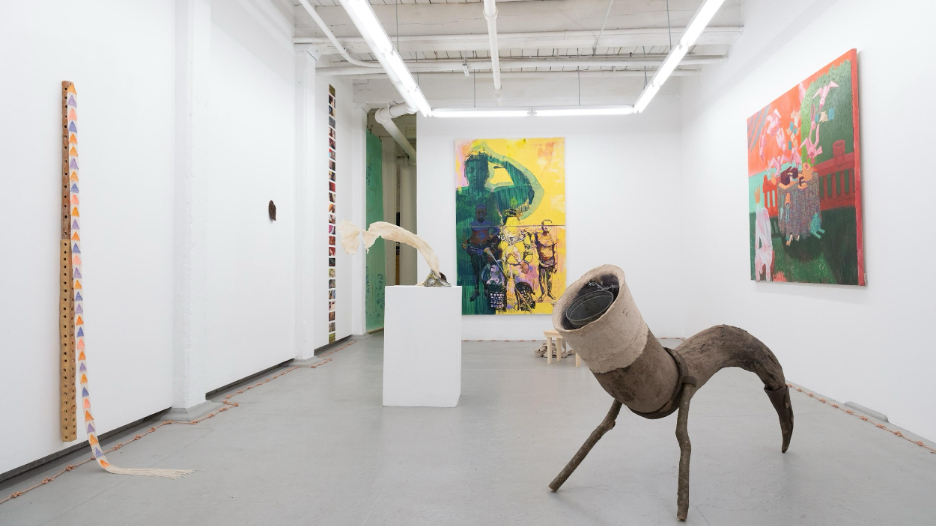
What does a gallery look like when the artists are in charge? Founded in 2013, Ortega y Gasset Projects (OyG) is an artist-run collective with no fixed curatorial line and a non-hierarchical structure shared equally among its eight co-directors. Since 2023, it has become the annual New York home for Cornell University’s MFA thesis exhibition — a partnership built on a simple premise: artist-run spaces value experimentation, innovation, and risk-taking, giving graduate artists the freedom to present work without commercial constraints or curatorial imperatives.
I Happen to be Rock, this year’s show, brought together seven artists from Cornell’s Creative Visual Arts program. The title borrows from a scene in Everything Everywhere All at Once — two rocks, conscious and chatting — at once comical, mystical, tender, and tragic. It was a fitting frame for work that spanned materiality, identity, ecology, memory, and the body, with six of the seven artists presenting site-specific or site-responsive installations.
We spoke with Leeza Meksin, interdisciplinary artist and OyG co-director, about the collective’s model, what this cohort brought to the gallery, and what’s currently at stake for non-profit artist-run spaces.
OyG was founded in 2013 as an artist-run collective with no fixed curatorial line. What has held steady about that model, and what has shifted?
Originally, a group of us came together to offer an alliterative space for artists to gather, connect, and show their work. From the beginning, we envisioned our organizational structure as non-hierarchical, where the co-directors (the 8 artists who run the space) share equally in all decisions as well as in all administrative and programmatic needs of the gallery. I’m proud to say that we’ve stayed true to this challenging and uncommon ideal, working through difficult moments with patience and persistence. One thing that shifted a bit is our resolve to never show our own work in the gallery. Over the years, we came to the conclusion that the artists who run OyG deserve the institutional support of the organization we all work to maintain, and now we occasionally include each other’s work in group shows that thematically resonate with a particular studio practice, and offer opportunities to our co-directors to exhibit solo projects when we have an open slot in our programming.
Why has OyG become the recurring home for Cornell MFA thesis shows, rather than a university or commercial venue?
Each Cornell MFA grad presents a solo thesis exhibition in one of AAP’s galleries in Ithaca, NY. In addition to this solo show, the grads get a chance to present a group show in NYC to expand the audience for their work.
Since 2023, OyG Projects has been hosting this annual exhibition of Cornell’s MFA cohort. Having a space in New York that regularly hosts Cornell’s MFA graduating shows gives the artists time to focus on their work, rather than having to find a new gallery to present the exhibition every year. This search can be very time-consuming, and by creating a partnership with OyG, the grads can have more time refining the ideas for the show.
The reason that an artist-run gallery is the ideal space for such an exhibition is simple: We value experimentation, innovation, and risk-taking, so the graduates are free to present any work they choose without commercial constraints or curatorial imperatives. Having said that, we do stress the importance of creating a cohesive and curated show rather than a collection of disconnected pieces, and welcome the opportunity to mentor the artists, creating an opportunity for deepening professional connections in our field.
This year’s Cornell MFA thesis show, I Happen to be Rock, has just ended. It brought together the 2026 MFA candidates from Cornell’s Creative Visual Arts program. How did the title come about, and what does it point to?
It’s an allusion to a scene from the 2022 movie Everything, Everywhere, All at Once, in which two rocks with googly eyes are conscious and chatting neighbors. The scene is at once comical, mystical, tender, and tragic. I believe the artists found this to be a productive and multi-faceted reference to their shared time together in the program: the growth, the bonding, the challenges, and the joys. The title also suggests a quiet firmness, remaining grounded amid instability.

What shared questions or preoccupations do you see surfacing in this year’s group?
As I mentioned earlier, we’ve been talking a lot this year about how to make a cohesive group show as opposed to just a series of individual, disconnected contributions. I was not sure how the artists would resolve the understandable tensions that arise when one is working collaboratively to present their individual works. I was amazed to see a fully fleshed-out presentation highlighting many of the shared themes, such as materiality, identity, nature, and site-specificity. For example, Sheila Novak and Carla Ragel García present works focused on ecological and environmental themes. This is especially interesting considering that Cornell is the only Ivy League school with forestry and agricultural programs, as well as Ithaca’s rural setting.
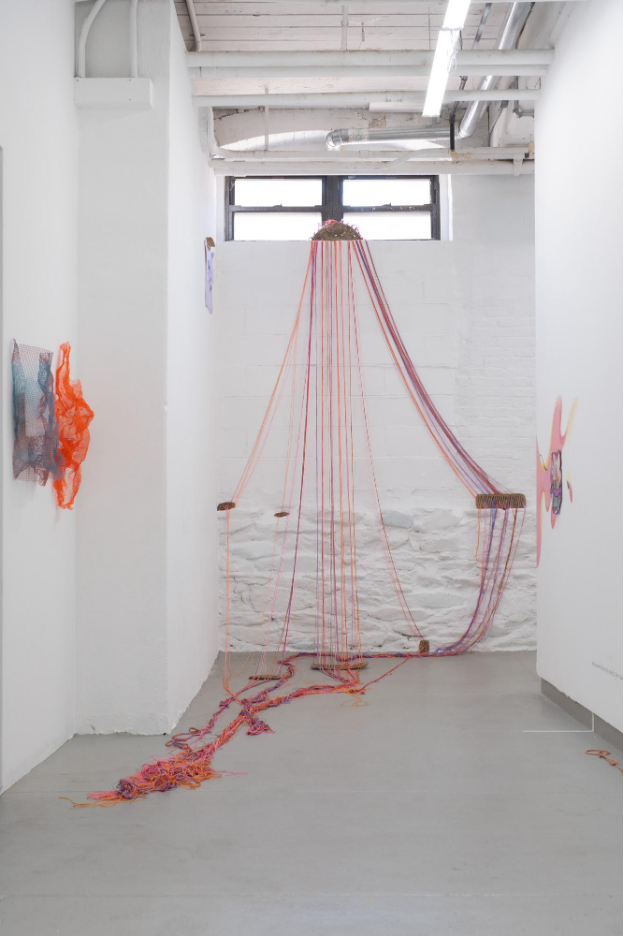
On the other hand, Marissa Cote, Onome Olotu, and Faye Pamintuan focused on haptic materiality, delivering content through the interplay of evocative media ranging from ceramics and paper to image and plaster. Walking into the gallery through our L-shape space, The Skirt, the exuberance and intensity that the artists bring was immediately palpable. Faye Pamintuan and Marissa Cote presented site-specific installations in vibrant colors, materials, and textures. Cote’s installation used the high window and the masonry wall ledge to display ceramic grates, strung together by long winding threads of yarn that stretched from the window above our heads and spilled onto the floor, evoking river deltas, ladders, and hair to climb on, from fairytales.
Site-specificity was a big thematic tie in the show. In fact, six out of the seven exhibiting artists presented work that is either site-specific or site-responsive. Mike Morgan’s site-responsive installation of paintings created a theatrical yet intimate viewing room in OyG’s project space, with a large-scale sea-foam-to-celadon painting of a giant, nearly naked figure gazing into a goblet that obscures his face, revealing the mask on the vessel instead. Another painting hung nearby, showing a male figure partially hooded in a bearskin. This masquerade was underlined by the fact that both paintings were hanging on top of curtains separating OyG’s project space from the office. The vivid colors of the paintings contrast with the white curtains on the two walls of the room, creating a toga-like allusion to Greek mythology, which Morgan references in some of his work’s titles.

Can you walk us through a few of the works in that show — what they looked like, what they were made of, and what was it like standing in front of them?
Faye Pamintuan’s mysterious wall sculpture, Layered Disturbances of the Urban Kind, was a haptic collage made of stoneware and abaca paper pulp, which looked at once as a living specimen and a taxidermy of an alien creature. The abaca paper appeared to snatch tightly around the ceramic tablet, creating both a frame and an outfit. The earthy palette and the textured materiality of the piece held hands, formally and conceptually, with Sheila Novak’s sculpture Whose Horn? Whose Plenty? made with stoneware, paper, and ash from the artist’s social practice piece Singing Sap – an exploration of the role of the maple tree in a culture in which our connections to the natural world have been dulled or severed. Novak staged community gatherings in the forest, facilitating ways for participants to better understand the life-giving impact of the forest.


Yun Hsiang (Sandy) Wang’s sanded-down black-and-white photograph of the curtain-covered sliding door in her grandmother’s bedroom presented a remnant of performative action as both a meditation on time, memory, and grief and a collaboration with one’s own ancestors. Wang sanded down the photograph as a performative action that obscured the image but also created a sensation that the artist was waving goodbye to her grandmother, leaving a trace of pigment on the white wall around the photograph. Tradition and innovation were united with this parallel funerary ritual, which in her native Taiwan is typically reserved for male descendants.

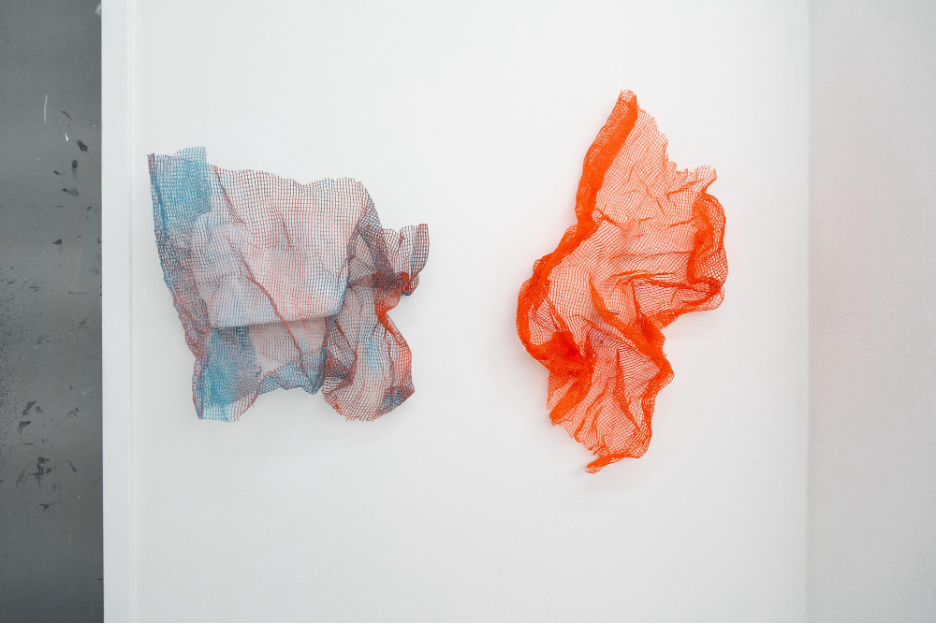
Onome Olotu’s It’s a Thigh iiipresented a plaster limb covered by a loose, spray-painted construction mesh. The limb, part of a thigh, was white and blended in with the color of the wall it was mounted on, becoming almost invisible under the crumpled, colorful mesh. The plaster cast was mounted lower than usual and evoked a body-conscious response, delivering a blow to the gut, rather than the head. These two sculptural works by the artist were installed near Cote’s and Pamintuan’s site-specific installations in The Skirt and together made a highly affective impact with a shared palette of warm, body-evoking colors, surprising materials, and original installation strategies.
As these seven artists step out of the program and into their practices, what do you hope stays with them — and what do you, as an educator, take from watching a group make this move each year?
This group of artists really gives me hope for the future. Community and interconnectivity are clearly such big aspects of what these artists value. One of the most amazing aspects of this group is that they all love to work collaboratively or in socially engaged ways. For example, Sheila Novak recently curated an art show at Ramble On Farm in Ithaca. Michael Morgan and Marissa Cote curated huge group shows last fall, one about cats and the other about craft and materiality. Faye Pamintuan collaborated with the Cornell Botanic Garden to create workshops that connected her work on abaca with communities outside the art program, and Carla Ragel García worked closely with a local farm during her time in Ithaca.
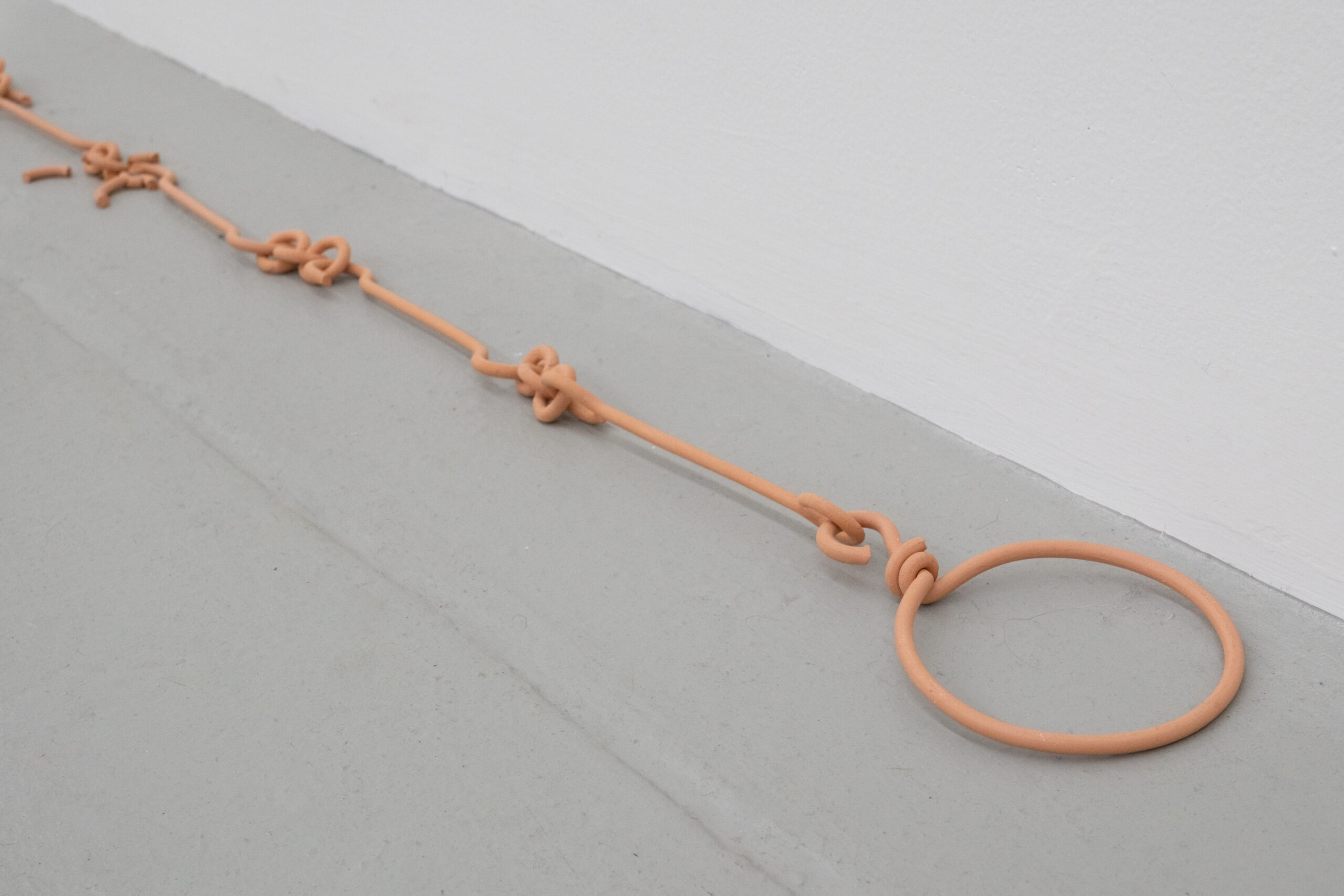
Artists form their own tribe, and if we learn how to support each other, we sustain culture, inspiring others to create. Carla Ragel García’s ceramic remaking of the Gunter Chain, invented to measure and parcel land, installed in this case, along the perimeter of the gallery, metaphorically symbolizes the group’s interconnectedness, while alluding to the consternations of private property and its periphery, through the fact that the fragile chain was stepped on by visitors at the packed opening.
What’s at stake right now for artist-run spaces and the artists who pass through them?
I would not be exaggerating to say that currently at stake is the very survival of non-profit artist-run spaces. With unprecedented cuts of cultural programs by the federal government, it’s been tougher than usual to continue financing our programming.
Make your tax-deductible donation today and help Art Spiel continue to thrive. DONATE
Leeza Meksin is an interdisciplinary artist exploring the gendered conventions of architecture, fashion, and the body through the overlap of painting, sculpture, and installation. Her site-specific works, including projects with the deCordova Sculpture Park and Museum, the Brooklyn Academy of Music, National Academy of Design, BRIC Media and UMOCA, deploy fabric as “architectural drag,” temporary, gender-shifting makeovers for buildings. This interest in surface and public space derives from a multi-generational family experience of migration, immigration, diaspora, and assimilation. Meksin’s work has been featured in Bomb Magazine, Cultured Magazine and the New York Times. In addition to her studio practice, collaboration and curation are central to her creative commitments. In 2013 she co-founded Ortega y Gasset Projects, an artist-run gallery in Brooklyn, NYC, which seeks to advance nonconforming expressions of art as a counterpoint to the industrializing effects of commercialism on cultural production. Meksin received the 2026 Guggenheim Fellowship in Fine Arts.
About the writer: Etty Yaniv is a Brooklyn-based artist, writer, curator, and founder of Art Spiel. She works in installation, painting, and mixed media, and has shown her art in exhibitions across the United States and abroad. Since 2018, she has published interviews and reviews through Art Spiel, often focusing on underrecognized voices and smaller venues. More about her art can be found at ettyyanivstudio.com and on Instagram @etty.yaniv