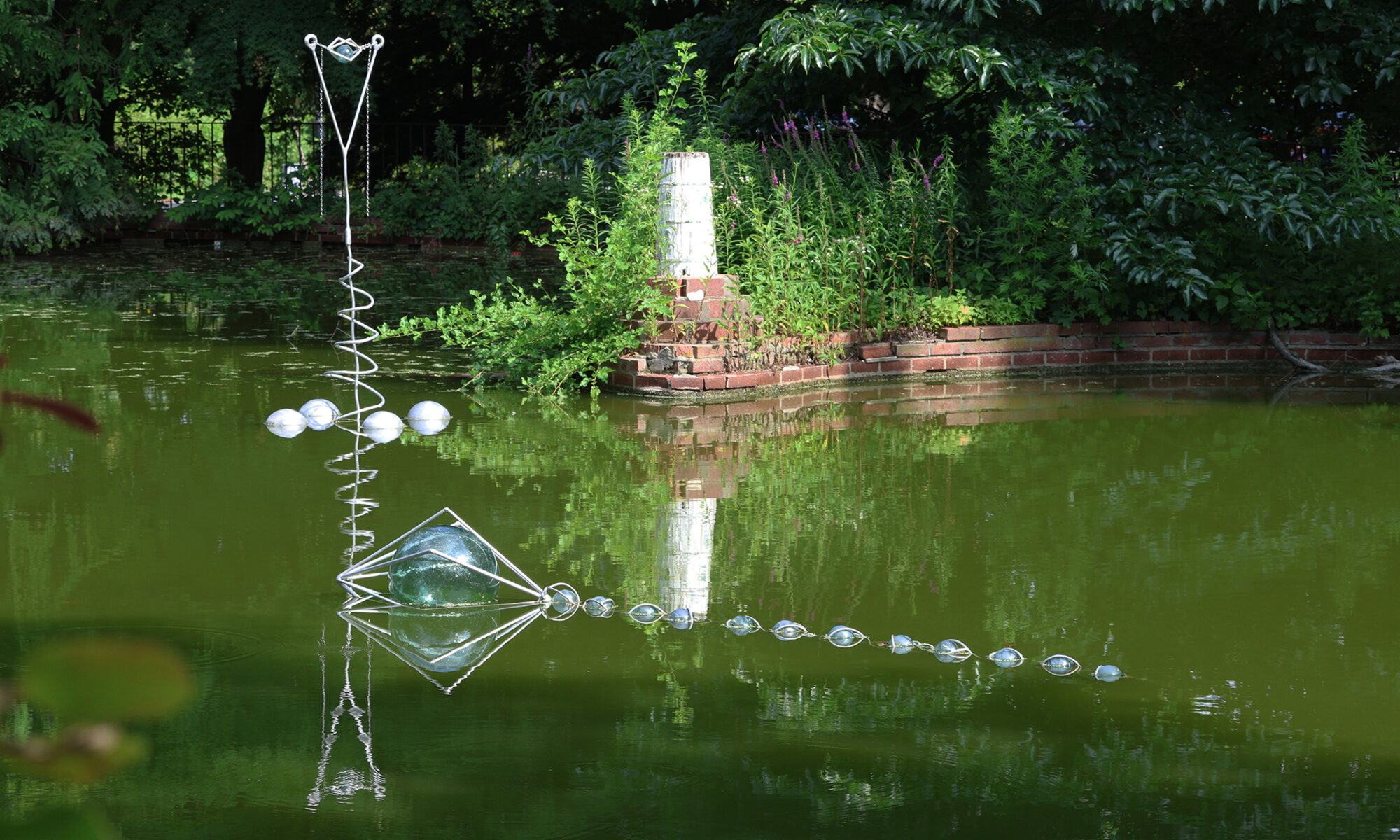
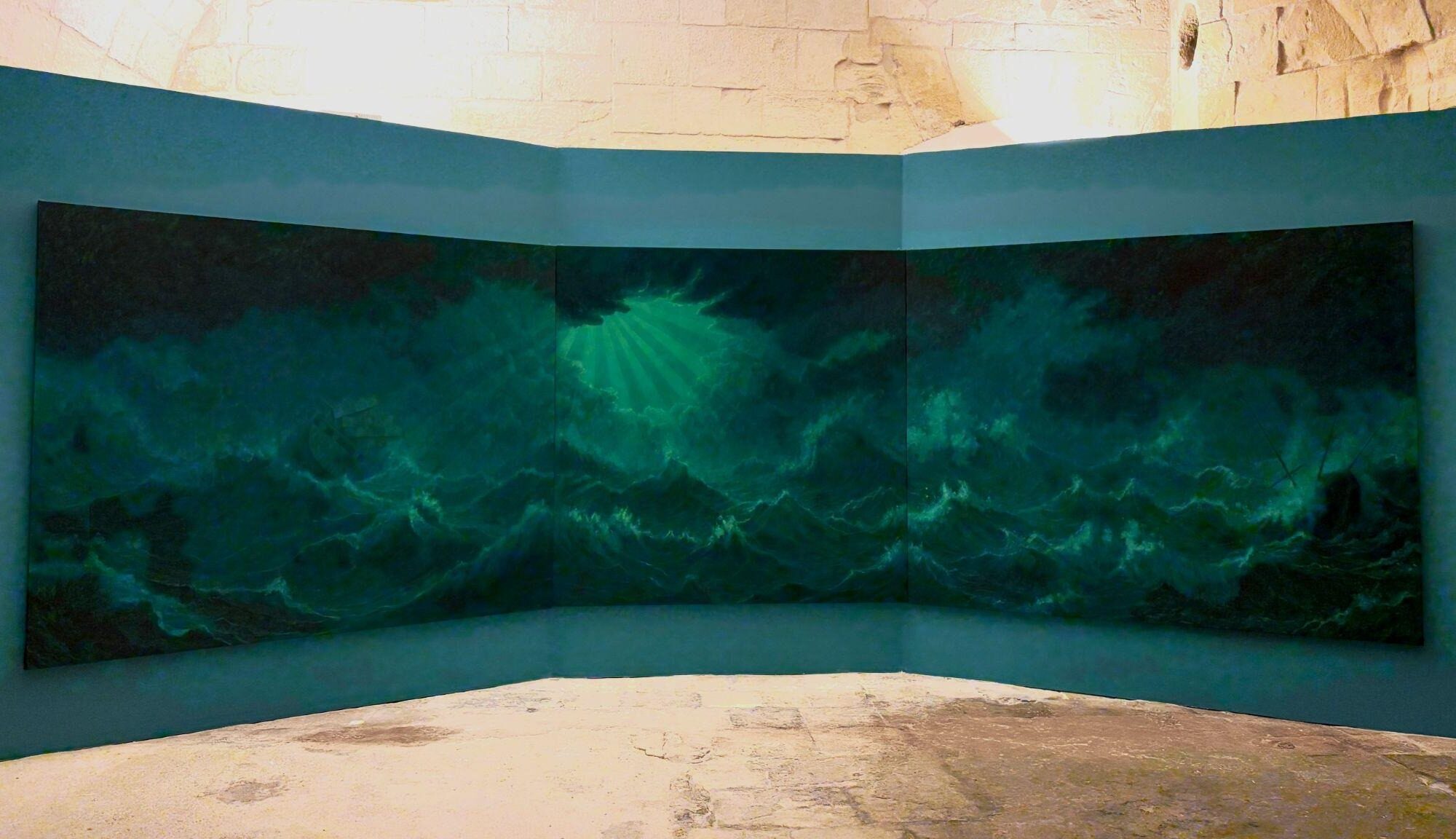
A chance meeting in October 2024 set Serpentine Sibyls in motion. Wandering into the Newhouse Center for Contemporary Art, Daniel Rothbart met its director and senior curator Melissa West, and a shared bond with the late critic and curator John Perreault — who ran the center in the 1980s — opened a collaboration that grew from the main pond to the two reflecting pools beside the Glass House. Rothbart’s floating forms in aluminum and glass, buoyed by salvaged Japanese fishing floats, drift and turn with wind, light, and water, so no two hours look alike. Named by West for the ancient prophetesses and for the serpentinite stone in Staten Island’s own hills, the work holds history and forecast at once, using the climate crisis as its undertow. Sited at a former sailors’ home along a tidal waterway, it runs through September 28 at Snug Harbor. The artist and curator discuss the project’s origins, its shifting forms, and the myth and history beneath the title.
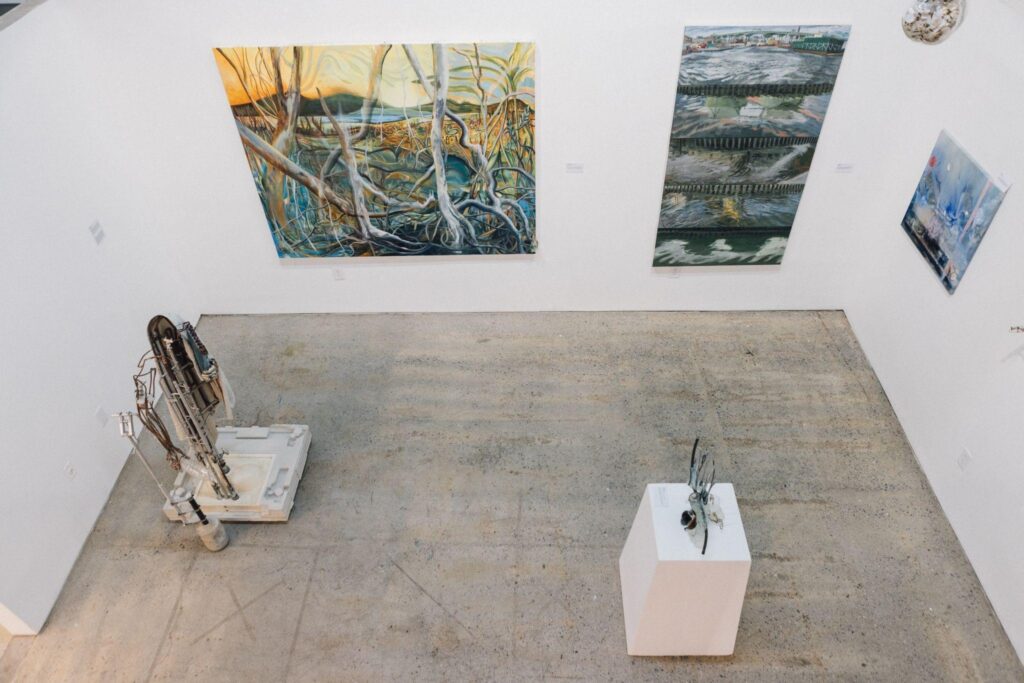
Stepping into Gallery 198, you become fully immersed in the exhibition Overflow, which connects the inside of the gallery with the outside. I quite enjoyed the nautical theme that seemed to stem from the waters and the vantage point that the metal spiral staircase provided, which allowed me to view works on the upper level and many of the works down below as well. Curator Andrew LaFarge Hamill utilized the space perfectly, and the surrounding site-specific works, including his own, make the exhibition an ever-growing and extended conversation beyond the gallery. It is like research that never fully stops. All of the artists in this exhibition are Skowhegan Alumni, and many of the works’ materials, especially those by Nancy Cohen and Elizabeth Demaray, are sourced or influenced by the Gowanus and Greenwood areas. The themes of the works are prevalent and immediate, and the research and care behind both the works and the curation are intricate. The exhibition brings a wide array of mediums, materials, ideas, and locations that allow viewers to fully immerse themselves within the Gowanus area.
Aerial View of the installation below. Photo Courtesy of Dahlia Dandashi
Overflow, true to the title, extends beyond the gallery into the surrounding urban landscape. The exhibition responds directly to the Harbor Hill Terminal Moraine, a glacial ridge where intensified rain events and aging sewer infrastructure have led to the overflow of sewage and pollutants into Gowanus Bay. In close dialogue with these conditions, the exhibition adopts a granular approach by including site-responsive, site-specific, and research-driven installations, as well as sculpture, painting practices, and video works that engage with the role that water resources play in the neighborhood and in the climate crisis as a whole. Each artist tackles themes of various bodies of water and the ecosystems that lie beneath; others tackle the theme of place and ecosystems that are impacted as the waters are affected. Other artists source materials nearby or within the NYC area to include a materiality that builds new forms from recycled materials emerging from the ecosystems that many of the other artists are painting, drawing, or recording. The conversations amongst the works are tightly knit and multi-layered.
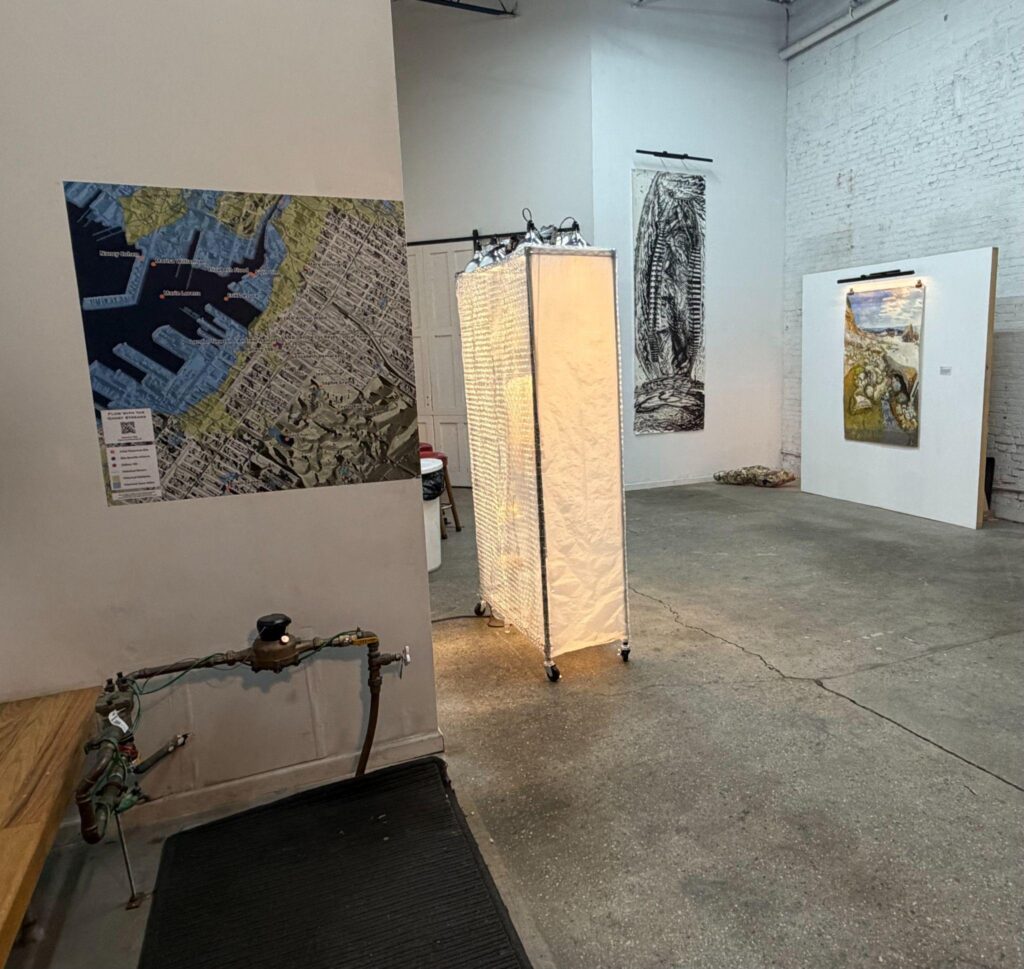
View of Interactive Map and installation view. Photo Courtesy of Andrew LaFarge Hamill
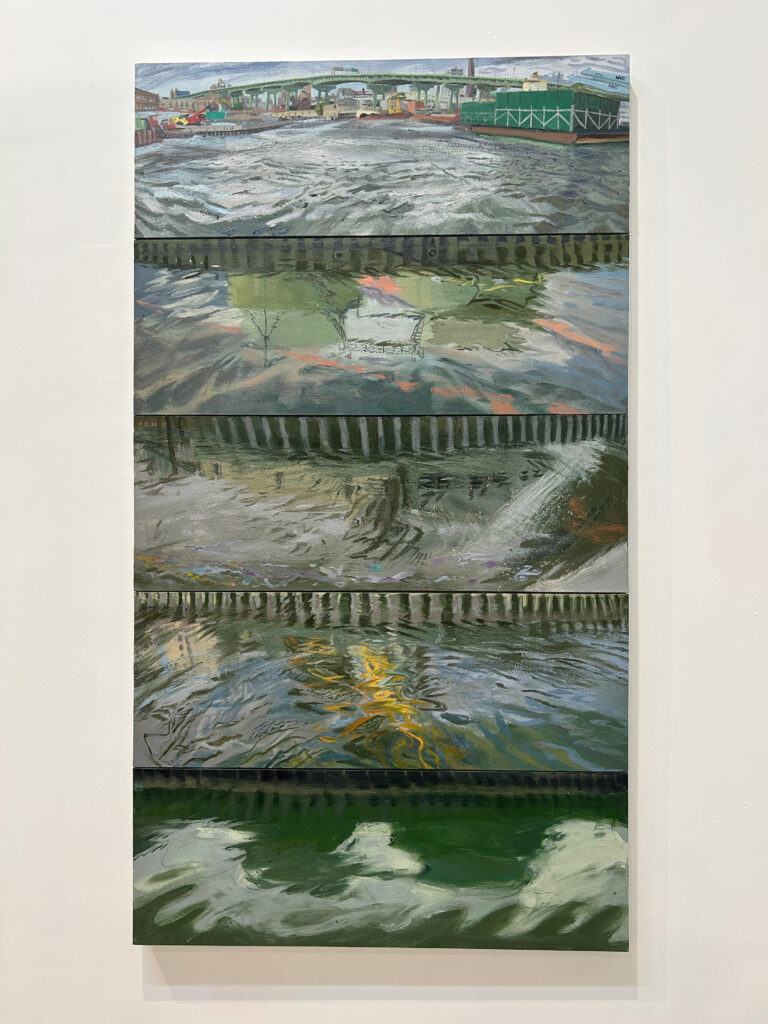
After moving to New York, I chose Gowanus as my home, and having been a resident for only a few years now, the sense of place that emanates from the works in this exhibition is welcoming. At the beginning of the exhibition, you are greeted with a map that can also be viewed digitally. Here, the artists’ works are noted on the map, indicating where materials were sourced, where the painting might have been painted, or where videos were taken. This cohesively pulls the neighborhood into the gallery and allows viewers to experience this eclectic place and its ever-evolving ecosystem and situation. Lili Chin’s video of Greenwood Cemetery, complemented by Sophia Grant’s birds, which were seen while exploring the cemetery itself, reminds me of my own walks there. Grant’s expressive and abstract backgrounds, especially in the work titled American Kestrel, allow the form of the bird to emerge and settle on the surface, as if glowing underneath bright sunlight. After stepping through Greenwood to the Gowanus canals and near the BQE, Elizabeth Flood’s works capture more wonderful moments. Especially the works titled Gowanus and Lookout (Hudson River, Storm King), by compiling several images with canvases stuck close together, Flood provides us with several scenic spots within each expansive work. Painting with a rougher, drier paint consistency, Flood allows the colors to glow and the rocks, mountains, debris, and ripples to show through; scraping, carving into, building up, or wiping away rough textures. Flood may only show what rises to the surface of the waters, deepening their reflections, but other works in the show depict details of the depth below.
Elizabeth Flood, Gowanus, 2026, oil on canvas, 75 x 42 in. Photo courtesy of Taylor Bielecki
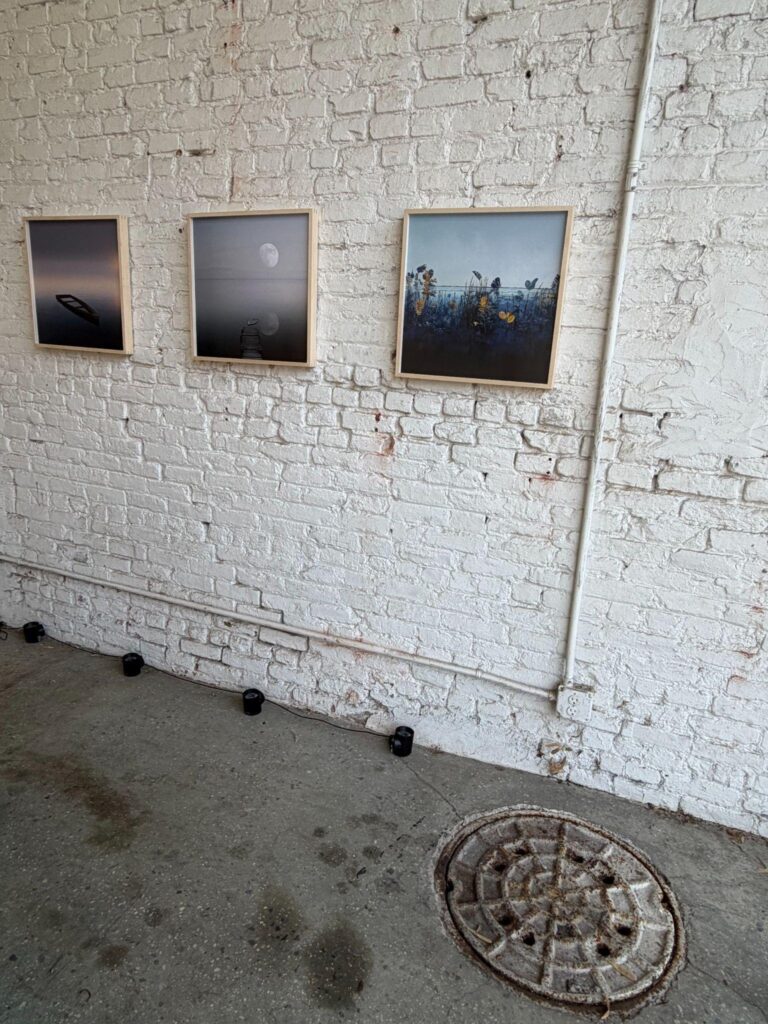
Revolving around the theme of water, several artists decided to depict the mystical side of water, the unseen depths below. Pulling us into a phantasmagorical, mist-filled environment, Mary Mattingly’s four metal prints depict murky waters. We do not know the depth, nor what is below, but Mattingly entrances us all the same. Using unknown light sources that permeate the mist, Mattingly lets the objects in the foreground, such as the sinking boat, the wooden pier, or the vegetation, become the focus as the water engulfs them. Mattingly shows us there are layers below that have yet to be explored as the objects seem to dissolve within the stillness of the surrounding waters.
Mary Mattingly installation shot. Photo Courtesy of Andrew LaFarge Hamill
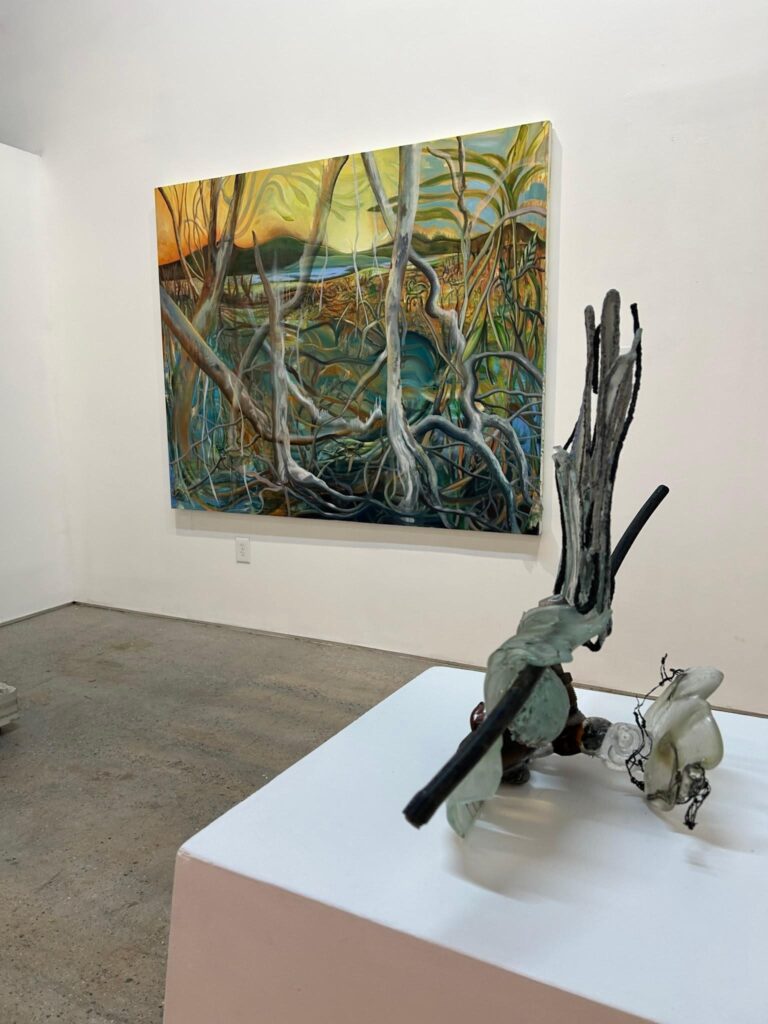
Deborah Wasserman’s paintings draw us into the intricacies of streams, rivers, and bays, and the flowing vegetation that grows alongside them. Especially through the painting titled The Tangled Land, The Strangest Sea, Wasserman pulls us into the depths to show the tangled root systems below. The anchors of the trees, the life force of their own ecosystem, the waters swirl around them and play a pivotal part in these environments, where both land and sea exist and benefit from each other. As in the painting Creatures of the Light, Wasserman draws us in with a stunning blue combined with layers of colorful reflections and several eyes that permeate from the currents. Just as we look through the swirling waters into the dissolving grasses above, the eyes watch us, placing us in the immediate role of being observed by nature. While humans are usually the ones affecting nature by polluting or changing water systems, these ecosystems still endure and instead watch us, to see if we change alongside them.
Nancy Cohen and Deborah Wasserman, installation view. Photo Courtesy of Andrew LaFarge Hamill
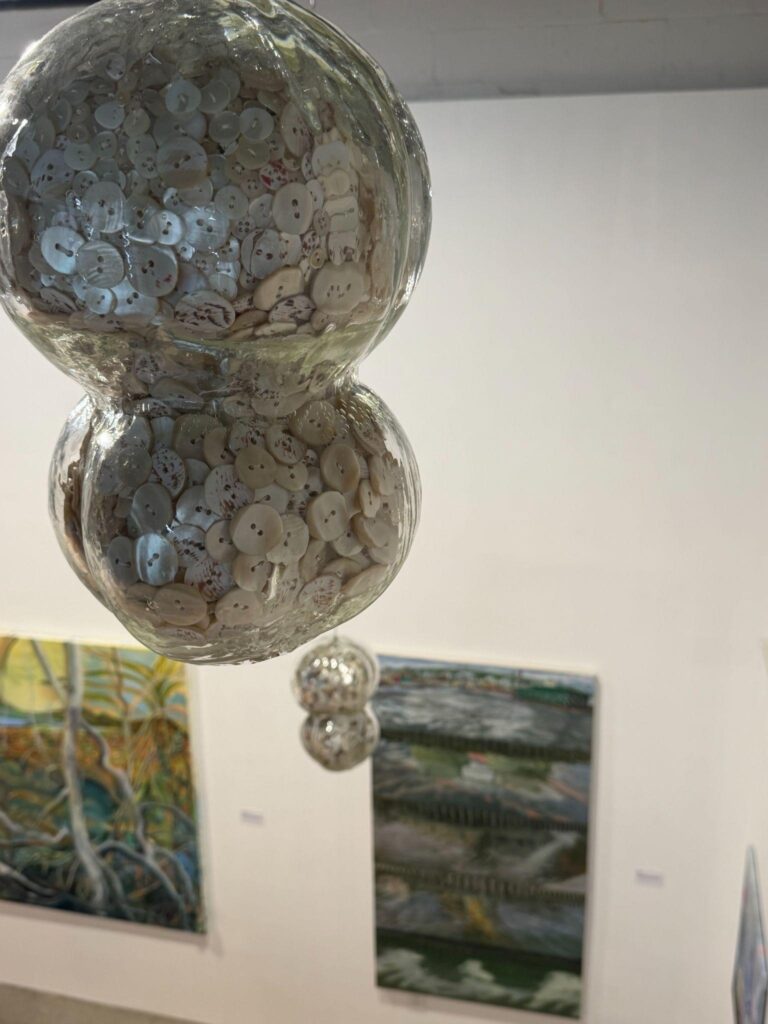
Another aspect of the exhibition that left me thinking long after I had left is the focus on materiality and the way many of the artists, such as Nancy Cohen, Jean Shin, Chris Pappa, or Taylor Baldwin, give items a new life. Nancy Cohen’s works all take found material and worked glass to create new conglomerates. Pieces like Side of the Road and Rubber River take discarded pieces from the surrounding areas, and instead of letting them flow away in the rain or litter the ground, Cohen gives them a new form, a new energy, and a new life. Using many handmade techniques to create paper and allowing glass to envelop metal or sand, Cohen expertly melds materials that are often at odds, since they are components that were either made or discarded and then reclaimed by Cohen. Jean Shin’s Tidal Orbs that hover over the gallery, or Chris Pappa’s mixed media forms that sit steadily on the ground, also pull from a combination of discarded and natural materials. They each show how materials can be reworked, rebuilt, reused, and given new life, one form suspended as if to complement the element of Air, and another of the earth. Here, these artists creatively repurpose objects, working with what the natural world has given them to rebuild entirely new creations.
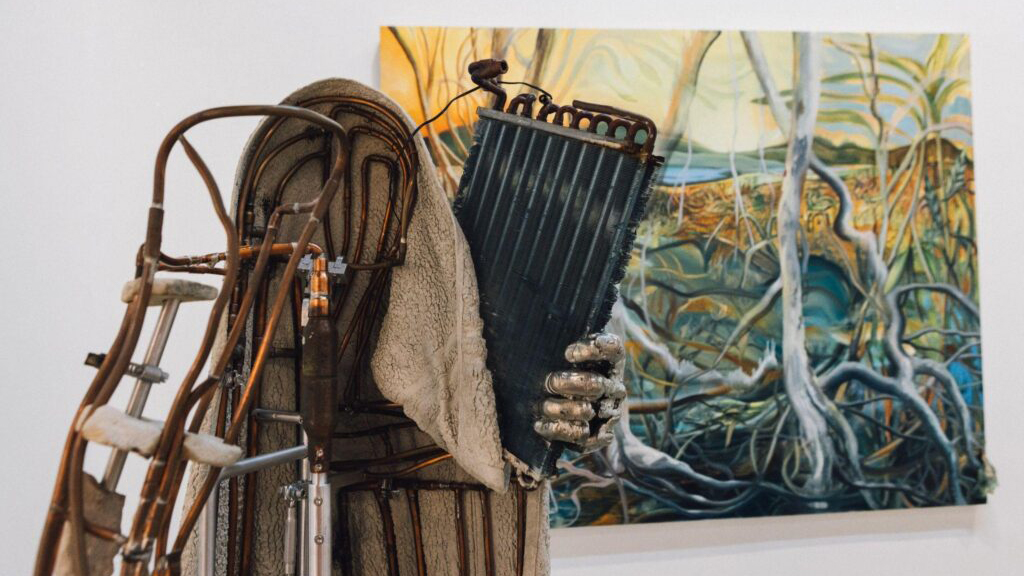
Interestingly, Taylor Baldwin’s sculpture is seemingly the only humanesque figure within the exhibition. This left me thinking that the audience is instead meant to be the other “figures”. We are viewing the work and being viewed. Baldwin’s sculpture titled Unnamed Priest With Libation is placed in the middle of the back gallery, seemingly looking at one of Wasserman’s paintings, wielding a form resembling a tablet. Here, I take this figure, emerging from an overturned sink, to be judging or recording the works, the visitors, and the ideas that flow through the space. Carrying an empty water bottle, Baldwin’s veiled figure is built from an amalgamation of items, but he leaves one side open, so we get to see its inner workings as we circle around the piece. Each of the artists in this exhibition allows us to see the inner workings of their pieces, ideas, or explorations, just as much as they delve into the inner workings of nature around our neighborhood.
Just as nature is ever connected and the waters are ever-extending around us, this exhibition extends beyond the gallery walls. It extends to the nearby Green-Wood Cemetery, which has completed a major climate adaptation initiative, transforming its historic grounds into an “urban sponge” that absorbs stormwater runoff. Drawing attention to the NYC law that allows any citizen to plant and care for street tree beds, Landon Newton, in collaboration with curator Andrew LaFarge Hamill, will create a series of site-specific plant-based sculptural interventions outside the gallery, acting as hybrid bioswales to help mitigate pollutant runoff in sidewalk tree pits. These interventions will take place in the 2.5 blocks between Jean Shin’s outdoor work, Offering (2026), at the cemetery and the works in Overflow at the gallery. By including these works outside the gallery and the interactive map inside, Hamill ties all the works together through location. They emerge from the sites around Gowanus and the New York state area, bringing prevalent looks into urgent and pressing ecological issues that many of us may simply walk by in our day-to-day lives. The artists in this exhibition instead bring these concerns to light, pulling us into the environments we coexist in and presenting us with solutions and ways nature is trying to be healed and protected (both by human means and naturally). Overflow takes us into the natural worlds that the artists have surrounded themselves with in their work, and it turns the gallery into an intricately researched conversation that welcomes us to explore all of the information given to us and helps us dive in ourselves.
Jean Shin, Tidal Orbs, installation view. Photo Courtesy of Andrew LaFarge Hamill
Gallery 198, Overflow, 198 24th Street, Brooklyn, NY 11232, Exhibition up until Jul 25th, 2026. Open Hours: 3 pm – 8 pm Wed- Sun, and by appointment.
Make your tax-deductible donation today and help Art Spiel continue to thrive. DONATE
About the Writer: Taylor Bielecki lives in Gowanus, where her studio is, and works at Pratt Institute, where she earned her MFA. She also studied at Penn State, where she earned a BA in English and a BFA in Fine Arts. She finished as a finalist in the Kennedy Center’s VSA National Emerging Young Artist program for 2017, where she earned an award of Excellence. She has shown prints internationally in a print exchange in Australia and exhibitions in Dubai, India, and the Glasgow School of Art. She has also shown paintings internationally in Gallery 24N, PhilaMOCA’s juried exhibitions in Philadelphia, Pa., Perry Lawson Fine Art in Nyack, NY, BWAC in Red Hook, and IW Gallery in Brooklyn. Taylor works for Two Coats of Paint, TUSSLE Magazine, and has joined Art Spiel as a contributing writer. @Taylor.Bielecki
What does a gallery look like when the artists are in charge? Founded in 2013, Ortega y Gasset Projects (OyG) is an artist-run collective with no fixed curatorial line and a non-hierarchical structure shared equally among its eight co-directors. Since 2023, it has become the annual New York home for Cornell University’s MFA thesis exhibition — a partnership built on a simple premise: artist-run spaces value experimentation, innovation, and risk-taking, giving graduate artists the freedom to present work without commercial constraints or curatorial imperatives.
I met Dierdre Murphy for our studio visit at Rolling Hill Park on one of the first true days of spring. She strode up the forested lane with a bright smile, and I followed her to a yellow cottage nestled among the trees and many meandering hiking trails. Bathed in the sound of tweeting of birds, Murphy explained her long history of working with the Lower Merion Conservancy both as a volunteer and as their Climate Artist-in-Residence. There, she has created several site-specific works, including a spectacular mural translating bird migration data into bright organic shapes.
One is never prepared for the Maltese archipelago and its vertiginous dichotomy of antiquity and modernity; an exhilarating compound of ethnicities, languages, and cultures. Though one might consider it diminutive, during the three-day press preview, I traversed the main island, Malta, and its quieter, more pastoral and bucolic sister island, Gozo, in a flurry of taxis, ferries, and buses. (Comino, a nature lover’s sanctuary, remains largely uninhabited.) Malta occupies a distinctly liminal position within the Mediterranean world: a central island shaped across centuries by exchanges among Europe, North Africa, and the Near East. Situated a mere 60 miles south of Sicily and roughly an hour’s flight from Tunis, it has long functioned as a site of passage, encounter, and cultural layering—a geographic palimpsest upon which successive civilizations have inscribed themselves again and again.
The Artist in Residence program at The Oyster Point Hotel was launched in 2020 and curated by Ellen Martin, with the support of Kevin Barry, the hotel’s President. Its premise is straightforward: contemporary art belongs not only in galleries but in the spaces where people actually live, rest, and move through their days. Each year, a selected artist’s work inhabits the hotel’s guest rooms, common areas, and the fabric of the place itself, encountered by thousands of visitors during their stay.
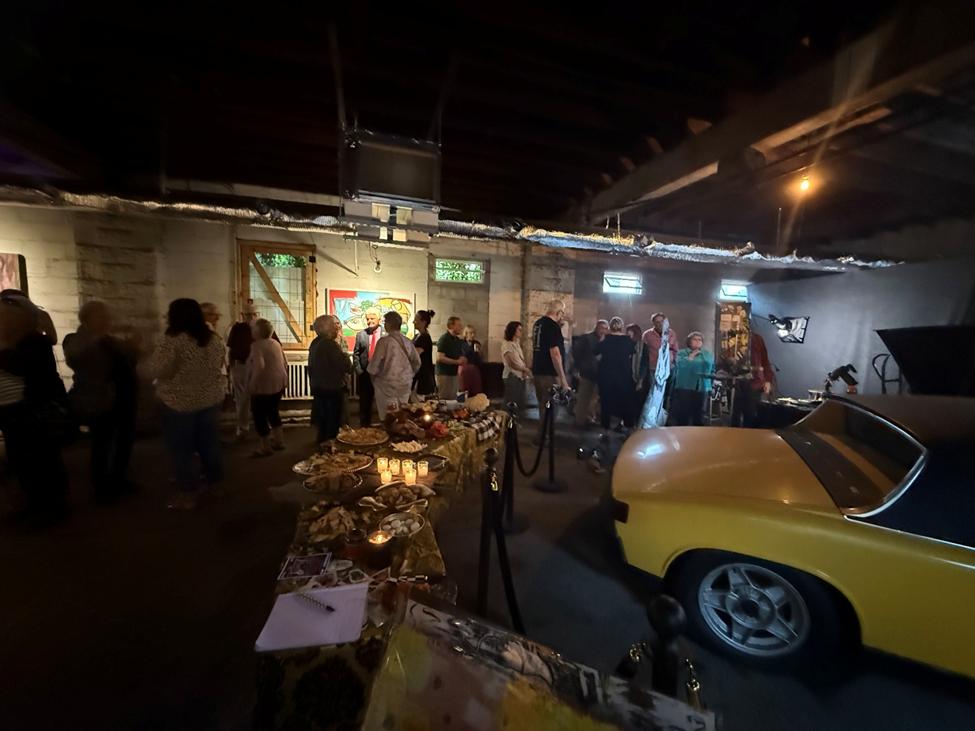
Closing Reception, Guests mingle among paintings, neon, and a vintage car, the grungy garage space alive with conversation, community and shared food. Photo courtesy of Jennifer Miller
Aleksandra Scepanovic’s story begins in then-Yugoslavia, where the stark presence of brutalist architecture shaped her early sense of form and space. As a journalist during the 1990s she reported on the Balkan conflicts, bearing witness to the fractured landscapes of cities such as Sarajevo.
Almond Zigmund, figure ground yellow, 2023, acrylic on paper, 36 x 53”, photo credit: Jenny Gorman
Almond Zigmund’s work occupies the charged space between structure and disruption. Moving fluidly across sculpture, painting, and installation, her practice explores the intersection of geometry, architecture, and lived experience—often in subtle yet powerful ways. I have the pleasure of discussing her work at the end of her recent exhibition at East Hampton’s Guild Hall. In this interview exchange, Zigmund speaks about the formative influences that shaped her, from growing up in a creative household to navigating the distinct geographies of Brooklyn, Las Vegas, and the East End of Long Island. The conversation delves into the improvisational roots of her approach, her ongoing engagement with spatial systems, and how tension—between control and spontaneity, place and perception, the built and the organic—continues to animate her work. With references to theorists, artists, Zigmund offers a thoughtful and richly textured account of how art can be both experiential and critical, formal and deeply human.
On April 26th and 27th, from 1 to 6 pm, artists in DUMBO will open their doors to the public as part of DUMBO Open Studios, offering a rare look inside the art studios along the Brooklyn waterfront. Since the 1970s, DUMBO has been shaped by its vibrant art community. This interview series highlights a handful of participating artists in 2025. Each response offers a glimpse of what’s waiting behind the studio door. Cheryl Wing-Zi Wong has been in DUMBO since 2015. Her studio is at 20 Jay Street #M10B (mezzanine level).
Hugh Hayden: Home Work at Rose Art Museum, Waltham, MA.
In the aftermath of the Presidential election, I feel inspired to visit galleries and museums more than ever. Not only am I feeling a conviction to support these now-endangered organizations, but I am finding respite in their halls and holdings. Regardless of your political leanings, this is a tender time for artists and art institutions, as well as for the curators and Directors who organize exhibitions. Obviously, what’s on view this month was curated before Election Day, but now that we’re in a new world, all of it seems singed by the results and potently relevant for the time. Hugh Hayden’s exploration of public education reminds us that the Department of Education may be gutted, and J Rowen O’Dwyer’s portraits of Trans people show us a vulnerable population that’s now even more susceptible to the threats of an angry and fearful nation. It’s a sobering time, but one that calls for art and artists to persevere.