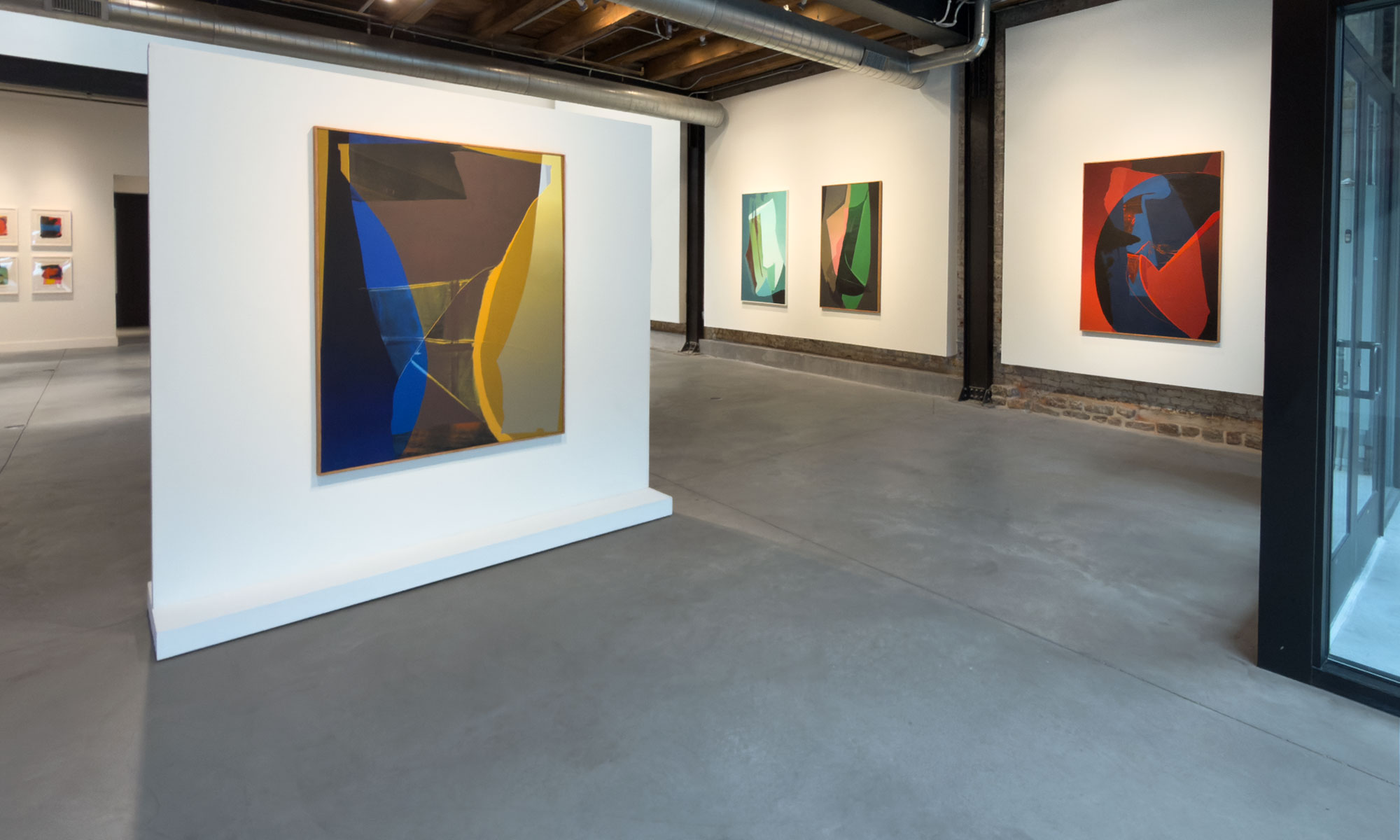
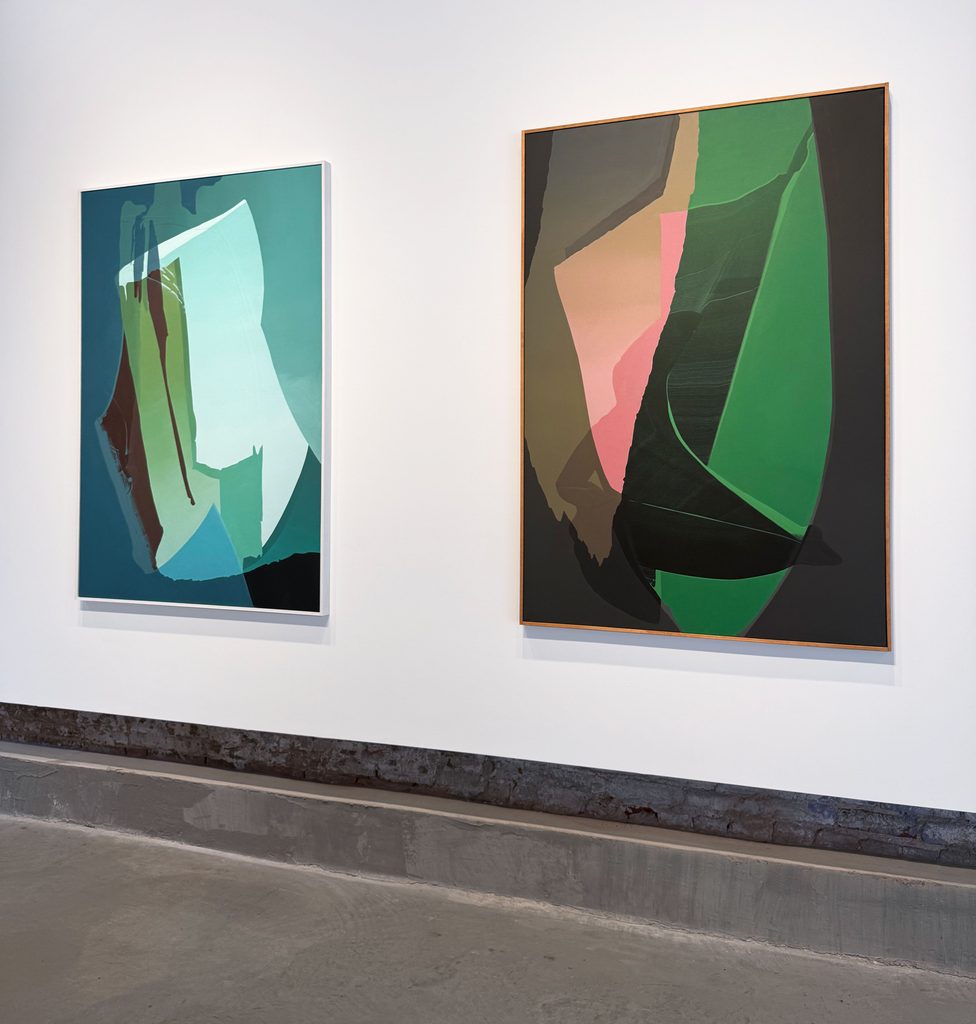
The abstract paintings in Pentimento, the debut solo exhibition at Wexler Gallery in Philadelphia by New York artist Danny Balgley, live up to their title. Like geological strata, the urban palimpsest of peeling billboards and weathered facades, or memory itself, their layers let traces of earlier marks show through, revealing themselves gradually, the longer we look.
Balgley applies thick paint, then scrapes and excavates it, turning the canvas into a record of its own making. Past strokes are never fully erased. They persist beneath and shape the surface. Each painting becomes both image and artifact carrying its own logic. As the show text says, this process driven approach resembles a form of painterly archeology, where each mark holds the residue of a previous action, its surface becoming a “site of memory and accumulation.”
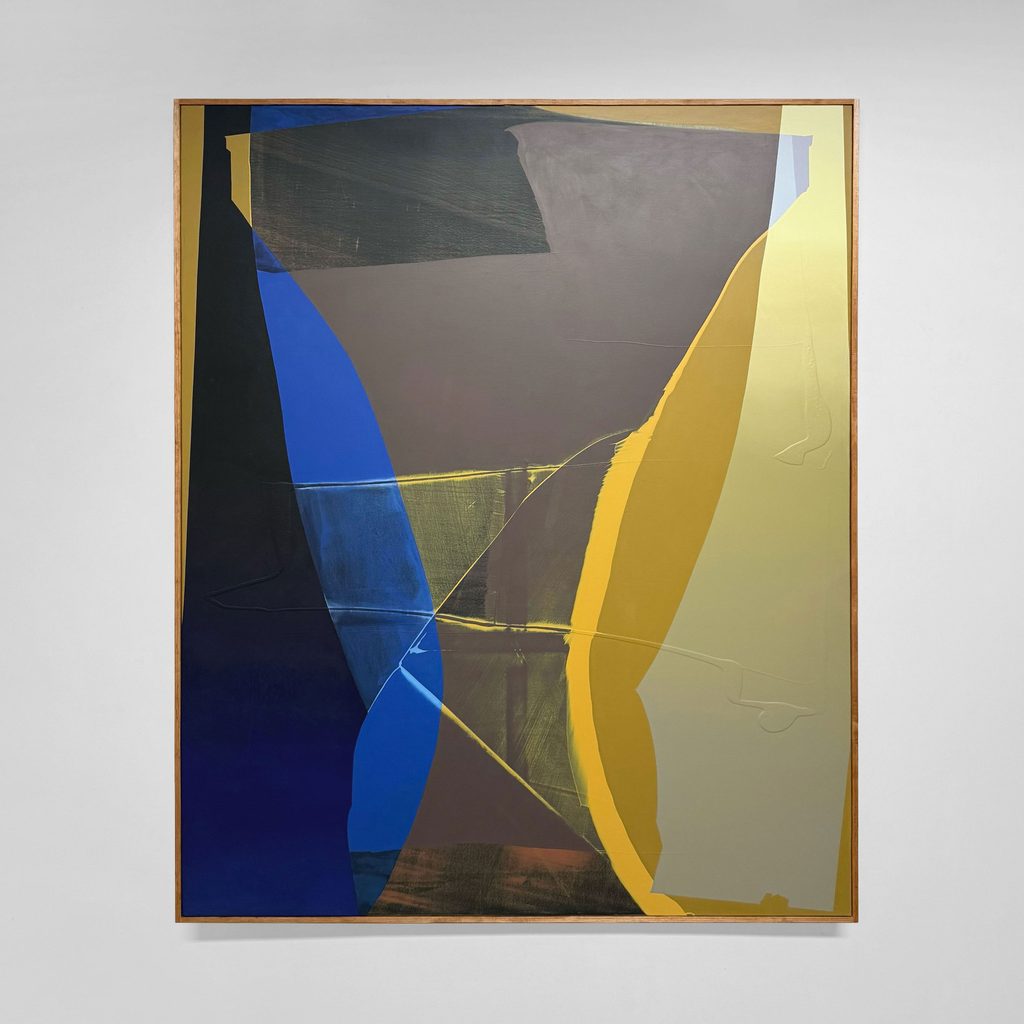
In Anvil (2026), a brownish gray plane divides yellow on the right from blue on the left. Its edges curve, then break into sharp points, as though the form had been hammered on an anvil. The gray at the top is calm, while below, veiled triangles interrupt it. These shapes cross into both colors and unsettle them. Where they overlap, yellow and blue stop being what we assumed they were.
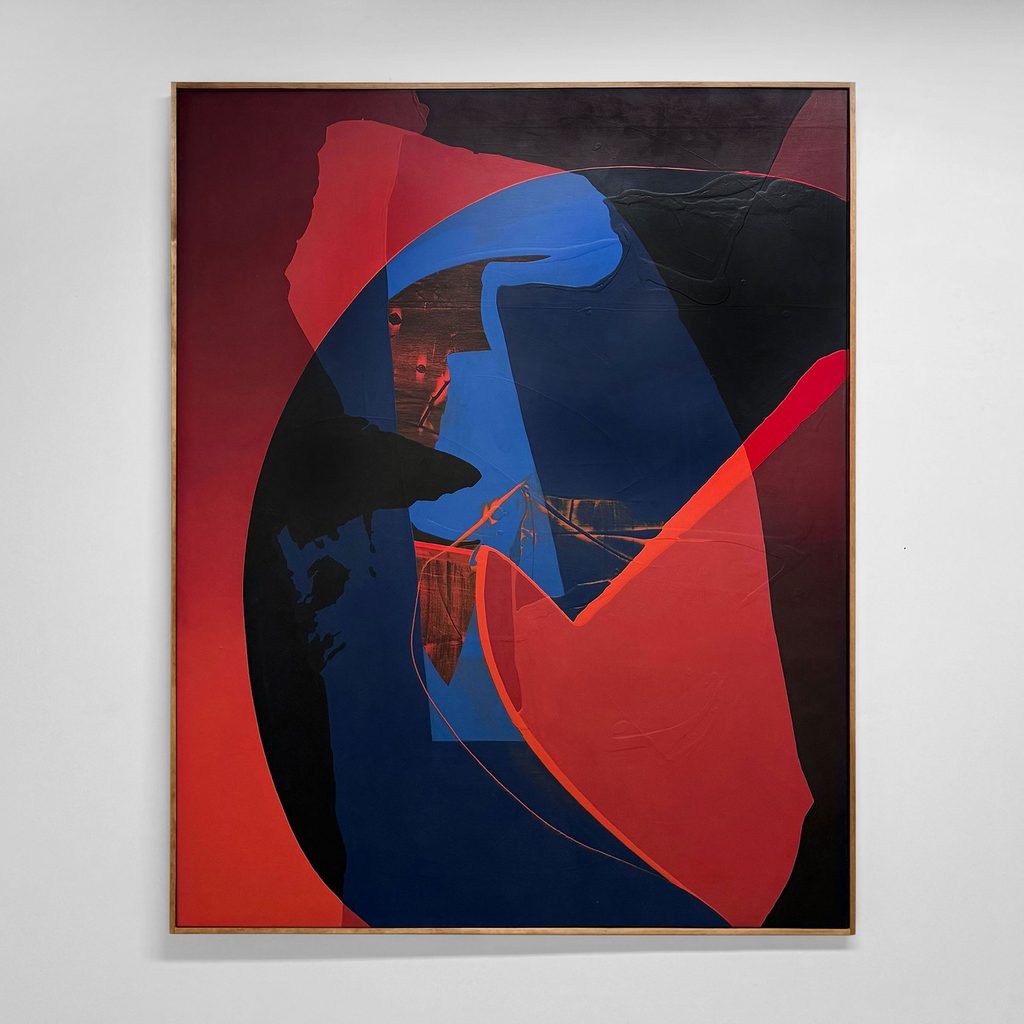
In Notes on a Rudder (2026), Balgley again places two large shapes on the left and right. Here they are red. Between them stands a blue vertical rectangle, irregular in outline, set over a dark circle on a dark ground. The blue lies in front of the circle, but the circle also cuts into the blue. Each interrupts the other. Neither holds the foreground. The two reds oppose each other, and the blue both separates and joins them. The longer one looks, the less stable the arrangement becomes.
The left red recedes. The dark circle advances, although the blue covers it. The layering says one thing, the eye says another. The title is apt. A rudder steers by resistance. Set at an angle against the current, it is pushed by the water, and the push turns the vessel. Direction is produced by opposition. Balgley’s painting works the same way. Its sense of direction comes from its conflicts, including front against back, red against red, and what we see against what we assume we see.
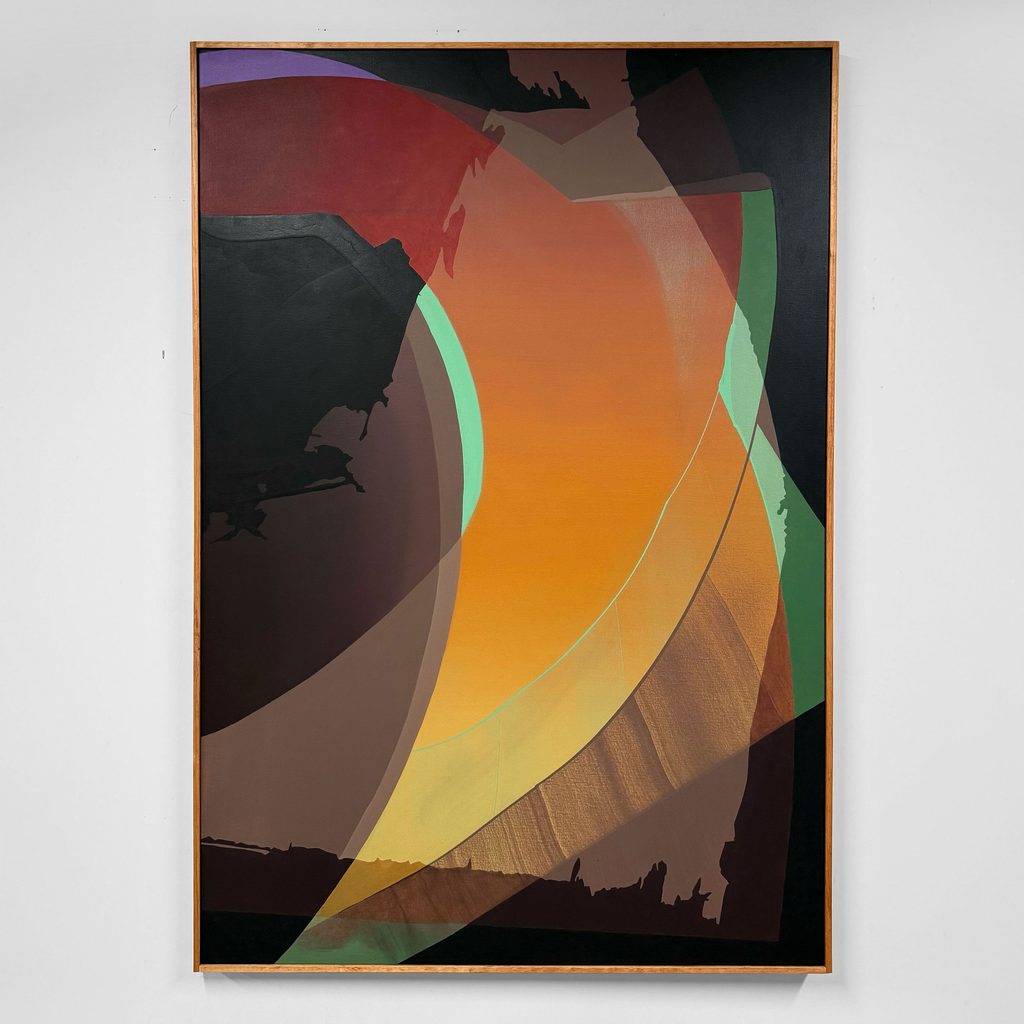
Sunset Slices (2026) is built on another bold form. This is a yellow orange arc that rises from the lower left and bends back toward the left edge. The drama lies in the contrast between this bright form and the darkness around it, heightened by a surprising lavender purple streak along its top and a thin neon green line tracing each side.
Balgley insists his paintings do not depict images of our world, but abstraction does not mean an absence of associations. His titles allude to specific ideas drawn from our reality, and they leave room for open-ended interpretation. Here the title, the orange, and the arc evoke the sun and the shift from light to dark. The form reads as a slice, a piece carved out of something larger. The painting does not depict a sunset. It captures its transitional essence, acting as a force that separates night from day, and doing so with a final burst of splendor.
Balgley’s paintings owe a debt to both Color Field painting and Abstract Expressionism, and they move between the two. One side offers the open, contemplative expanse of color, while the other brings the physical energy of gesture. In this new body of work, some gestures are oversized and emphatic, with the punch of Pop Art, and like Pop Art, they take cues from the brash commercial signs of the city. Those signs are never permanent. They are pasted over, replaced, and worn away, and something of each one remains.
Pentimento also describes the development of this body of work. The more muted palette of Balgley’s earlier paintings has not disappeared. It persists beneath the new, brighter color, the way scraped layers persist beneath each surface. The show’s title applies to the artist as much as to the paintings, reflecting a practice built in layers, with each stage visible in the next. The viewer adds the final layer. We bring our own memories and associations to each painting, a rudder, a sunset, a sign on a city street, and these become part of what we see. In that sense, the pentimento is not only in the paint. It is in how life accumulates.
About the artist: Danny Balgley (b. New York, NY) lives and works in Queens, NY. He holds an MFA from Columbia University, a BFA from Cooper Union, and attended the Yale School of Art Norfolk Program on an Ellen Battell Stoeckel Grant. He has been nominated for the Joan Mitchell Fellowship and is a recipient of the Ellen Gellman Fellowship, the Ethel Cram Memorial Prize, and the Mark Rothko Award. His work has been featured in Architectural Digest, New American Paintings, Arts in Square, and most recently, Friend of the Artist.
Courtesy of Wexler Gallery
Danny Balgley, Pentimento at Wexler Gallery, Philadelphia
August 27 to October 2nd, 2026
1811 Frankford Avenue, Philadelphia, PA 19125
Website: https://www.wexlergallery.com/
Featured Image: Danny Balgley, installation view, Wexler Gallery, Courtesy of Wexler Gallery, Philadelphia