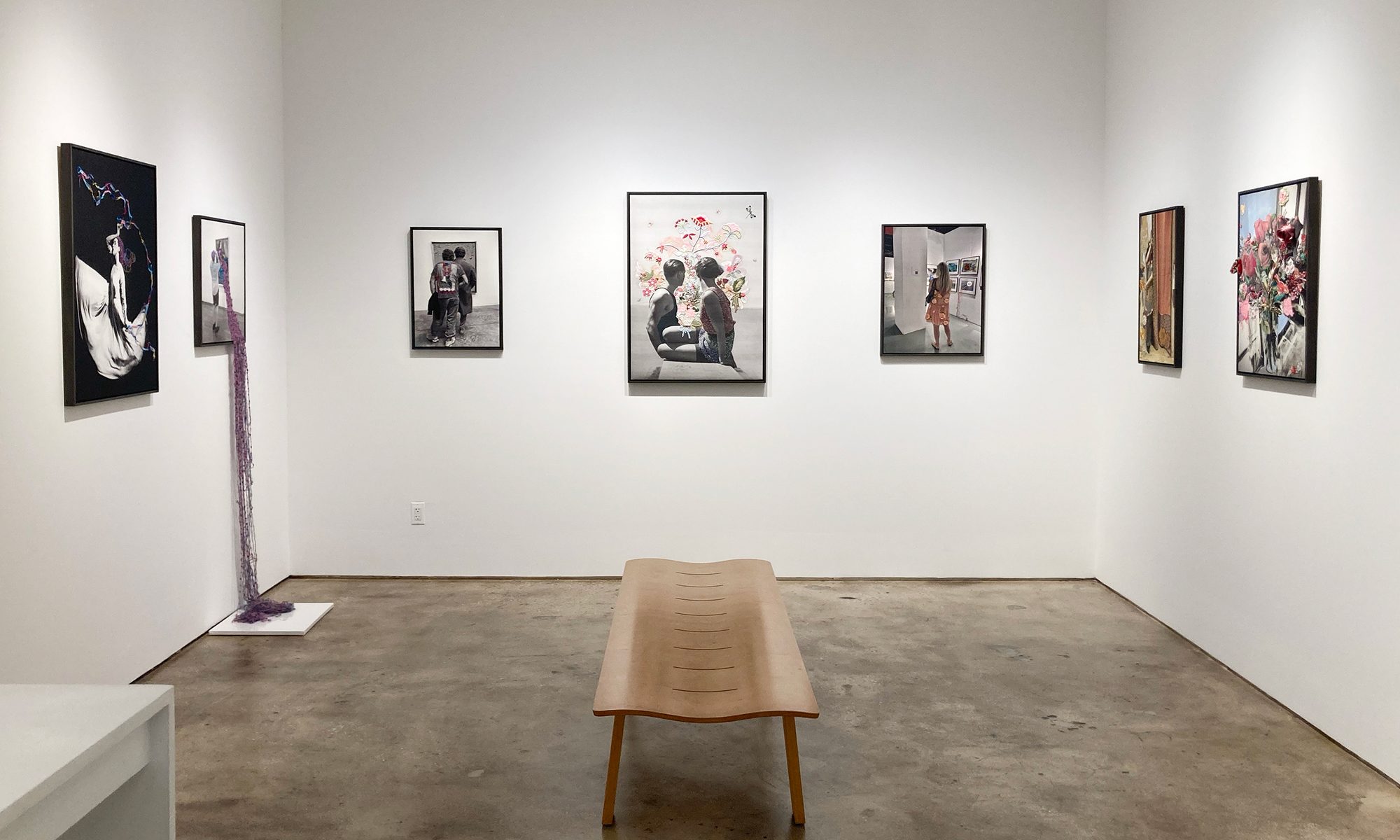
Orly Cogan stitches, crochets, and paints directly onto photographs. Under her needle, figures loosen from their frames, and in some pieces the thread spills past the edge onto the floor. Her work on photographs owes much to twenty years alongside the photography dealer Robert Mann. The two met at an art fair, reconnected at a collector’s party, and had their first date in her studio talking about her work; across years of openings, fairs, and long studio hours since, each has shaped how the other looks. Cogan, trained as a painter, came to read a photograph as an object with its own history and materiality, while Mann, whose gallery was built on photography, became an advocate for embroidery and its feminist history. That shared education first reached his gallery walls in 2014.
Behind the Lens and Through the Needle gathers the work that grew from that exchange and opens Mann’s newly built West Chelsea space in his thirty-fifth year with a public gallery. In Cogan’s hands, the two mediums hold different kinds of time: the camera’s caught instant and the needle’s slow, cumulative one. The photograph gives her the frozen scene; the embroidery reopens it, adding labor, touch, and imagination until the captured moment seems to keep unfolding.
You’ve known each other for more than twenty years and, as Orly puts it, have continually influenced each other’s artistic perspectives. How is that mutual influence reflected in this show, and what role did each of you play in bringing the series about?
Orly Cogan (OC): Art has never been separate from my daily life, so this evolution in my work has been profoundly shaped by sharing my time with a photography art dealer. We first met at an art fair, reconnected at a photography collector’s party, and our first date took place in my studio, talking about my artwork. At that time, Robert knew very little of the world of contemporary fiber art, and I never had an interest in taking a photography class while in art school. Since then, our lives have unfolded in ways that have let us educate and influence one another through our individual visual sensibilities and passions. Between art fairs, gallery openings, museum shows, studio visits, art talks, installing and deinstalling exhibitions, and him watching me work, we are constantly exchanging ideas and perspectives, influencing and inspiring one another.
I came to understand a photograph not only as an image but as an object with its own rich history, materiality, and place within the art market. Meanwhile, Robert embraced the world of textiles, becoming an advocate for embroidery and textile-based practices and gaining a deeper understanding of the medium’s feminist history and the time it takes to create this work by hand. Our conversations became an ongoing dialogue that helped shape the work I was doing in my studio and grew his interest in featuring fiber work in gallery shows.
Robert Mann (RM): Living with Orly for over 20 years has been both inspirational and informative, especially since her background in painting, drawing, and fiber arts has encouraged me to embrace artwork beyond my otherwise myopic focus on traditional photography. Before our relationship, I worked with artists who manipulated the photographic image, such as Susan Rankaitis, who employed chemical manipulation, and Luis Gonzáles Palma, who experimented with a variety of hybrid photographic processes. But through Orly’s influence, I was introduced to artists combining different media with photography, and I saw an opportunity for my gallery to begin showcasing this work. In 2014, we hosted our first exhibition diving into this genre; the show was called The Embroidered Image. We had about a dozen artists from around the world, each with a unique approach to combining photography and textile to create fabulous works. The show was very well received, and since that time we have mounted other similar exhibitions both in-house and at art fairs. It was Orly’s influence, not only her own work but through her art world affiliations, that afforded me exposure to this art genre and to dive deeply into it.
Robert, Behind the Lens & Through the Needle opens your newly constructed space in the West Chelsea Arts Building in your 35th year as a gallery owner. Why was this the right body of work for the moment?
RM: I wanted to open our new gallery space with a powerful and expressive exhibition, one that demonstrates our interest in exploring art beyond what is deemed traditional photography, which my gallery has been well recognized for over the past 40 years. Orly has been working on this very compelling series combining textiles with photographs that she took or acquired, and it seemed like the perfect fit.
Our newest gallery space in Chelsea also celebrates a number of milestones. It is our sixth gallery space since we began on the Upper East Side in 1985. It is our 35th year of having a public gallery space, my 48th year in the art world, and most notably, this September Orly and I will celebrate our 19th wedding anniversary.
AS: Orly, the press release suggests that in these works, the act of viewing art can itself become a creative act. How is that reflected in your depicted scenes?
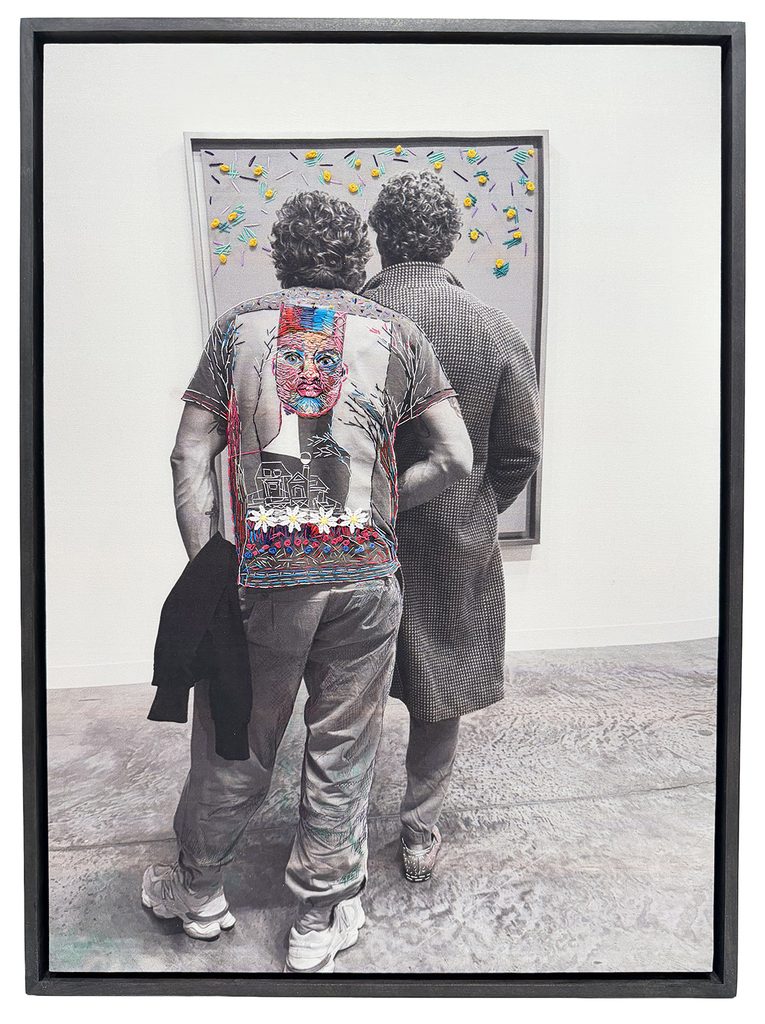
OC: Although I focused on painting in art school, for more than twenty-five years thread and narrative storytelling have been the primary language of my work, with photography as a quiet companion along the way. Long before photographs became part of the finished pieces, they served as reference material, helping me compose scenes and figural gestures. This naturally evolved into my interest in examining the role of art enthusiasts as a sort of performance in itself. I’m interested in the way attention can transform an ordinary moment into something more charged. The scenes I depict often contain small gestures, relationships, or tensions that might easily go unnoticed. By isolating these moments and giving them a new context, I encourage a slower, more attentive kind of looking. What initially appears familiar can begin to feel strange, intimate, playful, or even unsettling. For me, that shift in perception is where the viewer becomes an active participant in the work. This creative act is explored in many of the pieces in the show, such as Visible, Yet Unseen.
Orly, walk us through how a piece develops. Where do the photographs come from, and how do you decide what a given image needs — thread, paint, felt, beads, crochet?
OC: I work intuitively, but I’m also working thematically. I often have a couple of different areas of interest in my mind’s eye, and as I move through the world, I’m looking for images that connect to those ideas. I take a lot of photographs, and later, when I look back through them, I start to see possibilities; sometimes I’ll play with the color or tones, crop the image, or shift the focus before deciding which ones I want to print.
From there, it becomes much more of a process of experimentation. I’m working out the composition as I go, figuring out what belongs where and how the three-dimensional texture and color of my threadwork will interact with the usually black-and-white image printed on fabric. I’ll often try several different things, work on a piece for a while, and then put it down and let it be or hang it in the studio for a bit before I know if it’s finished or not. When I come back to it, I can see more clearly whether it needs something more. Some pieces are more restrained, while others call for much more intervention and whimsy. Each image seems to ask for its own kind of exploration. I’m not trying to impose the same visual language on every photograph; I want to discover what that image needs to become something a little magical, unexpected, or otherworldly. There’s a lot of trust involved in that process, and I think some of the magic comes from not knowing exactly where the piece will end up when I begin.
The press release frames this work as a response to Susan Sontag’s idea of photographs as neat slices of life, forever frozen in time, with Orly’s hand and needle breathing life into the pictures and, at times, forcing them to spill out of their frames. Which work in the show do you each feel conveys this best, and why?
OC: I think Audience as Subject conveys this idea especially well. The photograph begins as a fixed, captured moment, but the hand-stitched figures refuse to remain flat within that frame. The texture of the thread work introduces another kind of time, slow, intimate, and cumulative. As the needle moves across the photographic surface, the image becomes less like a record of something that happened and more like a place where something is still happening. The figures seem to observe us as much as we observe them, creating a kind of reversal between viewer and subject.
For me, that is at the heart of the Photo/Fiber works. Photography can freeze an instant, while embroidery asks us to slow down and consider the time, labor, and human touch embedded in the image. The stitches interrupt the photograph’s authority and smooth surface, making it tactile and imperfect, opening possibilities that weren’t there before. In some works, the stitched elements seem to push beyond the boundaries of the original image altogether, as if the photograph can no longer contain the story. The needle takes over where the camera stops, allowing the image to become something more surreal, imaginative, ambiguous, and alive.
The photograph is no longer treated as a fixed record of a moment. The photograph gives us the architecture of the scene and the frozen instant, while the embroidery introduces another dimension of time and imagination. It allows me to make connections that weren’t necessarily present in the original print and suggests that looking itself can be transformative. We don’t simply look at art; sometimes, in ways we don’t fully understand, we take a little bit of it with us.
RM: I can cite at least three examples of works in the exhibition that literally burst out of their frames. Bouquet Mayhem is a dynamic image of a bouquet of flowers where Orly’s embroidery and appliqué treatment has the flowers rising off the canvas and out of the flat plane. There is A Quiet Rebellion, where the threads spill out of the frame onto the floor below. And there is Guarding Her Becoming, a work that, in addition to the embroidery and appliqué, has such a textural and tactile component that it projects the illusion of material density. These examples, plus others in the exhibition, offer a contradictory viewpoint to Susan Sontag’s statement that photographs are frozen or static and do not flow. Orly’s embellishments breathe life and motion into the photographic images she works with.
Let’s turn to a few other pieces in the show, starting with the 2026 work Spilled Into Color. Tell us what is behind the imagery, its genesis, your sources, and the process of making it.
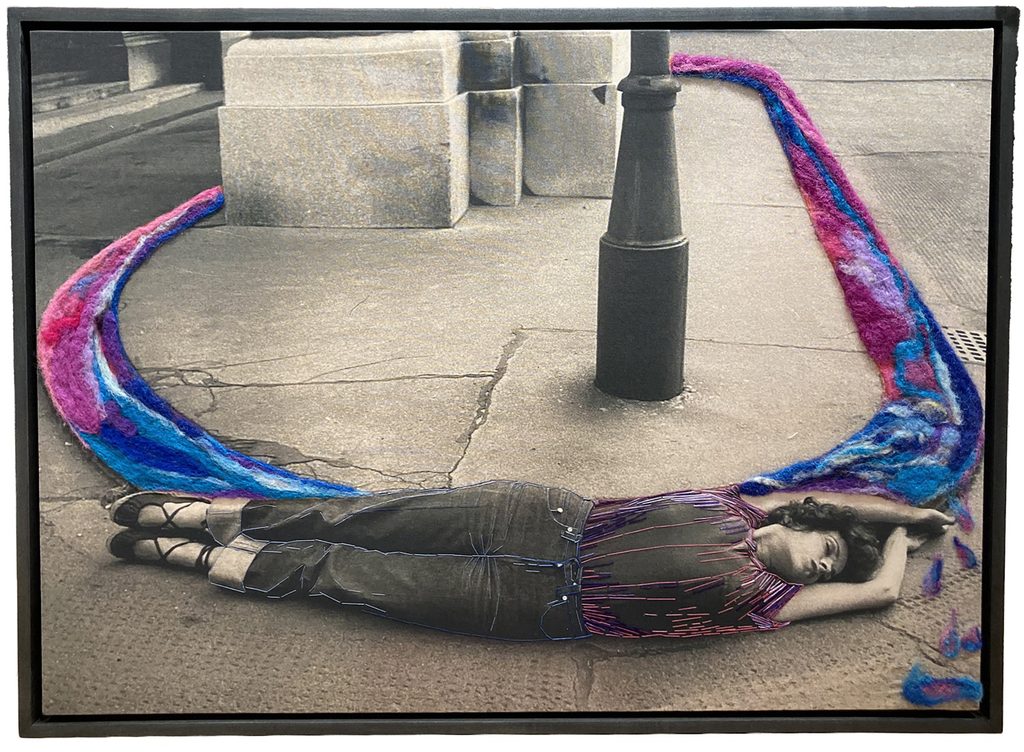
OC: Spilled Into Color began with an image by Valie Export. She was an important Austrian avant-garde feminist artist, particularly known for the way she used her own body to question how we occupy space and how the body can be shaped by its surroundings. Her Body Configurations series, made primarily in the 1970s, explored the relationship between the body and its environment through conceptual photography. I explore this concept in some of the other works in this show, and I think this piece adds to that dialogue. I wanted to pay homage to her, especially this year following her passing. I wanted to channel her creative energy and allow it to travel somewhere else through my own language of handwork.
I love that the original image is transformed through this very slow, physical process. The color and texture interrupt the photograph, but they also seem to grow out of it. In that sense, the handwork becomes another way of thinking about the body, not just occupying space, but moving through it, changing it, and leaving something behind. It felt like an appropriate way for me to honor an artist whose work opened so many doors for feminist artists and for thinking differently about the figure, the photograph, and the space between them.
AS: The Last Look, also from 2026, seems far more abstracted. What’s going on in this work, and how do you see its relationship to the other pieces in the show?
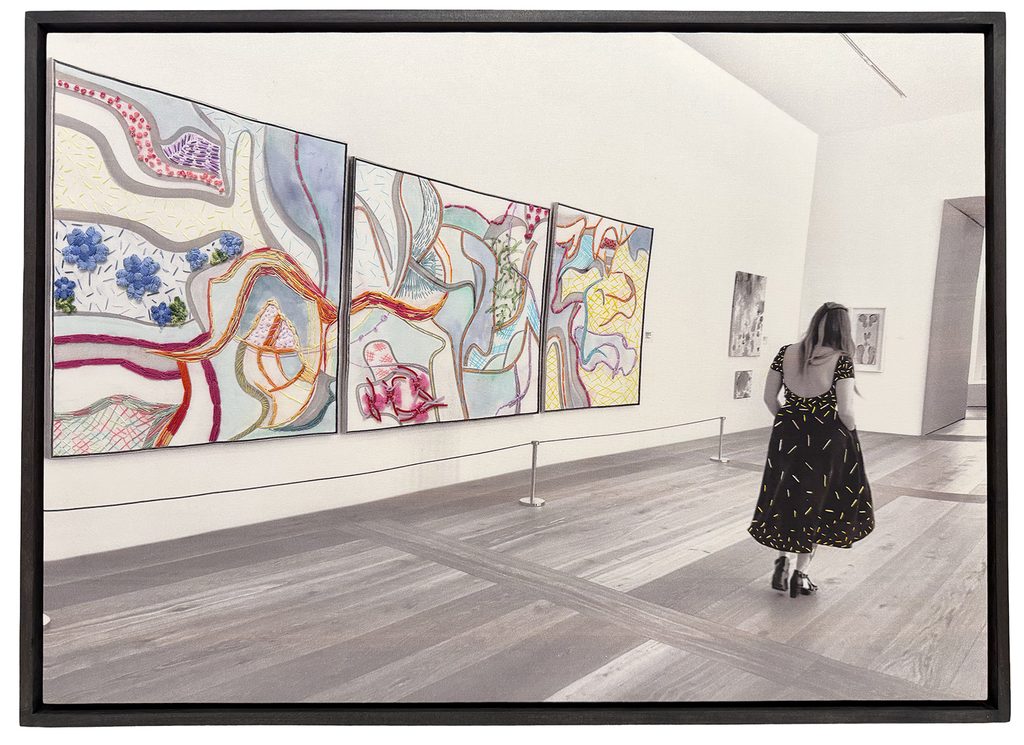
OC: The Last Look feels like a moment caught between looking and leaving. The stitches on her dress feel almost like confetti, little traces of color and movement that she carries with her from the painting as she exits that space.
I see this piece as a kind of meditation on what we take with us when we leave a piece of art at a museum or gallery. We may walk away, but something lingers, an impression, a color, a fragment of a story. The embroidery makes that invisible exchange visible. It interrupts the stillness of the photograph and creates another kind of time, where the captured moment is no longer fixed but continues to unfold.
AS: After twenty years of trading perspectives, what has this show taught each of you about the other’s medium, and any thoughts on what comes next?
RM: I believe Orly’s influence has encouraged me to be much more open-minded about artwork that I can connect to and ultimately to exhibit and promote. I suspect the gallery will continue to be tempted by other artworks that broaden our program.
OC: I’ve been taking pictures for years and just naturally compose images with an artist’s eye and intuitive thought process, which evolves and develops as I find themes to what I’m drawn to. Certainly, my exposure to a deeper resource of photographic imagery has taken place through Robert’s influence.
Photography and textiles have always shared an intriguing position in art history, existing between the celebrated and the overlooked, the mechanical and the handmade. Yet, they embody opposite experiences of time. The camera preserves a fleeting instant, while embroidery unfolds slowly, accumulating stitch by stitch. I love bringing them together, transforming the photograph from a fixed image into something playful and magical, and I expect to be mining this genre for years to come.
Orly Cogan: Behind the Lens & Through the Needle will open on Thursday, September 10, and run through Saturday, October 24, 2026, at the new Robert Mann Gallery space in Suite 4C within the famed West Chelsea Building on West 26th St. in Manhattan, NY. For further information and press materials, please contact the gallery at [email protected] and visit www.robertmann.com. For more information on Orly Cogan’s work, visit the artist’s page at www.orlycogan.com.
Make your tax-deductible donation today and help Art Spiel continue to thrive. DONATE