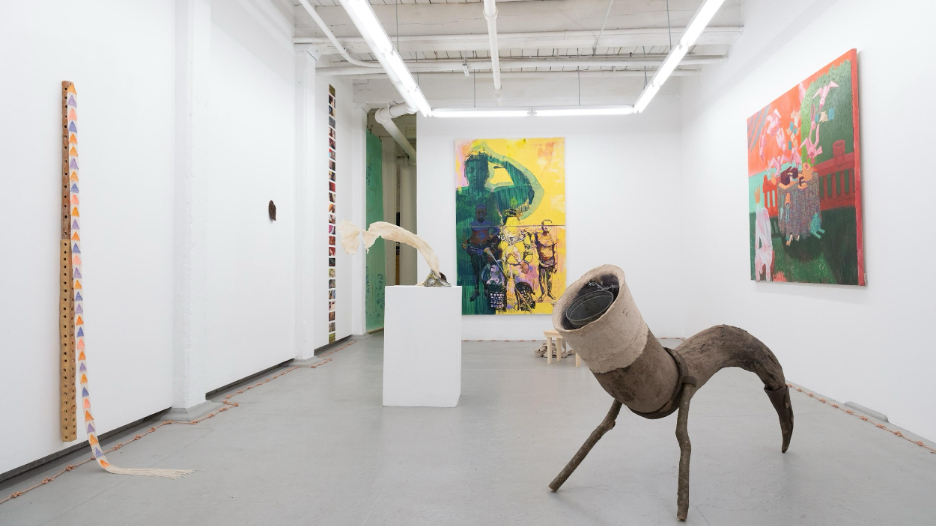
What does a gallery look like when the artists are in charge? Founded in 2013, Ortega y Gasset Projects (OyG) is an artist-run collective with no fixed curatorial line and a non-hierarchical structure shared equally among its eight co-directors. Since 2023, it has become the annual New York home for Cornell University’s MFA thesis exhibition — a partnership built on a simple premise: artist-run spaces value experimentation, innovation, and risk-taking, giving graduate artists the freedom to present work without commercial constraints or curatorial imperatives.
Continue reading “Run by Artists, Built for Artists: OyG and the Cornell MFA”Remade in Brooklyn by the Birdhouse Gallery
Art Spiel Photo Story

Back in about 2009 friends invited artist Sunny Chapman to a gallery opening in their apartment, a gallery of tiny art in an about 1 x 2 foot rectangular inset in one of their apartment walls. Sunny Chapman loved the idea and wanted to do one in her own apartment too but since they lived close by she thought it would be disrespectful. Yet, the idea of making a tiny gallery was always nagging at her.
Continue reading “Remade in Brooklyn by the Birdhouse Gallery”Private View from Home to Home
In Dialogue with Naomi Lev, Rebecca Pristoop, and Sarah Crown

Left to right, Noa Charuvi, Aimee Burg, Gabriela Salazar, installation view at Naomi Lev’s home (also in the picture: Dov Talpaz, Yahm, and Naomi Lev, as part of Lev’s personal collection).
The Exhibition Private View is a bit like an artist’s game of telephone. Three curators: Sarah Crown, Naomi Lev, Rebecca Pristoop, coordinated the movement of works by seven artists (Aimée Burg, Noa Charuvi, Tamar Ettun, Julia Goldman, KB Jones, Dana Levy, Gabriela Salazar) from home to home of each of the artists. In each new space the works were rehung, re-organized, and displayed in a new environment, often with the addition of the host’s collection of art. I interviewed the curators to find out how they planned and executed this show and how it was recorded and disseminated. In a way this exhibition reversed the traditional structure of personal and private: instead of the public being able to see artworks in a whitebox gallery or museum, which has been made impossible because of the pandemic, we became spectators on an artists private space—we couldn’t be there in person, but via Instagram we were shown more than we usually get to see. These notions of intimacy, personal expression, and a safe space in times of turmoil were central to the exhibition Private View.
Continue reading “Private View from Home to Home”