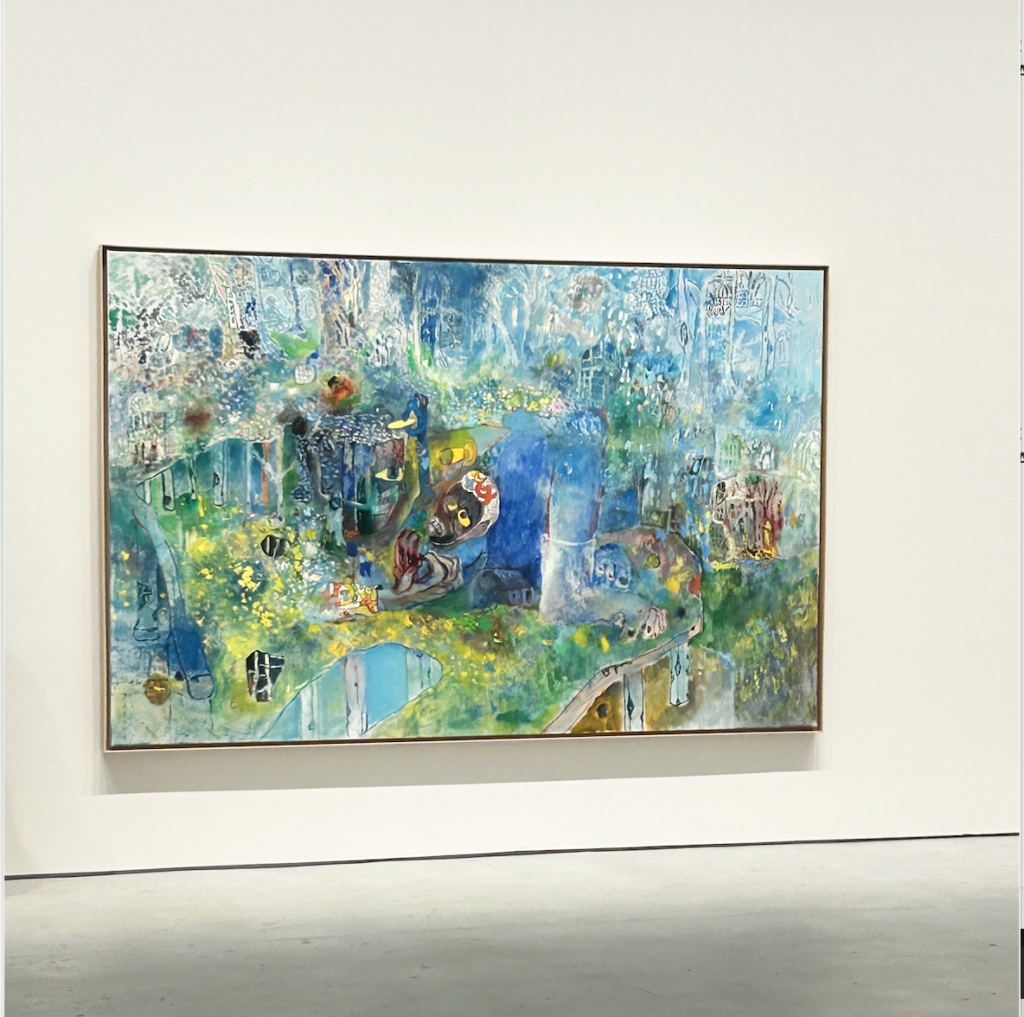
At first glance, Qiu Xiaofei’s paintings appear weightless, washed in vaporous blues and fractured light. They hover between memory and dream, suspended in a luminous haze. But sustained looking alters the experience. The mist does not dissolve — it thickens. What seemed ethereal becomes anatomical. The viewer descends from the sky into the soil, and then further still into the ruptured systems, broken bodies, and unstable architectures that structure human existence. Beneath the atmospheric softness lies something closer to the bowels of what we call life: exposed nerves of paint, skeletal fragments, windows that stare back like watchful eyes. The work stages, narrates, and exposes modes of excavation.
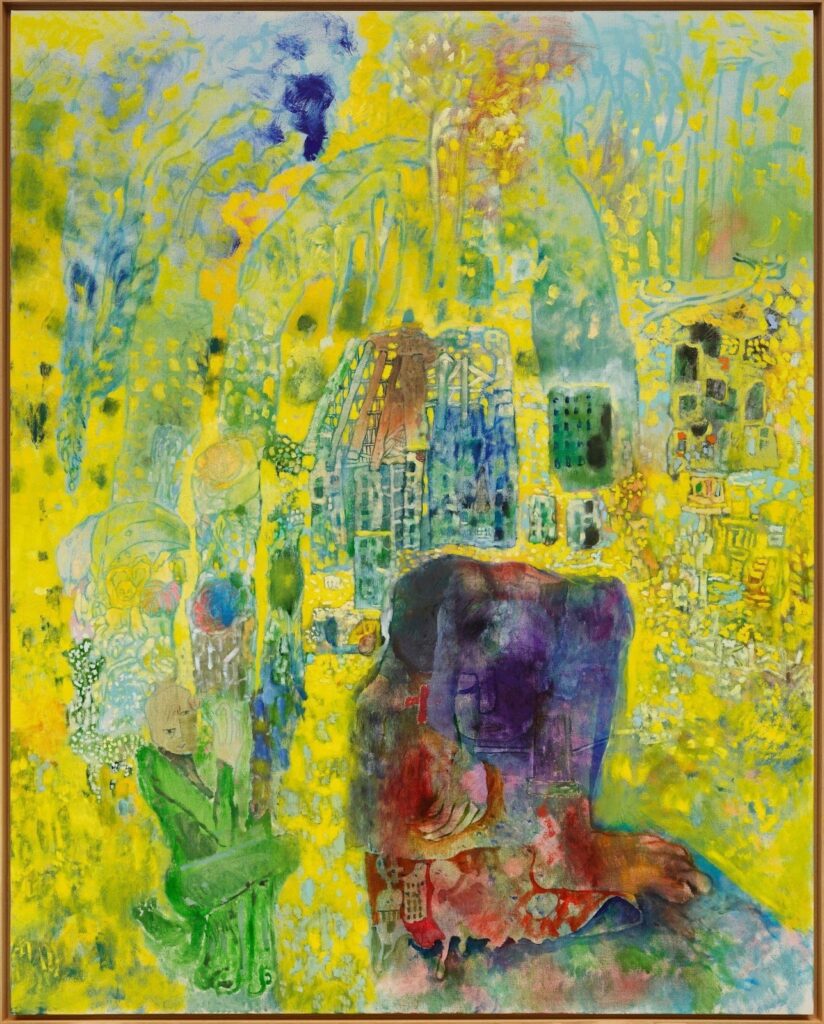
The exhibition presents a new body of oil paintings and works on paper inspired by a cache of previously unknown family photographs discovered after the artist’s father’s death. Rather than reproduce these images, Qiu treats them as catalysts — raw material for hallucinated landscapes, spiraling petals, architectural ruins, and figures that oscillate between specificity and myth.
In Angelus Novus, a large blue-toned canvas from 2025, a fragmented cityscape emerges beneath veils of white and yellow marks, as if seen through smoke or memory. Buildings rise and dissolve simultaneously. Small window apertures peer outward like embedded witnesses. Yellow drips cascade downward like exposed nervous systems. The paint shifts between opacity and wash, excavation and concealment. As a painter, I found myself drawn not only to the imagery but to the elasticity of the surface — how Qiu allows sedimented layers to evoke a sense of an expansion of space and time.
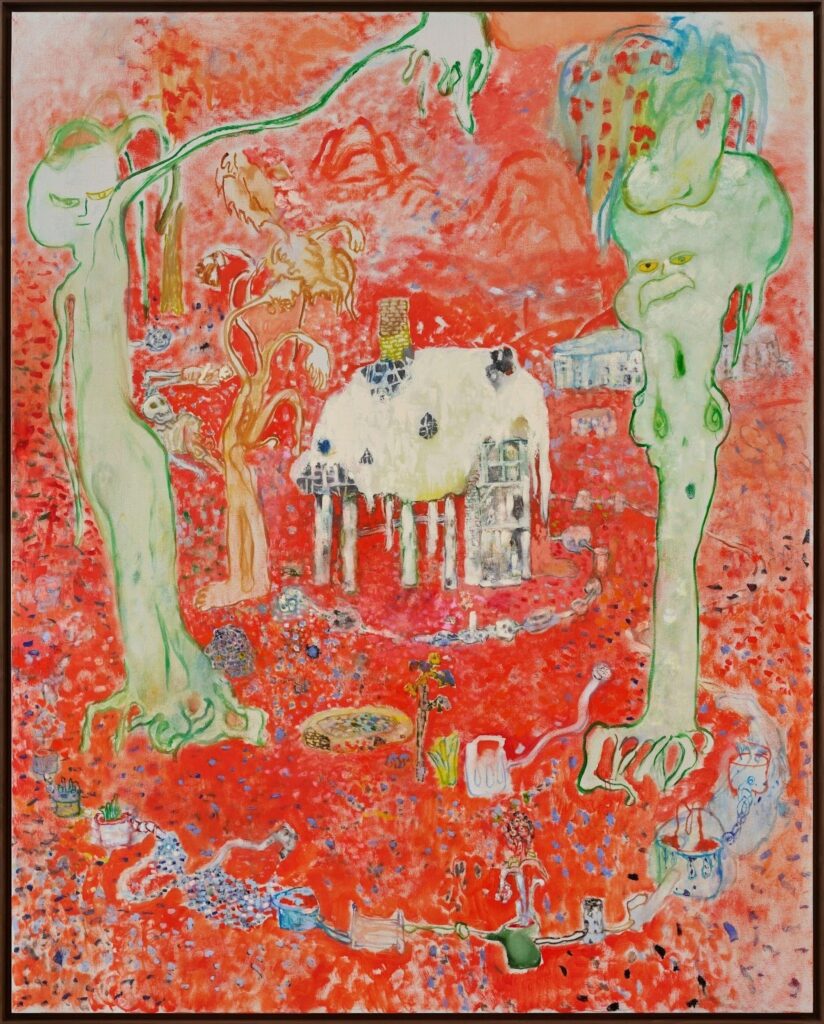
In The Theater of Wither and Thrive, 2025, another monumental red canvas intensifies the psychological field. Two elongated green figures frame the composition like columns of a ruined temple. Between them, a fragile white structure stands elevated on stilts, surrounded by skeletal forms, scattered objects, and embryonic fragments. The red ground vibrates — not decorative, but raw. The space feels theatrical yet claustrophobic, biblical yet contemporary. One of the two, tree-like figures reaches to the other, who seems decapitated, the hand gesture remains, as if frozen, in the air.
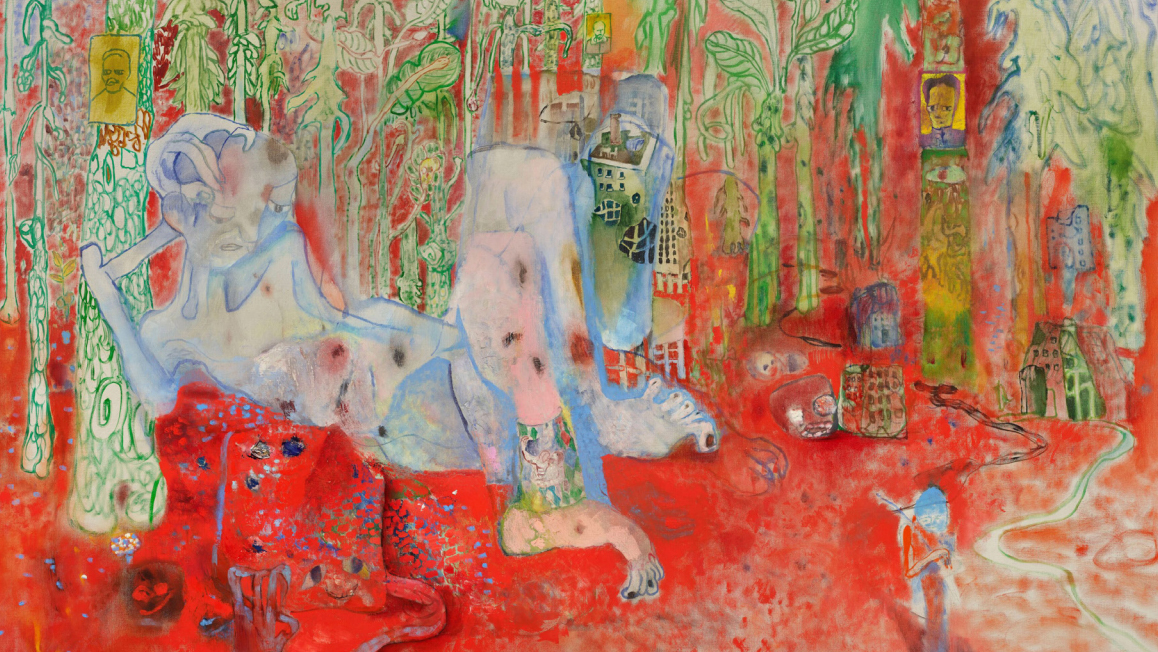
In a third work, Lodge in the Bamboo Grove reclining body floats against a pink terrain, part-lounging, part-suspended. The figure’s flesh is treated in chromatic ruptures — reds, blues, and yellows bleeding into one another — while distant architectural ruins tilt precariously along the horizon. The composition destabilizes gravity. The body rests, yet the world collapses behind it. It is intimate and catastrophic at once.
The exhibition, as a whole, unfolds like a series of staged acts. A dense red-forest painting functions almost as a curtain. Monumental canvases anchor the gallery space, while smaller works on paper operate as quieter interludes. The installation reinforces procession — you move through scenes rather than encounter isolated images.
Qiu’s surfaces are accrued, scraped, and reworked. Paint behaves like sediment. Revisions remain visible. The picture plane shifts between translucency and density, image and void. This creates what the artist has described as a “structure of time” — a collapse of past, present, and future into one pictorial field. In the painting, The Shelter with a Thousand Rooms, featuring two distorted, kneeling figures bound to a central tree, ancestry and mortality converge. The tree, suggestive of archetypes of lineage and rootedness, anchors the composition, while the figures seem transient by comparison. A watchful eye hovers above, reinforcing the exhibition’s theatrical premise: life as staged witness.
Buildings, roots, bones, windows, and skeletal fragments recur across the works. They speak to systems, architectural, political, and familial that construct meaning and inevitably disintegrate. The imagery resists sentimentality. Grief is present, but never softened.
Standing in the gallery, certain art-historical resonances surfaced for me — Gustav Klimt’s patterned density, Paul Klee’s translucent geometry, even Marc Chagall’s drifting bodies. These are subjective associations rather than claims of direct influence. Trained at the Central Academy of Fine Arts in Beijing, Qiu works within a rigorous academic lineage while allowing for expressive rupture. His visual language feels culturally specific — at times evoking architectural structures and monumental forms associated with Chinese modernity and the Soviet milieu that shaped his father’s history—yet unmistakably globally conversant.
What struck me most, however, was the emotional distance embedded within the work — what theater might call aesthetic distance. The paintings feel surgical and unafraid, willing to confront death, aging, decay, and the collapse of institutional structures without melodrama. In a historical moment marked by global political instability, these works resonate beyond their personal origins. They become metaphors for our time.
As an artist who also thinks through landscape as psychological terrain, I felt both kinship and resistance. Qiu stages memory not as nostalgia but as excavation. His landscapes are not environments to inhabit; they are fields of reckoning. The viewer is not invited to resolve anything, only to witness.
The Theater of Wither and Thrive functions as a rehearsal. Memory appears as layered sediment, persistently unstable yet stubbornly alive. In doing so, Qiu Xiaofei affirms painting’s capacity to invoke a sense of collapse, offering defiance without surrendering to it.
Qiu Xiaofei: The Theater of Wither and Thrive at Hauser & Wirth, 542 W 22nd Street, New York. On view through April 18, 2026, Tues – Sat, 10 am – 6 pm.
About the writer: Deborah Wasserman was born in São Paulo, Brazil, raised in Tel Aviv, Israel, and lives and works in New York City. She is a graduate of the California Institute of the Arts, the Whitney Museum Independent Study Program, and the Skowhegan School of Painting and Sculpture. Her work has been exhibited in the United States at the Queens Museum, the Bronx Museum of the Arts, White Columns, Pierogi 2000, Socrates Sculpture Park, and A.I.R. Gallery, and internationally in Brazil, the Netherlands, Germany, and Israel. Wasserman has received grants and fellowships from the Experimental Television Center, Aljira Center for Contemporary Art, the Bronx Museum’s A.I.M. Program, and the America-Israel Cultural Foundation. She received a NYFA IAP Social Practice Fellowship in 2017, grants from the Puffin Foundation in 2018, Citizens Committee for New York in 2019, and Queens Council on the Arts in 2020 and 2024. She has received the Su-Casa Award annually since 2015 and was a finalist for the NYSCA/NYFA Artist Fellowship. @deborahwassermanart