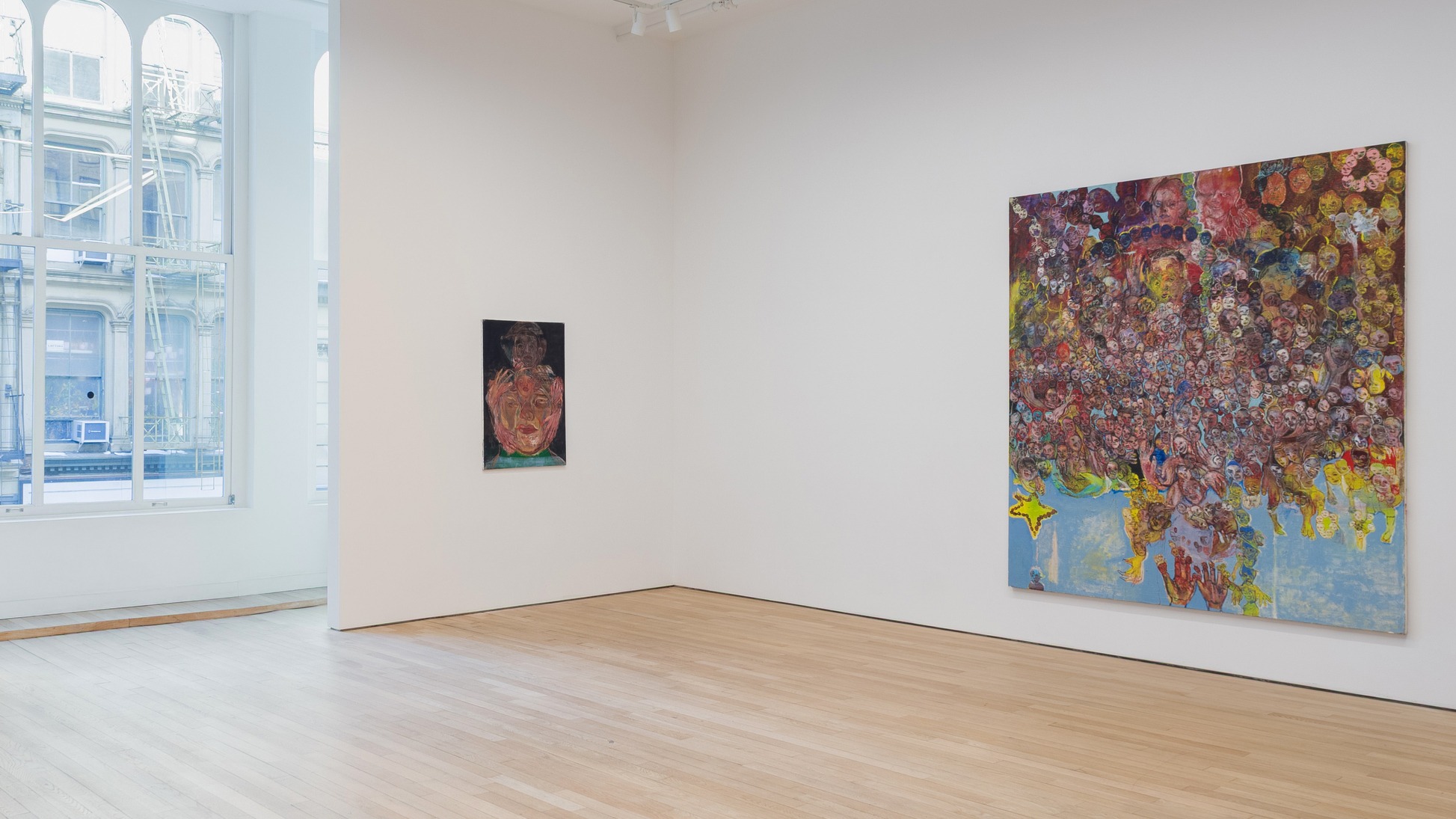
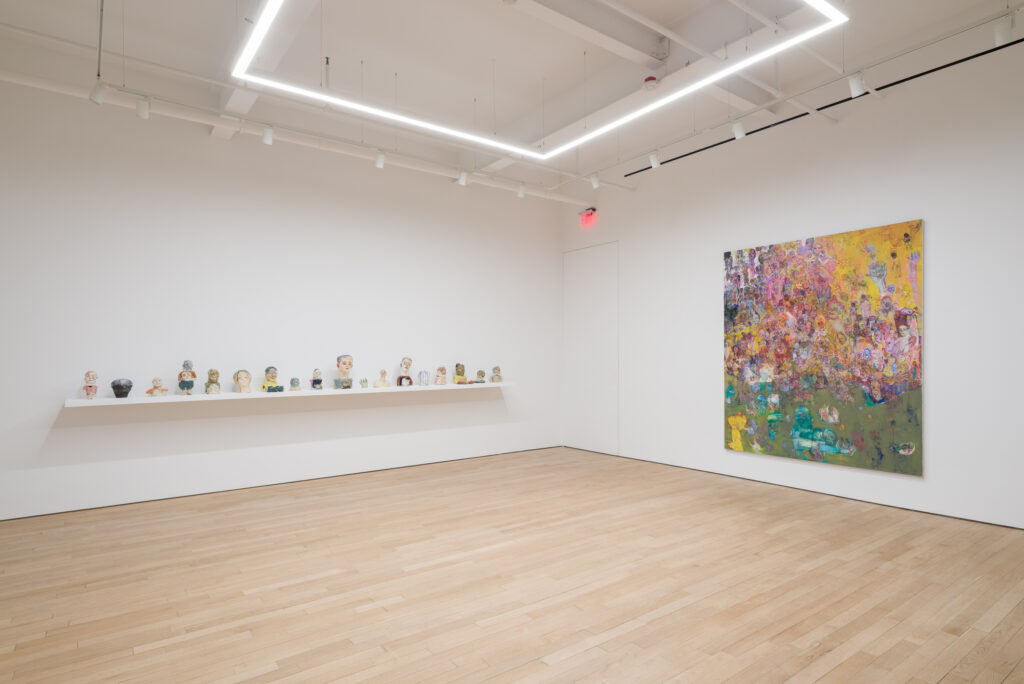
Glantzman’s heroically scaled works immerse viewers in the energetic world that she creates. I really appreciate the diversity in scale of the works in this show. The smaller-sized canvases offer a snapshot, still detailed but a more compact telling of the world she is creating. Whereas the larger works allow viewers to step in and entangle themselves within the forms, narratives, symbols, and ideas that Glantzman offers. Walking into the gallery brought an immediate sense of excitement, wonder, and a need for exploration and adventure within the pieces. The paintings introduce the characters and scenes, while the ceramics are the pieces Glantzman chooses to pluck directly from the compositions and bring into 3D forms.
The surfaces of her canvases tell a story just as much as her characters do. The frenetic accumulations of rendered self-portraits and disembodied floating heads, hands, and feet are created through a continuous process of layering, scraping, destroying, and reworking her surfaces. It is as if she is building up the figure or persona through the surface, letting the canvas become the figure. The canvas envelopes the figure, creating a new sense of place that we can explore, expanding the surface into an active setting. The canvas essentially becomes an experience. Such as in Over the Rainbow, the accumulated mass of figures appears to pour out of the sky or collectively approach a new place.
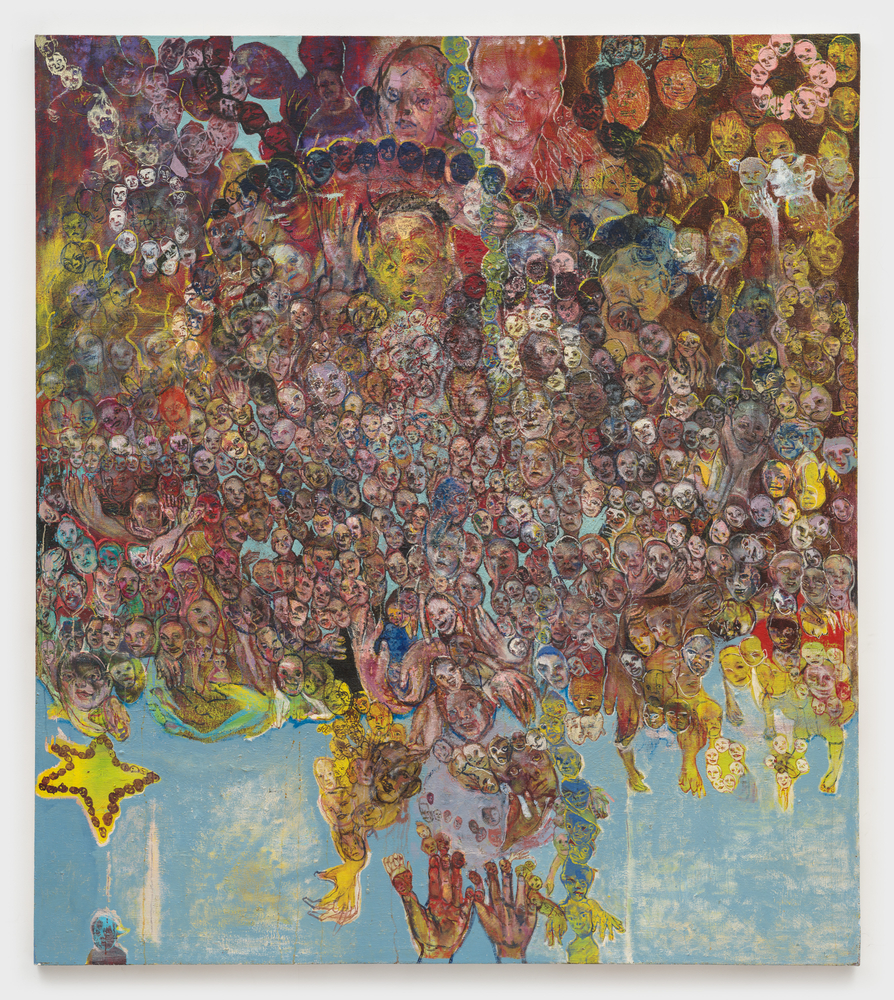
I also really enjoyed the art historical references, ranging from ancient Greek theatre influences to religious painting inspirations. The energy is culminating and dramatic. The masses of figures seem to move as if they are in some fluid flowing across a stage, moving from one scene and into the next. Across these works, personal symbols emerge from the center of her canvases or are inscribed within triangular, haloed, cruciform, or totemic configurations. These symbols are interesting additions to the characters and places she is constructing, further adding another layer to the pieces being rendered as self-portraits.
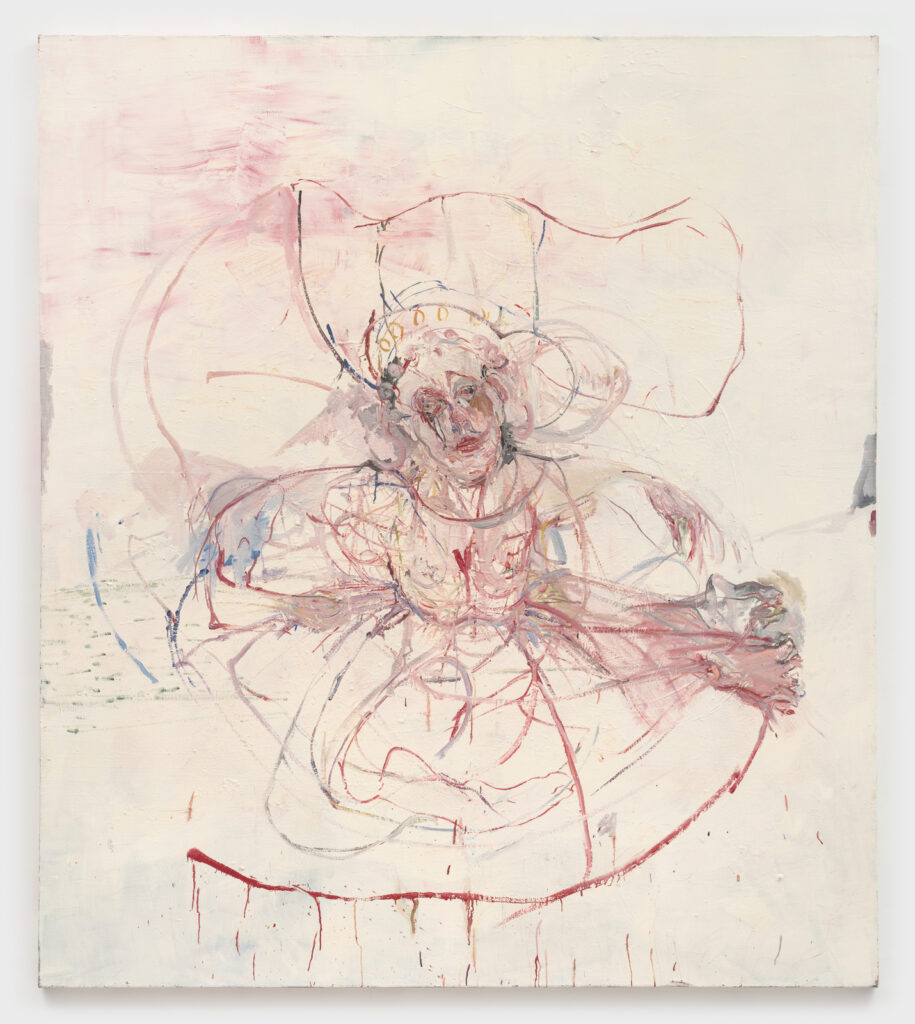
Glantzman’s process, especially for the piece Angel, pictured below, is fascinating. Glantzman uses white as a building block. She excavates through the white to uncover and build her forms. The press release explained the processes of layering her painted white surfaces- ‘In covering her canvas in thick white paint before inscribing it with a central female figure, she writes that, “In these paintings, the figure is emerging from the white as well as being swallowed back into it. The whole body of the painting is the figure, the paint its skin.”’ This idea that the painting becomes a figure creates an interesting interaction between the 2D and 3D works within the exhibition. The pieces are not separate; they all build one world to experience.
Blurring the line between painting and sculpture, the works appear to have leapt from the two-dimensional surfaces of Glantzman’s painterly accumulations and have emerged through the clay figures and forms. The disembodied hands seemed to have been made whole, reaching towards some unknown place or object. Glantzman is using glaze as paint; washes of glaze allow colors to emerge, bringing the figure to life, like in the Untitled ceramic figure pictured below. The pieces become animated and whimsical. Glantzman is really wonderful at letting the color illuminate and drive the sculptural forms.
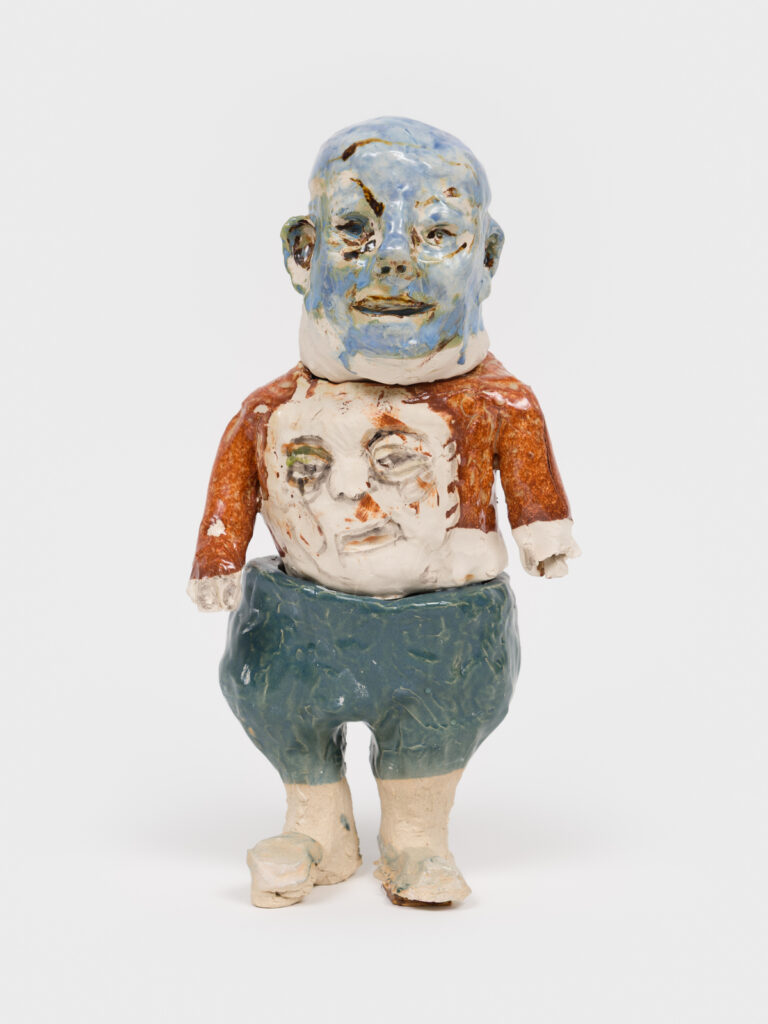
This exhibition is expressive, and the surreal environments Glantzman creates are wonderful to explore. As a visitor, letting our minds wander, making up stories about the characters, or seeing illuminations or glimpses of the artist within these works, is an exciting experience. The characters may appear chaotic or unsettling at first glance, but when you spend more time with them, noticing the details and energy within them is a great way to add to the narratives Glantzman may be creating for these figures. Human existence is weird at times, and this show adds a playful twist to that, making the idea of “playing with dolls” become a reality through the painting and ceramics, with storytelling at the forefront.
Playing With Dolls, Judy Glantzman at P.P.O.W, 390 Broadway, 2nd Floor. On view through March 14th, Tues – Sat, 10 – 6 pm.
About the Writer: Taylor Bielecki lives in Gowanus, where her studio is, and works at Pratt Institute, where she earned her MFA. She also studied at Penn State, where she earned a BA in English and a BFA in Fine Arts. She finished as a finalist in the Kennedy Center’s VSA National Emerging Young Artist program for 2017, where she earned an award of Excellence. She has shown prints internationally in a print exchange in Australia and exhibitions in Dubai, India, and the Glasgow School of Art. She has also shown paintings internationally in Gallery 24N, PhilaMOCA’s juried exhibitions in Philadelphia, Pa., Perry Lawson Fine Art in Nyack, NY, BWAC in Red Hook, and IW Gallery in Brooklyn. Taylor works for Two Coats of Paint, TUSSLE Magazine, and has joined Art Spiel as a contributing writer. @Taylor.Bielecki