
Born and raised in New York, Lacey McKinney is a New York-based fine artist whose work explores the tensions between interspecies dynamics, gender and ecology, the paradox of life and death, and bodily transformation and decay. Having exhibited nationally, received major grants such as the NYFA/NYSCA Project Grant, and completed residencies including the McColl Center, McKinney’s practice continues to evolve. Her work meditates on the complexities of existence, as self and in relation to others, unraveling the differences that separate us, and highlighting the interdependence entangled within all species, ecosystems, and identities.
McKinney’s gestural material application and stylistic dynamism merge, meld, reconfigure, and transform figures, flora, and fauna, creating liminal compositions that blur where form begins and ends. Her pigments and paints examine the relationship between predator and prey, a relationship that, though antagonistic, still relies on reciprocity to survive. Insides become outsides, differences become diffused, and touch becomes transformative.
Tell us about your art residency at Foundation House?
In January, I was an artist in residence at Foundation House in Greenwich, Connecticut, alongside seven other artists. It was an amazing experience, and I’m so appreciative of the time, space, community, and daily nourishment in many forms that allowed me to focus on my practice. While I was there, I worked on drawings, thinking about kinship and interdependence between species that exceed human exceptionalism. I’ve also been looking at violence and vulnerability as figures navigate a threatened landscape. @foundationhousect
Tell us about Contact Zone. How are you addressing interspecies relationships through feminist ecology?
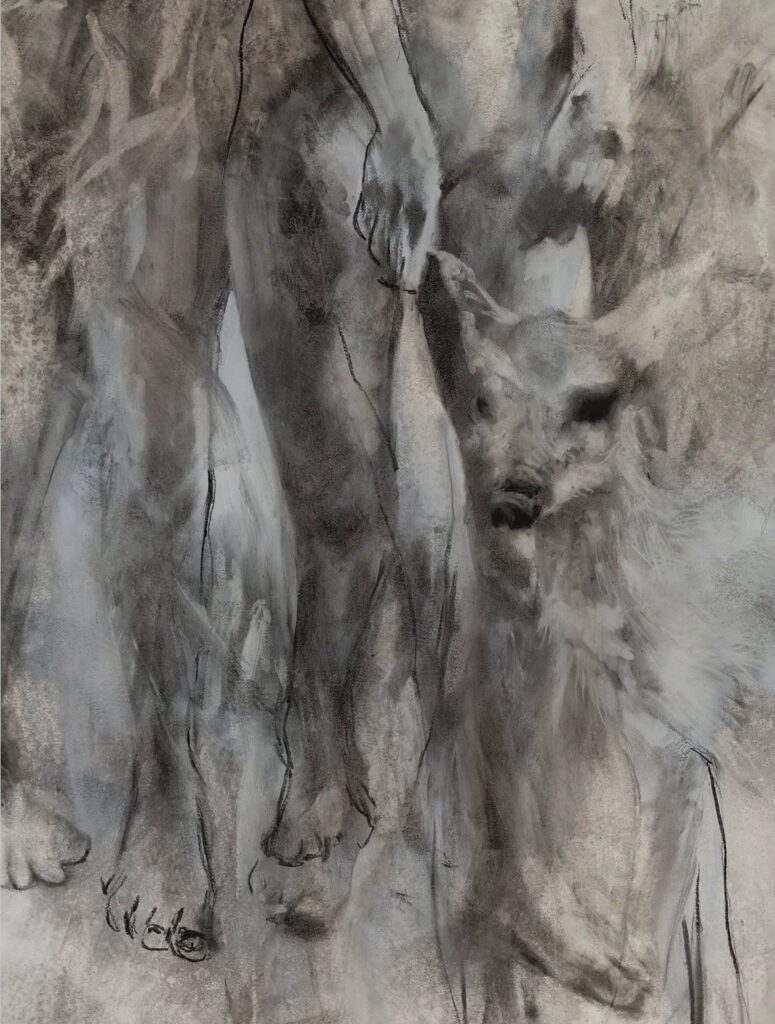
Contact Zone explores themes of transformation through figurative painting and drawing. I’m building representations of living things that fade in and out of clarity and ambiguity. The edges become undefined, and multiple bodies of difference intertwine to become one another. I think of the plants and more-than-human animals in the images as proxies for female human experience, drawing parallels between ecofeminist critiques that link the domination of nature by humans with systems of gender disparity.
The predator/prey relationship is a point of particular interest, where one species must hunt to survive, and the other becomes adept at evading danger. These encounters reveal how bodies are constantly negotiating threat and interdependence simultaneously. Survival demands adaptation, responsiveness, and intimate knowledge of the other. I return to these relationships because I struggle to accept the fact that for one to live, another must die, yet this is the fundamental condition of embodied existence.
My approach is an invitation to recognize reciprocity across species. Rather than positioning humans as separate from or superior to nature, I’m interested in depicting moments of contact and entanglement where bodies meet, merge, and transform one another. Cultural frameworks have taught us to see separation. By rendering these encounters, I’m visualizing the porousness of boundaries we’ve constructed between self and other.
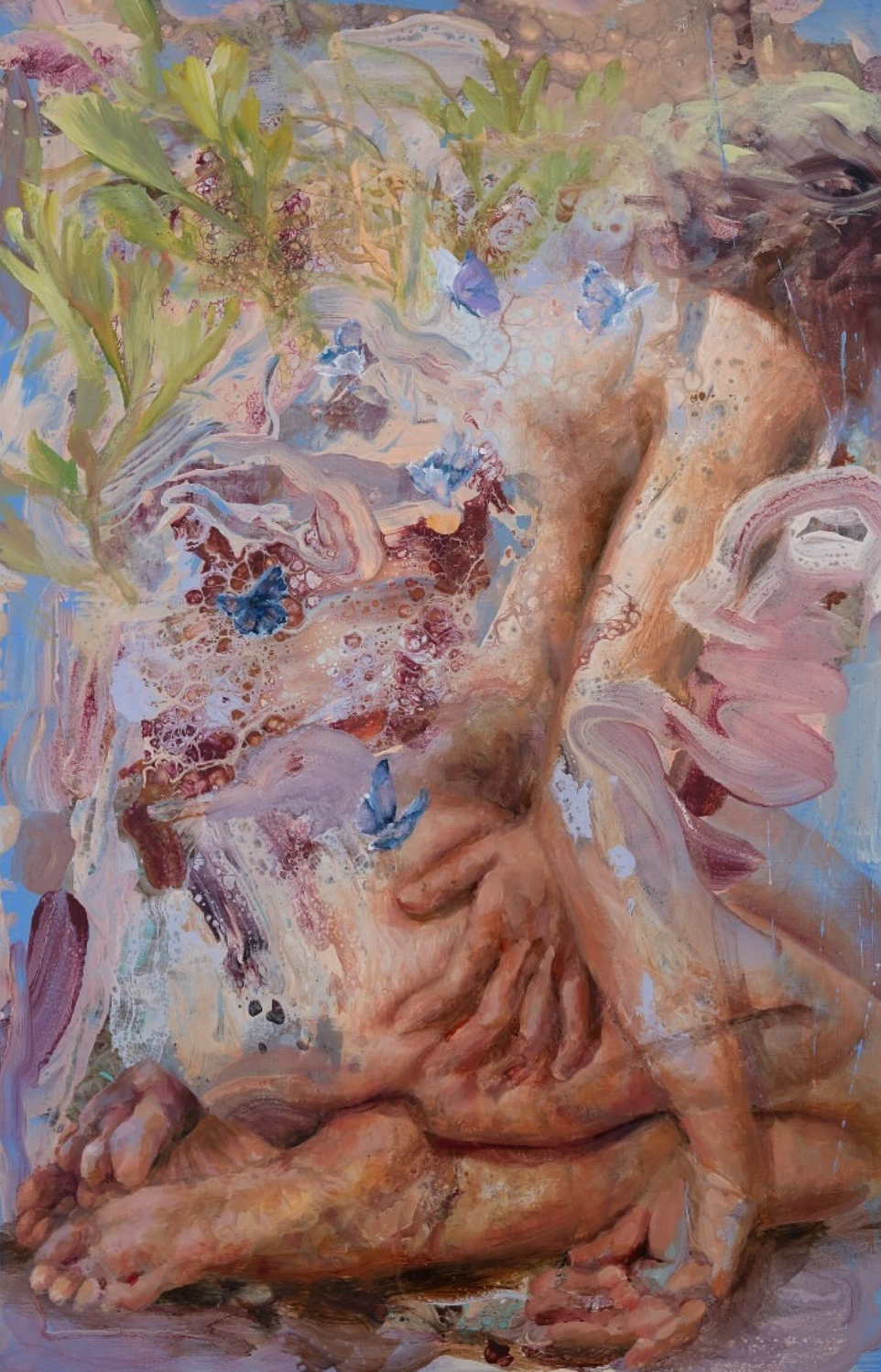
Can we look at Contact Zone 20 – Tell us about the idea, process, and your approach towards representation in this painting?
In this painting, I was experimenting with different mark-making techniques. For example, I began with an abstract ground by staining, pouring, and wiping paint. I used these marks as an armature on which to build figures: the bodies of plants, insects, and human forms. I read the serendipitous marks as internal organs, messy and visceral. As I constructed the image, a sense of what is internal began to fold outward and become the external skin, then out further into the atmosphere, dissolving the boundary between body and environment. This collapsing of interior and exterior space mirrors the permeability I’m interested in, where bodies don’t end at their edges but are always in contact with what surrounds them.
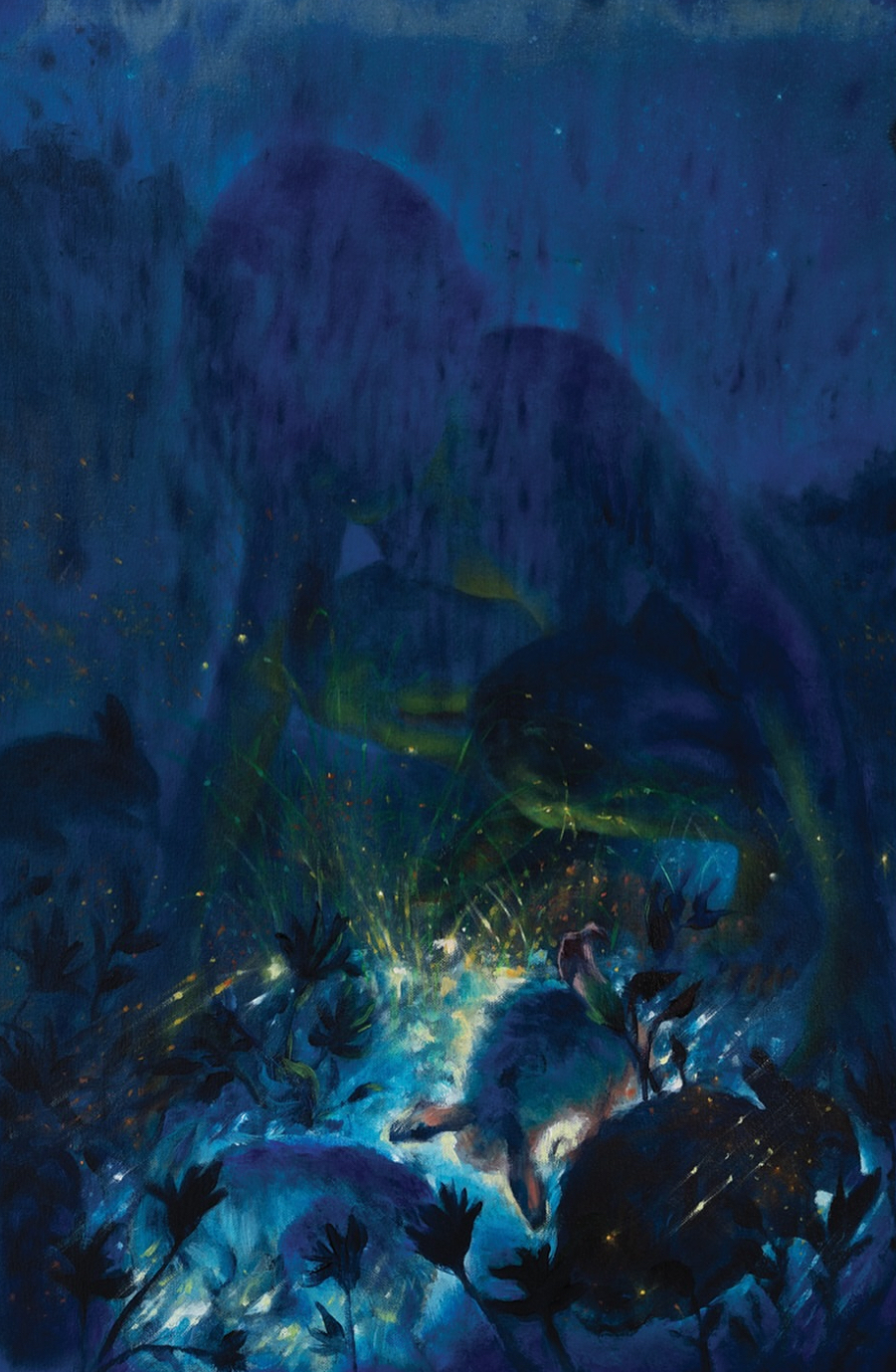
Contact Zone 17 presents a very different palette. Can you tell us about this painting?
I have an affinity for blue, evidenced in a previous body of work called Reconfiguration, where I worked extensively with the cyanotype process to make photogram collages. One of my goals is to investigate blue more in painting, drawing, and sculpture. Blue carries particular resonance for me; it evokes water, atmosphere, and the transitional spaces between states of being. In Contact Zone 17, I wanted to explore how shifting the palette changes the emotional tenor of an image. It evokes a sense of wonder, magic, and the unknown.
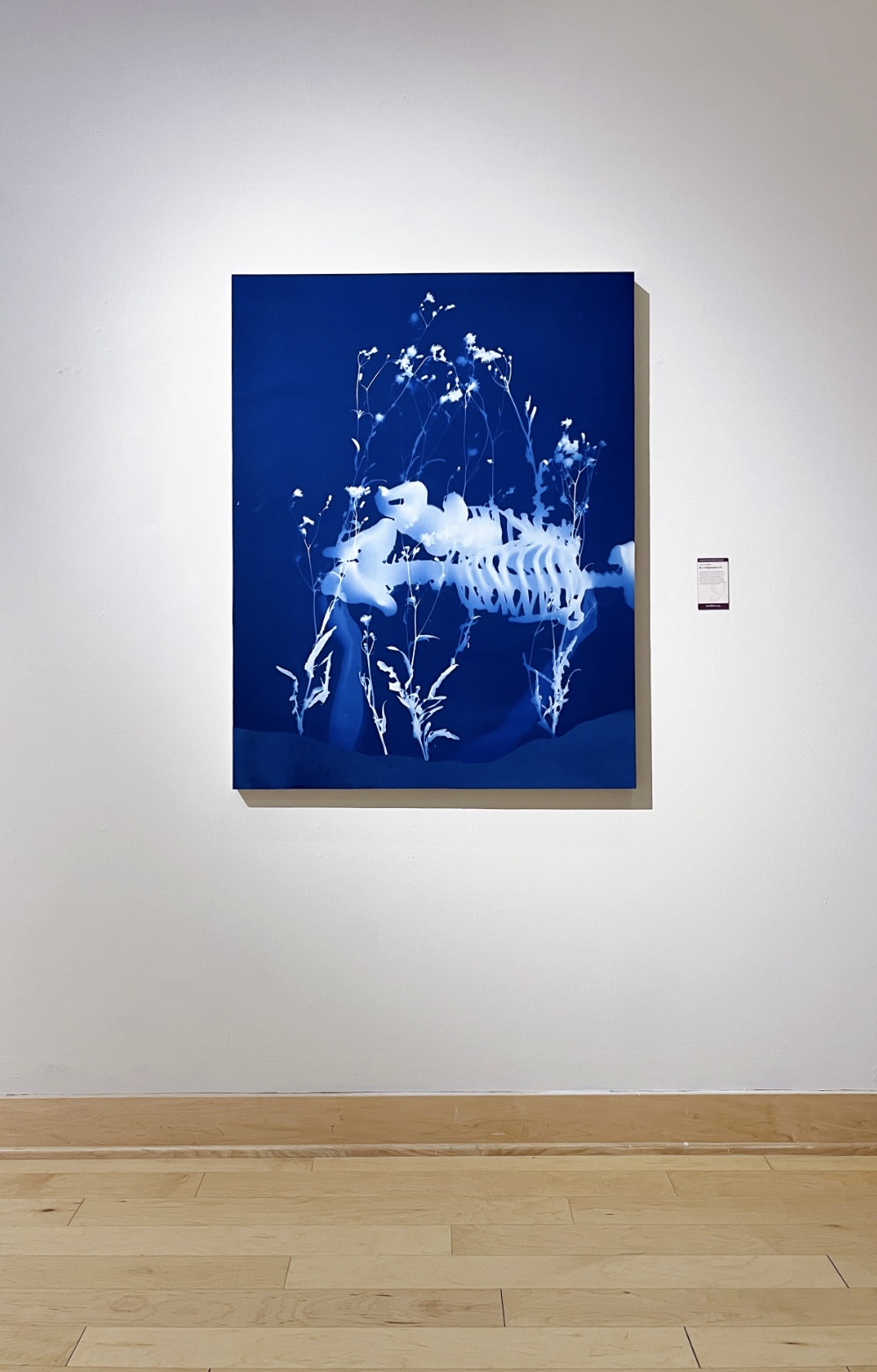
I am curious to learn more about m(other)ing at James Madison University, 2025. What can you tell us about this work – its genesis and process?
Reconfiguration 83 is part of the traveling exhibition m(othering), featured recently at James Madison University. The exhibition touches on themes related to motherhood, motherly bodies, and a diverse array of reproductive journeys. This photogram collage combines my body, plants, and a child’s doll to explore female bodily agency, gestation, decay, and mortality. Reconfiguration visualizes permeability between bodies and the natural world, engaging the monstrous feminine: the female body rendered simultaneously beautiful and grotesque as it navigates thresholds between life and death.
Your work was featured in Art Spiel back in 2020. How do you see your Contact Zone project in the context of your work then?
Contact Zone builds on my ongoing inquiry into gender, power dynamics, and the feminine body as a site of contention. What’s shifted is the scope: where earlier work focused on human relationships, this project asks what we might learn from interspecies encounters. The overarching aim to visualize connection across difference remains, but now that difference includes the more-than-human world.
About the artist: Lacey McKinney is a visual artist living and working in Central New York. She has exhibited work across the United States, including at Mana Contemporary (New Jersey), The University of North Carolina (Charlotte), and Pen & Brush (New York City), among others. Her solo exhibition Reconfiguration opened at the Everson Museum of Art in 2020, and her forthcoming solo exhibition of the same title is scheduled for fall 2026 at the Holter Museum of Art (Helena, MT). Her work is held in numerous private collections and has been featured in ARTnews, Art Zealous, Cultured Magazine, and Huffington Post.
She has been awarded residencies at Foundation House (Greenwich, CT), Constance Saltonstall Foundation for the Arts (Ithaca, NY), McColl Center for Art + Innovation (Charlotte, NC), and Fremantle Arts Centre (Australia). McKinney received a Light Work Grant in Photography in 2022 and a NYFA/NYSCA project grant in 2020.
McKinney holds an MFA in Painting and Drawing from SUNY New Paltz and a BFA and MA from SUNY Oswego. @mckinney_lacey
About the writer: Ella Jackson is a New York–based painter and creative, serving as Editorial Coordinator at Art Spiel and as gallery assistant at Plato Gallery. She earned her Bachelor of Fine Arts in Painting from Pratt Institute, where she developed a rigorous studio practice grounded in compositional exploration and critical dialogue. Her curatorial work includes an exhibition at The Blanc Gallery, and her artwork has been presented in shows such as her solo exhibition at Steuben Gallery and a group exhibition at IW Gallery. @ellagracejackson_