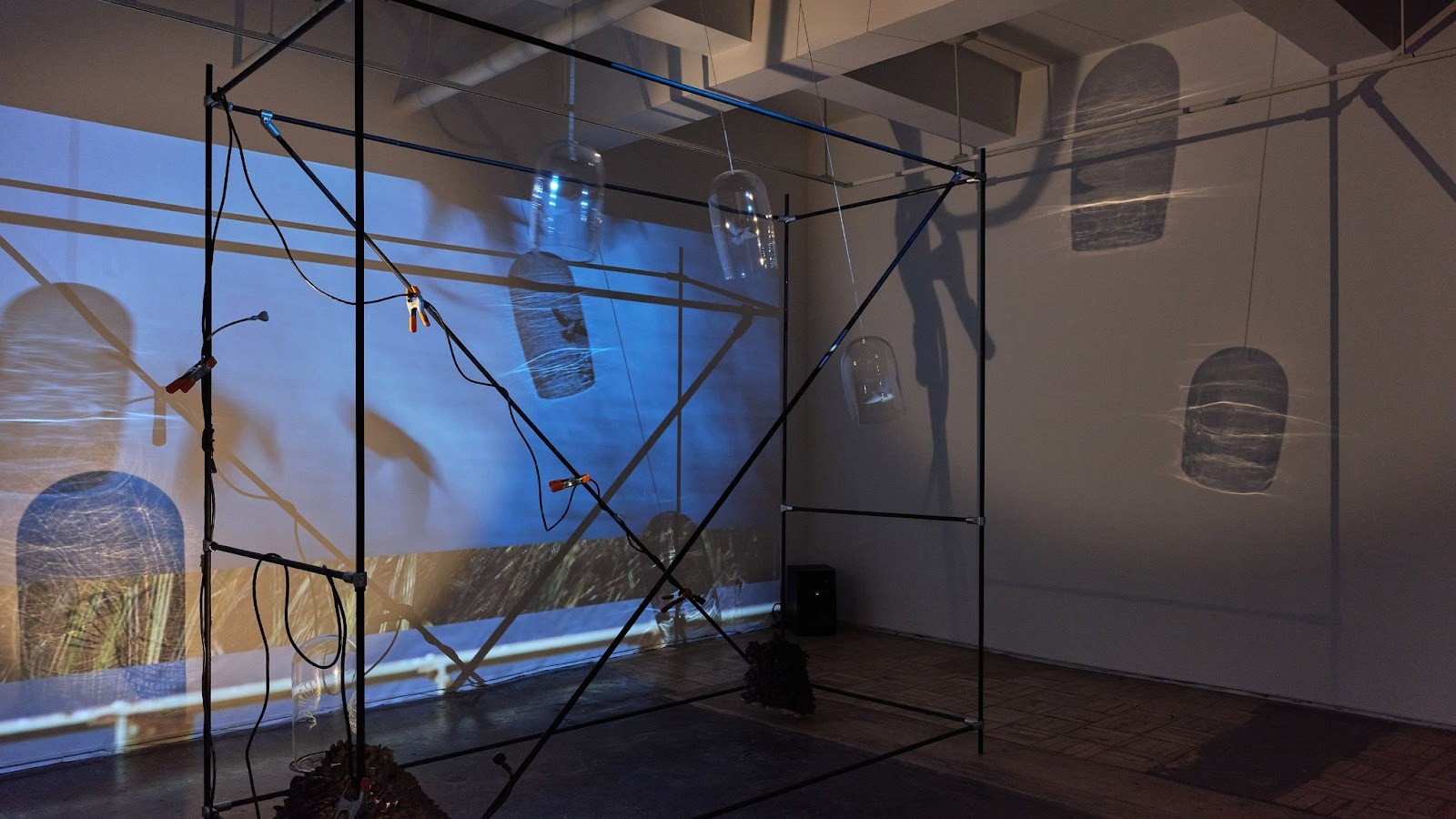
Alice Pixley Young’s Still Life takes shape in semi-darkness at A.I.R. Gallery as an immersive meditation on ecological time, stratified and shadowed by industrial residue. Installed as a multisensory environment of video projection, sound, industrial scaffolding, and glass bell jars, the installation places viewers in a space where remediation and damage coexist. Suspended from tall black scaffolding, the glass containers move like dimly illuminated pendulums, casting shadows across the walls and establishing the installation’s temporal pulse from the outset.
The work’s rootedness in place is central. Young’s studio is located on an Ordovician fossil bed near a nuclear Superfund site in the Rust Belt. Her exhibition in Brooklyn hints at another Superfund site, the Gowanus Canal, linking two contaminated landscapes across geography. The central video shows horizontal strata in constant motion. Below the upper dusky blue sky, you can travel slowly through narrow moving bands — grasses and wildflowers filmed at the Fernald site in southwest Ohio — creating a lateral sense of passing through a remediated landscape. Alongside it, a thinner strip shows water seen from a bridge, evoking an industrial waterway shaped by contamination and cleanup. The cross sections are clean-cut and suggestive, tinged with a bluish monochrome.
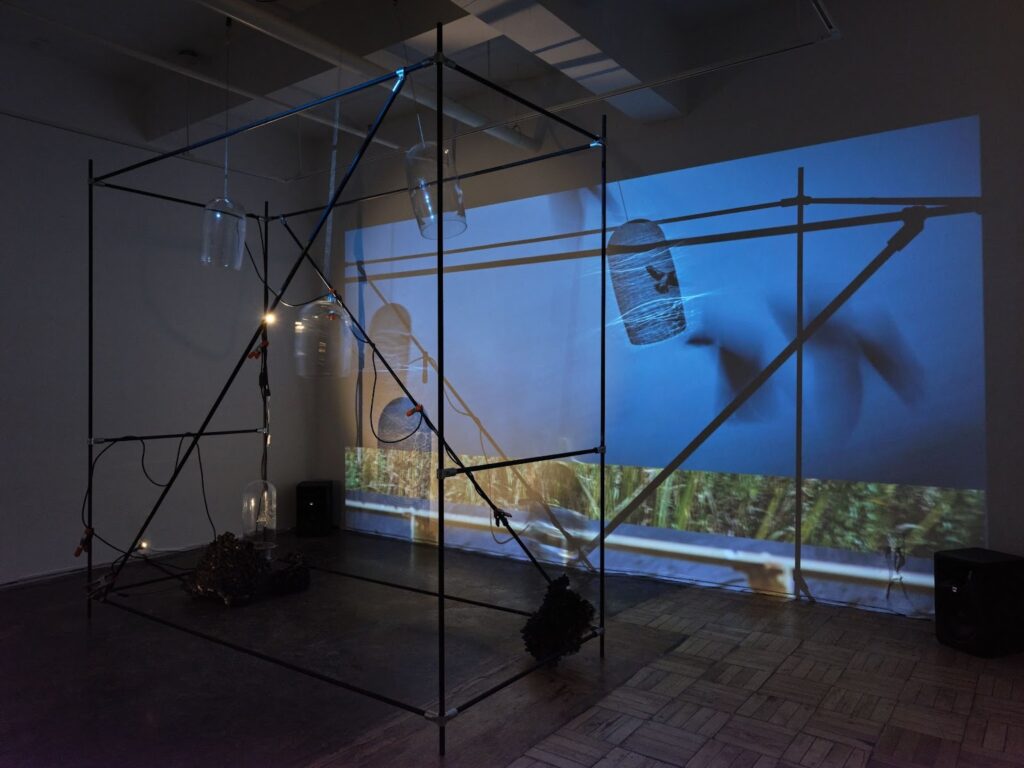
Birds enter through sound and sight. The birds’ calls, recorded by the artist, continuously shift and reorganize, gradually overtaken by industrial noise. They suggest a tough migration. The suspended glass bell jars are engraved with imagery of Eastern Meadowlarks (one of the bird speciesin population decline). The glass pieces swing slowly like pendulums of grandfather clocks, casting moving bird shadows across the projection, encapsulating past, present, and future. These dome-shaped transparent jars are recognizable as decorative containers used to showcase collected specimens, typically placed on a safe shelf. In Young’s installation, they lose their ground, engraved on, and swing side to side hypnotically. Here, these fragile containers of life also signal warnings, becoming what she calls “active image-makers.” I can imagine those glass jars holding the souls of vanished birds. The birds’ blurred wings flicker as their cries reverberate through the space, at times piercing, at times distant.
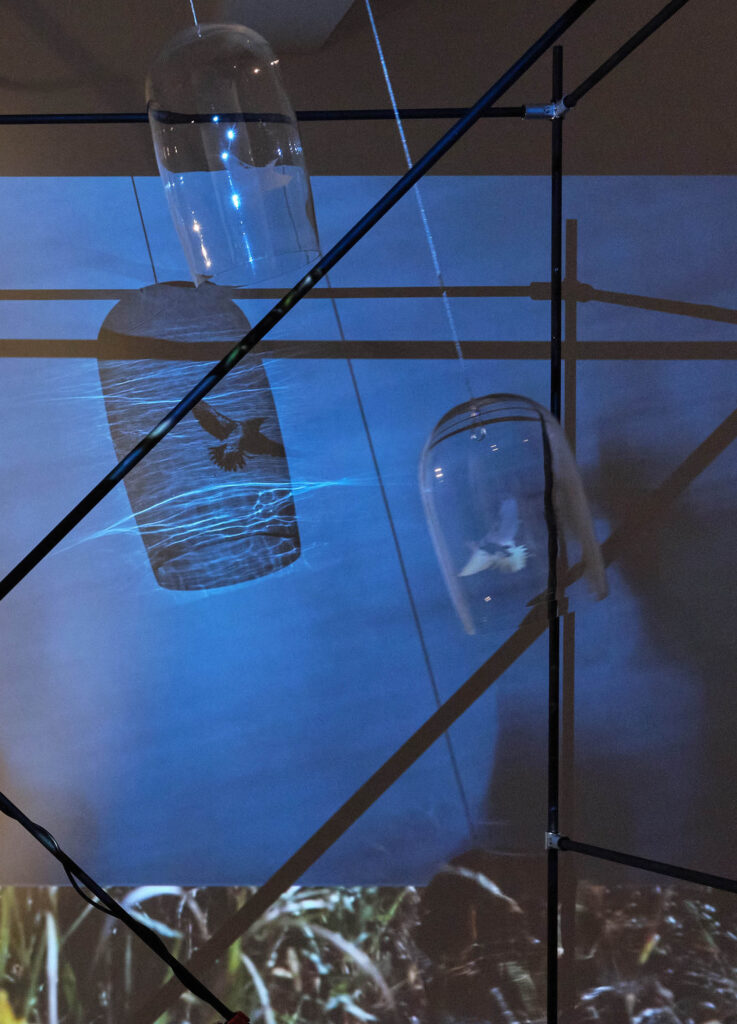
The birds’ imagery appears in motion, blurred and only partially formed, more hinted at than fully seen. The birds seem to move as if traveling between sites, from Young’s Rust Belt landscape toward Brooklyn’s Gowanus Canal, some vanishing along the way. The black scaffolding structure stands before the screen, geometric, imposing, and bare. It interrupts the projected space, holding the blurred flight behind it in tension with containment. Objects, shadows, and projected imagery fold into one another. The present physical space bleeds into its layered past, reaching toward an unknown future. The disappearing birds, the scientific monitoring of contaminated landscapes, and the broader theme of environmental time link seamlessly. Or as the artist says, the projection reads like a “cross-section connecting atmosphere, land and contaminated infrastructure.”
As projected forms lengthen and shift, they spill beyond the screen and into the room, animating the gallery with a haunting beauty that is eerie, grim, but not yet fatalistic. Still Life does not settle into elegy. It resists the stillness implied by its title. It operates as a poetic wake-up call.
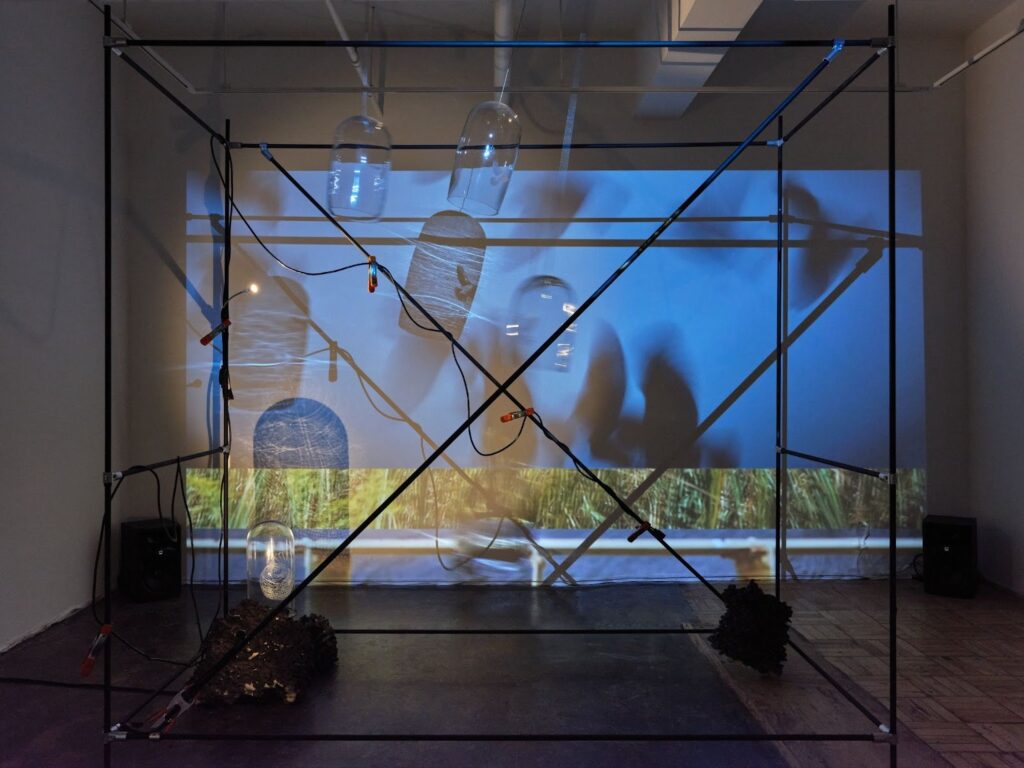
Alice Pixley Young: Still Life at AIR, 155 Plymouth Street
Brooklyn, NY 11201.On view throughMarch 15, 2026. Wed–Sun, 12–6 pm
About the Writer: Etty Yaniv is a Brooklyn-based artist, writer, curator, and founder of Art Spiel. She works in installation, painting, and mixed media, and has shown her art in exhibitions across the United States and abroad. Since 2018, she has published interviews and reviews through Art Spiel, often focusing on underrecognized voices and smaller venues. @etty.yaniv