
Katy Fischer and Marie Lorenz go back to the mid-90s and the printmaking department at RISD, where the sheer amount there was to learn on a technical level sealed both of their paths as artists. Cantilevers, their two-person exhibition at Roundabouts Now in Kingston, includes no printmaking at all — yet a printmaker’s habit of setting up a repeatable process and then letting it devolve runs through both bodies of work. Lorenz, who has operated a tide taxi in New York Harbor since 2005 in boats she designs and builds, shows kinetic, pendulum-based sculptures weighted with porcelain casts of objects found on the beach. Fischer’s script-like porcelain shapes and new mosaics draw on techniques with roots reaching back 1,500 years. In the conversation that follows, the two artists discuss their shared history, the systems behind their work, and the tension of balancing porcelain on a single point.
You’ve been friends since your time in the printmaking department at RISD in the mid-90s — how has that shared history shaped the way you think about each other’s work, and what made this the right moment to show together?
Katy: Yes, it was so much fun to work on the install of this show together because we very easily fell into the rhythm of working side by side the way we did all of those late nights in the printshop at RISD. We are both complete gearheads when it comes to the technical aspects of art-making, going all the way back to when Marie convinced me to go check out the printmaking department our freshman year. I remember us debating the pros and cons of the different majors and how it was the fact that there was so much to learn on a technical level in printmaking that sealed both of our fates. I don’t think there is any actual printmaking featured in the show, but it informs both of our approaches to any medium.
The striped black-and-white markmaking on my ceramic wall work has a Xerox-like irregularity that, although not literally printed, really looks like it is. And this is because the clay has been rolled out numerous times under newsprint, which gives it a texture very reminiscent of the way rollers on a press might leave the ink streaked or variegated.
Marie: Yes, the install really brought me back to art school where things are developing quietly, and we are both almost in the background. We had a conversation over the course of 2 days that could have fit inside of a 30-minute phone call, but the substance was totally different.
That is so true, too; there is no printmaking in the show, but all the forms and processes refer to it. I think we both like to set up a process that can be repeated, like a print ‘matrix’ and then let things devolve. For me it is the ceramic cast. I wonder what it is for you, Katy? Maybe a set of parameters or tools for making forms and laying down color?
Katy: Oh yes, I am happiest when I have a system in place that allows me to go through a sequence of repetitive tasks and jam out countless variations. The ceramic “pretzel” shapes I used for the wall piece are so satisfying to make because there are these little moments of improvisation interspersed with a ton of manual labor.
In terms of shows we have been in together, we were in a show called STRATA at Arsenal Gallery in New York City together in 2014 that explored some of the same themes around artifacts and fragments that are at play in Cantilevers. It seemed like a natural pairing given that I was planning to show mosaics this time around and Marie is always excavating in literal and figurative ways in her practice.
The exhibition is titled Cantilevers and described as a fulcrum between two practices — one pointed outward, one inward. How did you arrive at that framing, and does it reflect how you experience the difference between your approaches?
Marie: It is hard to totally reconstruct how the title came about. A few months before the show, we started texting images from our studios. These two images came through about the same time; mine was the upper part of a metronome, and Katy’s was a mosaic chunk, a dark one with slender arcs of white. I was shocked; it was like we were making the exact same drawing but from totally different sources and materials. For the title, I think we wanted something that touched on those arc forms, something that referred to the formal balance in both of our work, but didn’t narrow the reference point.
Katy: Yes, and I liked how the technical definition of a cantilever can be summed up as something balanced on one point. So it’s a literal description of the way Marie’s metronomes are balanced on their bases, and my porcelain wall elements are hanging from single nails. We both place porcelain objects in surprisingly precarious positions, so for me this idea of the cantilever sums up the tension that is created when one pushes the boundaries of what ceramics can do. And in a larger sense, the word also points to how precarious everything feels these days, which for me is one of the undercurrents that runs through this show.
Marie, the Tide and Current Taxi has been the spine of your practice since 2005 — can you talk about how the kinetic sculptures in this exhibition grew out of those voyages, and what it meant to develop them during the Kohler Residency?
Marie: Yes, since 2005 I have operated a ‘tide taxi’ in the New York harbor in boats that I design and build. It is an art project, but the activity also supplies a lot of the material and ideas for my studio-based sculptural artwork. In 2015, and again in 2025, I went to the Kohler Arts Industry residency at the Kohler factory in Wisconsin. This is a great resource for artists to work with industrial porcelain casting. (If anyone is interested, look it up here; their application opens every winter.) I made hundreds of molds of beach debris and cast them in porcelain. The weighted parts on either end of the metronomes are porcelain casts of things I find on the beach. The titles of pieces refer to places around New York where I find the junk: Elders Point, Sparrow Marsh, etc.
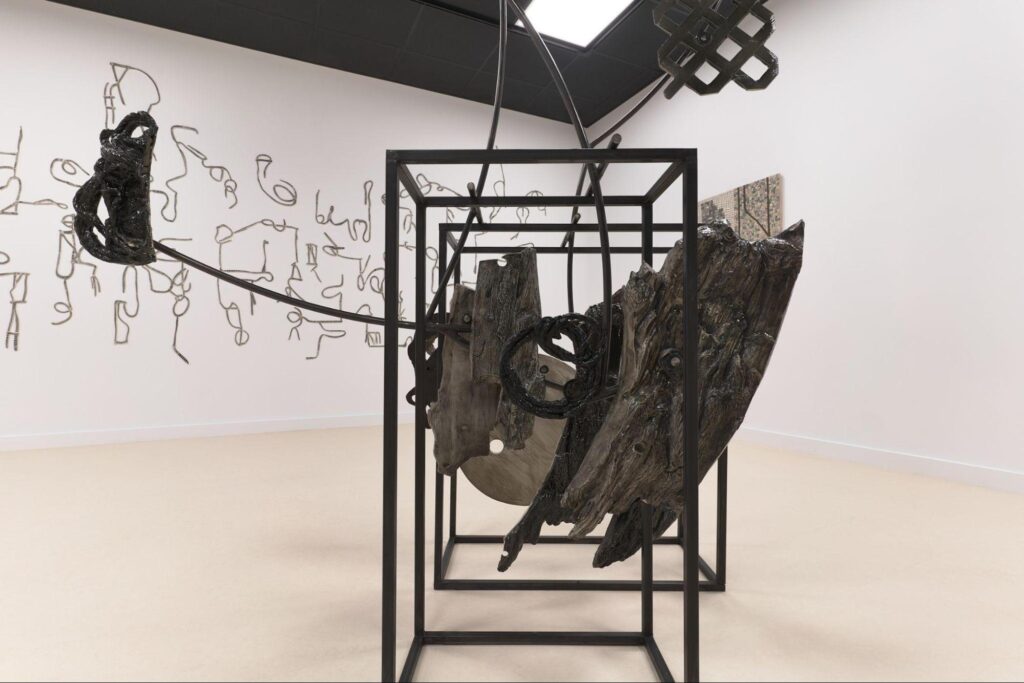
Marie, the sculptures take the form of steel armatures — metronome-like pendulums balancing ceramic casts of construction debris, driftwood, and objects gathered on your voyages. Can you walk us through what we see in the gallery, and what drew you to the pendulum as a structure for holding these found things?
Marie: In 2023, I collaborated on an opera in the Newtown Creek with a writer (Dana Spiotta) and a composer (Kurt Rohde). The composer asked me to make an instrument that would play by itself, or be activated by the water. I made a series of lute-type instruments that were strummed by wave movement. The instruments never made it into the opera; they were too delicate and finicky for that context, but they were so fun to make, and it sent me on this journey of making moving things. My pendulum forms were meant to strum an instrument, but suddenly I was like, wait, they could be silent! They could be metronomes and just imply the rhythm of the waves.
I also love this other reference to the sea; pendulums were the basis of early navigation equipment, as were pendulum clocks. So I like thinking of these metronomes as early mapping devices, plotting out terra incognita, but in a sort of lyrical, trash-filled way.
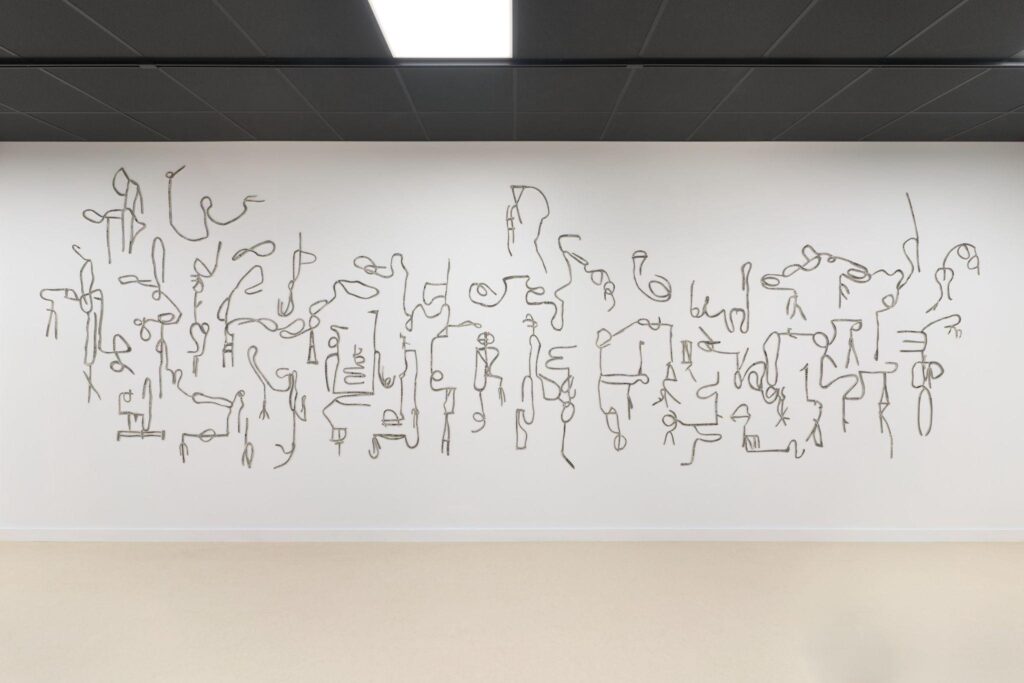
Katy, your wall works take the form of looping, script-like forms drifting across the gallery like a cryptic inscription — and they recall your MTA commission. What are these forms reaching toward, and how does working at this scale change the experience of your process?
Katy: When I do a site-specific installation, I usually have a set methodology for how the elements will be hung, but not a strict plan, and for this show, even the methodology changed once I was on site in reaction to both the space and the other work in the show. In this case, I allowed the script-like elements to touch, merging them into larger curling, drippy, doodled shapes reminiscent of figures. Although the connection to scrawled writing remains, the larger groupings are far more playful than what I expected to make. Working large is always a thrill because really surprising things happen, maybe because I am not able to exercise my normal level of precision. Rather, the inevitable loss of control that the larger scale imposes, along with the compressed timeline of a site-specific installation, forces me to let go and innovate.
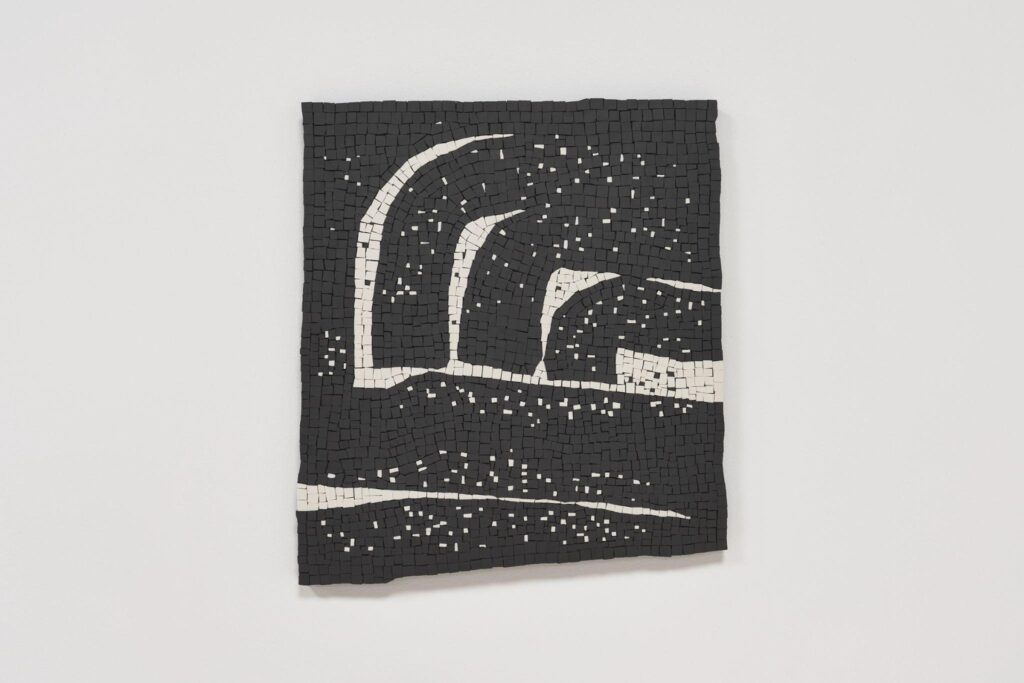
Katy, your new mosaics draw on the double reverse Ravenna method and the spatial logic of the Roman rules, a 1,500-year-old technique. What drew you to that tradition, and how do you see it speaking to what the PR describes as “our own precarious time”?
Katy: I have worked on a couple of public mosaic projects with an awesome fabricator, Mosaika, based in Montreal, whose work and expertise are really inspiring, and I have been making my own ceramic tiles for many years, so learning the craft of mosaics was a natural next step for me. I have spent the last couple of years exploring a range of mosaic techniques from contemporary direct approaches to more classical reverse methods that follow the “Roman Rules” – a set of guidelines that dictate how the tesserae should be spaced, shaped, and placed. One of the reasons we associate mosaics with the ancient world is because they survived. Mosaics, thanks to the fact that they are broken into tiny pieces, are uniquely durable because they can bend along all of those little seams. Even if the ground buckles in an earthquake, as seen in the fantastically wavy Roman mosaic discovered in Antakya, Turkey, or they’re buried in a volcanic eruption, like the ones at Pompeii, they endure.
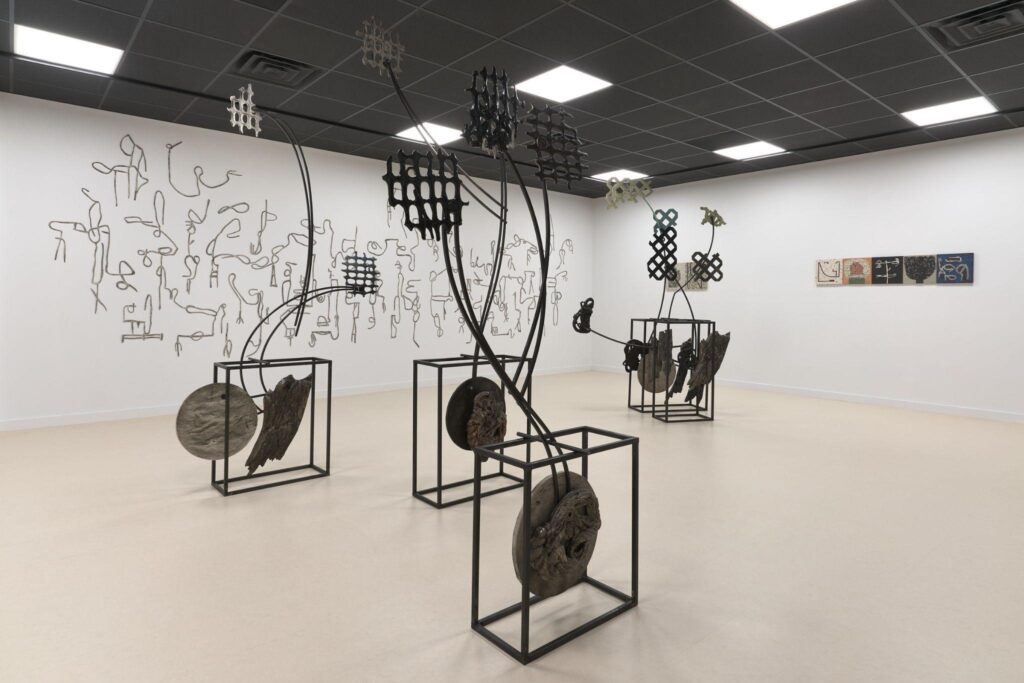
The work in this show spans steel armatures, ceramic casts, mosaic, and wall-based sculpture — very different material languages. When you look across the gallery at each other’s work, what do you see in common?
Katy: There are a lot of rope and fence-like forms in this show. As far as I see it, shapes that are coiled or cross-hatched have a distinctly calligraphic quality. We both have an ongoing interest in gestural markmaking. But neither of us tends to get there by simply making a mark in the conventional way. Rather, we find or make marks using three-dimensional materials, which seems particularly related to our backgrounds as printmakers.
Marie: I also was checking out Katy’s large wall piece on the main wall and thinking about how it responds to the plane of the floor and wall. There are all these chaotic squiggly lines, but when each line makes a turn toward vertical, they tend to be plumb. You can sense a very slight gravity working on the vertical forms. I tried to do that with the nets in the upper parts of my metronomes. They tend toward a square or plumb relationship with the ground.
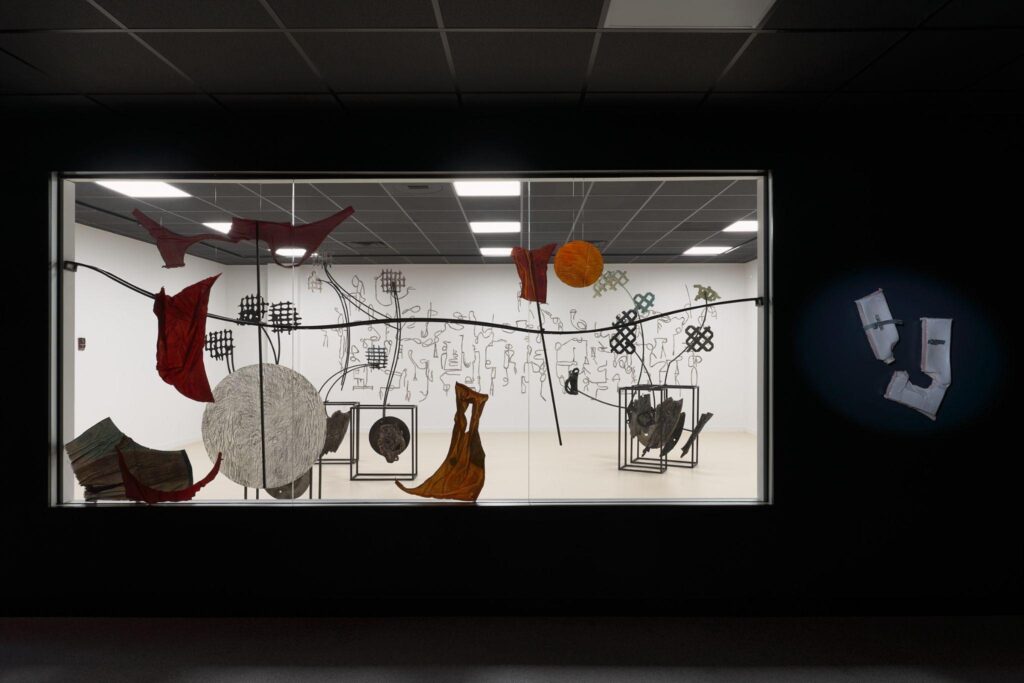
Roundabouts Now is based in Kingston — how does the venue and its context factor into how you conceived or installed the work?
Marie: Craig and Alta were big factors for us. Their sensibility and direction were our site specificity in a way. Early in the process, Craig visited my studio, and he was getting excited about the color in my work, which was great to hear, except at the time there wasn’t any color. The metronomes were almost all gray and black. We were both imagining this perfect beach plastic color, but I wasn’t using any of it yet. I tried so many different ways to get color in there, glazing porcelain, painting it, and finally, I just started using the actual marine debris, then spray painting the material to get some of that weird, intensely sun-faded beach plastic color. Those objects became the window piece. Katy and I were joking that my window piece and her back wall piece were like the future of our artwork. I think these new directions have a lot to do with Craig, Alta, and the context they developed by putting us together.
Katy: Yes, Alta and Craig fostered an incredibly open, generative atmosphere and helped push my work forward into new territory by encouraging me to explore more playful configurations in the wall installation and experiment with how the mosaics could be installed in unconventional groups and pairs. I had conceived of making a frieze-like row of mosaics for this show early on, but had abandoned it months before. During the installation, the idea came back up, and we were able to realize it in a way that surprised even me and ultimately really helped to elevate the work. This show at Roundabouts Now definitely served as an incubator for new work and risk-taking, and I think their unexpected location is part of the magic that allows for those things to happen.
CANTILEVERS
KATY FISCHER / MARIE LORENZ
25 Barbarossa Lane, Kingston, NY 12401
roundaboutsnow.com @roundaboutsnow_
July 11th – August 23rd, 2026
Make your tax-deductible donation today and help Art Spiel continue to thrive. DONATE
Katy Fischer is a New York–based visual artist whose work includes ceramic wall installations, porcelain and glass mosaics, and collaged works on paper. Her work has been exhibited nationally and internationally, including at New Release Gallery in New York, Mindy Solomon Gallery in Miami, Lamp Gallery in Tokyo, Figge Art Museum in Davenport, Iowa, and Vedanta Gallery in Chicago. She presented a Script site-specific installation at NADA House on Governors Island with Geary Gallery in 2019. Solo exhibitions include Finders, Keepers, Losers and Weepers at 356 Mission in Los Angeles and Phrases, a site-specific ceramic installation presented at Frieze, New York in 2023. Fischer’s work has been featured in The New York Times and The Boston Globe and is held in numerous public and corporate collections, including Fidelity, Progressive, Capital One, The Cleveland Clinic, and New York-Presbyterian Hospital. In 2017, she was commissioned by MTA Arts & Design to design the mosaics for the Bay Ridge Avenue R train station in Brooklyn, New York. Recent public art projects include two mosaics commissioned by Art in Embassies for the U.S. Consulate in Nogales, Mexico, and a four-panel glass artwork commissioned through New York City’s Public Art for Public Schools, opening in August 2026. www.katyfischer.com @_katyfischer
Marie Lorenz is a visual artist based in New York City. In her ongoing project, The Tide and Current Taxi, Lorenz navigates with participants through New York waterways in boats she designs and builds, using tidal currents for propulsion. Recent solo exhibitions include Confluence at the Center for Contemporary Art in Montbéliard, France, Drift Tilt at Jack Hanley Gallery in New York, and Undertow at Watershed Art & Ecology in Chicago, Illinois. Lorenz’s work has been featured in group exhibitions, including Shifting Shorelines at Columbia University’s Lenfest Center for the Arts in New York and Women Reframe the American Landscape at the Thomas Cole Museum in Catskill, New York. Lorenz was recently awarded the 2026 Award in Art from the American Academy of Arts and Letters. In 2023, Lorenz received Creative Capital and National Endowment for the Arts grants for Newton Odyssey, a collaborative opera performed along Newtown Creek in New York City. She holds a B.F.A. from Rhode Island School of Design and an M.F.A. from Yale. https://www.tideandcurrenttaxi.org/ @lorenzmarie
About the writer: Etty Yaniv is a Brooklyn-based artist, writer, curator, and founder of Art Spiel. She works in installation, painting, and mixed media, and has shown her art in exhibitions across the United States and abroad. Since 2018 she has published interviews and reviews through Art Spiel, often focusing on underrecognized voices and smaller venues. More about her art can be found at ettyyanivstudio.com and on Instagram @etty.yaniv