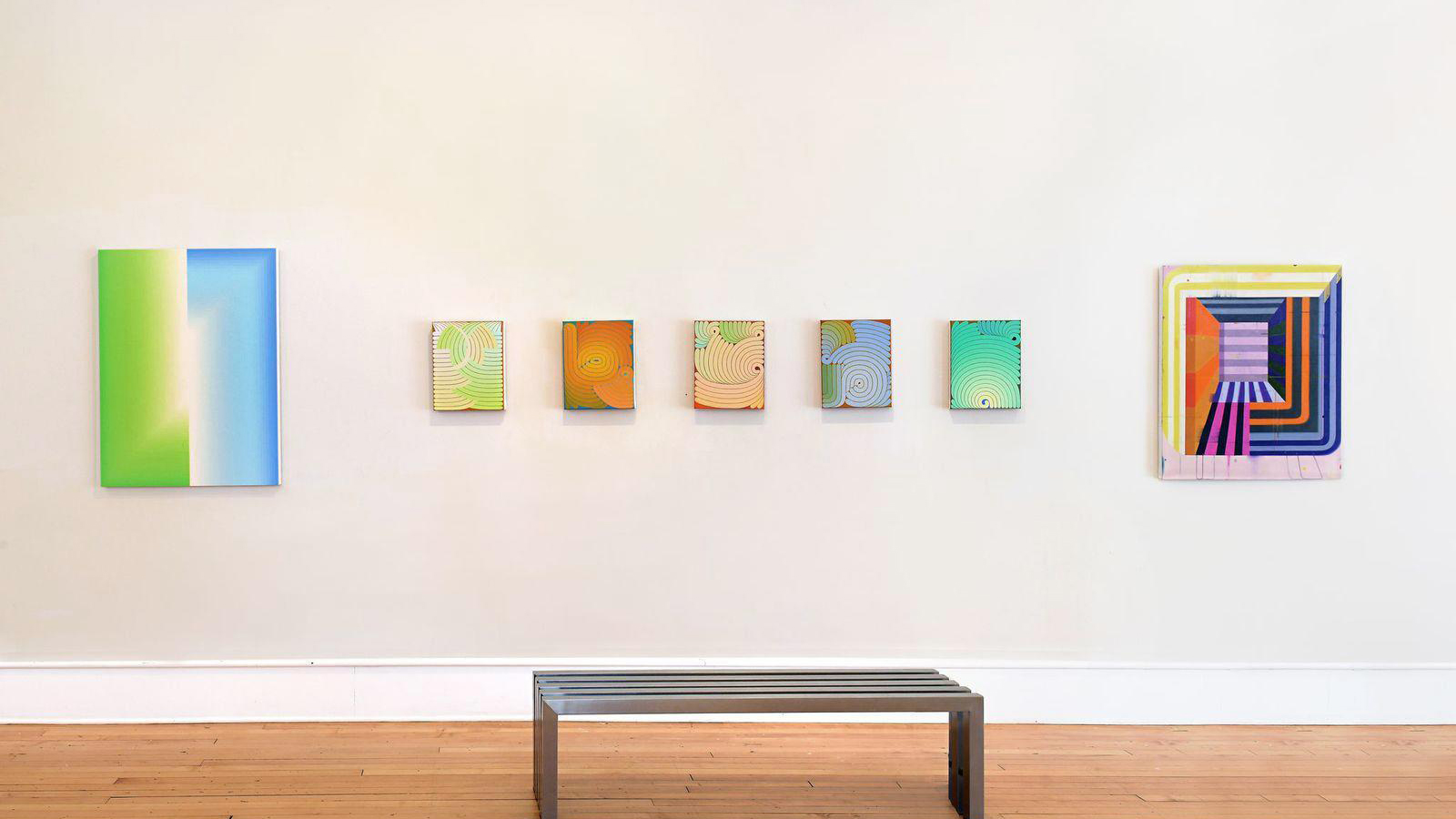
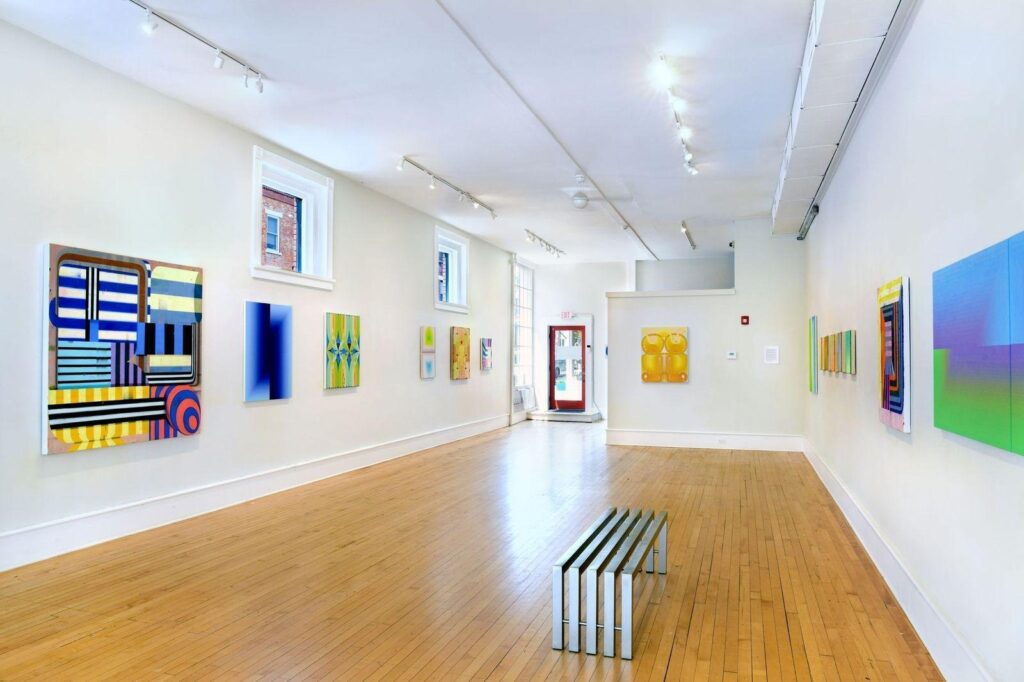
Polychrome, on view at Bernay Fine Arts, brings together paintings by Jenny Kemp, Audrey Stone, and Deborah Zlotsky in an exhibition on abstraction and geometric structure. Across three distinct practices, the artists use color as structure and sensory experience, although each arrives at abstraction through her own internal logic. Here abstraction is a form of concentration, examining the texture of experience: how can attention intensify and shift? How can time accumulate? How can systems hold together and slip apart? Artist Meg Lipke, a long-time colleague and friend of the artists, visited the show and addressed questions for the following conversation.
Meg Lipke: The title of the show is Polychrome, so let’s talk about color! The press release for the show rightly affirms, “…the artists use color as both architecture and sensation.” Can each of you speak about the specificity of color in your work?
Deborah Zlotsky: Once I have a structural idea, I build it through an exploration of color relationships informed by color theory and intuition. A friend calls unresolved issues ones she’s “still arguing with.” I think of my colors that way, still arguing, not fully compliant.
My synesthesia also shapes what I’m drawn to. I taste color. Trippy as that sounds, the sensation guides my search for something rich, complex, unexpected. It’s part of why I feel such a kinship with Jenny and Audrey’s lush approach to color, sensation, and structure.
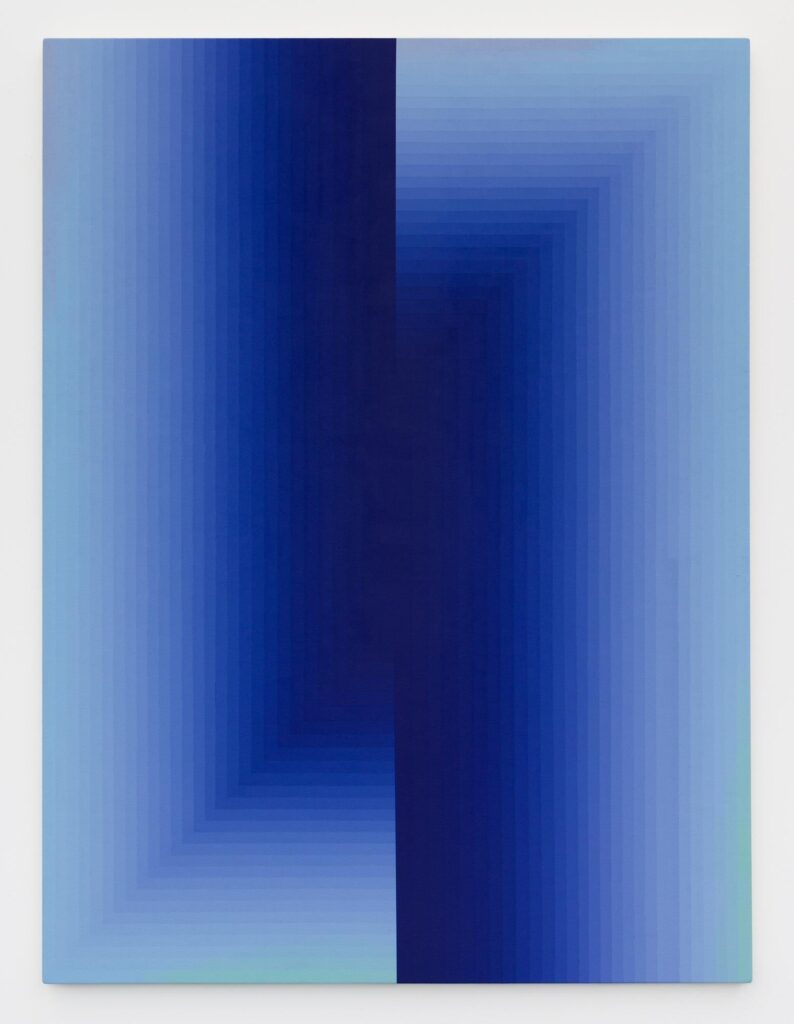
Audrey Stone: I use color to elicit both excitement and calm. The gradients create a physical sense of vibration. The color transitions mimic what might be seen or felt as changes in light or time of day. Areas where the gradients are barely perceptible appear as more solid moments of color, pauses in the overall rhythm.
Jenny Kemp: I’m driven by the reveal of unexpected interactions in color and try not to preconceive my palette too much before painting. I am, however, looking for a sense of aliveness in how color operates, constructing a space to explore its tricky, chameleon-like nature. This happens through working responsively in a process of slow, gradual shifts in hue intensity. A slow-growing sense of animation is made between curvilinear forms that vibrate next to thin, separating lines of opposing hues.
Meg Lipke: All three of you paint in an abstract, geometric language in which bands and gradations of color and line arrange to shift and organize space in very different ways. What visual systems are you alluding to or drawing from, or are you creating your own? What surprises do you utilize to disrupt the innate “order” in your paintings?
Audrey Stone: When we were planning Polychrome, we knew color would be a common thread, while our approaches to the canvas’s space would stimulate a conversation about abstract painting.
My own compositional structures tend to be minimal while the color shifts are more maximal. I’m drawn to the strength and sense of presence in symmetry and concentric movement.
Of course, lapses of attention inevitably occur, resulting in ‘off’ measurement, or a section of ‘missing’ color in otherwise uniform pacing. When bits of unrelated color from the paint mix come in, I might keep or even enhance them. Occasionally I add impasto marks to cover them, like a Band-aid. I welcome surprises that briefly interrupt the surface as reminders that you’re looking at a human, handmade thing.
Jenny Kemp: I’m led by a personal logic generated through a set of evolving, self-imposed rules. I am particularly drawn to the underlying structures found in the growth patterns of living bodies. Repetition within these architectures has become a key part of my visual language, serving as a framework that gradually gives way to invention, which is the moment I’m after. This happens through negotiating tensions between organic and geometric systems, to depart from that underlying logic in unexpected ways and develop a singular personality.
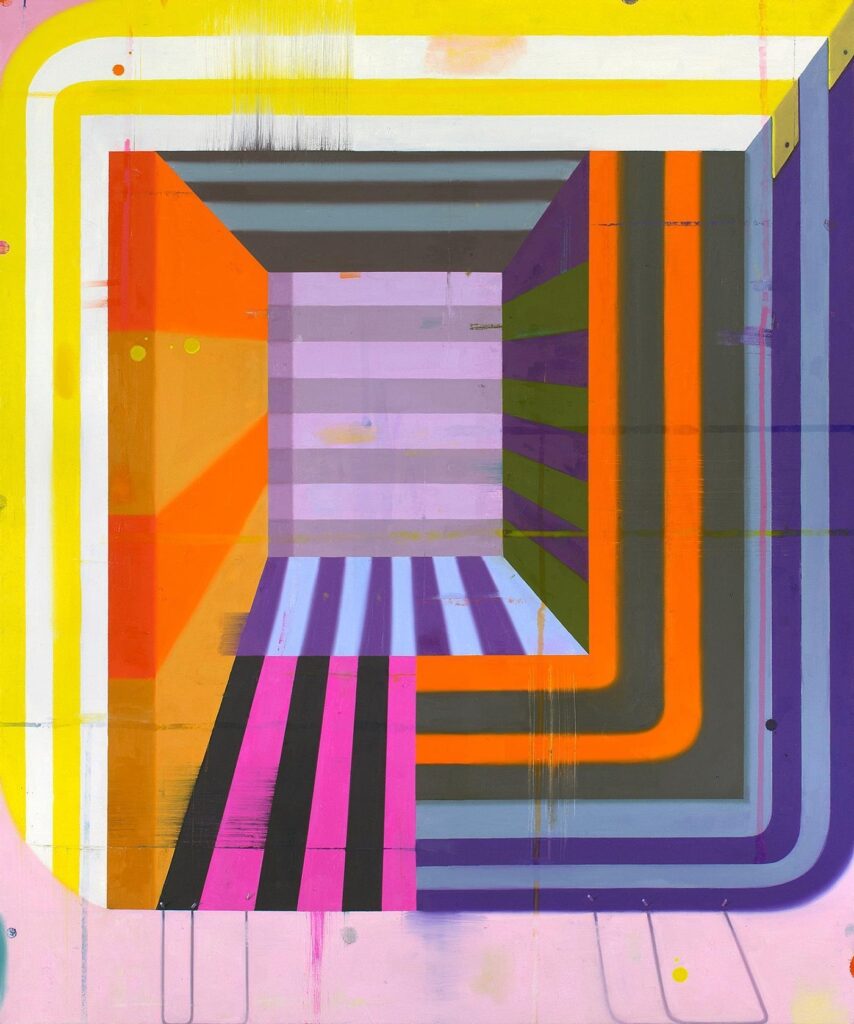
Deborah Zlotsky: Stripes are patterns and cycles reduced to their essence. I’m interested in how they metaphorically connect to other patterns: neurological pathways, family patterns, generational cycles, historical timelines. Though I work intentionally, anomalies inevitably develop, like unexpected color relationships, spatial irregularities, and shifts in orientation and scale. I gravitate toward these kinds of slippages, accidents, and “illogical” dynamics.
I’ve joked that learning I was an “accident” at a young age shaped my sense of infinite multiplicities. I’m drawn to making sense of contradictions, as if processing incongruities will lead to a higher level of understanding. It doesn’t, of course! But the possibility still captivates me.
Meg Lipke: Is there a meaning in the work that you think about privately, even though the work remains abstract for the viewer? Would you feel comfortable sharing what the work means to you? Are there reference points or experiences particular to the way you grew up that inform the work?
Jenny Kemp: Ambiguity is really important in my work; it’s why I’m interested in abstraction. Meaning emerges through surprises within the process of making, and that continually excites me. One way meaning is developed is through the soft-shaped linear forms I have been exploring in my work. I see them as suggestive of a sense of awareness rooted in an embodied experience. Through repetition, the shapes gradually come to resemble a presence that feels both familiar and strange. I’m continually interested in the ways abstraction can carry traces of a feeling or experience without being explicit. This is why I am thrilled to see my work in conversation with Audrey and Deborah, because they explore this so successfully.
Deborah Zlotsky: I value the privacy of abstraction and visual metaphor for telling a story under the radar. Lately I’ve focused on my experience of assimilation and of being Jewish at a complicated moment. I’m interested in the historical ways dominant cultures insisted Jews be identifiable. For example, in 13th-century England, laws required Jews to wear a white fabric badge shaped like tablets (Ten Commandments); in 13th–16th-century illuminated manuscripts, various marginalized groups, including Jews, were depicted in striped clothing. Over time, I’ve come to see my indirect references to Jewish history as something more personal, as perhaps one of the ways I embody the carefulness of a people whose presence wasn’t/isn’t always welcome.
Audrey Stone: In general, it’s more about energy than narrative. However, the compositions in Polychrome all contain splits; I like the idea of working on something simultaneously divided and whole.
Music often comes to mind while I work, sometimes appearing as a direct reference like a title or more subtly in rhythm and pacing. While I don’t have true synesthesia, I do feel colors have a tone or sound. I played piano as a kid and will use my hand spread – an octave on the keys – as a measurement when I paint. In that way, the paintings are connected to the physical scale of my body.
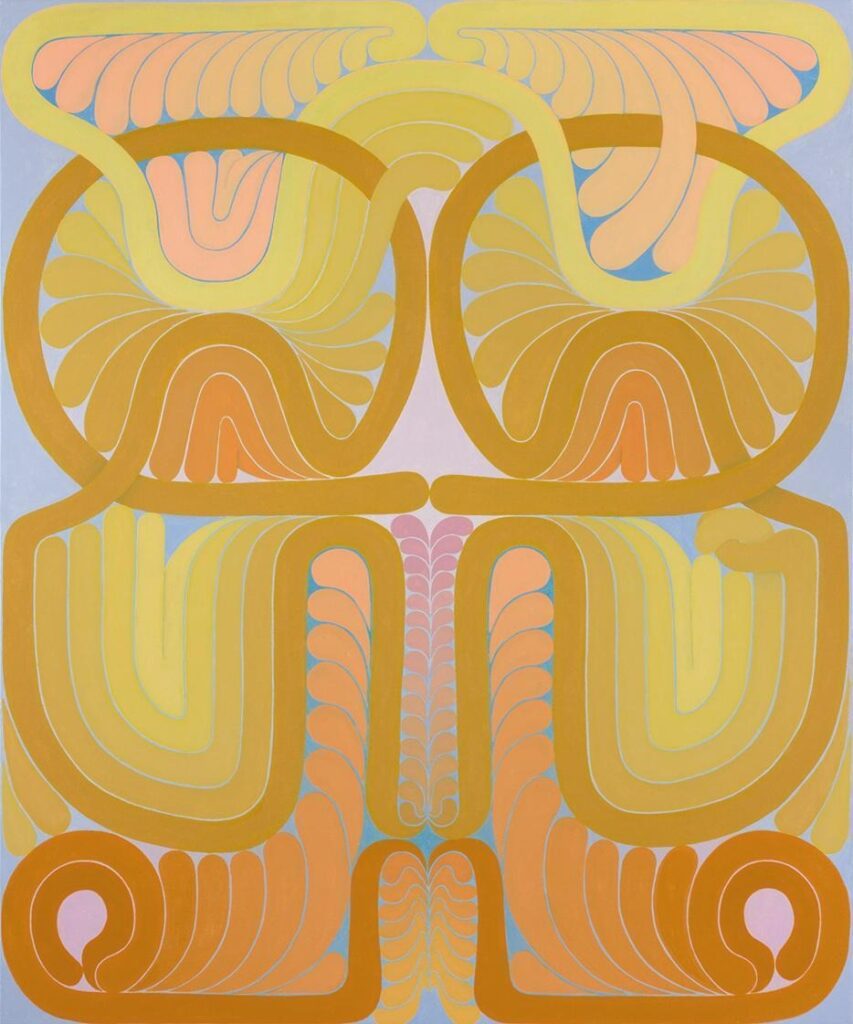
Meg Lipke: Jenny, some (but not all) of your paintings register as being symmetrical, but the more time one spends looking, discrepancies and interruptions to the symmetry reveal themselves. This compounding of expectations feels both poignant and human. How did you develop this aspect of your work?
I think of my paintings as existing somewhere between figuration and abstraction. I began as a figurative painter way back in art school, and over time my work gradually found an abstract language. Certain qualities of the figure have remained: symmetry, curvilinearity, and a search for a living quality. As my process has become increasingly responsive rather than planned, those structures have become less fixed and more improvisational, which has led to the teasing of expectations. Initially, these decisions, either in color or form, can feel unresolved or uncomfortable, but that’s usually when I know I am on a good track!
Meg Lipke: Deborah, I’ve known your work the longest -almost 30 years! I have often experienced, while looking at your paintings, a simultaneous and contrary feeling of orchestrated delirium and stillness that feels almost narrative, like the arc of a character in a great book or a favorite film or piece of music. How intentional is it to give the viewer these different experiences?
Deborah Zlotsky: What you call my paintings’ “delirium and stillness” may be what I understand as the pull between things that don’t obviously belong together: flat shapes yoked by trompe l’oeil strings, flaps, and bolts; unlit areas alongside glowing light, shadow, and form; crisp edges near soft, blurred ones; all beneath a haze of surface abrasions and drips. Combining dissonant elements feels irresistible to me. I adjust and adjust until the ratio of friction and consonance feels poignant, beautiful, or humorous to me and, I hope, the viewer.
Meg Lipke: Audrey, a question for you: lately you’ve begun some exciting new diptychs in which the collector or curator can exercise authorship and move the paintings in relationship to each other. This can create some unexpected compositions and new meanings. How did this development take place?
Audrey Stone: In 2023, I began working with “quadruplets” (4-panel paintings), and the recent diptychs came out of that process: I map out compositions that tell me the painting will work, but when I finish painting, I rearrange the panels in as many ways as I can. Each configuration alters the color scheme and composition. The process can radically change my perception of the painting; sometimes I much prefer a new arrangement to the original idea. Knowing a painting may end up in a different configuration than I originally intended becomes a collaboration with chance and challenges my desire for control in a world where I feel so little control.
Make your tax-deductible donation today and help Art Spiel continue to thrive. DONATE
About the writer: Meg Lipke is an artist known for her sculptural sewn canvases as well as her paintings with one rounded corner. She shows at Broadway Gallery in NYC and lives and works between upstate New York and the Berkshires. @meglipke
Jenny Kemp received her BS in Art from the University of Wisconsin–Madison and her MFA in Painting from the University at Albany. She is represented by Duane Thomas Gallery in New York City. Her work has been exhibited nationally and internationally and is held in the collections of the Tang Teaching Museum, the University Art Museum at the University at Albany, Union College, and Fidelity Investments. Highlighted publications include 100 Painters of Tomorrow, New American Paintings, and Chronogram. She is a 2015 NYFA Painting Fellow, teaches at Rensselaer Polytechnic Institute, and serves on the board of directors of Collar Works in Troy, New York. @jenister
Audrey Stone received a BFA from Pratt Institute and MFA from Hunter College. She received an Artist in the Marketplace fellowship from the Bronx Museum of the Arts, and has been a resident at the Surf Point Foundation in York, Maine. In 2023, Stone was elected a member of American Abstract Artists, the historic artist-run organization. She is represented by Morgan Lehman Gallery, New York, NY; Kenise Barnes Fine Art, Kent, CT; Winston Wächter, Seattle, WA; Japhet Bates Collective, Houston, TX; and Roy Gallery in Seoul, South Korea. She lives and works in Brooklyn, NY, and the Hudson Valley. @audrey_stone_studio
Deborah Zlotsky received a 2019 Guggenheim Fellowship and NYFA Artist Fellowships in Painting in 2012 and 2018. Her work is in a variety of public, private, and corporate collections in the US and abroad, and she has been awarded residencies at MacDowell, Yaddo, the Bogliasco Foundation, and the Bemis Center, among others. Zlotsky is represented by McKenzie Fine Art and Markel Fine Art, both in New York City, Robischon Gallery in Denver, Sandler-Hudson Gallery in Atlanta, and Bernay Fine Art in Great Barrington, MA. She teaches at the Rhode Island School of Design and lives in the Hudson Valley. @deborah_zlotsky
Bernay Fine Art is a contemporary art gallery located at 296 Main Street, Great Barrington, MA. Polychrome is up until August 12th. Learn more at www.bernayfineart.com @bernayfineartgallery