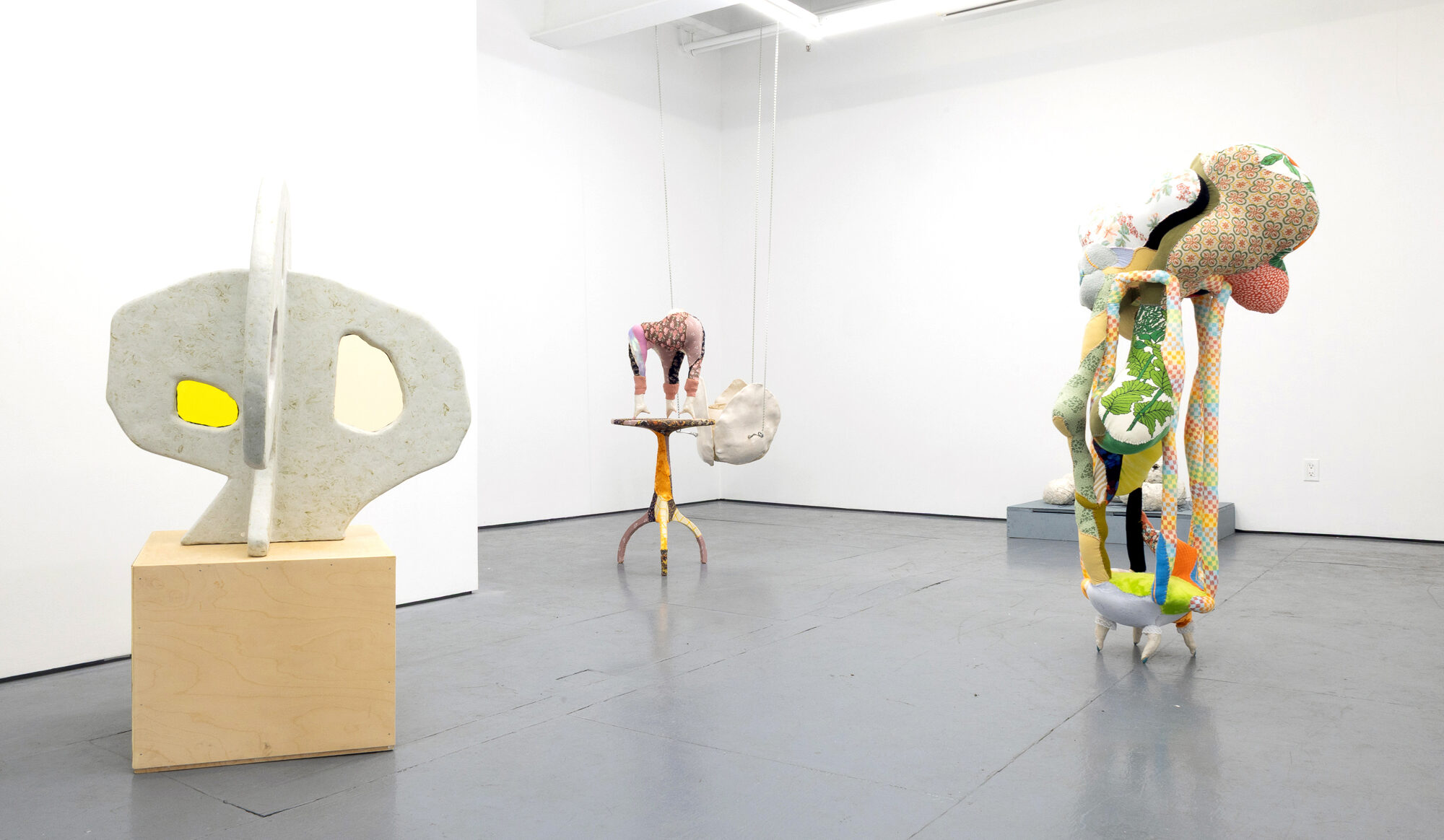
Entering the bright gallery space, shared with Tiger Strikes Asteroid on the other side of the wall, you are welcomed by brightness and playfulness. Like walking into a kindergarten classroom, a playroom, or a yoga studio, the sculptural inhabitants are cordial yet also preoccupied with themselves. It is no coincidence that the curator and three of the artists are mothers who spend time with children.
When I asked curator Genevieve Lowe about the motive behind the exhibition, she said that for years she had been thinking about the human compulsion to see ourselves and our bodies in inanimate things or spaces. Lowe recognized, and I agree, that this is often the driving force in art-making. She added that, especially in the past five years, raising young children who are more prone to see the human imprint in all things and leaning into the magic feelings that come from that, she noticed real whimsy and profundity in these involuntary observations. This influenced the work she chose for the exhibition.
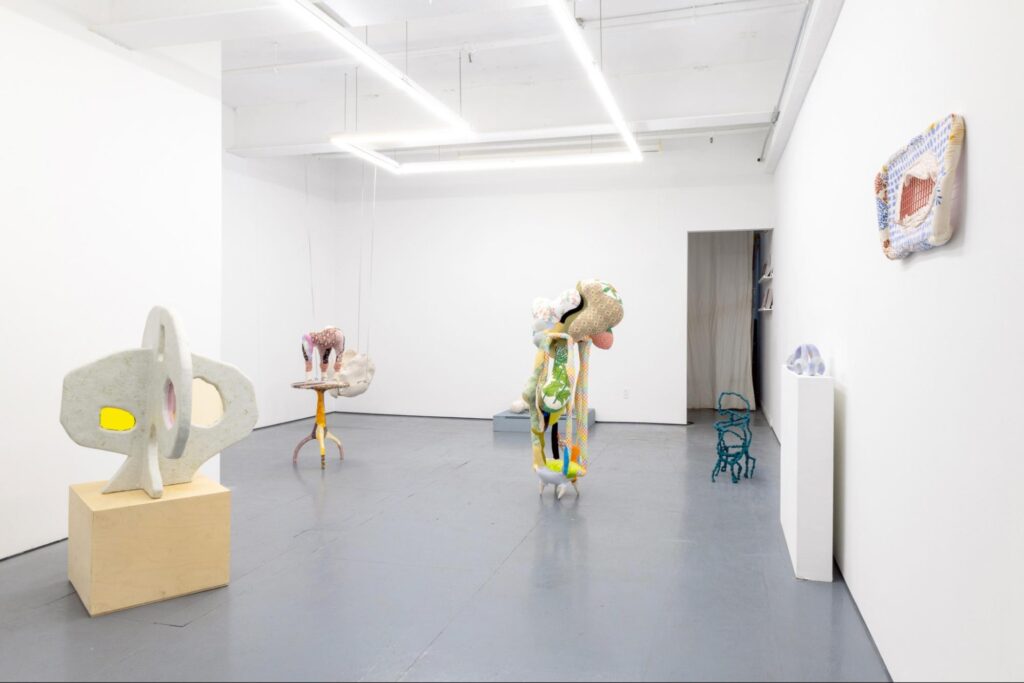
Lowe was researching Jane Bennett’s idea of Vibrant Matter, which speaks of a vital materiality in all things alive or inanimate; everything is alive in some way. Bennett recognizes the energy and power inherent in all things around and within us. She further develops the Deleuzian concept of assemblage, which claims that agency is spread over a group of circumstances and relationships. Bennett also suggests that agency isn’t only human and that we should develop a more responsible ecological political system that determines the web of forces affecting situations and events. Looking up assemblage, I found it close to my definition of a group exhibition: a dynamic, provisional arrangement of heterogeneous, autonomous elements. It defines wholes by their external relations, meaning components can plug in, detach, and re-emerge elsewhere without losing their innate properties. These ideas hold this group of artworks together, connecting material manifestations of different personalities that combine humor, physical experiences, and material exploration.
Zigzagging through the room, a group of sculptures gently nod to you and each other, acknowledging they are not alone but also self-absorbed and protective of their allocated spaces. Each has her own quirks and fashion taste. Some are warped, some wrapped, some stare at you directly, and some are closed off, challenging you to come close and peek in. Some are shy, some outgoing, and they all find harmony in the sunlit, cozy space. Soft colors and edges run through the works: pinks, yellows, teals, and cream, with rounded edges of clay and epoxy. The only straight lines are in the pedestals. The use of furniture in Hanna Washburn’s patched, covered forms also adds to the sense of interior domestic space.
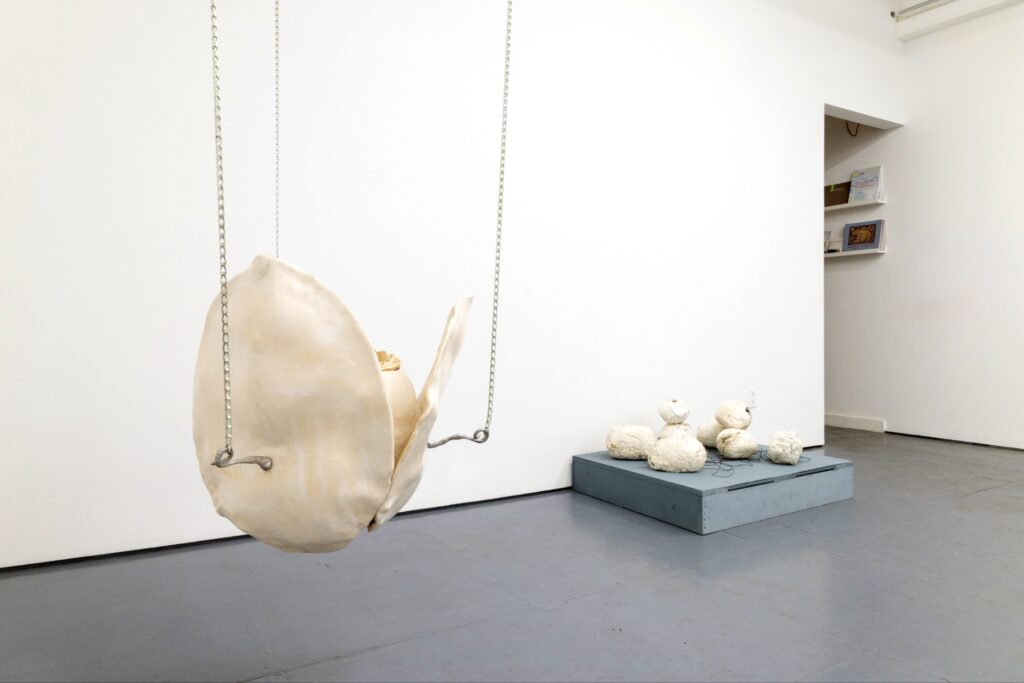
The human body allegory is present in Alison Kudlow’s two pieces. In her statement, she writes that the work is based on her physical experience of transformation through illness, pregnancy, and lactation. The forms she uses are part human, part plant. When encountering them, they seem familiar yet intimidating. While completely still, they create a dramatic, cinematic experience. In Ēostee (Risen), a rose-like flower is suspended in air on a metal chain gripped by custom-made metal hooks. It seems harmless until you look inside the fleshy petals and see little red droplets on its rim and shards of glass inside the core petals. Like Audrey II in Little Shop of Horrors, Frank Oz’s cult film from 1986, it grips your gaze with alarm. The same eerie feeling rises when you look at the wall piece, Rupture, shaped like a seed pod sewn shut and leaking a clear discharge, made of glass. Each material is expertly used to convey weight, fragility, and resilience.
Nearby on a low pedestal, Se Young Yim’s piece Pebble stages eight scattered balloon-like objects. Made of Hanji, traditional Korean paper, plaster, and silicone, they are flexible and soft but keep their shape, hiding a moving element rolling inside like an embryo. The texture imitates materials seen in miniature in the animal world: cocoons, spiderwebs, or bird nests. Their arrangement seems random, as if fallen from above; some on top of others, leaning or gently touching, and some close to another. A thin electrical cable runs through them with a motor that activates the rounded element inside, stretching them when in contact with skin. The motor creates a whirring sound, a white noise like the sound of bodies recorded from inside. The contrast between soft natural shapes and mechanical sound creates tension, like an aching or yearning. But the pebbles are left to their bearings.
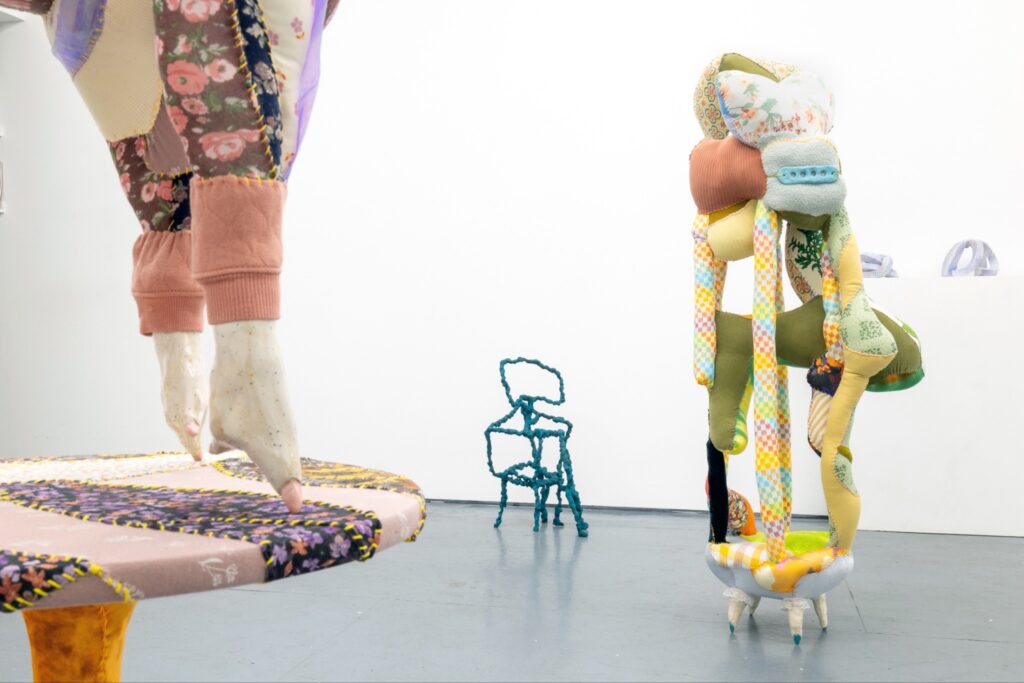
Hanna Washburn’s How do you carry yourself? stands on its tippy toes, four clay fingers with painted nails. Stuffed with batting and objects, the stitched found fabrics of contrasting colors and patterns create a tall, endearing creature. A fellow creature, Pitter-Patter, stands on three two-fingered arms balanced on a side table, all wrapped in multicolored fabric. On the wall, a dangling, bulging branch-like shape hangs on a hook shaped like a folded finger, both holding it firm yet coaxing you to come closer. The careful equilibrium of each structure creates another layer of material tension, alongside the stuffing that stretches the fabric almost to bursting. They seem to perform together on a theatrical set.
Another dynamic creature stands near the desk, wiggly and painted deep blue green. Lagoon, by Susan Meyer, seems to crawl on its thin legs toward the center of the room. Behind it on a shelf, three variations of a bent linear form, painted lavender purple, dance together or stretch like shrunk minimalist sculptures from the school of Di Suvero or Joel Shapiro. They work with the same abstract ideas that shaped modernism but use a color palette that softens the forms and a smaller size that makes them friendly. In “Noze”, perhaps the most straightforward reference to a human part, an abstracted portrait is made of two simple flat shapes that remind you of a Picasso but with a nicer, updated color scheme and a humorous thread that runs through all of Meyer’s pieces in the exhibition.
The exhibition suggests a human-nonhuman work group. Imagine yourself in each of the fantasy worlds these characters inhabit. Their lifelike presence acts as a portal to a world where you are a stone, a leaf, a petal, a fruit, or a table with a limp.
Transmitter, Do I Know You From Somewhere?, 1329 Willoughby Ave. 2A, Brooklyn, NY 11237. Exhibition is up until August 16th, 2026. Open weekends 1–6 pm and by appointment, [email protected]
Make your tax-deductible donation today and help Art Spiel continue to thrive. DONATE
About the writer: Noa Charuvi is a visual artist living and working in Brooklyn, NY. She holds an M.F.A in Fine Arts from the School of Visual Arts in New York and a B.F.A in Fine Arts from the Bezalel Academy in Jerusalem, Israel. Her work was exhibited internationally in venues such as The Bronx Museum of the Arts, Haifa Museum of Art (Haifa, Israel), and Mishkan Museum (Ein Harod, Israel). Charuvi was a recipient of the Pollock Krasner Foundation Grant in 2018. Her work is included in ” Landscape Painting Now,” an anthology of contemporary landscape painting published in 2019. @noa_charuvi