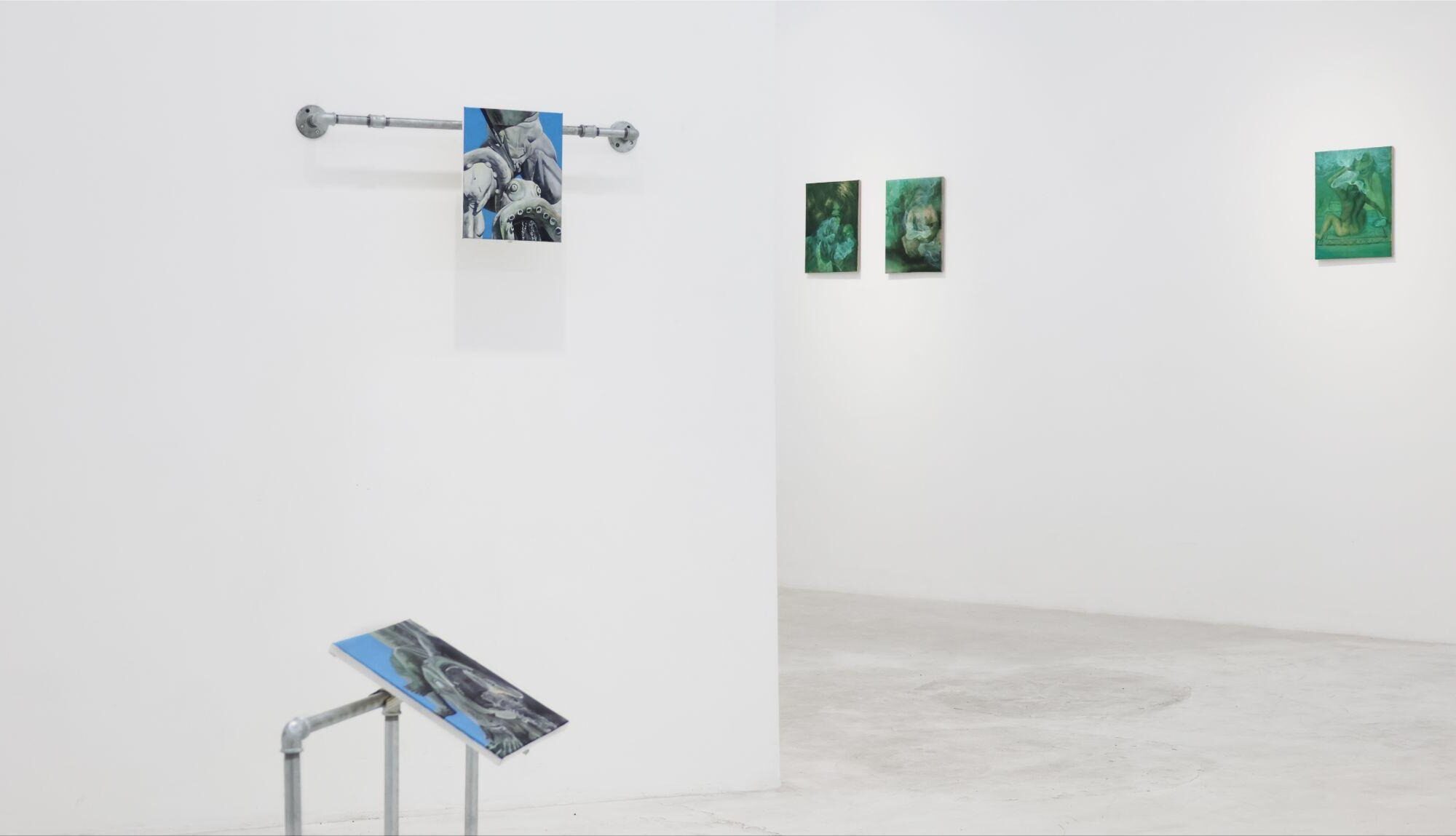
Presented at the AAIE Center for Contemporary Art in Rome, He Spoke to the Birds brings together works by Jeremias Rumpl, Diego Azzola, and Huang Zhe in an exhibition curated by Fanfan Yuxuan Fan. Taking its title from Carolyn Christov-Bakargiev’s reflection on Saint Francis of Assisi and Arte Povera, the exhibition asks what it might mean to listen not only to human voices, but also to birds, ruins, pipes, smoke, and matter itself.
Rather than treating Arte Povera as a historical style, the exhibition approaches it as an ongoing way of thinking about materials, energy, and nonhuman presence. In this conversation, the curator, artists, and AAIE’s director discuss material agency, Rome’s layered history, and the forms of attention that matter may ask from us.
Kun Sok: The title He Spoke to the Birds suggests a form of communication beyond ordinary human language. In this exhibition, what does it mean to “listen” to materials, images, and nonhuman presences?
Fanfan Yuxuan Fan: Listening is not about any specific language, but about recognizing that humans and nonhumans exist on the same plane. To listen is to slow down and be patient enough to let something other than yourself generate meaning. It begins with the belief that all forms of existence are equally significant. As Carolyn Christov-Bakargiev shared, Arte Povera offers a vision of vital and energetic things, placing natural and cultural forms on the same level through which energy flows.
The title He Spoke to the Birds took me a long time to arrive at. I think it captures this worldview: a conversation grounded not in human language, but in attention, coexistence, and reciprocity. It also speaks to a way of making rooted in the elemental qualities of material, a respect for nature, and a celebration of labor in its simplest and most honest form.
Kun Sok: Arte Povera is often associated with humble or ordinary materials. How did you want to rethink Arte Povera through the practices of these three artists?
Fanfan Yuxuan Fan: When I conceived this exhibition, I wanted to return to the spirit of Arte Povera—an avant-garde movement that emerged in late 1960s Italy, radical and experimental, committed to stripping art back to its essentials. I was also deeply impressed by the Arte Povera retrospective at the Pinault Collection in Paris in 2025, which reminded me how the movement rejected the commercialization and elitism of the art world, turning instead to materials considered humble or discarded, yet treating them as carriers of revolutionary potential.
What struck me was how this impulse influenced Japan’s Mono-ha movement and China’s ’85 New Wave. Italy in the late 1960s was marked by political and economic turmoil, while Japan was undergoing rapid industrial growth, yet both contexts shared a rising assertion of cultural identity and a desire to move beyond American dominance.
Today, we may not need that radicalism. Rather than reviving Arte Povera as history, I wanted to engage with its openness toward the material itself. The three artists work with very different textures, yet each searches for their own artistic language through contact with matter. For me, that experimental attitude—the willingness to let material think, respond, and generate meaning—may remain Arte Povera’s most enduring legacy.
Kun Sok: The exhibition brings together zinc, galvanized pipes, and smoke—materials that differ greatly in weight, visibility, and permanence. How did you think about the relationship between heavy materials that endure, structures that circulate, and traces that disappear?
Fanfan Yuxuan Fan: I didn’t set out to engineer a contrast between heavy, enduring materials and traces that disappear. What drew me to these three artists was that each had already developed a material language of their own. What I responded to was their shared conviction that material can carry meaning on its own terms. The contrast between what endures, what circulates, and what disappears emerges naturally from bringing these practices into the same room, each material holding, moving, or withdrawing.
Kun Sok: In the installation views, some works physically enter the gallery space, while others create a more atmospheric or psychological field. How did you consider the exhibition as a space where different forms of time and material presence coexist?
Fanfan Yuxuan Fan: What I find compelling about AAIE Center for Contemporary Art is that its space resists the conventional rectangular “white cube” logic. The gallery unfolds through triangular corners, diagonal lines, and fluid circulation, echoing the spatial logic of Roman architecture, which is less about containment than about movement and discovery.
This spatial openness allows multiple forms of presence to coexist. Each corner accommodates the three artists’ practices without forcing them into a single, linear reading. The space already enacts what the exhibition is trying to say: that materials carry their own time and pace of becoming. I think of the exhibition as a spatial-temporal arrangement where material, light, and movement continuously reshape how time is experienced.
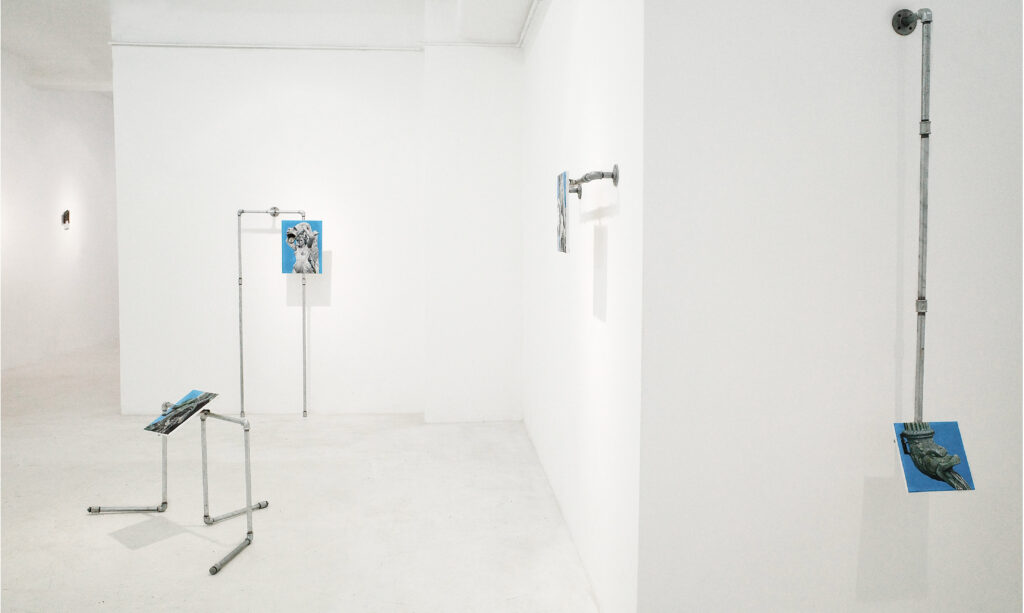
Kun Sok: Your zinc works begin with drawings from your small books, but through etching, welding, and corrosion, the metal also begins to transform the image. At what point does the material stop being a surface and become a collaborator in the work?
Jeremias Rumpl: The drawings form the basis of my zinc works, though not always; it depends on the piece. The works in this exhibition all originate from two small books that I’ve been drawing in over the past few years. I wouldn’t call them sketchbooks; they are finished drawings. Using them in the zinc works allows me to bring them out of the books without dismantling them. I think of the material as a collaborator from the very beginning. It’s always a back-and-forth between what I intend and what the material does in return. I try to stay open to how it behaves and to what emerges. I experiment a lot, deliberately leaving parts of the process outside my control. I do not fully understand everything that occurs during the process, but that is also part of its beauty.
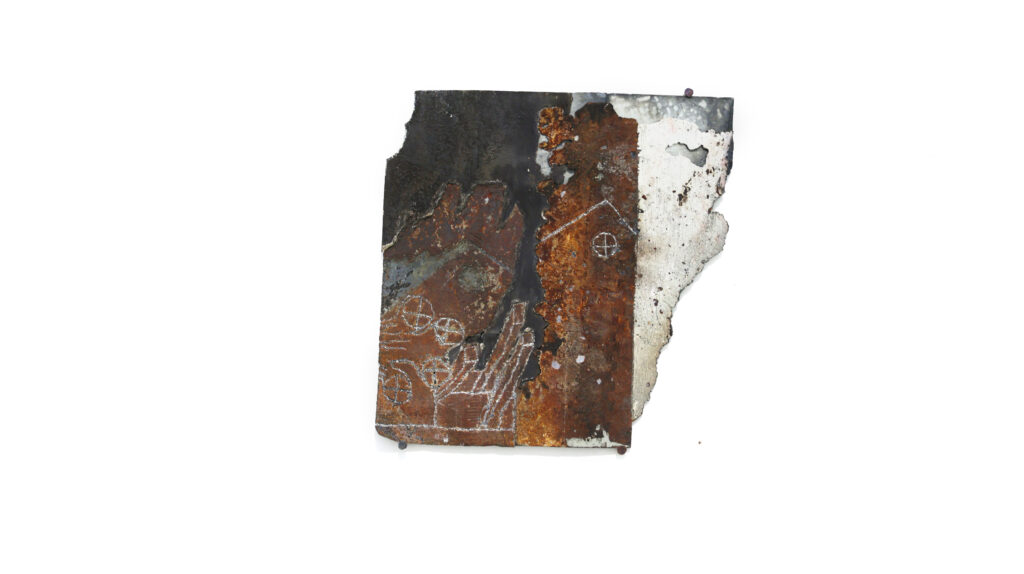
Kun Sok: Ruins and decay appear in your work both as subjects and as material processes. Are you interested in decay as an ending, or as a way for time, history, and memory to remain active within the object?
Jeremias Rumpl: The latter. It gives me the possibility to deal with something that is beyond ourselves or the finished artwork. I’m interested in moving away from the idea of static, infallible objects that get passed on from generation to generation, as if sealed off from the world. I don’t want the artwork to become a hermetically sealed thing that once again shows off our dominion over nature and our peers. Instead, I want to subject it to these processes and make them visible, to give an idea of what “time,” “history,” or “memory” might mean in relation to us and our surroundings, and to dwell on that.
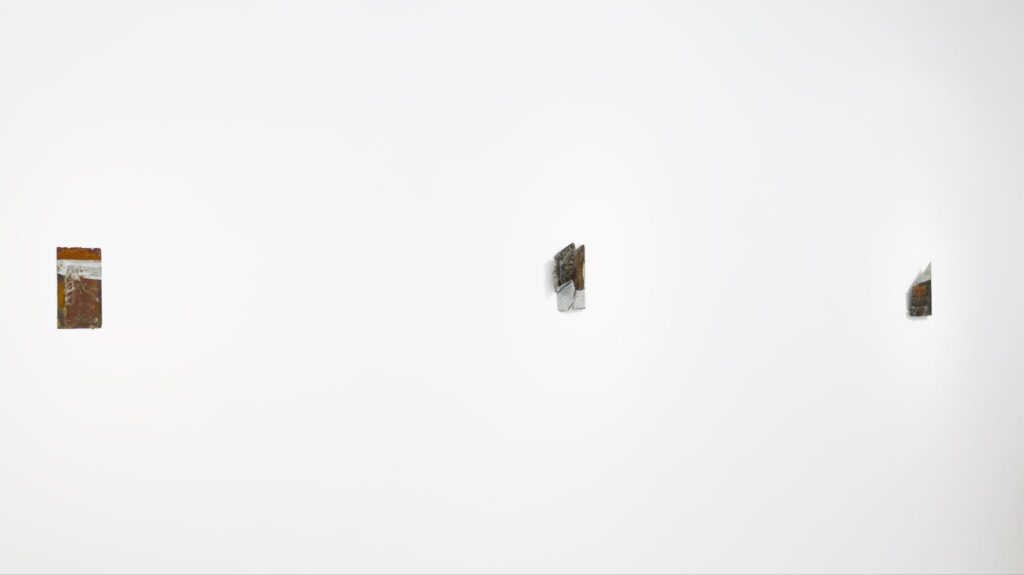
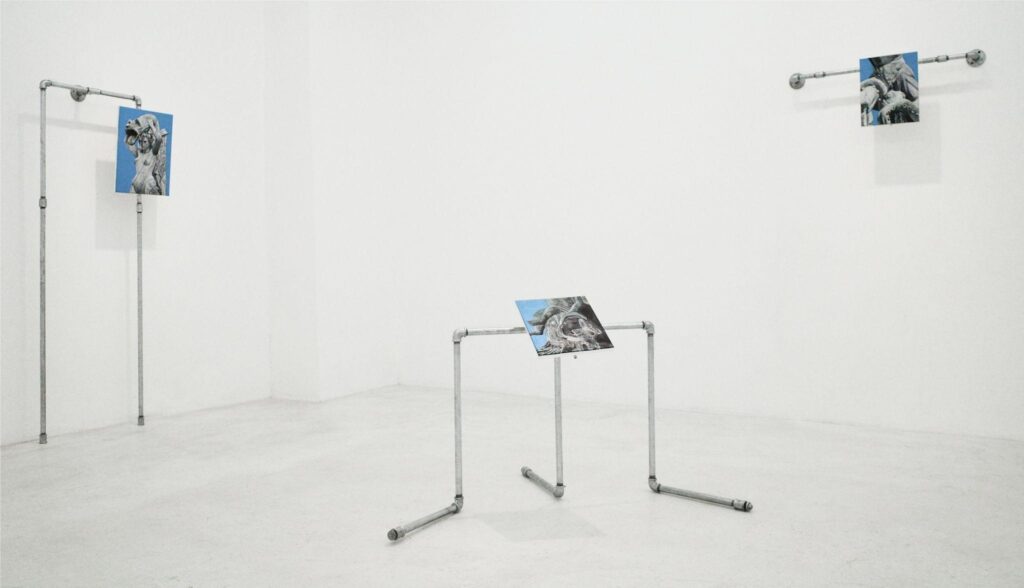
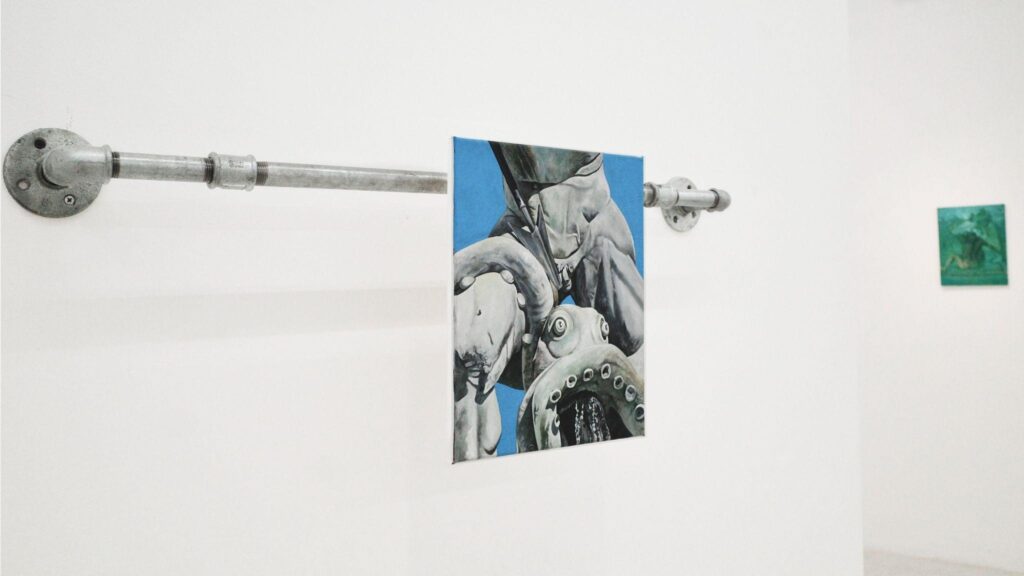
Kun Sok: Your pipes do not simply support the paintings; they extend into the gallery like fragments of infrastructure, almost guiding how the viewer moves and looks. How do you think about the pipe as both a physical structure and a living or circulating system?
Diego Azzola: The pipes function as a kind of scaffolding, a skeletal structure, or even a limb. They seem to emerge from the painting or disappear into it, becoming an integral part of the work itself. Usually hidden from view, pipes symbolize the human-made infrastructure that contains and channels water, a fundamental symbol of nature. In this sense, water becomes a kind of lifeblood or sap that animates the work, while the pipes reveal the often invisible systems that sustain and direct its flow.
Kun Sok: Your work brings together industrial materials, aquatic imagery, and hybrid forms of life. Rather than separating nature from the artificial, are you interested in showing how they are already entangled?
Diego Azzola: Yes, I’m interested in the points of contact between these elements—the liminal zones between one state of matter and another, one definition and the next. I’m fascinated by spaces where the “undefined” becomes possible, where categories lose their rigidity and boundaries are no longer fixed. I don’t see nature and the artificial as opposites, but as entities that are already deeply entangled. What interests me is what emerges in these in-between spaces: between the organic and the industrial, between species, between the living and the non-living. These are territories of transformation and contamination, where identities are not fixed but constantly evolving. Ambiguity is where I find new possibilities for imagination and existence.
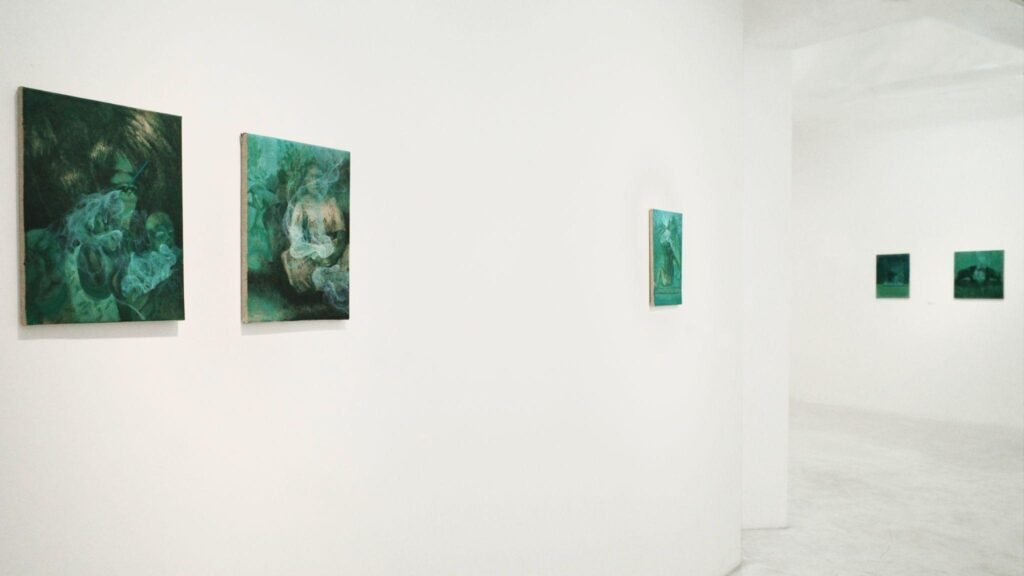
Kun Sok: Smoke in your paintings comes from personal memories of incense and Buddhist family life, but it also becomes something unstable and almost impossible to hold. How do you paint something that exists between presence and disappearance?
Huang Zhe: For me, the “uncertainty” of smoke is exactly what draws me in. I deliberately avoid rendering smoke too realistically or with defined contours. I’m more interested in how it affects space, color, and the way we look. Smoke obscures and connects different spatial layers; it blurs the distance between near and far, allowing time to pause and flow. What the viewer encounters is a state that can never be fully confirmed.
Kun Sok: What interested AAIE in collaborating with Fanfan Yuxuan Fan on He Spoke to the Birds, especially in relation to supporting younger curatorial voices and international artists in Rome?
Yaning Zhu: This collaboration felt very natural. AAIE was never meant to be only a fixed exhibition space in Rome. We have a 200-square-meter space here, and that physical base matters to us, but from the beginning, I have thought of AAIE in a more satellite, nomadic way—something meant to grow through movement, dialogue, and collaboration across cultural contexts.
Working with Fanfan Yuxuan Fan (@ FanFlus) felt organic, almost inevitable. What interested me was the moment itself: Fan’s curatorial approach, rooted in a nomadic ethos, brings together multicultural experience and opens a conversation that could happen in Rome without being limited by it. AAIE comes out of a cross-cultural background, and this way of working is not separate from who we are. Especially now, when exchange across cultures can no longer be taken for granted, I feel even more strongly that this is part of our role.
Kun Sok: Rome is a city where ancient materials, ruins, water systems, and contemporary life constantly overlap. How did AAIE’s space and local context shape the way this exhibition could be experienced?
Yaning Zhu: Rome is a city where history is never abstract; it remains present in stone, ruins, water systems, and in the texture of daily life. Materials such as zinc, pipes, and smoke could be experienced with a particular immediacy here. In Rome, these works do not feel isolated from their surroundings but enter into a conversation with the city itself, with its layered sense of time, erosion, memory, and survival. Our space allowed that conversation to unfold, so the exhibition could be experienced physically and emotionally.
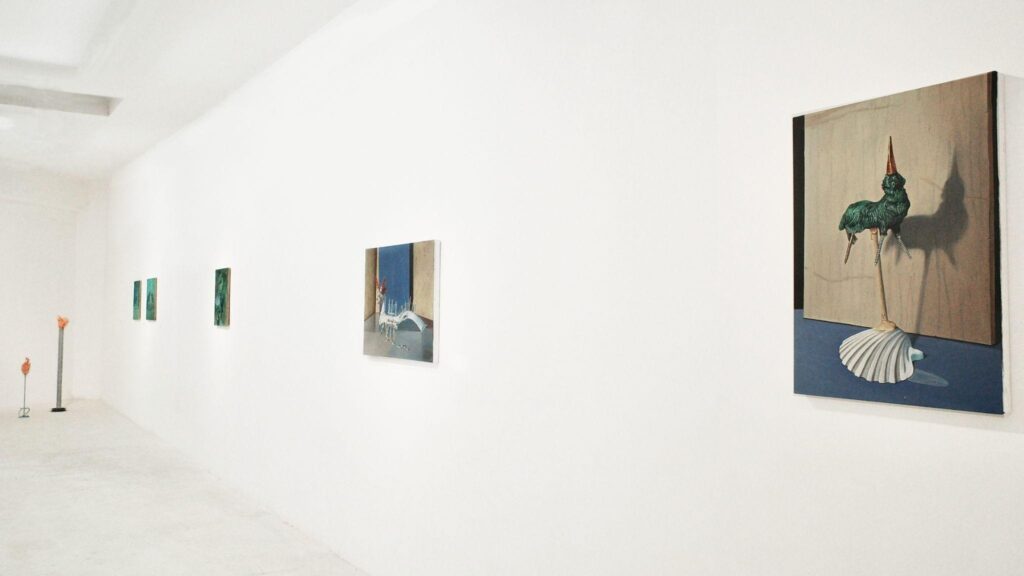
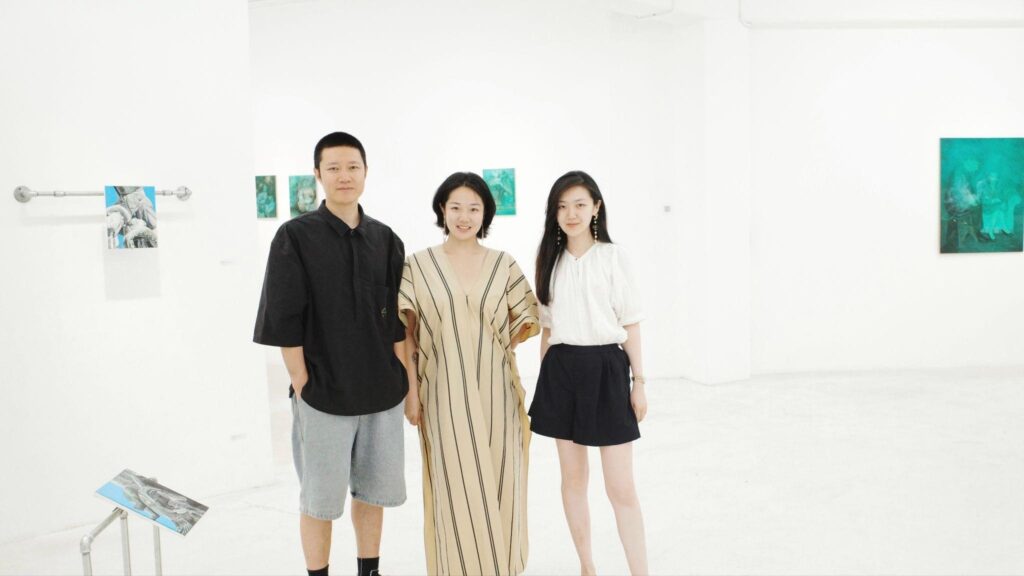
He Spoke To The Birds, AAIE Center for Contemporary Art (Via Sermide, 7, 00182 Roma RM, Italy)
June 17 – July 28, 2026.
Featured artists:
Jeremias Rumpl @jeremias_rumpl
Diego Azzola @d.ego_studio
Huang Zhe @zhehuangart
Curator Fanfan Yuxuan Fan @fanflus
Make your tax-deductible donation today and help Art Spiel continue to thrive. DONATE
About the writer: Kun Sok is a Korean-born artist and writer based in New York. Before studying art, she received an MA in African Studies from SOAS, University of London. She later received her BFA and MFA in Fine Arts from the School of Visual Arts. Her writing focuses on contemporary art, materiality, memory, collaboration, and diasporic experience. Her reviews and essays have appeared in Whitehot Magazine, Two Coats of Paint, and Tussle Magazine.
About the curator: Fanfan Yuxuan Fan is a curator and writer based in New York City. She has worked for Asia NOW Paris Art Fair in Paris, Eli Klein Gallery, and Marc Straus Gallery in New York. She has curated exhibitions including He Spoke To The Birds (AAIE, Rome), To Elongate, To Entwine (China American Arts Council | Gallery 456, New York), Soft Instructions (Art Cake, Brooklyn), and Threshold in Relations (Nguyen Wahed, New York).