
Walking through MoMA PS1 for the first time in several years, I realized how much it has changed and how much I still remembered from my first visit, before officially becoming a New Yorker. The meandering, bustling energy of the building remained, each turn and new corridor offering discoveries. It was special to witness how eclectic and unique each artist’s vision and process was and how many identities and stories are gathered under one roof. Organized for the first time by MoMA PS1’s full curatorial team, the exhibition emphasizes the forces that shape daily life in the city today. This includes strategies of resistance and adaptation in the face of increased surveillance, shifting identities, economic uncertainties, how we view ourselves and others, and the ever-changing technologies around us. This exhibition notes both optimism and anxiety throughout all of the artists’ attention to the layered, eclectic lived textures of New York City and the people intertwined within it.
This exhibition offers numerous installations within the meandering galleries and rooms, allowing for many interesting interactions and conversations between the works. This is an energetic show, full of resilience, determination, and identity. I did not follow a map, nor any specific order. I just went with the flow, and like life in the city every day, I was greeted with many surprises within each room and around every corner. Some of the works interacted with other pieces in ways that changed my perspectives on their placements, the curation, and the conversations that the works were having with each other. Each artist within the show tackles the here and now; the reality we are in today. One where edges blur, moments change, and things distort. We get to see the process, vision, ideas, and journey- and glimpse behind the curtain of some of the themes behind these works, to provoke conversations, make us question, and encounter yet another way of exploring new ideas.
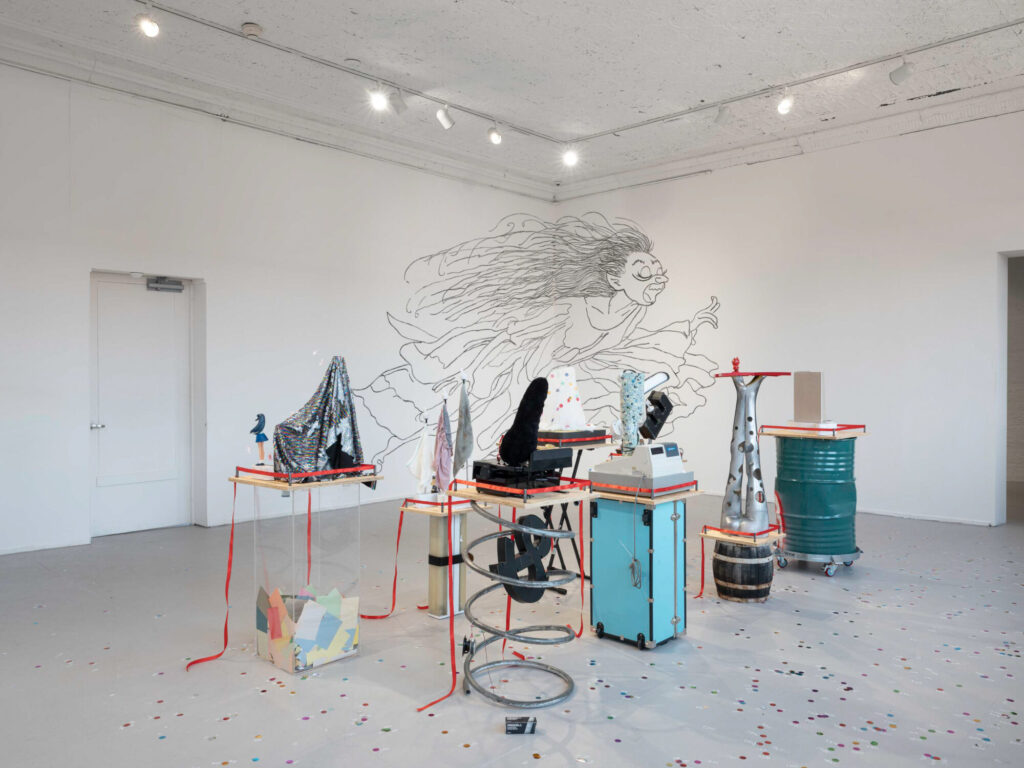
The artists in this exhibition are transforming the world around them; fantasy and imagination become important foundations to search for a sense of self, a sense of place, a sense of existence, and to navigate the systems of life. Tackling many themes that activate the space, especially the biggest overall theme: the city, this exhibition brings a frenetic, steady energy, expressing the numerous stories that build and grow within Greater New York. Joining alongside the endless flow of the city itself, where everyone and everything keeps moving forward, the exhibition becomes a sort of built space on its own. It is filled with pieces inspired by city architecture and photos or recordings that make us viewers question our place within all of the works. They provoke an awareness of the self, of being viewed, and what it means to be viewed.
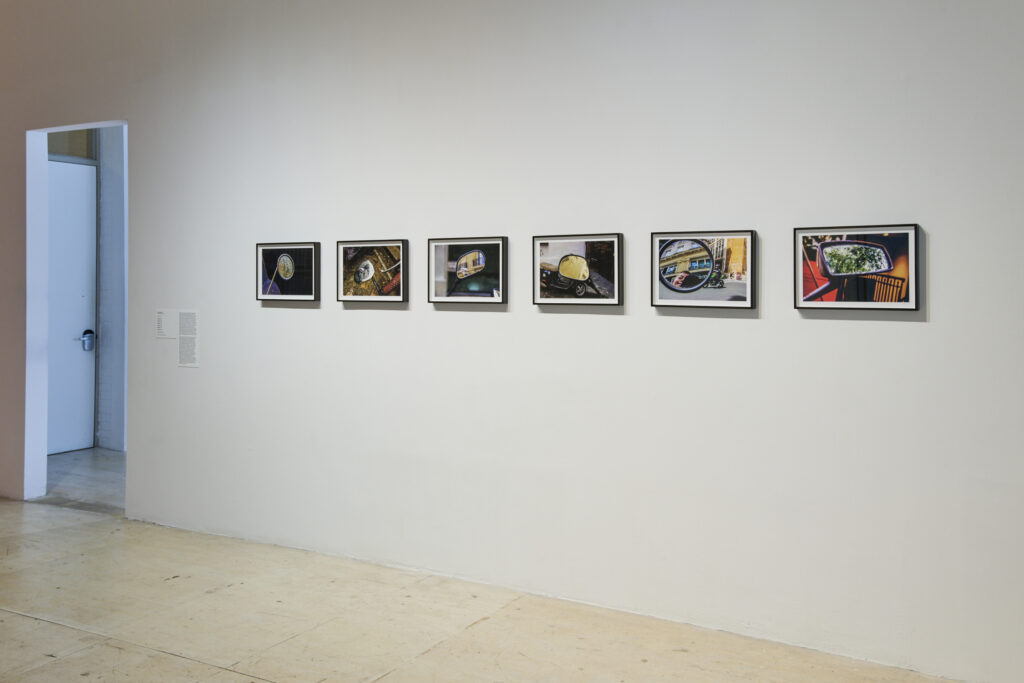
Along with a sense of New York, a deep sense of self and identity weaves within many of the works, as well as a focus on viewing people, or allowing reflections and cameras to show views of other people as well. Rachel Handlin’s Scooter photographs focus on viewing through reflection, using mirrors as she traversed France. Handlin takes us on a journey through the many reflections she had seen, showing hints of both herself and her surroundings. It offers a unique view of someone or a new place that you may not be familiar with or well-versed in just yet. Handlin directs our focus directly towards certain details, like a sliver of road or a slice of a building, nothing ever completely in view. By pulling us in, viewers become both the spectator and spectated, as we look through the mirror Handlin looks back at us as well. Whereas Taina Cruz tackles identity through a means of world-building. Using a combination of material from their collected digital archive, Cruz’s paintings weave fantasy, history, and myth together to build a world where Cruz has us question just how identity is built, especially within a media-saturated world. Particularly in the painting titled Uptown Twilight Sauté, the character steps into a glowing alley, the city lights beckoning in the distance, as Cruz begins to reveal the character to us by means of the warm street lamp as they look to step into the fabric of the city itself. Here, Cruz allows us to step into the narrative, one we may or may not know, but we approach it nonetheless.
Fulfilling a sense of place, several artists in the exhibition capture moments, objects, or people; often chronicling the everyday moments of life, or even simple interactions with objects and travels. Each drawing, film still, slideshow, or photograph offers a suspended moment in time. Each piece offers its own view of the city or of everyday life in some way, shape, or form. Travelouge drawings from Sophie Friedman-Pappas offer intricate drawings of objects or buildings, as if piecing together a narrative of an ongoing journey. The artist’s hand gives us a lively recording of what the artist was seeing, exploring, or remembering these places. Whereas Marie Angeletti’s slideshow, Men at Work, also depicts the constant movement within the urban setting, a constant building and creating that pulses through the exhibition as a whole. While fields harrington’s photographic stills of bicycles in various locations around the city depict a glimpse of the city’s after-hours. A nightscape captured in time, where another moment of the everyday starts to become abstracted as the lights and the glints reflecting off the bikes start to blend into one another. The image of an electric blue bike in the piece titled 3rd Ave and St Marks Pl, New York, NY (indefatigable), emerges from the stark nightscape in the background and a soothing grey of the asphalt and sidewalk- perhaps moments often missed, but now captured at a standstill. For a city that is constantly in flux, these artists have built a sense of the place around them. Similar to the constant fluctuations of the tumultuous times we may find ourselves within today, taking time to still observe the everyday, a place we root ourselves in, slows everything down to an entirely different, but intricate experience.
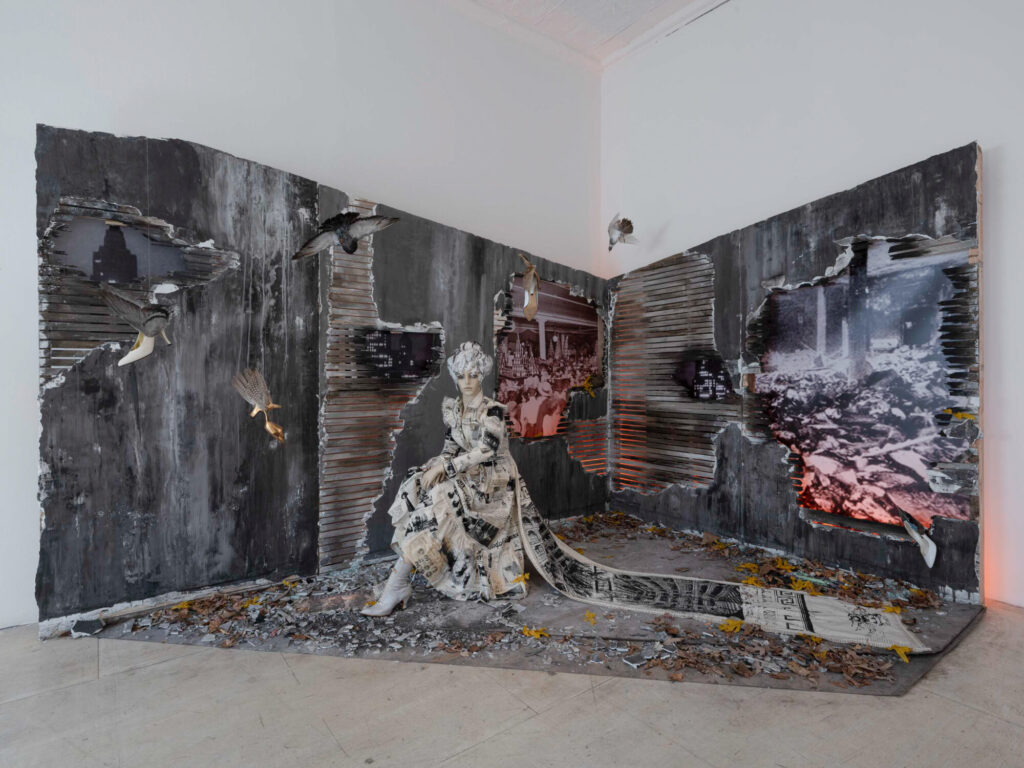
Some of the other artists’ works depict the systems that drive our everyday lives, structures that the city is built upon, and the history woven in between, considering questions of how we navigate these systems. Sofia Sinibaldi’s work is wonderfully layered and illustrates a sort of foundation within those systems, as if building up the city itself through texture, material, and image; she reveals the inner workings and surfaces that are often buried or left below. Another captivating installation that grabbed my attention for quite some time, across from Rachel Handlin’s photos, is the Women’s History Museum installation titled Chez les heureux du monde. This installation included many different pieces of New York’s fashion history and the efforts, trials, and tribulations that women faced throughout it. The history and minute details were intriguing to discover the closer you got, like the stitching or embroidery on an outfit, articles printed on clothes, or even the charred paper; each detail mattered. The most significant details that pulled me in were those on the Triangle Shirtwaist Fire, presenting a moment in history when the systems of working conditions and safety were deeply questioned. The installation allows viewers to step into a charred room, the Victorian-style figure perched in the midst. A dense air whirls about it as you observe the charred remains and the stilled figure, sitting stoically amongst the debris. The details are deeply considered and important as this tragic moment is brought back into the spotlight, interestingly, across from Handlin’s reflection pieces, adding another layer to what it means to look at something both directly and indirectly by means of a reflection.
Another interesting take on viewing and being viewed confronts us with another system: surveillance. The work focused on surveillance is yet another piece that captures moments from the past, and allows us to experience them again in the present. Surveillance is a prevalent aspect of the city and life within it. Kameron Neal’s piece titled Down the Barrel (of a Lens)(2023) gathered footage of declassified surveillance film showing people being recorded (and the moments they realize it). In his work, he places us within the in-between, between two large screens; no matter where you stand in the room, you become part of various systems of looking: the authority, the watcher, and the lens that is filming. All three carry with them different ways of navigating, especially as the people being filmed now look back at you; the question of who is really being surveilled is now multilayered. While many of these issues vary, the works present inner workings of aspects of living within some of these systems. Working conditions, surveillance, mechanisms, and everything in between are all systems many of the artists in this show present to us. They want the conversations about them to continue and expand, just as much as the city keeps expanding. The intricacies of the everyday are important to notice and be aware of, especially in the context of the times of today.
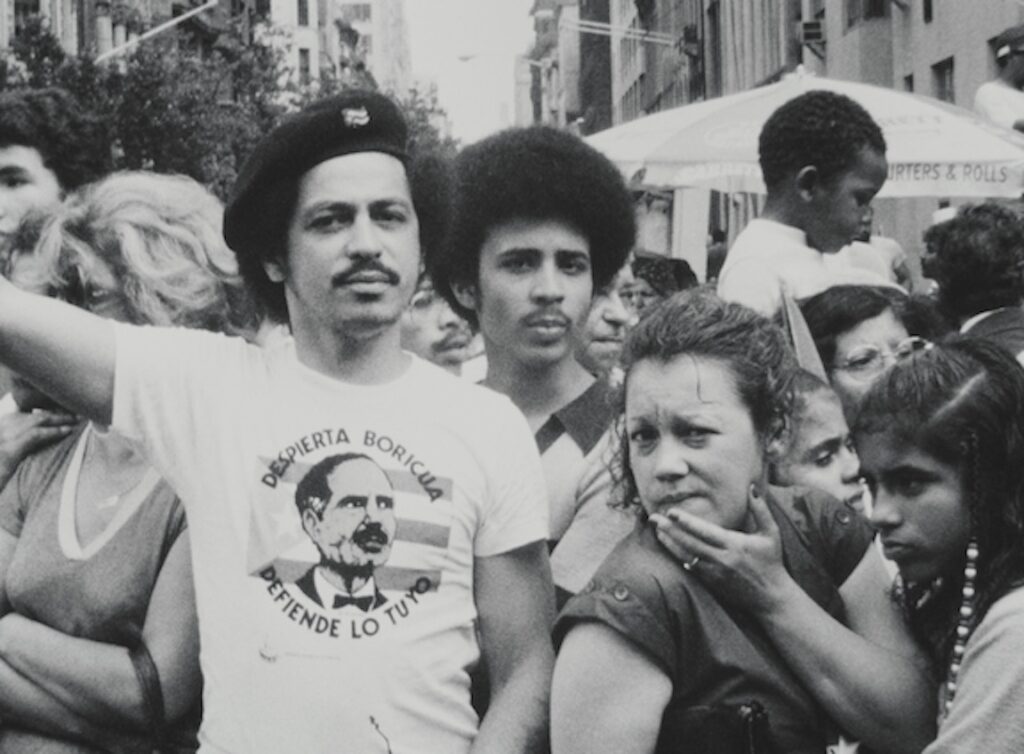
This exhibition is expansive and multilayered. It is energetic, electric, and full of vast narrative and multilayered questioning, allowing viewers to immerse themselves in new spaces and conversations. Despite the tumultuous times surrounding so many people, the artists all tie in the spirit of the city: from its inner workings, its history, and the people within it, the artists come together to build a sense of community that is strongly interwoven and constantly growing and adapting. Works from the artists mentioned above, and also Esteban Jefferson, Dean Majd, Georgica Pettus, and so many others, tackle many complex themes. Pulling from source materials, surroundings, and life stories, the artists build their own place amongst the city and welcome viewers to explore these intricate conversations even more, leaving us to wonder what exactly is our role within this show, as a viewer, and as a member of the city as well.

MoMA PS1 Greater New York 2026,22-25 Jackson Avenue, Queens, NY 11101, on view through Aug 17th, 2026. Open 12–6 p.m., Sat open 10 a.m., closed Tue and Wed.
Make your tax-deductible donation today and help Art Spiel continue to thrive. DONATE
About the Writer: Taylor Bielecki lives in Gowanus, where her studio is, and works at Pratt Institute, where she earned her MFA. She also studied at Penn State, where she earned a BA in English and a BFA in Fine Arts. She finished as a finalist in the Kennedy Center’s VSA National Emerging Young Artist program for 2017, where she earned an award of Excellence. She has shown prints internationally in a print exchange in Australia and exhibitions in Dubai, India, and the Glasgow School of Art. She has also shown paintings internationally in Gallery 24N, PhilaMOCA’s juried exhibitions in Philadelphia, Pa., Perry Lawson Fine Art in Nyack, NY, BWAC in Red Hook, and IW Gallery in Brooklyn. Taylor works for Two Coats of Paint, TUSSLE Magazine, and has joined Art Spiel as a contributing writer. @Taylor.Bielecki