
The Artist in Residence program at The Oyster Point Hotel was launched in 2020 and curated by Ellen Martin, with the support of Kevin Barry, the hotel’s President. Its premise is straightforward: contemporary art belongs not only in galleries but in the spaces where people actually live, rest, and move through their days. Each year, a selected artist’s work inhabits the hotel’s guest rooms, common areas, and the fabric of the place itself, encountered by thousands of visitors during their stay.
This year, that artist is Cynthia Pareja Dubin, a Peruvian-born New Jersey-based visual artist whose work engages color, texture, and layering as primary means of communicating with the viewer. The paintings now on view at the hotel emerge from a recent and deliberate shift in her practice — a period between 2025 and 2026 in which she set aside external expectations to make work closer to her own experience. The hotel sits near the water, a context that sits naturally alongside work shaped in part by coastal memory and the rhythms of natural environments. We spoke with Pareja Dubin about the residency, what drew her to this format, and what it means to show work outside the gallery.
What drove that shift in your practice, and what did it feel like to make work from that place?
This series represents a conscious rejection of the pursuit of flawlessness or peer validation — instead, it is a celebration of what brings me genuine joy and a deep reverence for the creative process. By merging my personal history with these newfound realizations, I have created a visual narrative that honors the intangible self and the everlasting visual possibilities.
Ultimately, I view my practice as an ongoing experiment with intention. I am deeply interested in how different organic environments, multi-dimensional structures, rhythms, layering styles, textures, and alluring hues can communicate emotion. Throughout my career, I have learned that art is a form of dialogue; I am constantly moved by how the heart and emotion put into the pieces can resonate with the viewer.
You are presenting 38 works here at the Oyster Point Hotel as the 2026 Artist in Residence. Can you walk us through the show and what visitors will encounter?
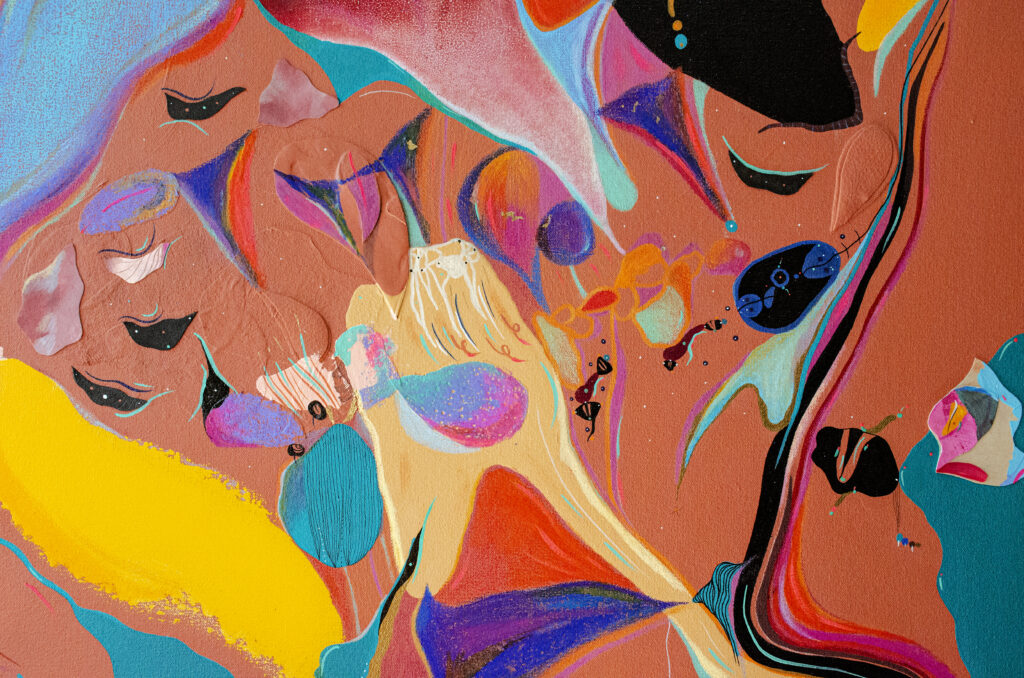
Visitors will be immersed in a collection of works characterized by an abandonment of the everyday and transcendence beyond pre-defined imagery, offering a refreshing opportunity to connect with the essence of individuality. Within these immersive environments of absolute abstraction, I intend to create a platform where both the artist and the viewer can discover their own resonance, a reminder of art’s power to go beyond language.
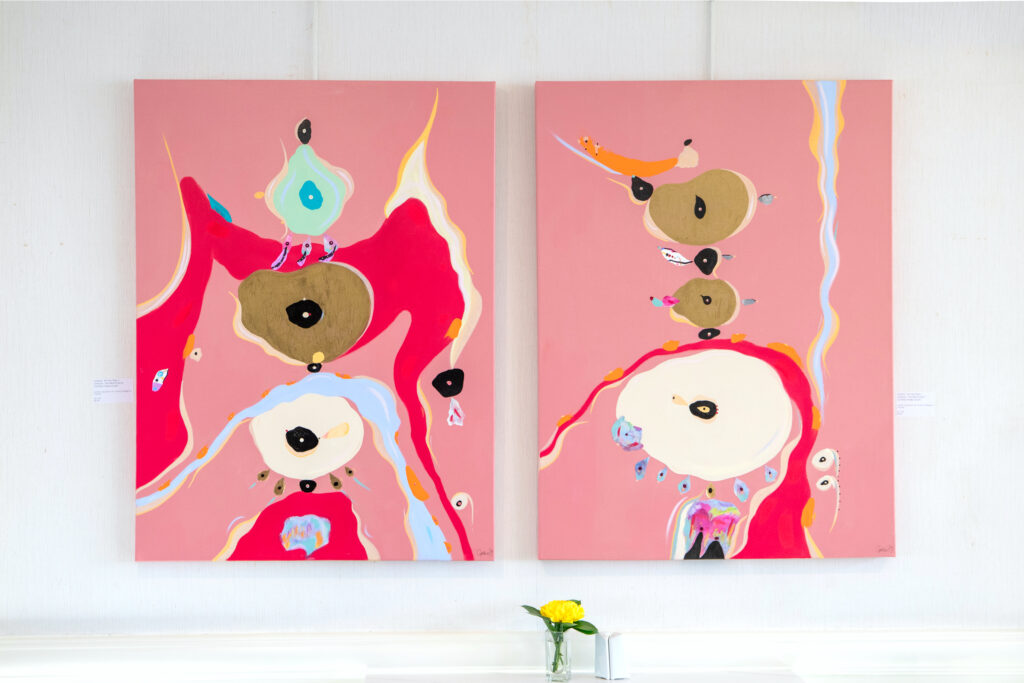
You describe these works as distilling the persistent hues of past horizons, suns, skies, and sands into their most essential states. What does that distillation process mean to you?
My mind often functions like a photographic album, and this series represents a deep exploration of self and a profound sense of gratitude for the experiences that have shaped my life. These works are the radiant lights of my memory, recalling the cloudless skies, the sense of freedom, and the minimal technology of my youth in the south of Lima, Perú. I think of twilight-bathed oceans and the quiet sunrises that celebrate health, presence, family, and nature, the very things we often long for as adults.
Rather than painting literal landscapes, I focus on the distillation of energy and the dream-like states of those memories. They exist as a personal code within me. By translating these moments into a powerful, vivid palette, I aim to create a space that invites the viewer to escape the surface of our fast-paced, technological world and journey into a more essential, introspective state.
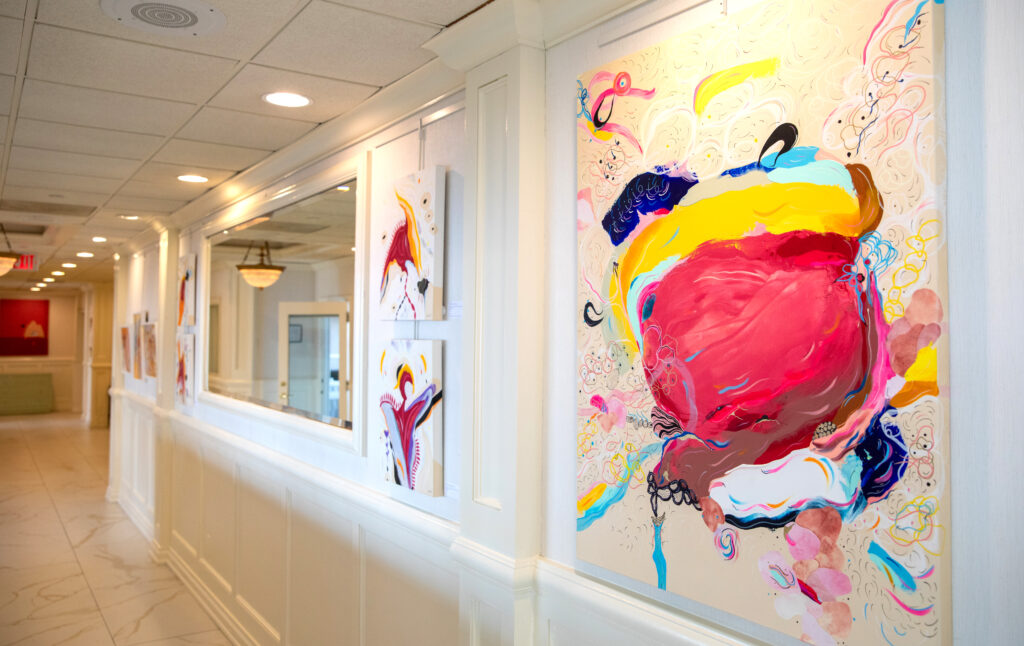
With Magical Leap, you use rotational symmetry to move beyond what you call the geometric rigidity and inherent boundaries of the traditional four-sided canvas. What drew you to that departure?
My attraction to the circular form traces back to my early years in an objet d’art studio. After graduating from Universidad de Palermo and moving back from Buenos Aires to Lima, I spent time painting my own designs on non-traditional surfaces, including circular ornamental plates, an experience that first introduced me to the unique flow of a rounded surface. This, combined with my long-standing affinity for the shapes of vinyl records and CDs, and the designs and illustrations at their centers that rotated while being played, planted the seeds for this departure. Although I transitioned into a professional career primarily focused on the traditional four-sided canvas, I always carried the memory of that circular freedom.
The shift back to the round form happened organically during a sketching session for a complex collage. The composition was structured around shrub-like forms and organic growth, and I found myself frustrated by the ‘geometric rigidity’ of the square. The corners felt like obstacles rather than frames. Moving to a circular surface felt like a liberation; it removed the inherent boundaries and allowed the energy of the piece to flow outward in every direction.
What I find most compelling about this departure is the rotational perspective. Unlike a square, which dictates a top and a bottom, the circle allows the work to exist in a state of constant, fluid movement. It invites the viewer to engage with the composition from multiple angles, mirroring how music and memory are not fixed in one direction but rotate and evolve within us.
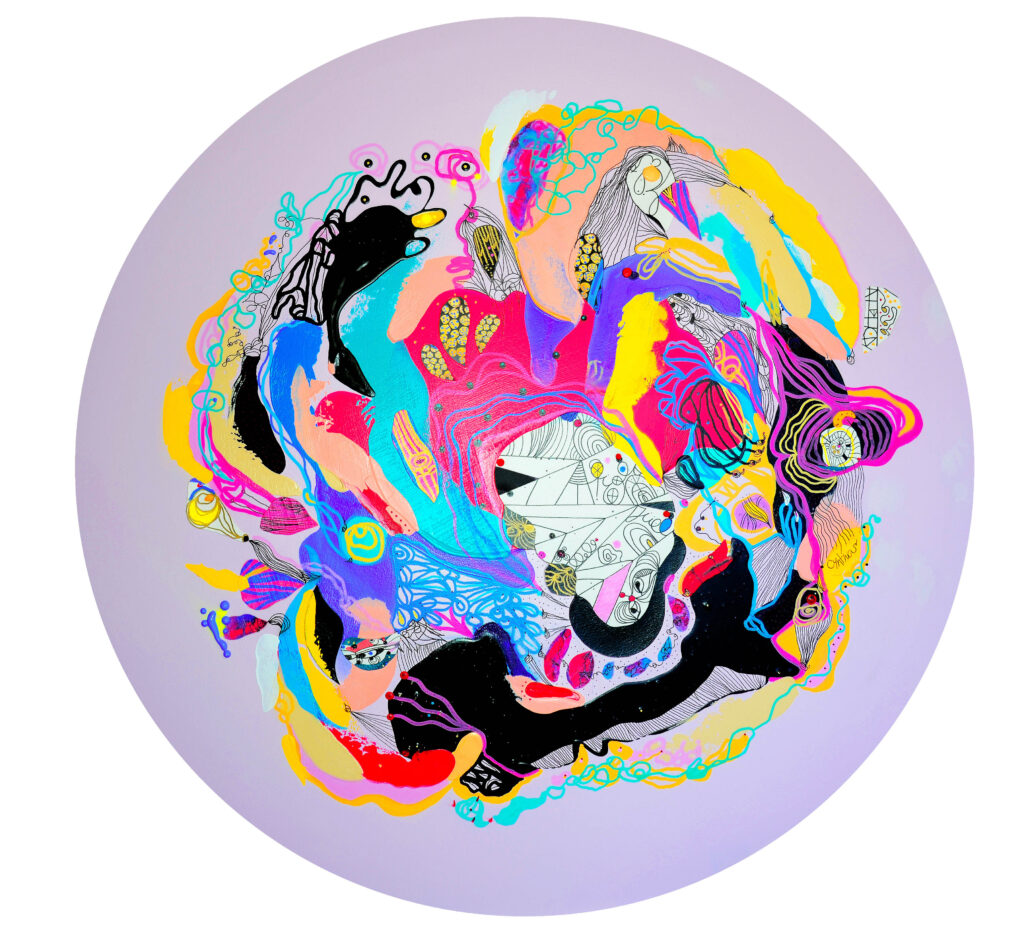
The starting point for The Bite of Light, 30 Times Stronger was the Paraponera clavata, the Bullet Ant, native to the Peruvian rainforest. What was it specifically about the insect’s body structure and presence that first captured your attention?
In 2009, I explored several regions of the Peruvian Amazon. During one of these journeys, guided by a local through the dense rainforest, we encountered a burrow that served as a nest for the Paraponera clavata. I was immediately struck by its formidable presence. When I pointed out the insect’s unique structure, our guide warned us: ‘That is one of the largest ants, with a sting 30 times more potent than a wasp’s. Please be careful.’
That encounter stayed with me for years; while most people in urban environments view ants as harmless, I carried the memory of their power and defensive architecture. I sketched the form many times over the years, but it wasn’t until I began a process of deep abstraction, enlarging, deforming, and repeating elements of its body structure, that I truly found my own rhythm with it.
By integrating my own intricate details and transforming its morphology, I was able to recreate the essence of the Paraponera through my own vision, turning a memory of natural warning into a celebration of complex form.
You deconstructed the Bullet Ant’s anatomy into what you describe as fragmented, totemic visual elements. How did that transformation happen?
To be quite honest, my initial reaction to the Paraponera was one of childlike curiosity; I felt a strong impulse to hold it in my hands, much as a child would hold a butterfly or a roly-poly. Of course, the reality of its danger kept me at a distance, but that tension fueled my fascination. I was captivated by its unusual scale, the mechanical grace of its legs, and the way it seemed to command the space around it with its antennae.
From an elevated perspective, the distinct segments of its body, the head, thorax, and abdomen, already felt inherently totemic. However, the transformation happened during the sketching process. By experimenting with visual repetition and the perceived weight of those anatomical spheres, I began to deconstruct and reassemble the ant’s morphology. Through this play with balance and scale, the structure evolved into a totem, my own personal, visual interpretation of the ant’s power.

You describe the metallic textures and rhythmic black accents as a visual pulse representing moments where light and memory strike with overwhelming clarity. How do those two elements work together for you?
For me, the creative process is deeply tactile; it is a physical exchange between my hands and the material. Through the act of shaping, drawing, cutting, and layering my own hand-painted elements, I develop a multidimensional surface that possesses its own relief and topography. I want the viewer’s eye to feel as though it is ‘touching’ the work and to sense that the painting has a skin composed of meticulous juxtapositions.
The river-like curves function as the veins. The metallics capture and release light, sometimes texture as well, while the black accents provide a grounding, percussive contrast. Over the years, I have refined the technique, moving away from the excess of my earlier years toward a more intentional simplicity that maintains its essential power. These elements work together to create a visual pulse; the artwork becomes a living entity that does not just represent a memory but vibrates with the energy of being alive in the present moment.
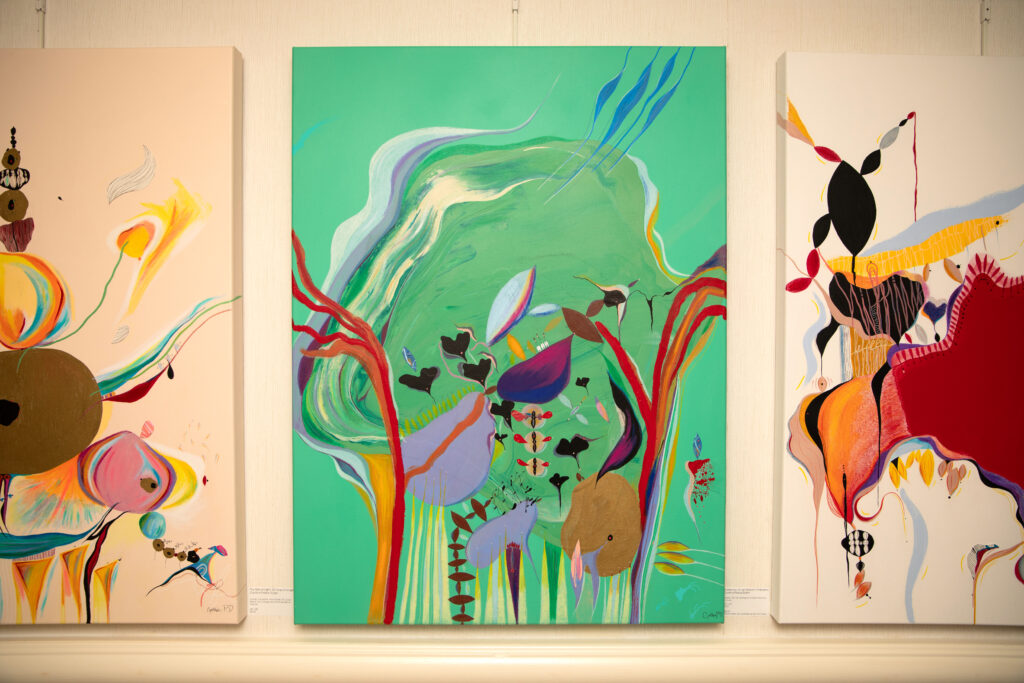
You compare this body of work to a musical composition that transcends language to speak directly to the subconscious. Why music specifically?
Another of the central pieces in this collection is titled ‘La Música es la Máquina para Viajar en el Tiempo’ (Music is the Time Machine). This title reflects my belief that music is an intangible instrument; it greatly fuels the exploration of the self and acts as a bridge to distant or present memories and emotions. For me, music is as essential to the studio as a brush, a sketch, my hands, or the paint itself; it is a primary protagonist in my creative process.
When I close my eyes and connect with music, I begin to visualize a choreography of hues, vibration, dancing figures, and fluttering shapes. It allows me to translate weather-like feelings, tension, sunlight, or warmth into a visual language. In this way, I am not just painting; I am ‘composing’ on the canvas. Music assists the rhythm of layering and the movement of the shapes, allowing the work to transcend spoken language and speak directly to the subconscious.
As part of the Artist in Residence program, your work will hang in the hotel’s guest rooms for a year, exposing it to thousands of guests. What does it mean to you to have your work live in that kind of intimate, everyday space?
I believe this shift will offer guests a unique opportunity to engage with the work, which I envision as a bridge between my inner world and the viewer’s own introspective journey. My intention lies in that very connection, using the unique environment of the residency to invite a deeper, quiet exploration of the visual narratives I have developed. To further this connection, we recently hosted an artist talk and exhibition tour on Saturday, April 18th. This was a special opportunity for guests to immerse themselves deeply amidst the artworks and learn more about the creative process, as the collection has moved into the guest rooms to be enjoyed and experienced throughout the year.
The Oyster Point Artist in Residence program, curated by Ellen Martin, invites the artwork and guests to share the same journey; arrival in the lobby, the Pearl bar and restaurant overlooking the water, and then moving upwards into the guest rooms, integrating the collection as part of the hotel’s guest experience. This allows them the delight of living with original, handcrafted artwork, invigorated by the irreplaceable energy each composition embodies.
Art is an essential element of life and the human experience that all should learn to engage with, allowing the introspection that inspires us to learn more about ourselves, connect with each other, and live a complete life.
The Oyster Point Hotel, 146 Bodman Pl, Red Bank, NJ 07701. On view through April 27th. Curated by: Ellen Martin. Artist in Residence Program.
About the artist: Cynthia Pareja Dubin (b. 1986, Lima, Perú) is a multidisciplinary visual artist. Her practice explores the interplay of sensory memory and the subconscious, translating organic environments into complex abstract compositions that investigate themes of identity and the human spirit. A 2026 New Jersey State Council on the Arts Painting Finalist, Pareja Dubin’s career is marked by significant solo exhibitions, including “Intangible Ecosystems” at the Hotel Sofitel Philadelphia and “Reappearing Treasures” at the Visual Arts Center of New Jersey. Her work has earned national recognition, featured in high-profile publications and interviews such as Juxtapoz and NJ Home Magazine. Beyond her studio, she is a dedicated educator and philanthropist, supporting global initiatives for women’s empowerment and social causes. Her art is held in private collections worldwide. IG: cyndsgnr