I think it’s safe to say that everyone dreads turning on the news nowadays, with the turmoil of politics and world events. If it’s not on the TV, stressful headlines take over email news updates or flood social media platforms. However, for an artist, it can either bring one’s mood down or inspire one to take action by creating one’s own interpretation of a solution. Blair Saxon-Hill is the latter. With Saxon-Hill’s newest solo show at SHRINE, Saxon-Hill’s oil paintings, which portray mostly flowers, provide serenity to this chaotic state of American politics.
Continue reading “Saxon-Hill’s Flower Escapism at SHRINE”Gabriele Münter – Contouring a World
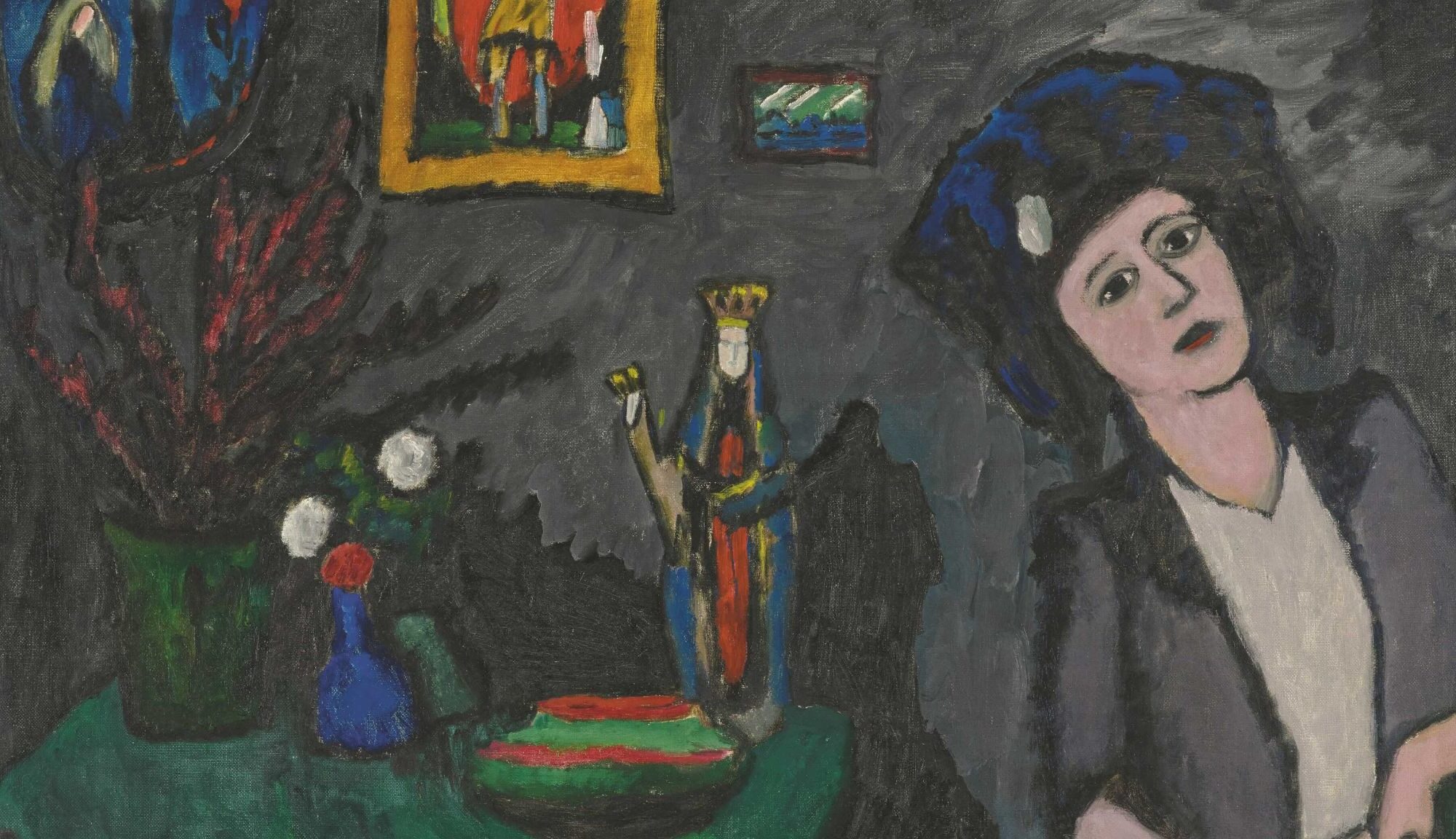
Entering the fourth floor of the Guggenheim, you are met with fields, mountains, lakes of the Bavarian Alps, daily objects, and people—bright, saturated colors held together by dark edges. The exhibition brings together landscapes, portraits, and still lifes, with a focus on Münter’s early Expressionist years alongside later paintings.
Continue reading “Gabriele Münter – Contouring a World”Keisha Prioleau-Martin: Recenter at Olympia

Recenter is a delightful return to Impressionism in many ways. Prioleau-Martin chooses for her subject matter decidedly impressionistic themes—moments at home, moments of introspection, and unrehearsed tenderness, all the casual yet poignant subject matter that marked painting’s initial move from the historic and fantastical to the everyday and human in the 1870s. She also employs the paint with a focus to capture the spur of the moment and the unexpected. Her small-scale ceramics, composed on the templates of stock sculptural types—odalisques, Rodin-like romantic poses, and busts, are, by virtue of their Lilliputian size and wit, Impressionist re-interpretations of dry classic forms. They start out as one thing and shift mid-stream into another: this is particularly evident in Prioleau-Martin’s bust Self-portrait (2024) which masquerades as a planter with fabric and wire vegetal tendrils emanating from her cranium along with her braids.
Continue reading “Keisha Prioleau-Martin: Recenter at Olympia”Silence Breaking: Gail Winbury at Kean University

Silence Breaking is a hidden gem of a show featuring abstract paintings by Gail Winbury at the Carl and Helen Burger Gallery on Kean University’s idyllic, park-like campus in Union, NJ. A New Jersey native, Gail Winbury’s oil paintings depict interpretations of various poems and personal stories that manifest into abstractions with colliding shapes and colors. Her use of gestural abstraction and expressionist lines reflect her interest in the elicitation of psychological responses via painting. Most of the work in the gallery is in large square format, dominated by celadon or mint blue green – a color frequently ranked among the calmest colors. The Field of Green series, which is most of the show, is a departure for the artist, whose previous series had much more aggressive lines and brighter shapes, which more comfortably rested into a traditional rectangular surface dimension. The compositional choices in this body of work are deliberate and minimal, reflecting a more meditative feel full of cooler tones and calmer transitions.
Continue reading “Silence Breaking: Gail Winbury at Kean University”Splendor and Misery at Leopold: New Objectivity in Germany

”BRUTALITY!
CLARITY THAT HURTS […]
BRUSH AS FAST AS YOU CAN –
TRY TO CAPTURE RACING TIME“
—–George Grosz
Nearly a century after the Weimar Republic’s brief, chaotic existence, curator Hans-Peter Wipplinger presents Splendor and Misery: New Objectivity in Germany at Vienna’s Leopold Museum. This comprehensive exhibition, the first of its kind in Austria, brings together around 150 works—100 paintings, 40 works on paper, photographs, and archival materials—from international museums and private collections. Born from the ashes of World War I, Neue Sachlichkeit offered a stark, unsentimental portrayal of reality, capturing both the hardships and the hopes of the “Golden Twenties.” The show features a lineup of key figures of modernism, such as Max Beckmann, Otto Dix, George Grosz, and Christian Schad, alongside lesser-known artists such as Heinrich Maria Davringhausen, Karl Hubbuch, Grethe Jürgens, Lotte Laserstein, Felix Nussbaum, Gerta Overbeck, Rudolf Schlichter, and others, who each captured the era’s spirit with an unflinching eye.
Continue reading “Splendor and Misery at Leopold: New Objectivity in Germany”Paula Modersohn-Becker: Ich bin Ich / I am Me at the Neue Gallerie

German painter Paula Modersohn-Becker, born in 1876, is relatively unknown in the United States. This is quite surprising, considering she painted the first nude self-portraits known to have been made by a woman. Many of these audacious portraits capture her own pregnancy—another first among Western women artists, paving the way for later figures like Alice Neel. Modersohn-Becker’s portraits of women spanning all ages—bold in their composition, subtle in their detail, and utterly present—strike a powerful note throughout the first major retrospective of her art in the United States, curated by Jill Lloyd at the Neue Galerie New York, and fittingly titled Ich bin Ich / I Am Me.
Continue reading “Paula Modersohn-Becker: Ich bin Ich / I am Me at the Neue Gallerie”Vom Abend, Joe Bradley at David Zwirner

The ten paintings in Vom Abend, Joe Bradley’s current show at David Zwirner, measure up to 93 x 120 inches and are all dated 2023-2024. They are big and, with one exception, are in landscape orientations. Framed with white oak strips, they have stately feel, yet they are hardly genteel. They are full of crusty skins of dry paint that seem randomly attached to the surfaces. They are creased and folded. They reek of oil paint. And while the color is buoyant, joyous even, they are also dark. Bradley isn’t afraid of black, and he explores shit brown with an alarming gusto. There are passages where the paint seems to have been aggressively ripped off the surface of the canvas, only to be tenderly painted over again. There are staccato stippling marks. There is erasure and heavy impasto in stretches. Although this may sound like the paintings are heavily labored and full of themselves, they aren’t. And careful examination reveals worlds to explore.
Continue reading “Vom Abend, Joe Bradley at David Zwirner”Accommodating the Object: Elizabeth Yamin and Bosiljka Raditsa at The Milton Resnick and Pat Passlof Foundation
Opinion

The exhibition Accommodating the Object of paintings by Elizabeth Yamin and Bosiljka Raditsa is presented by The Milton Resnick and Pat Passlof Foundation in New York and was curated by William Corwin, who describes this exhibition as an intimate survey that offers the viewer an opportunity to compare the works of these two artists, who were active during the latter part of the twentieth century without attaining prominent careers.
Continue reading “Accommodating the Object: Elizabeth Yamin and Bosiljka Raditsa at The Milton Resnick and Pat Passlof Foundation”Amy Talluto Describes a Munch Print – Towards the Forest II
Meditation on a Munch Print

“An eyewitness described Edvard Munch supervising the print of a colour lithograph in 1896. He stood in front of the stones on which the head of a masterpiece was drawn. He then closed his eyes tightly, stabbed the air with his finger, and gave his instructions. ‘Print… grey, green, blue, brown.’ Then he opened his eyes and remarked, ‘Now it’s time for a glass of schnapps.’ The whole performance, including the air of melodrama and that shot of spirits, was highly characteristic.”
-Martin Gayford, The Spectator
Continue reading “Amy Talluto Describes a Munch Print – Towards the Forest II”Zachary Keeting: Reconciling Layered Energies

In Zachary Keeting’s restless and complex paintings swirls of vivid purples, yellows, and reds float by or contained within geometric shapes of subdued browns and pinkish off-whites. Together they orchestrate distinct rhythms and create a sense of luminosity. Keeting’s alluring colors often generate dynamic pictorial spaces filled with an imaginative array of fragmented forms which remind me of mirror shards prisms against a shifting light, particles in a quantum physics lab, or visual transcriptions of sounds. Although each of these parts, whether biomorphic or geometric, appears to assume a distinct characteristic, the overall sense we get is—what we see now is on the verge of changing within the next second.
Continue reading “Zachary Keeting: Reconciling Layered Energies”