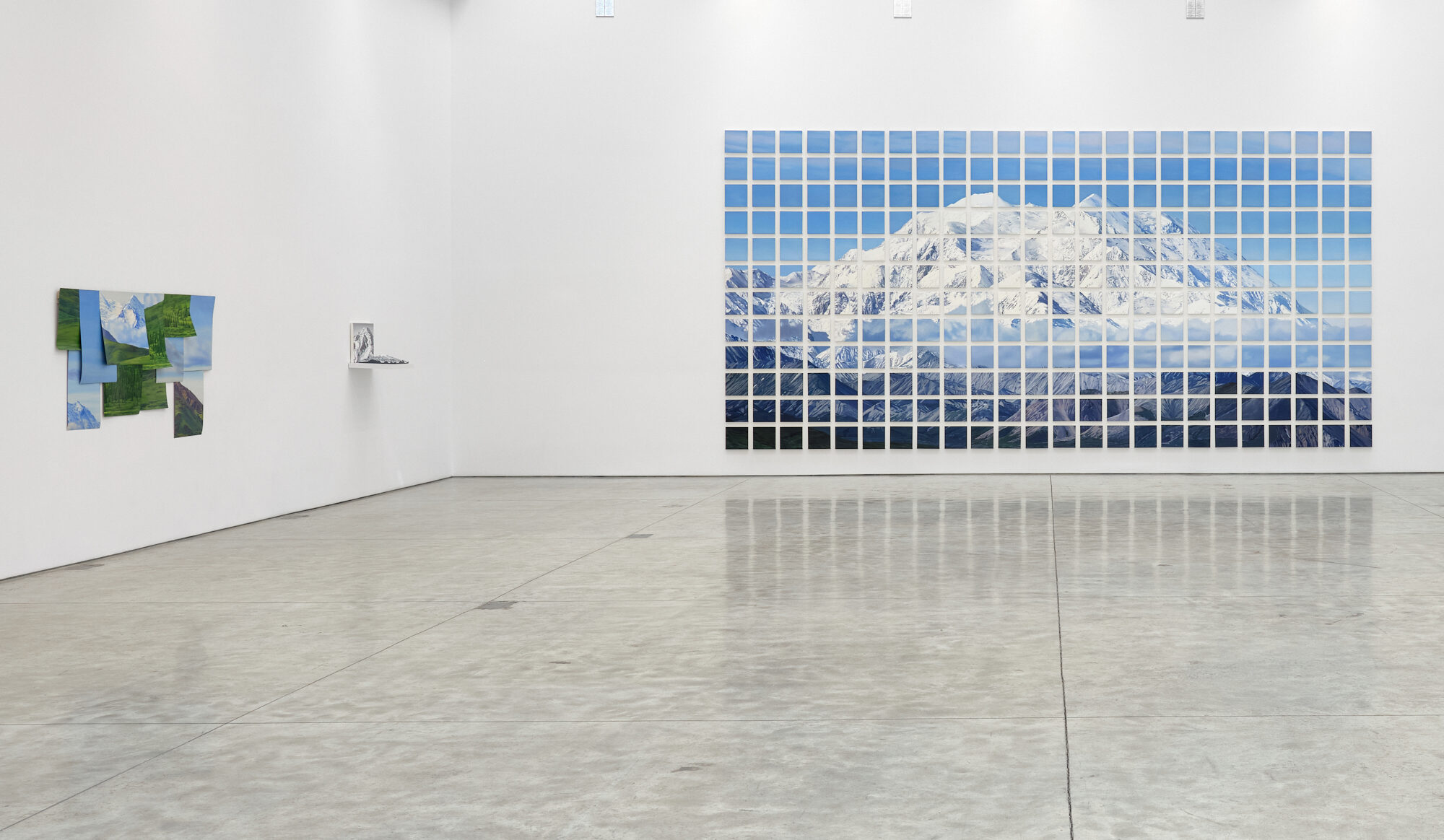
In Cynthia Daighnault’s exhibition at Olney Gleason, the walls are covered with different versions of the same subject: Denali, the tallest mountain in North America. A natural wonder and a national treasure at risk, Denali has lost over 60 percent of its glacier mass, and rising temperatures have accelerated permafrost thaw and disrupted local ecosystems, directly affecting the wildlife that depend on it. The paintings in this exhibition preserve their likelihood like the sculpture of the last three rhinos (by Gillie and Marc, now installed at 441 Ninth Avenue), but this documentation of endangered species contains an underlying criticism of American megalomania, without escaping the artist’s own American identity and ambitions. A big, beautiful white thing, Denali’s demise mirrors the nation’s uncertain future and the accumulative effect of its past.
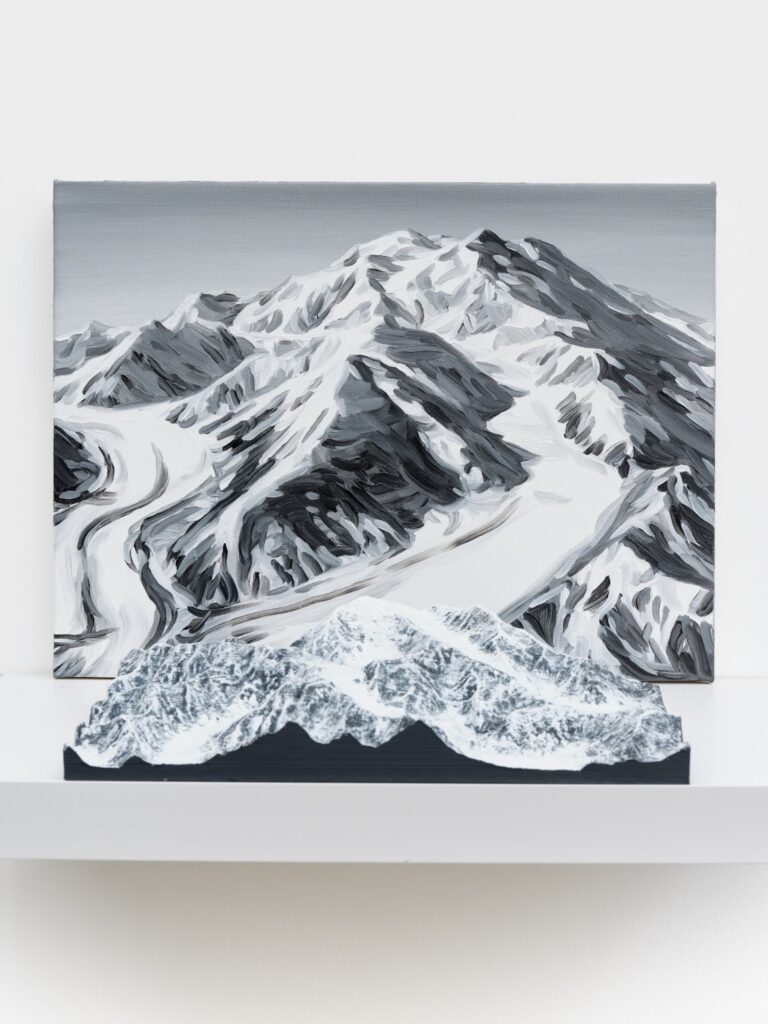
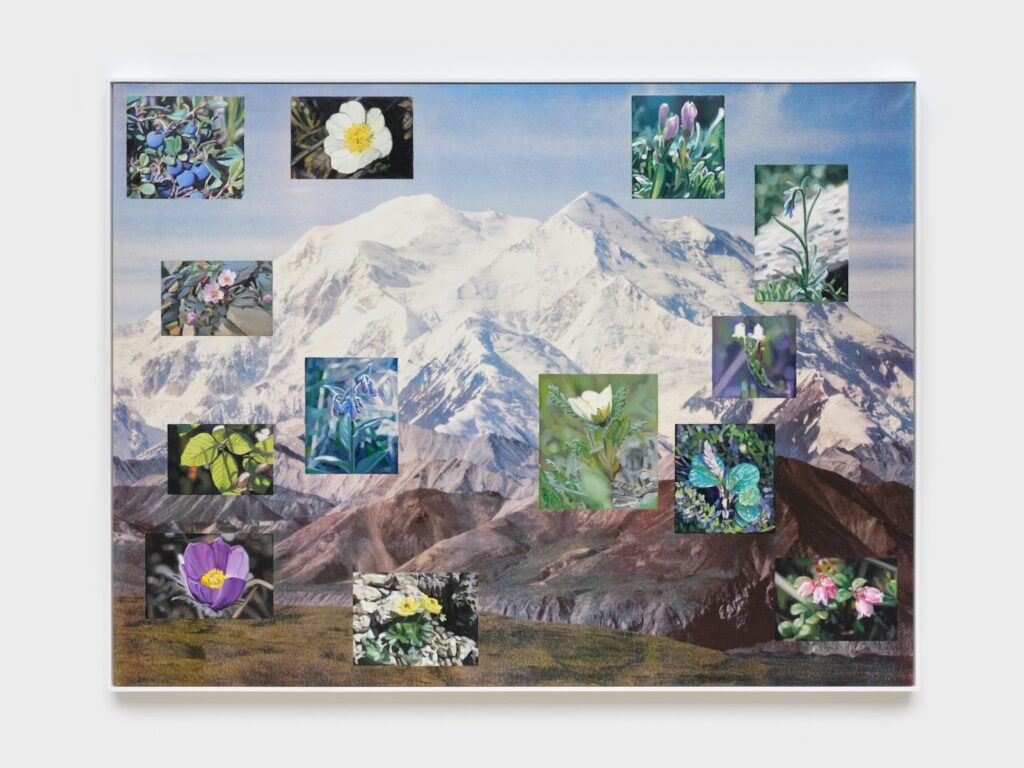
Daighnault’s painterly research of her subject leaves no rock unturned, quite literally. The centerpiece, Denali, is a 288-panel, 24-feet-wide compilation of square canvases creating an image of the whole peak. To its right: two fractured images of the same peak; one, Alpenglow, is split into colorful stripes; the other, High on a Rocky Ledge, has the same peak silkscreen-printed in the background, with close-ups of native wildflowers hand-painted on top, like a flyer for the natural park. On the left of the centerpiece, Memento, a small 3D-printed, hand-painted black-and-white model of a glacier bulges from the wall, with a painting attached to its back. Surrounding it are paintings of book pages, postcard-sized works, a painting of a life-sized slide, a tiny canvas next to a large-scale one, and two pieces hanging in front of one another from the ceiling. Moving from micro to macro, flat to three-dimensional, broken down to straightforward, Daighnault allows herself full freedom in scale and reference materials while staying true to her purpose: studying her singular subject.
Known for her grids and rows of canvases displaying the same image with slight alterations, as in a storyboard or video stills, she now takes the deconstruction of images through painting a step forward. She does so by testing it in multiple ways and allows us to step back and take notes. It is an experiment or an exercise in observation. Through painting, she positions the act of looking as a kind of thorough research. Painting’s tactile, deliberate process does not deny the consumable abundance of digital media but rather imitates it with brushwork and color that seem almost mechanical and endless repetition. Daighnault is testing painting’s capacity to slow down, distill time, and endow any mass-produced image with extra meaning. Taking on a banal subject of a snowy mountain, which brings to mind a decorative calendar of American national parks, she deconstructs and reworks it until the painting’s status as a unique material object is diminished. When we look at these paintings, we suddenly notice how we look at them. The artist demands we acknowledge that the compulsive tendency that sends us scrolling endlessly through images on our devices is the one that drives the ecological disaster destroying nature and its beauty.
This disarming of painting as a unique object parallels the disarming of iconic imagery that Daighnault has pursued throughout her career. It recalls Luc Tuymans’s strategy, where he takes charged historical imagery and renders it with muted, almost indifferent brushwork, stripping it of its straightforward power. Daighnault participates in this lineage of dismantling the aura of iconic images through painterly intervention.
However, despite the redefinition of the painterly gesture, we are still allowed the pleasure of looking at a well-crafted painting. The sunsets, flowers, caribous, and mountain slopes are described using impressive technique and a thorough knowledge of American landscape painting traditions. Daighnault chooses to use the magic of painting for a cause, but it is unclear who wins between the medium and the message. The ambivalence is sincere, and painting is a medium that allows it.
As we take in the beauty of these images, we are confronted with an uncomfortable question: What part do our own patterns of image consumption play in the environmental crisis unfolding at Denali? Are we content to admire depictions of wilderness while ignoring the habits that threaten its survival? Daighnault’s work quietly asks us to consider our own responsibility, leaving us to reflect on whether our gaze is an act of care or complicity.
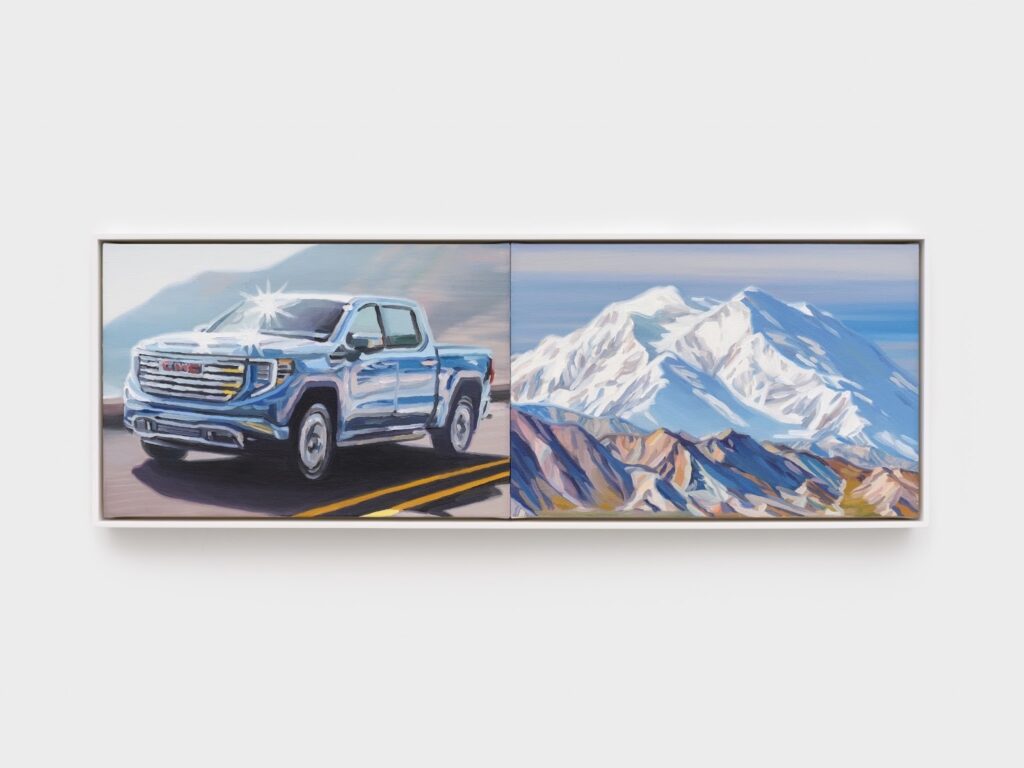
Denali, Cynthia Daignault at Olney Gleason, 509 West 27th Street
New York, NY. On view through March 28th, Tuesday – Saturday, 10 AM – 6 PM
About the writer: Noa Charuvi is a visual artist living and working in Brooklyn, NY. She holds an M.F.A in Fine Arts from the School of Visual Arts in New York and a B.F.A in Fine Arts from the Bezalel Academy in Jerusalem, Israel. Her work was exhibited internationally in venues such as The Bronx Museum of the Arts, Haifa Museum of Art (Haifa, Israel), and Mishkan Museum (Ein Harod, Israel). Charuvi was a recipient of the Pollock Krasner Foundation Grant in 2018. Her work is included in”Landscape Painting Now,” an anthology of contemporary landscape painting published in 2019. @noa_charuvi