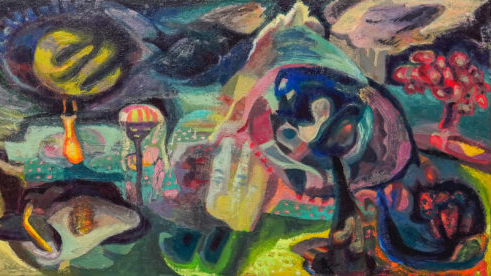
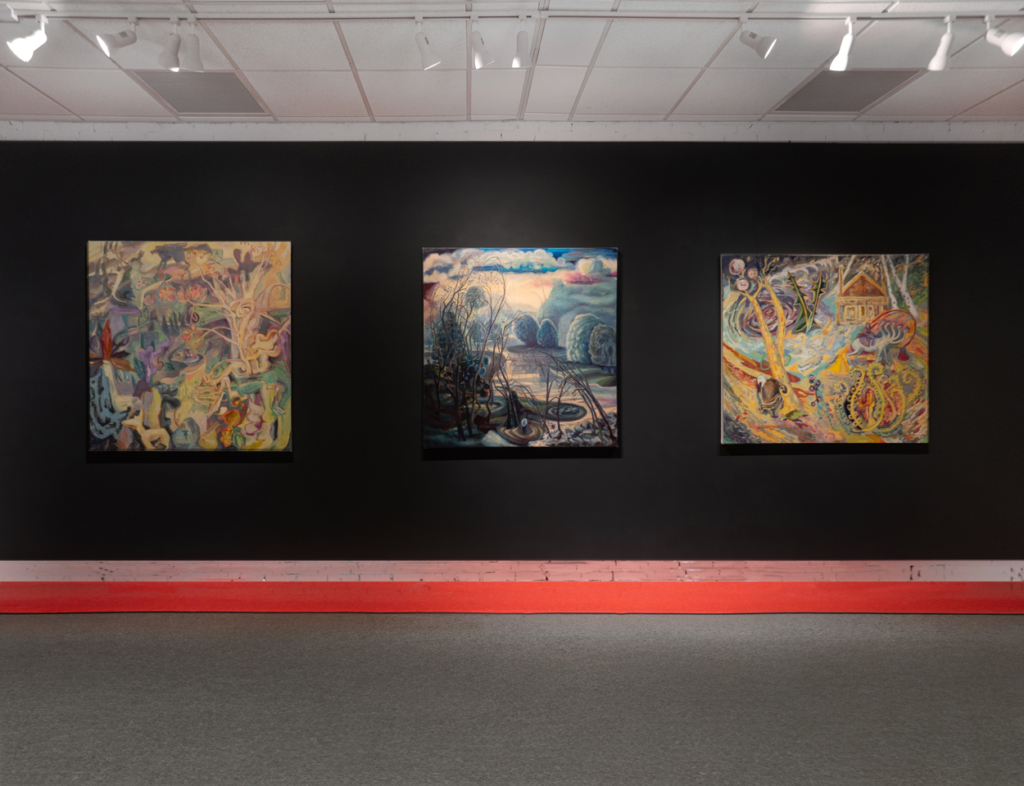
Opium Dreams, the exhibition of Laurie Fader’s pictures at the Susan Moremen Gallery, is an update of the artist’s bold transition from oil sketches of Umbrian hillsides to a psychological map of contemporary insecurities and vulnerabilities. She addresses our economic, political, and ecological ructions with exuberant irrationality, improbable scale-shifting, and a highly personal landscape vocabulary. Surreal humor and fantasy are her touch points, rather than anguish and despair.
A dead opossum lying in a fetal position along a contaminated riverbank in Quito became, for Byron Toledo, both an encounter and a sculpture. That moment, tender and violent at once, is at the heart of The Whole Water of a River at Tiger Strikes Asteroid Brooklyn, an exhibition that follows the Machángara River from its mountain source through the city. Ceramic animals, distilled plant aromas, and sound recordings gathered along the watershed map the river as a living system that connects hills, ravines, plants, people, and the city itself. The project carries unusual stakes: in 2024, an Ecuadorian court ruled that the rights of the Machángara had been violated, a ruling for which Toledo’s own video work served as evidence. We spoke with the artist about walking the river, collaborating across disciplines, and what it means to make art inside an ecosystem fighting to survive.
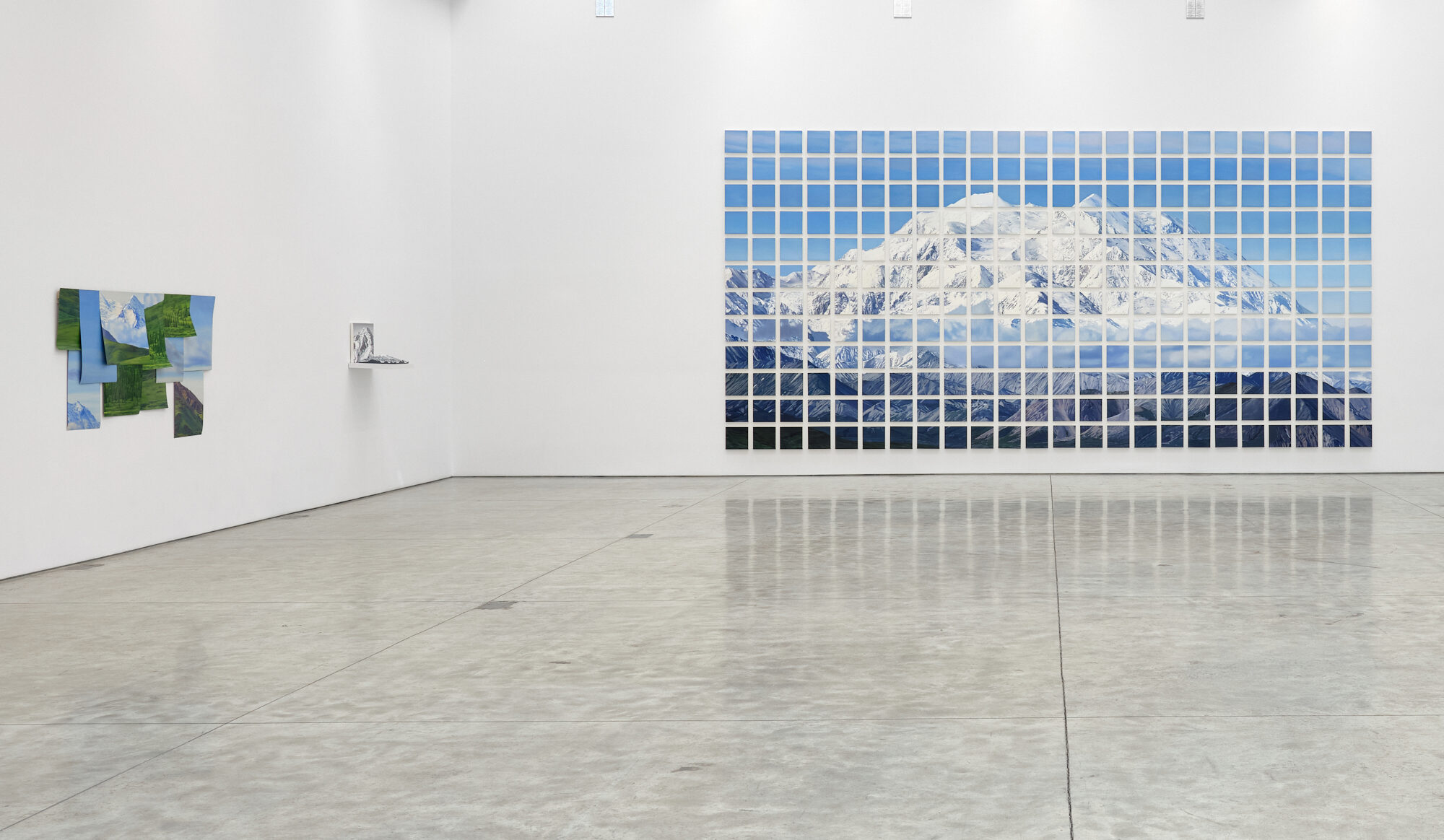
In Cynthia Daighnault’s exhibition at Olney Gleason, the walls are covered with different versions of the same subject: Denali, the tallest mountain in North America. A natural wonder and a national treasure at risk, Denali has lost over 60 percent of its glacier mass, and rising temperatures have accelerated permafrost thaw and disrupted local ecosystems, directly affecting the wildlife that depend on it. The paintings in this exhibition preserve their likelihood like the sculpture of the last three rhinos (by Gillie and Marc, now installed at 441 Ninth Avenue), but this documentation of endangered species contains an underlying criticism of American megalomania, without escaping the artist’s own American identity and ambitions. A big, beautiful white thing, Denali’s demise mirrors the nation’s uncertain future and the accumulative effect of its past.
Katerina Lanfranco is a painter most known for her magical and fantastical colorful paintings. She recently embarked on a new challenge in her solo show Snowed-In, which is one of her most ambitious projects yet, as she let her viewers in on the process.
In Dialogue with Linnéa Gad, Magdalena Dukiewicz, and Anna Ting Möller
Linnéa Gad. Detail from Shoal II. Photographed by David Schulze. Courtesy of The Immigrant Artist Biennial.
Instead of transcribing a previously established set of ideologies through scholastic mediums, Linnéa Gad, Magdalena Dukiewicz, and Anna Ting Möller engage with materials that “breathe”—materials whose lives and afterlives warrant separate biographies.
Presented within the context of The Immigrant Artist Biennial 2023: Contact Zone, Swedish artist Gad creates sculptures with limestone, oysters, lapis lazuli, and other materials profoundly connected to the Earth’s carbon cycle. On Governors Island, her sculptures, Shoals I-II, evoke humanity’s resonance with and reliance upon nature. Polish-born artist Dukiewicz juxtaposes industrial components with provocative, organic materials such as hair and blood. In the group show, Enmeshed, Dreams of Water, at NARS Foundation, Dukiewicz’s Object #6 (2023) contains decay, regeneration, and fluidity elements into beautifully translucent and sculptural artwork. Chinese-born Swedish artist Möller, whose work will be presented in Parasites and Vessels at Accent Sisters, unpacks the convoluted social history of kinship via kombucha cultures. The oysters, hair, and kombucha are not subjected to manipulating the artists’ hands; instead, the materials are collaborators in these projects, bringing their subjectivities, histories, and sociological implications into the creative process.
Together with TIAB’s co-curator, Anna Mikaela Ekstrand, the artists speak about their work about technology, materiality, and ecosystems.