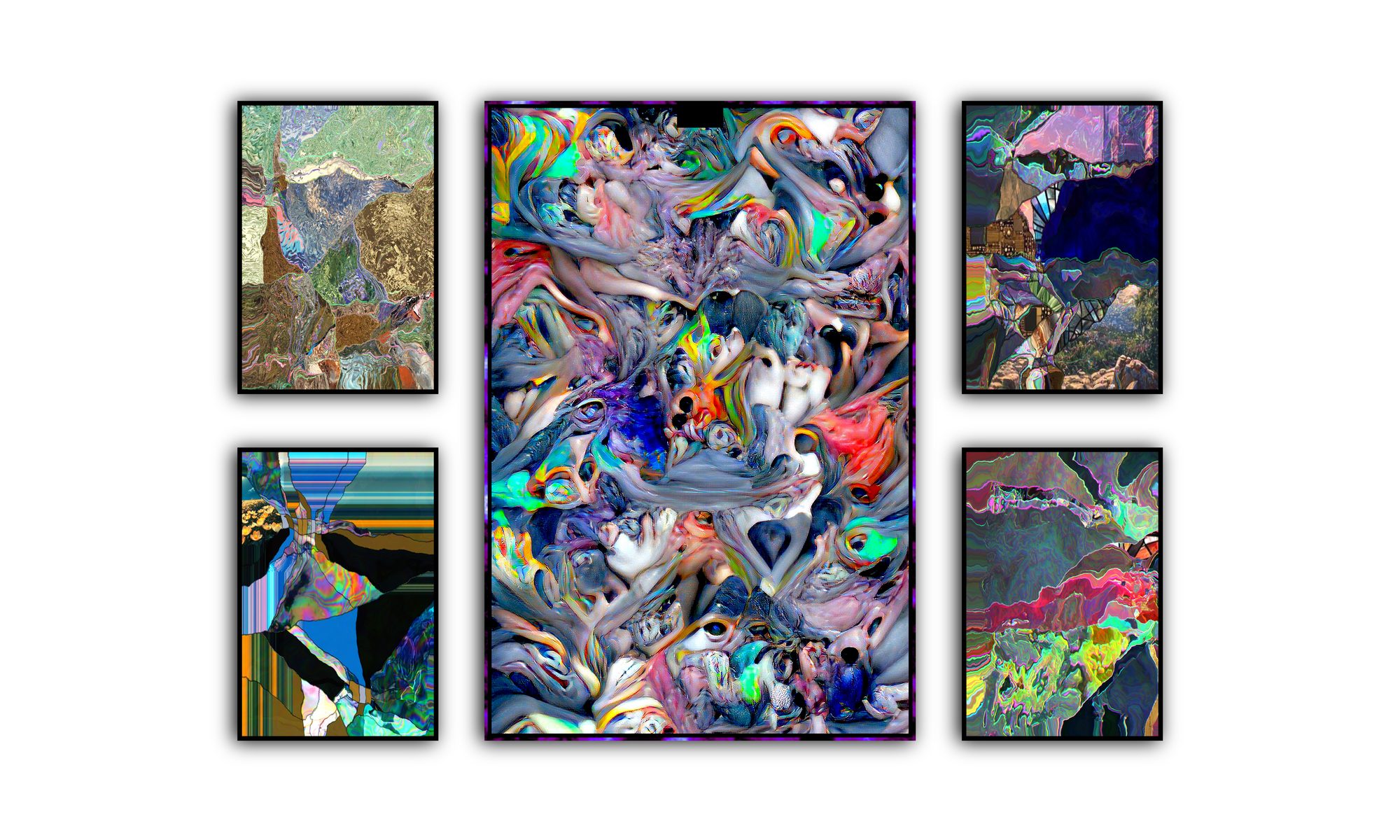
How does a field barely a decade old start to have a past? ./spiral takes up that question, gathering eleven artists who were present at the early days of AI, code, and blockchain art and asking each to pick up a formative work, tool, or loose end and carry it forward from where they are now. For co-curator Atay Ilgun, a London-based artist and technologist, the burst of new tools between 2017 and 2022 has only lately settled far enough into the past to be seen clearly. His fellow curator, SuperRare’s Jonathan Carmel, describes the return as a way of moving forward by first turning around. The works cross from screen into matter along the way, Helena Sarin’s ceramics drawing AI imagery toward ancient clay, Robbie Barrat’s Plexiglas prints nudging it back toward the glow of a monitor. Presented by SuperRare at Justin Aversano’s Fondazione Aversano in New York, September 3–10. Here, Ilgun and Carmel discuss how the show came together, the move from screen to object, and the histories their artists carry forward.
How did ./spiral come together, and how did the two of you come to curate it? Where did the idea of returning to formative tools and methods come from?
J: ./spiral came out of conversations Atay and I were having about early AI and how quickly work in this field can begin to feel historical. We wanted to highlight important artists working across AI, code, and blockchain through some of their formative works, but not treat those works as endpoints. Instead, they became provocations for asking what had changed in the artists’ practices, in the technology and in the world around them.
A: I feel 2017 to 2022 were quite a special five years for lots of creatives in the field, with all the new tools coming out around then. This year almost felt like the first time, in ourselves and around us, that enough time had passed to reflect and realize it’s not the near past anymore. All this makes you want to have almost a checkpoint, a means to assess the passing time, artistic practice, and everything that floats around these.
So, going back to the formative works also came out of that. Asking someone to return to something they made in 2019 shows you the distance traveled better than asking what they’re working on now.
The eleven artists here helped shape AI art in its early years. For a field this young, what does it mean to treat that recent past as a history worth returning to?
J: There’s an inherent push and pull between the pace of technology and the pace of art. New tools can move faster than culture is able to understand them, while artists are often the ones who reveal what those tools can become. As curators, it felt important to pause and appreciate the vision these artists had when technologies like AI and blockchain were still culturally distant ideas. Returning allows us not only to recognize that history, but also to tap into an impulse the artists have, and maybe we all have, to look back in order to look forward.
A: We feel it’s important to highlight this interval because the interval itself is the medium and the thing we have to keep considering to keep the momentum going. In this space, there’s a certain fetishization of historicity, the firsts, the OGs, which I think tends to divide time into units, and I feel it’s often not a productive way of approaching things, pushing people to capitalize on historicity rather than bring energy to it. So we thought treating this recent past differently might be a fresher take on the space, almost inverting the logic of the history we return to, to point at something more generative and alive.

Much of this work began as early AI experiments — pix2pix, StyleGAN, old code — and here it takes physical form as ceramics and prints in a room. How do you think about that move from screen to object, and what does each form give the work?
J: It’s fun because even within these material manifestations of art + computer, there are very different approaches. Helena’s ceramics, for example, reach back toward pre-Columbian art through dirt and clay. By translating images born from AI into one of our oldest materials, she makes the work feel organic, tactile, and almost archaeological.
Robbie’s prints on Plexiglas take nearly the opposite approach: they began as a study of digital texture and have now become a study of the “ideal landscape,” drawing on Camille Corot. The Plexiglas mimics the surface of a screen, using physical material to make the image feel even more digital.
That’s what makes ./spiral so interesting: the physical material doesn’t just give the digital work a body; it reveals a different history already contained within it. Helena pulls the digital back toward earth and ancient craft, while Robbie pushes the physical object closer to the screen.
A: I find it quite poetic. In my own case, I used to run Wounded Wolf Press, a small artist-run publishing house selling limited edition prints, hand-made poetry pamphlets, and so on. I often talk about this in artist talks: what first drew me to crypto came directly from that sensibility, making limited editions and building direct relationships with the people who support the work. Part of it was also a struggle. I couldn’t find a way to publish AI work in that same form, and blockchain was where that became possible. Now I find myself going back to those origins.
So these things rarely flow in one direction. You can see them fluctuate in an artist’s psyche. Even though it first reads like a drastic change, going from AI and crypto to ceramics, the line is much thinner than we think, and that’s the beauty we want to highlight.
The title is ./spiral — a spiral returns but never to the same place. Where does that show up in the actual works, where an artist goes back to old ground and finds something new there?
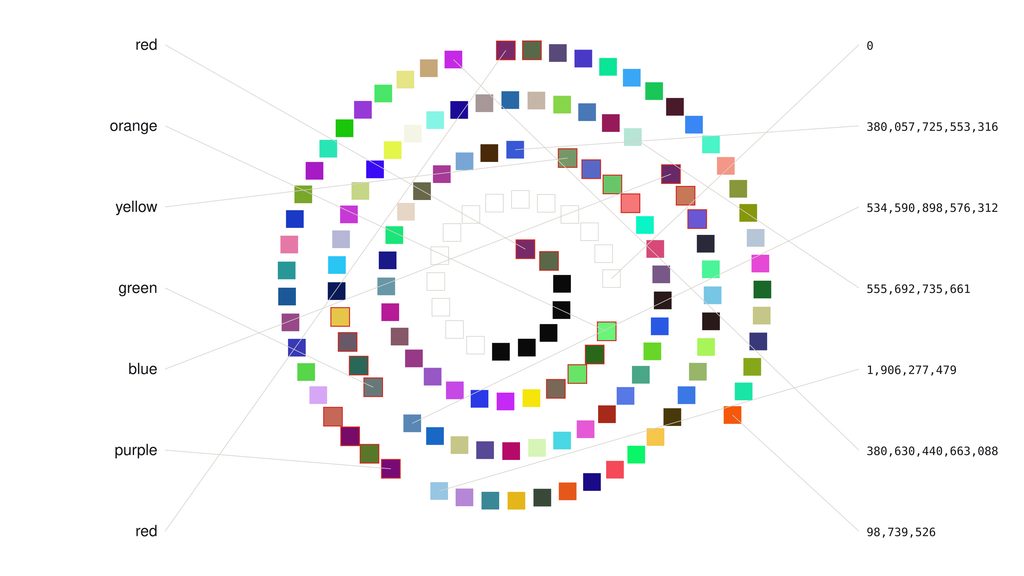
J: Rhea Myers offers a clear example. In two earlier works, 1 Doge = 1 Doge and Portents, she explores how easily we find meaning in systems that understand nothing themselves. The first turns a rare cryptographic coincidence into a kind of absurd proof; the second searches old Bitcoin records for references to events that had not yet happened.
In the new work, Grinding, she returns to that idea through language. Four works begin with “red,” “one,” “circle,” and “point,” then search for related words around colour, number, shape, and form. The computer finds the patterns, but we give them meaning. That is the spiral: the same method returns, but leads somewhere new.
A: An artist’s early work is almost never fully behind them at a measurable distance. It’s always still running in the background, occasionally interfering with whatever they’re doing now, so in that sense the spiral is unavoidable. Curatorially, the work is picking that layer out and making it visible through a single set of works, and on this show it manifests in quite a few different ways.
Your description points to unresolved ideas that the artists return to. What got left unfinished as AI art rushed ahead — and did any of it turn out to matter more than it seemed at the time?
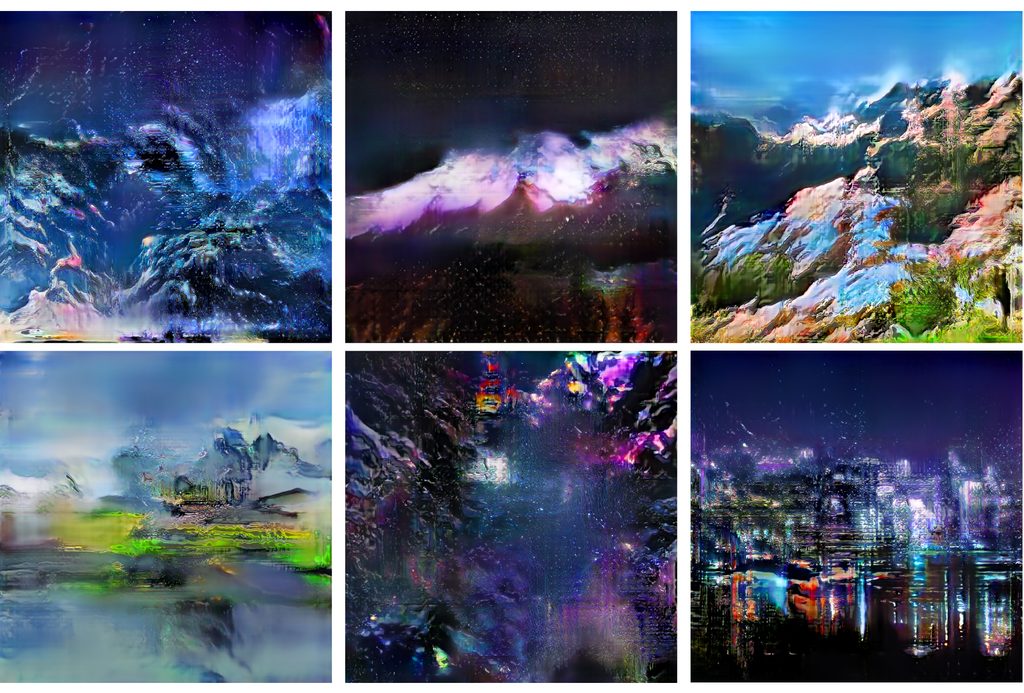
J: Atay and I have been speaking about how earlier AI art can feel more human precisely because it is imperfect and raw. Fast forward to today, and AI can produce images with an extraordinary level of realism and polish, but that fluency can sometimes smooth away the friction that made the earlier work feel alive.
I don’t think either expression is inherently better or worse. What got left unfinished was the artistic potential of those early limitations. The abstraction, errors, and visible struggle of GAN-based processes were treated as things technology would eventually solve, but they created a visual language that matters more than we realized at the time. They left room for both the artist and the viewer to make meaning in the gaps.
A: Back in the early days, everyone was experimenting with these tools to see what they were capable of, trying to figure out their aesthetics under different methodologies and contexts within their practice, so I feel it’s a rather different story for each artist, as we’re showing in the exhibition. But as Jonathan mentioned, one common denominator is that we can now go back and appreciate the expressive strength of those early outputs. What might have appeared simply as janky then comes off as very abstract and beautiful now, in a way that might not have been visible to our eyes back then.
And the same thing is happening again, whether we realize it yet or not. The look of vibe-coded and agent-made work will date just as precisely, and in a few years someone will find it beautiful for reasons nobody can see yet. So I feel the show sits between both, and that’s one of the spirals in it.
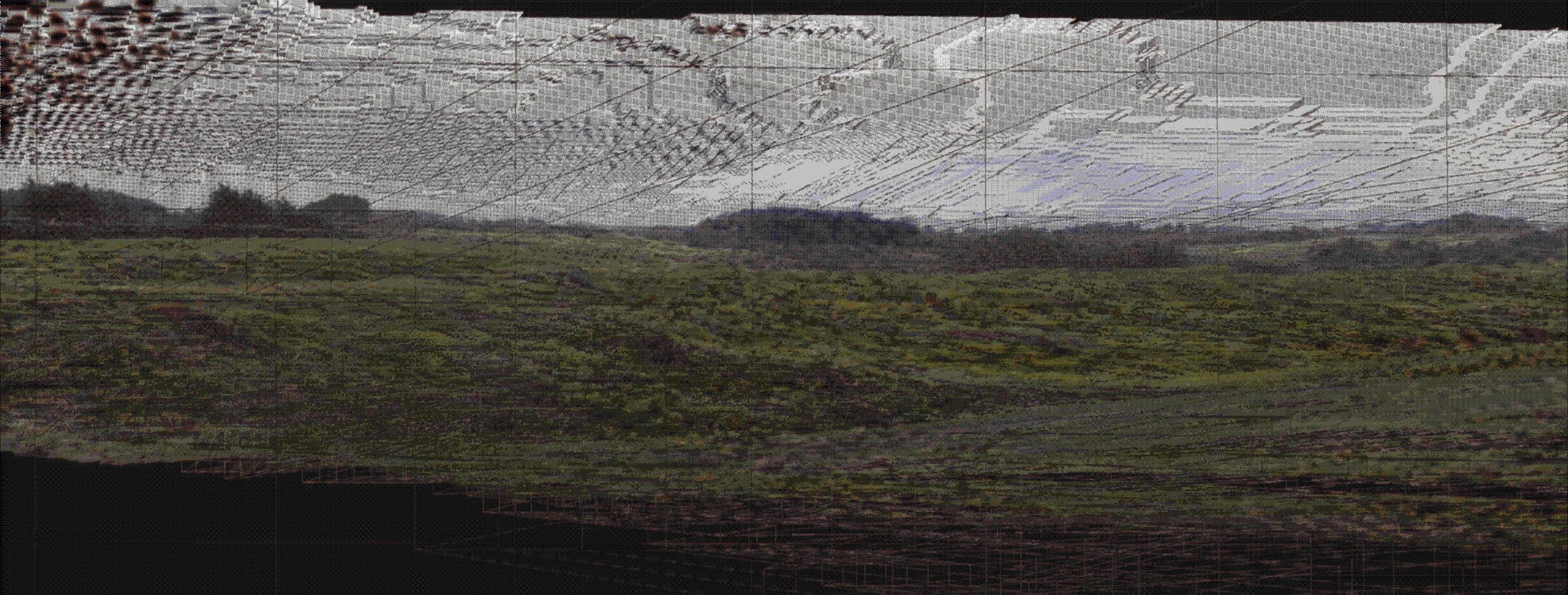
For example, Artonymous’s AI TRASH deals with this directly: what’s left on our hard drives from all those experiments. My own piece, Otherness, deals with the loss of abstraction and sense of reality, taking early and new AI as two ends of a spectrum and building a narrative on our understanding of the nature of the image.
SuperRare, which presents the show, is a platform built around NFTs. Were these works — or their earlier versions — ever minted or sold as NFTs, and how does that history sit alongside showing them as physical objects now?
J: The answer varies by artist. Some earlier works were minted as NFTs, some of the physical works here are connected to tokens, and others deliberately carry no token at all. SuperRare holds a rich history of digital art minted on the blockchain, including seminal works by several artists in this show. Robbie Barrat’s “AI Generated Nude Portrait #1” was the first artwork tokenized on SuperRare in 2018, while Pindar Van Arman’s “AI Imagined Portrait Painted by a Robot” was another early work on the platform. In ./spiral, however, the relationships vary: Helena’s NFT and ceramics form one inseparable artwork, while Robbie’s Landscape prints carry no token.
To me, that reflects a growth in digital art where NFTs no longer need to sit so heavily in the foreground. They can be a record of authorship and provenance, part of an artist’s material vocabulary, or sometimes absent entirely. SuperRare can honor the early origins of tokenized media and the artists who shared that vision while recognizing that growth means focusing less on the NFT itself and more on the art.
A: Since I’m not directly affiliated with SuperRare, maybe I can answer this from a more personal place, about my own perspective on SR, its history, and what that history looks like from inside this show.
Around 2018, SR was a big influence on me, though not in the way most people would think. I remember trying to learn Solidity and web3 development after first hearing about NFTs, looking around at other platforms and at how people were publishing them, and seeing that SuperRare used one shared contract for everything. That made me even more curious about how they work. And I must confess I’ve always been a very DIY person, wanting to personalize everything I do, get as low-level as possible, understand how things work, and build my own tools from scratch. So I wanted my own. That’s what led me to create my first NFTs in 2019.
What’s remarkable to me is that after years that have been hard for platforms and mid-size galleries everywhere, SuperRare is still shipping tools for artists, still helping curators like us put out shows like this, and still adapting to what artists and spaces actually need, like the physical editions Jonathan mentioned. Even the way this show is presented runs on tools they built. So I couldn’t be more honored to be working with them and with Jonathan on this. And I think the show reflects something of that: artists who were there from the earliest days, still here, still changing, under the same roof.
The show is hosted by Justin Aversano’s foundation in New York. How did that venue come about, and how would you describe the space and its role in the exhibition?
J: Truthfully, Atay and I had more modest ideas for how ./spiral might take shape. When we spoke with Justin about the show, he insisted that it needed a physical exhibition and was generous enough to open the doors of Fondazione Aversano to us. That generosity is very characteristic of Justin. He is a gifted artist, a committed supporter of other artists, and someone I’m grateful to call a friend.
Justin is also a natural host. He is constantly bringing together friends, artists, collaborators, and collectors over tea, maybe some tarot, and always honest conversation. I think Fondazione Aversano will bring that same inviting, reflective, and unifying spirit to *./spiral*. It gives the work a space to be encountered through conversation rather than simply displayed.
A: From my side, and thanks to Jonathan, really, since he connected us. We already had this intrinsic wish that ./spiral deserved a physical show, but we were trying to scale to what life offered us. So when Justin was so kind and supportive about it, it felt like the natural and right thing to do. Hugely grateful to him, and flattered to be the inaugural show at Fondazione Aversano.
Mostly, I can’t wait to greet everyone and share a room for once, instead of X DMs and video calls.
./spiral, presented by SuperRare, at Fondazione Aversano, 60–62 East 11th Street, 5th Floor, New York, NY 10003. Public opening, Thursday, September 3, 2026, 6–9 PM. On view through Thursday, September 10, 2026 (full online release follows via SuperRare on Friday, September 11). Curated by Atay Ilgun and Jonathan Carmel. Artists: Anne Spalter, Artonymous, Atay Ilgun, Bård Ionson, Gene Kogan, Helena Sarin, Kyle McDonald, Mario Klingemann, Pindar Van Arman, Rhea Myers, and Robbie Barrat. More info and RSVP: https://spiral.superrare.com/
Make your tax-deductible donation today and help Art Spiel continue to thrive. DONATE
About the curators:
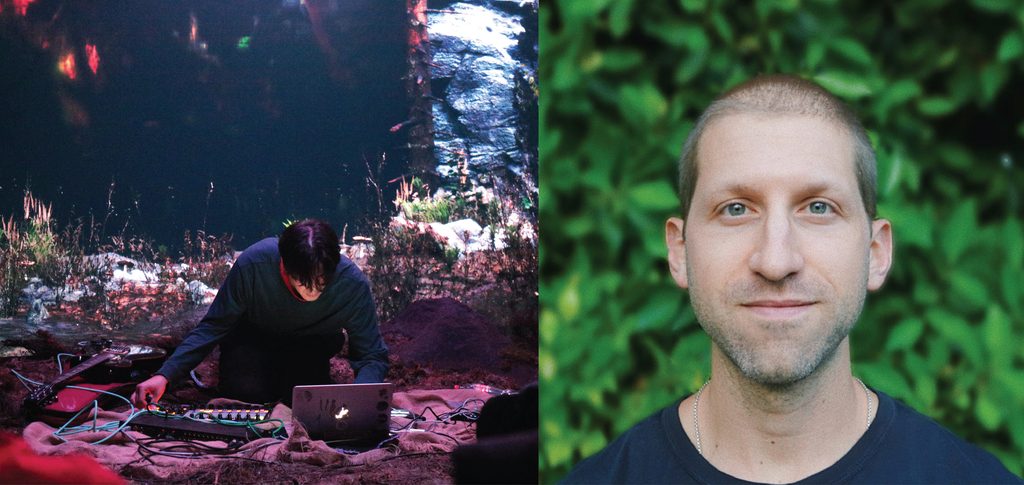
Atay Ilgun is a London-based artist, curator and creative technologist working across AI, blockchain and computational media. His practice moves between image-making, protocol design, software, installation and sound, and examines how emerging technologies produce and reshape systems of reality, perception and value. Realiti (2019), one of the earliest AI artworks minted on Ethereum, was included in Sotheby’s Contemporary Discoveries in 2025, selected by Luba Elliott. He has presented work at CVPR, Sonar+D, Creative AI London and UAL’s Creative Computing Institute. He has curated at IKLECTIK in London since 2020, programming across digital art, sound and emerging technologies. In 2026, he founded soft world, a studio dedicated to protocol art.
IG: @the_prince_of_this_world
Jonathan Carmel (jonooo) is a New York-based curator at SuperRare working across digital and protocol-based art. His work centers artists who use code, networks, and emerging technologies as creative material, placing digital art in contexts that extend beyond market cycles. Recent exhibitions include Post-Portrait, Intimate Systems, and ./spiral, which he co-curated with Atay Ilgun. Before joining SuperRare, Carmel worked in artist management and led artist relations at Prohibition, a generative art platform built on the Art Blocks.
IG: @jonnycarmel
About the writer: Etty Yaniv is a Brooklyn-based artist, writer, curator, and founder of Art Spiel. She works in installation, painting, and mixed media, and has shown her art in exhibitions across the United States and abroad. Since 2018 she has published interviews and reviews through Art Spiel, often focusing on underrecognized voices and smaller venues. More about her art can be found at ettyyanivstudio.com and on IG: @etty.yaniv