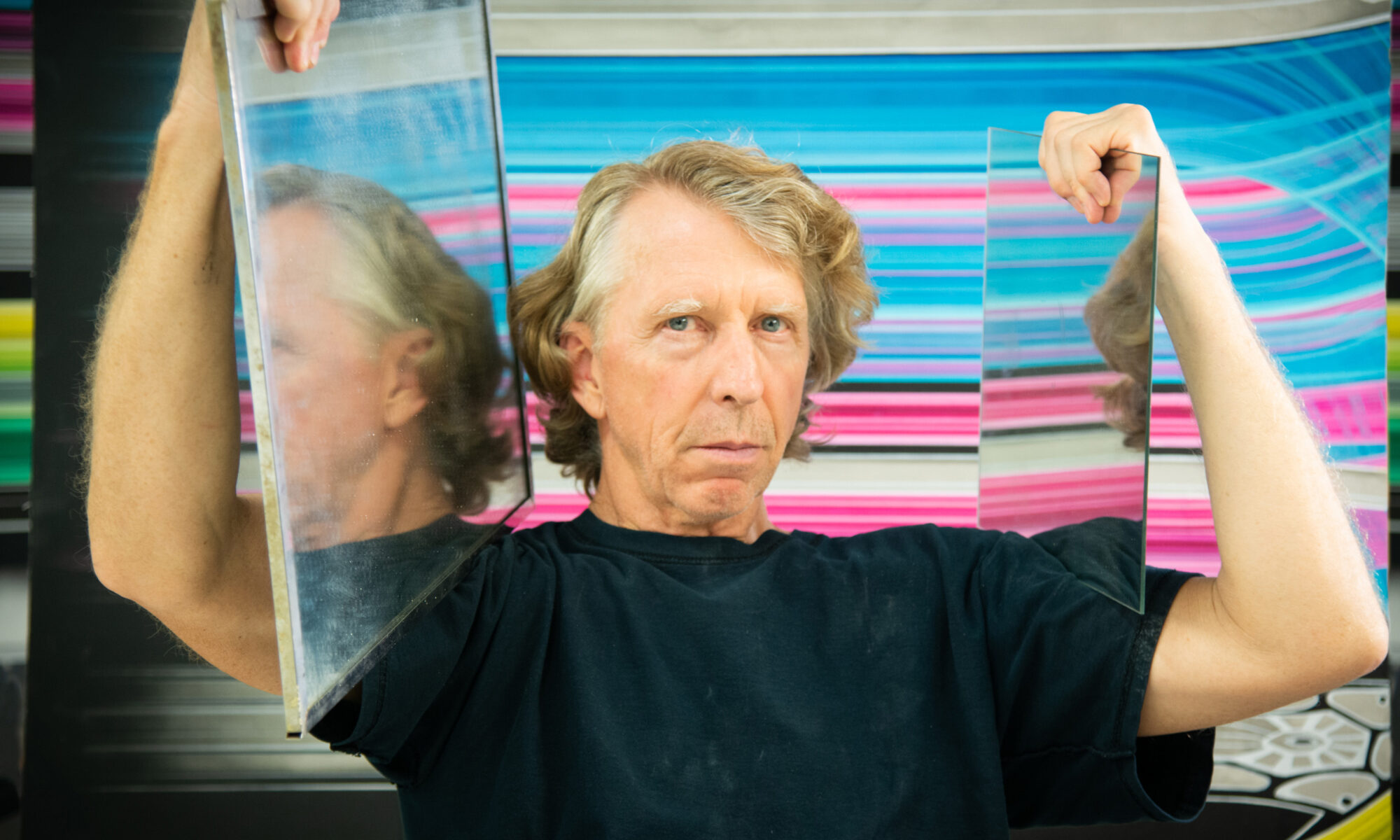
Timothy Makepeace has spent nine years making art about one of the most complex machines humanity has ever built. Since his first visit to NASA’s Goddard Space Flight Center in 2016, the artist has developed an expansive body of work in response to the James Webb Space Telescope — its gold-plated beryllium mirrors, its acoustic test chambers, the light it gathers from increasingly distant points in time. The culmination of that inquiry is Ghost in the Machine, on view at the American University Museum at the Katzen Arts Center in Washington, DC, through August 9, 2026. We spoke with Makepeace about working with NASA engineers, the formal decisions behind his square-format drawings, and what kept drawing him back to a telescope now orbiting the Sun a million miles from Earth.
You’ve spent decades exploring engineering, science, and the built environment in your work, often turning to industrial structures and architecture. What was it about the James Webb Space Telescope specifically that made you want to keep returning to it for nearly a decade, since your first visit to Goddard in 2016?
The JWST is an extraordinary visual and sculptural machine with its gold-plated beryllium primary mirror and unique function-dictated shapes, which I found artistically compelling. From the day I first saw JWST when it was only 30 feet away, I knew I would have a personal connection to the telescope through making art about it; that connection endures even when it ended up one million miles away, circling the Sun in a paired orbit with the Earth.
We often mistake art and science as parallel lines that don’t cross, but my work throughout the years has focused on finding the beauty within their intersections: their contrasts and similarities. With JWST, I found a synergy between the problem-solving process of the brilliant people who worked on the project over the years, building a scientific marvel that had never been made before — and my attempts to translate their achievements into art. Those scientists’ immensely imaginative solutions to questions that had no obvious answers were so compelling that they inspired my own creative ideas for nine years.
What was it like working with NASA on this — was your access a one-time visit, or did it continue as an ongoing relationship? What did NASA ask of you, if anything, and how did the scientists and engineers at Goddard respond to having an artist in their space?
Working with the engineers and science communicators was a great honor, and it was a true pleasure to interact with such knowledgeable and creative scientists, both in my official visits and in later conversations. The engineers at Goddard were all very supportive and interested in an artist’s perspective and interpretation of their work. I have since made friends with a few who helped me with engineering details, and who have come to encourage me at my exhibits.
NASA did not constrain me in any way or have preconceived ideas about my artwork. They hoped I would make art that would help communicate the great achievement of JWST, and display the work in an exhibit at the NASA Visitor Center, which I happily did. They were also supportive of my 2020-21 exhibition Reflections on a Tool of Observation: Artwork Inspired by the James Webb Space Telescope at the National Academy of Sciences, and contributed a foreword to the catalog.
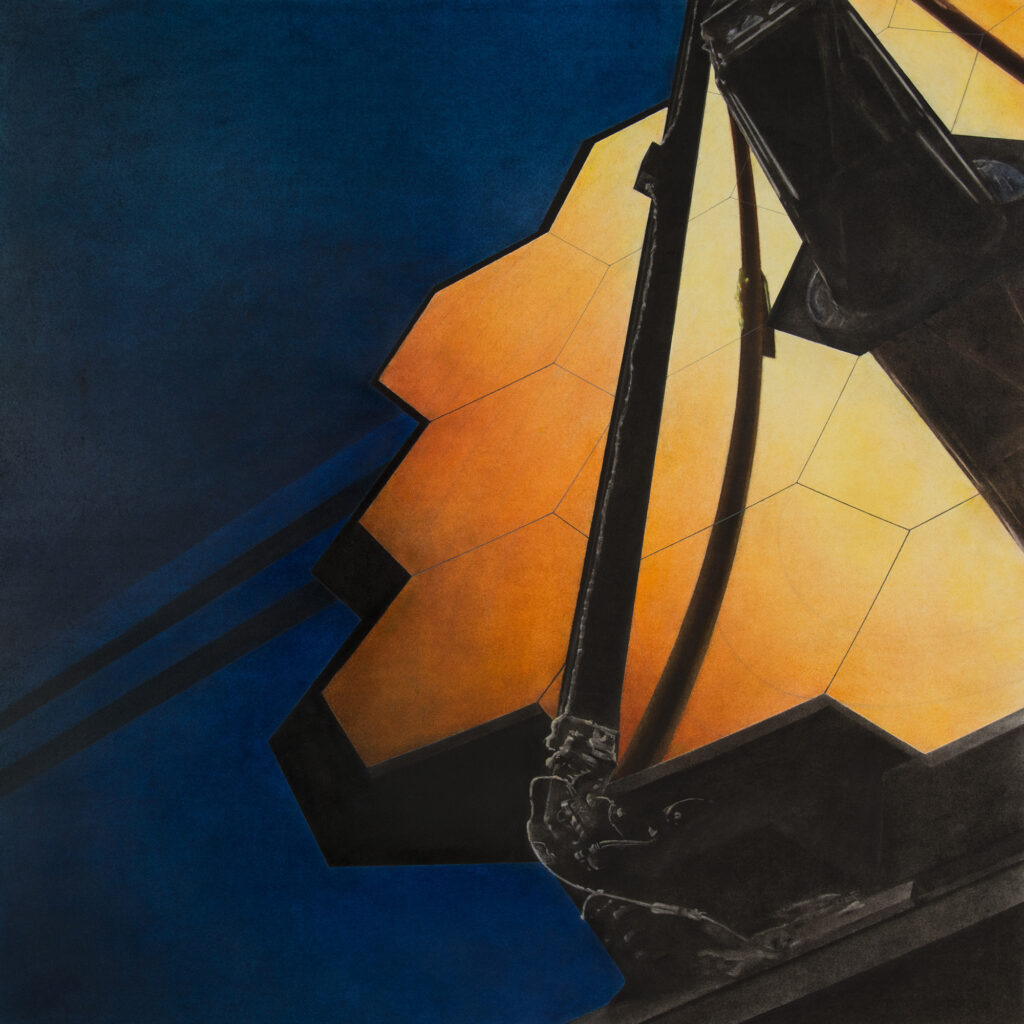
How has your approach to depicting the telescope evolved across this body of work — from the warm, gold-toned drawings using charcoal to render something engineered with extreme precision, to a piece like JWST Cryo Testing, rendered in white marks on black, closer to a star field than to hardware? What changed, and what stayed constant?
Fundamentally, the work ranges from the very close to the very far — from the drawings of the mirror, the heat-shield reflective film, the light path in the camera, to the distant orbital path of the telescope against the stars. Each body of work that I investigated led me on a path to consider another aspect of the telescope — what it looks like, how it works, where it is in the sky, and what it will be used for. I am tapping into a rich vein of potential inquiry.
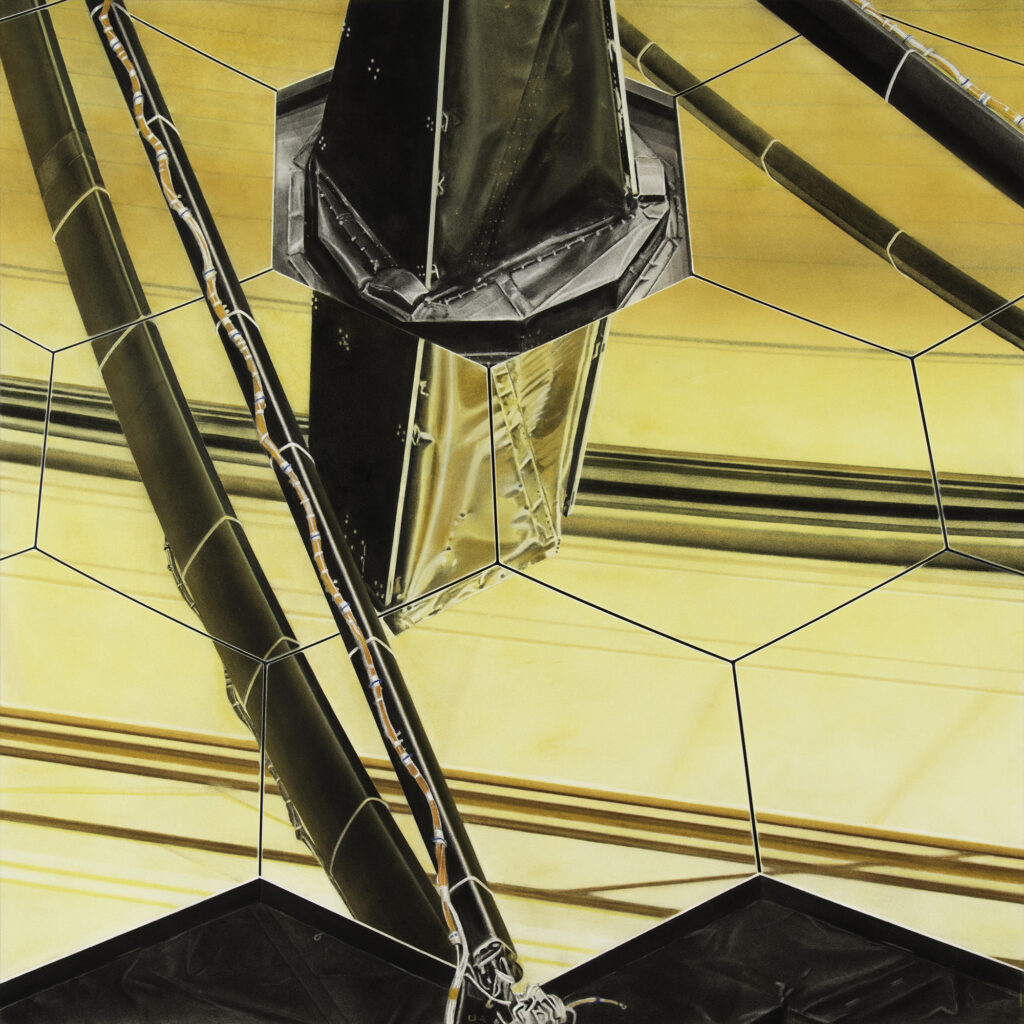
You’ve said that a photographed detail of the primary mirror happened to resemble a Feynman diagram’s bowtie shape, and that resemblance became the basis for the JWST vs. QED series. Can you walk us through how that visual coincidence led you to combine the two — and why the diagrams, which you’ve said illuminate the mutability of time and space, felt like the right counterpart to the mirror?
The JWST vs. QED series touches on the connectedness of space, time, and light. The drawings originated when I noticed a bow-tie-like shape in a close-up image I made of the JWST mirror. The shape reminded me, coincidentally, of a similar bow-tie shape depicted in the famous Feynman Diagrams. The idea was to use the juxtaposition of the formal shapes to link two ideas about the fluidity of time.
The superimposed diagram is a representation of quantum electrodynamics (QED), which describes how an electron can emit a charge-carrying photon, which can then be absorbed, slightly later, or slightly earlier, in time, by another electron. This demonstrates the fluidity of time.
The JWST can also be seen as a time-machine of sorts; the more distant the objects it images, the further back in time it sees. This is possible because the light emitted by distant objects takes time to reach our eyes. So, what we see has already happened sometime in the past.
The challenge I set for these artworks was to explore the notion that space and time are effectively interchangeable and are facets of the same thing, depending on one’s relative point of view. The work juxtaposes a rendering of the JWST’s large light-reflecting mirror (and its ability to see back in time), with a diagram describing quantum particles and the fluidity of time and our perception of light — the large and the small, the classic and the quantum, and the mutability of time.
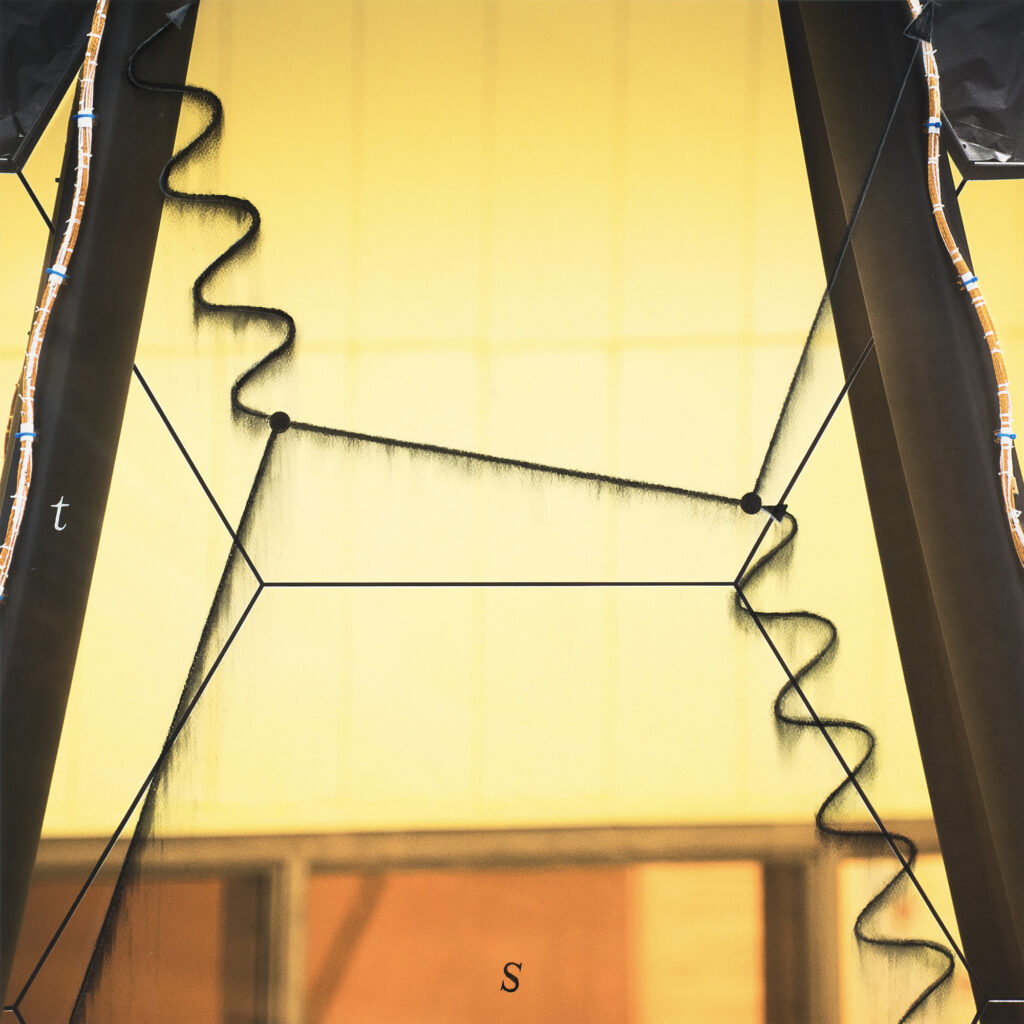
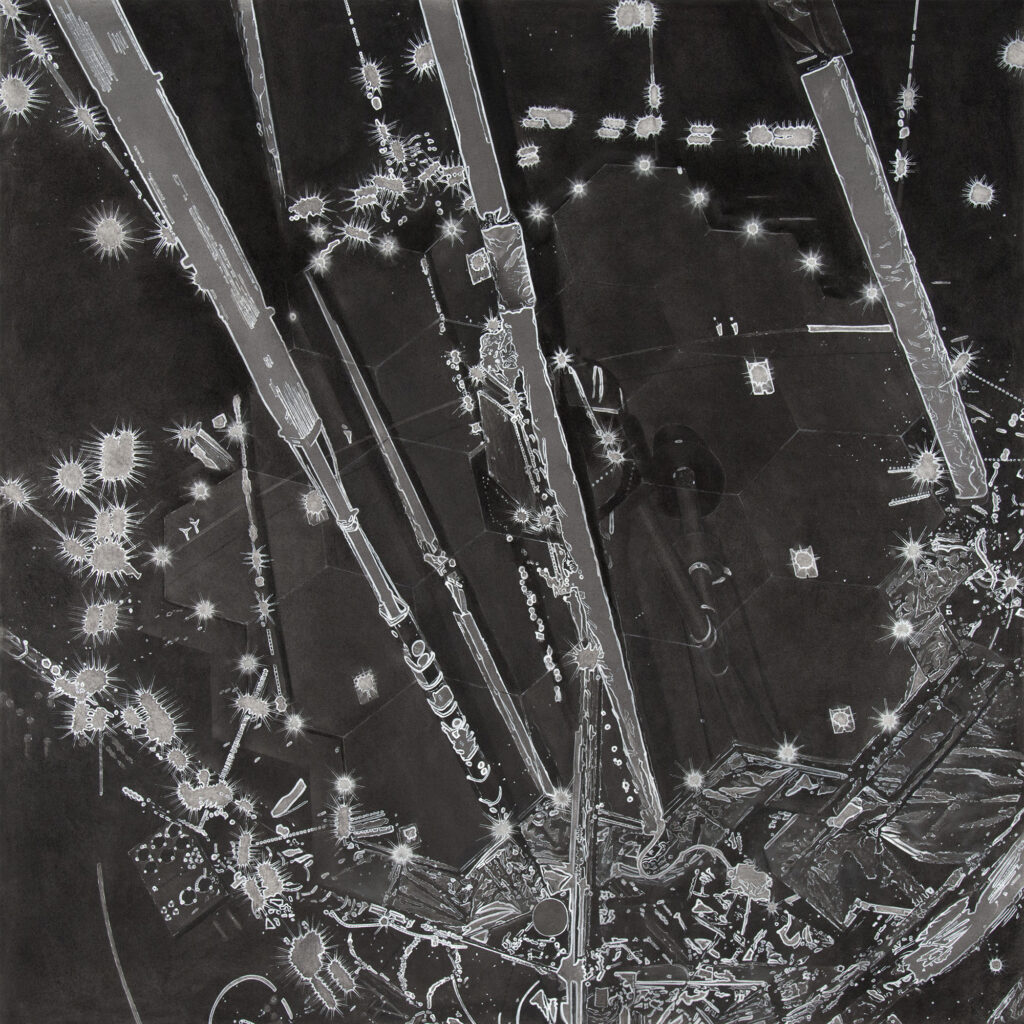
You’ve described Acoustic Test Chambers as depicting something boring in a sense, the chamber where the telescope was tested for vibrations, yet you were drawn to it. What is it about working elements and structural, mechanical things that interests you more than a more recognizable image of the telescope?
The Acoustic Test Chamber is not the most flashy machine, but it is very specialized and in service to the engineering of the telescope. It’s just a tool, albeit a very unique tool, but, like the JWST itself, it’s full of interesting shapes, angles, and industrial design, derived from its pure function.
I was interested in the juxtaposition of the mundane and the exquisite within the composition. Showing the unglamorous tool used to construct the telescope sets up a dichotomy with JWST’s exquisite engineering, as well as with the transcendent universal knowledge the telescope will eventually help us gain.
I think one of the things that drew me to the composition in the artwork was that, in the back of my mind, it had the feeling of a Renaissance painting, maybe one like Raphael’s School of Athens painting, with diagonal compositional lines leading the eye to the various points of interest and subjects. The Test Chamber has these diagonal lines, but they are more like false perspective lines that lead the eye in a circular path with no clear subject, other than the curious specialized elements of the machine.

You’ve said you chose a square format in part because it evades the horizon line we expect in landscape work. What was behind that decision, and how do you want it to change the way someone looks at the image?
I work in the square format because it’s not a portrait format, with its inherent pictorial expectations, and it’s not a landscape format, with its expectations of a horizon. It is something else: something more conducive to heightening the inherent abstraction within the subject. That’s what I want people to see.
The telescope is named for James Webb, who, as NASA Administrator, founded the agency’s art program in 1962, recruiting artists to record the history of space exploration. Did you know that history before starting this work, and how do you think about your own project in relation to it?
I was familiar with NASA’s art program from the 60’s. That program commissioned well-known artists to help publicize its achievements. The program I was involved in had no budget, no restrictions, and no expectations, other than to help spread the word about the amazing JWST. I think the idea was that the more the public is engaged with the program, the harder it would be for Congress to cut NASA’s budget. The result was, for me, total freedom to dream up and make whatever I felt like, which is quite liberating. It was an amazing and fulfilling opportunity, for which I’ll always be grateful.
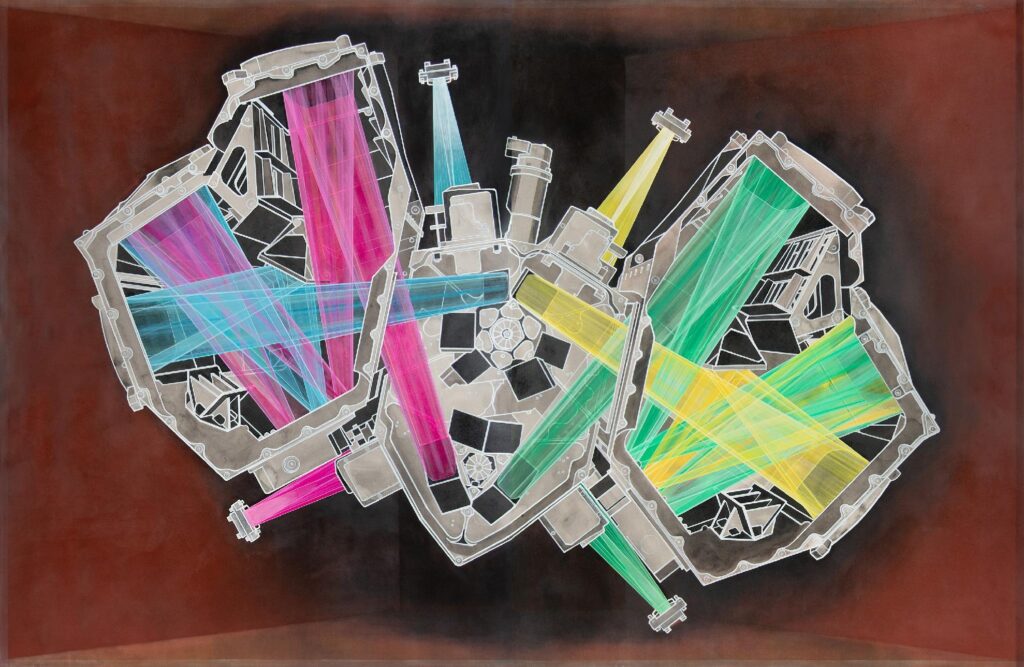
Timothy Makepeace: Ghost in the Machine at The American University Museum at the Katzen Arts Center on view June 13 through August 9, 2026.
Curated by Michael O’Sullivan and Thomas Drymon, the exhibition is the culmination of nine years of sustained artistic inquiry into the James Webb Space Telescope — the most powerful infrared space observatory ever built.
AU Museum is at 4400 Massachusetts Ave., NW, Washington, DC 20016. Exhibition runs Wednesday – Sunday, 11 am – 4 pm. Free admission.
Exhibition catalog
@aumuseum_katzen
Make your tax-deductible donation today and help Art Spiel continue to thrive. DONATE
About the artist: Timothy Makepeace is a Washington, DC-based artist who has worked in photography, sculpture, drawing, and painting, as well as various combinations of these media. His subjects range from gritty industrial infrastructure to his current fascination: the exquisite James Webb Space Telescope. His artwork explores the interaction of engineered structures, geometry, orbital mechanics, and nature. Influenced by Constructivism, a movement that elevates common building materials and emphasizes geometric abstraction, Makepeace investigates the interplay between realism and abstraction, as well as between the physical and ephemeral. He is both a photographer with a sculptor’s eye and a sculptor with a photographer’s eye; as such, his works reflect a degree of physicality as well as immaterial presence. Makepeace received a BFA from Cornell University and studied at the Corcoran School of Art and the Smithsonian Institution. He has exhibited widely and received multiple DC Commission on the Arts and Humanities fellowships. @tim_makepeace
About the writer: Etty Yaniv is a Brooklyn-based artist, writer, curator, and founder of Art Spiel. She works in installation, painting, and mixed media, and has shown her art in exhibitions across the United States and abroad. Since 2018 she has published interviews and reviews through Art Spiel, often focusing on underrecognized voices and smaller venues. More about her art can be found at ettyyanivstudio.com and on Instagram @etty.yaniv