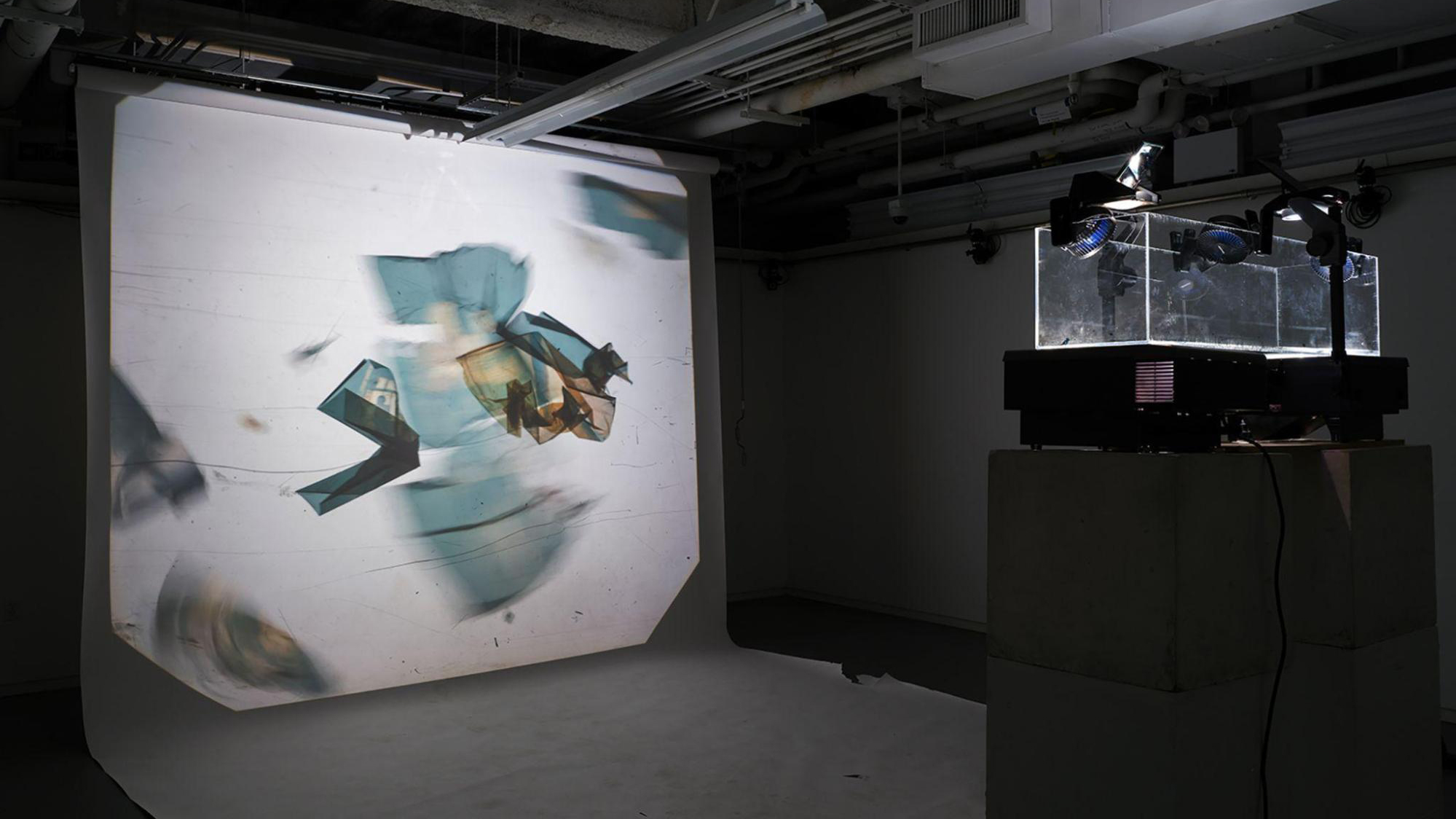
Since its invention in the early 1800s, photography has evolved from merely capturing moments. Over time, photography became intertwined with other traditional art mediums and slowly became a more accepted medium in the fine arts space. Now, with Parsons’ 2026 Photography MFA thesis show, Latency continues to expand what photography can be, literally.
The twenty-five artists utilize photography as a foundation for exploring memories, identity, and reexamination, telling a cohesive story by drawing on their backgrounds in other art mediums, such as ceramics, graphic design, film, and even fashion, just to name a few. They all use some form of reflection to enhance their photography, whether through mirrors, Mylar, or metaphorically looking internally and at the world around them.
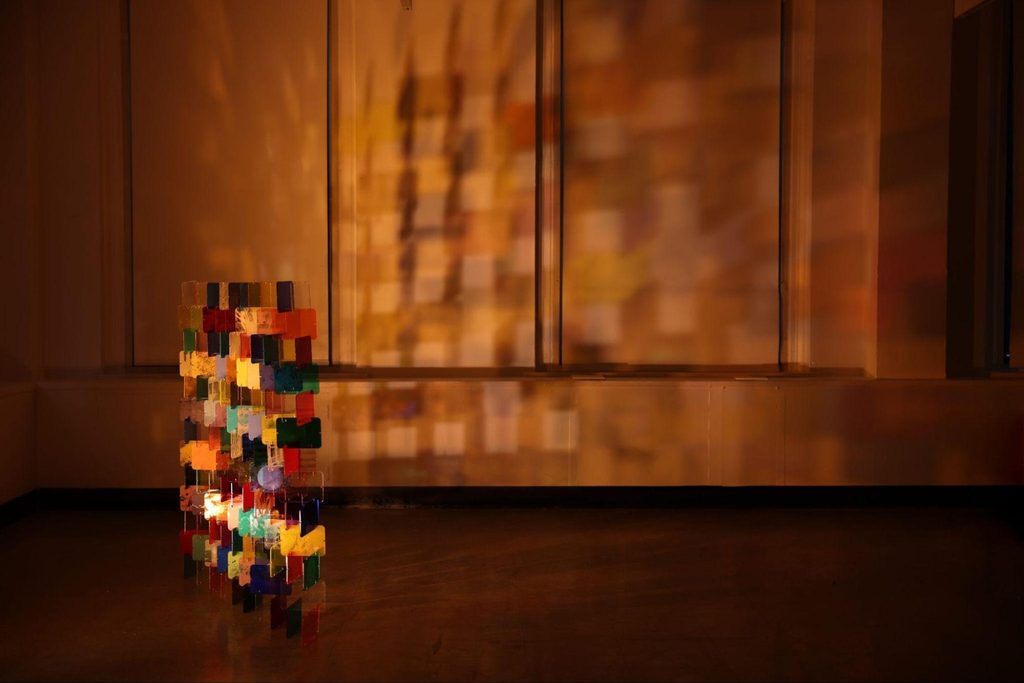
Eugene Lee and Yu Wang (also known as Yeti) both combine sculpture, photography, and installation, but in curiously different manners. In Lee’s What we can build from memory, Lee etched photos, similar to film negatives, onto bright and colorful acrylic cards stacked into each other to create a wall of memories. In this way, Lee’s work creates a strong sense of nostalgia by preserving memories of people and places. The use of color is almost the same way our eyes, as children, saw the world: brighter and full of saturation. As we grow older, our eyes tend to lose that vibrancy slowly.
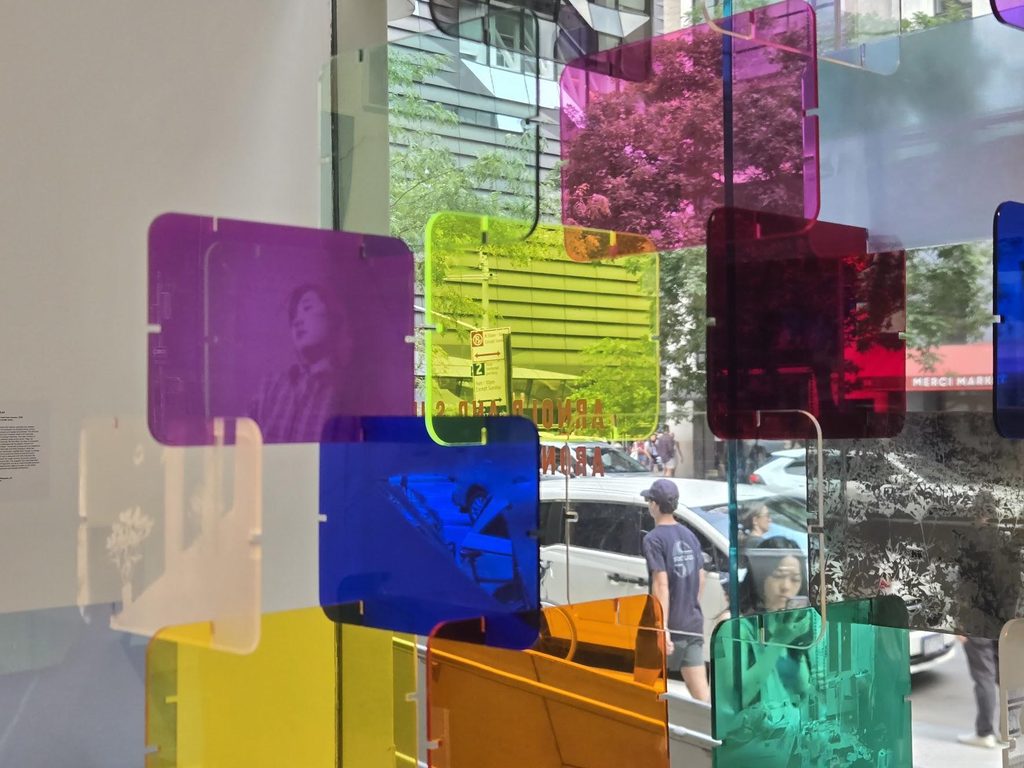
Displayed at the far side of the gallery space, close to the window, the semi-transparent, colorful cards alter one’s physical view of the space and the view outside the window. Because the window is in front of this piece, the acrylic vividly distorts its surroundings, and the hues overlap other cards. Lee’s artistic practice often engages the viewer with light and how it reflects, expanding photography almost in a three-dimensional way.
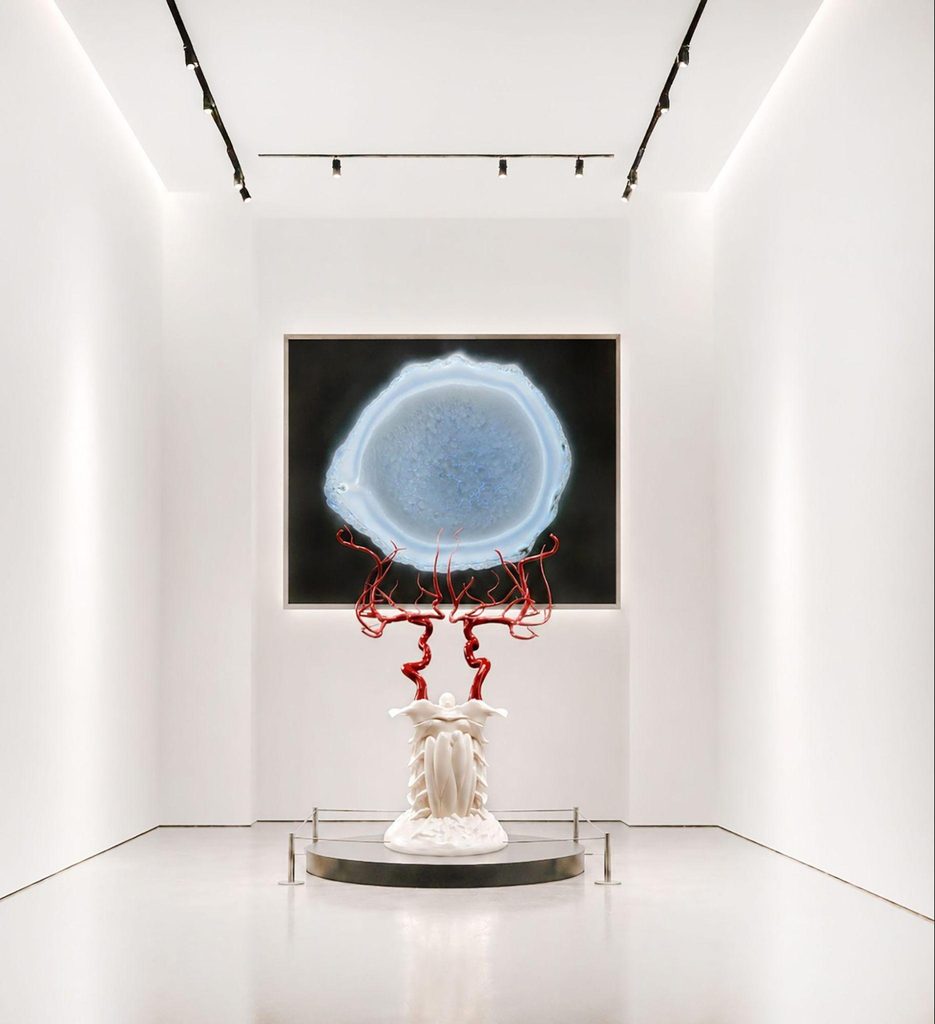
Likewise, Yu Wang combines a tree and human spinal sculpture, something three-dimensional, to enhance a digital scan of Wang’s brain, something two-dimensional, bridging the connection between the body and nature. The parallels between tree branches and cerebral blood vessels seen in medical images inspired her to create Where Thought Becomes Roots. When standing in front of the sculpture, the bright red “tree branches” draw the viewer’s eye to the center of the image behind it, making this two-piece artwork successful in engaging the viewer.
Wang is interested in producing interdisciplinary work driven by philosophy, poetry, and the natural world whilst diving into the intersection of Eastern and Western culture. By using these dual mediums, Where Thought Becomes Roots also speaks to the cultural differences and how they can speak simultaneously.
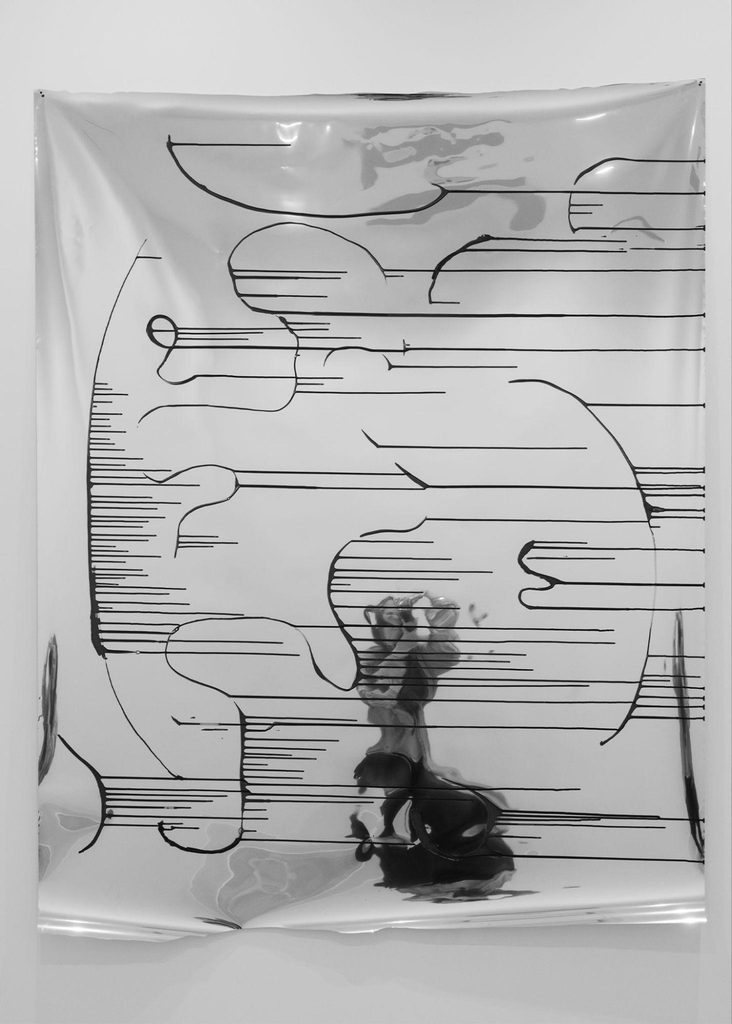
Nazli Erbes is an artist who plays with reflection through light, shadow, and surrealism. Erbe’s untitled works dabble with monochrome and material. I specifically want to highlight material here in her work because the artist uses Mylar. Since Mylar is highly reflective, you can see your reflection in Untitled #1 but mainly in Untitled #2. By using shape and different-sized lines, Erbes’ art makes everyday feel subtly unfamiliar while remaining anchored in recognition. By distorting common views, it becomes arguably uncanny.
Reflection in this show also goes beyond the literal and extends to the viewer’s inner reflection.
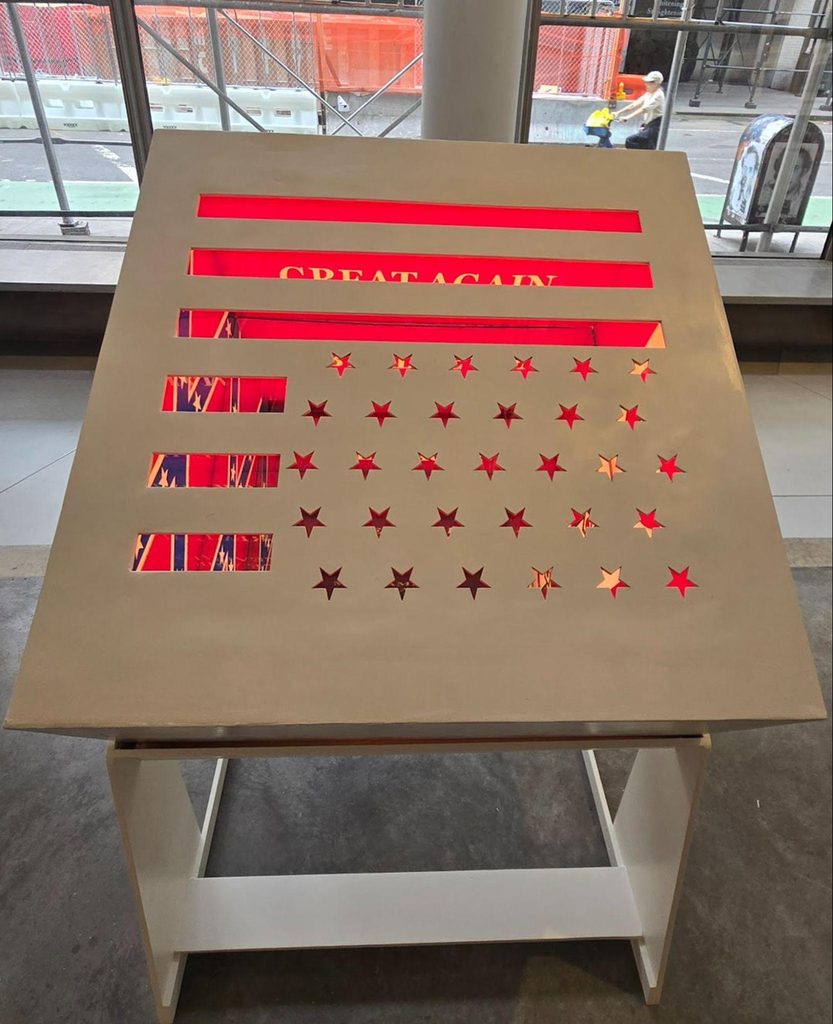
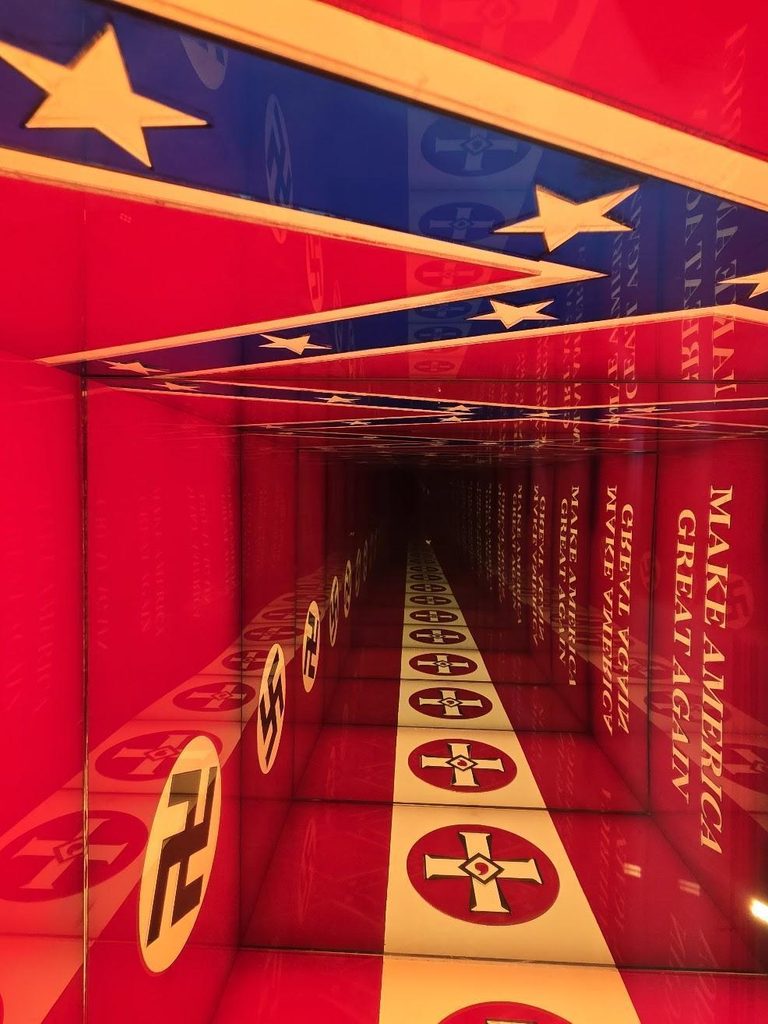
With political tension evidently reaching an all-time high approaching the upcoming midterm elections, Andrew Finch’s 31 Stars describes how hateful organizations are a continuing cycle of hate; the viewer is “responsible” for the rebranding as another one rises in its place after one is exposed. Here, Finch uses four flags: the Make America Great Again, or better known as MAGA, the Nazi flag, the Confederate flag, and the KKK flag, and mirrors them into infinity with the American flag outside of this glass box. The flags are used as commentary on how history repeats itself, in this case, in an extremely negative way.
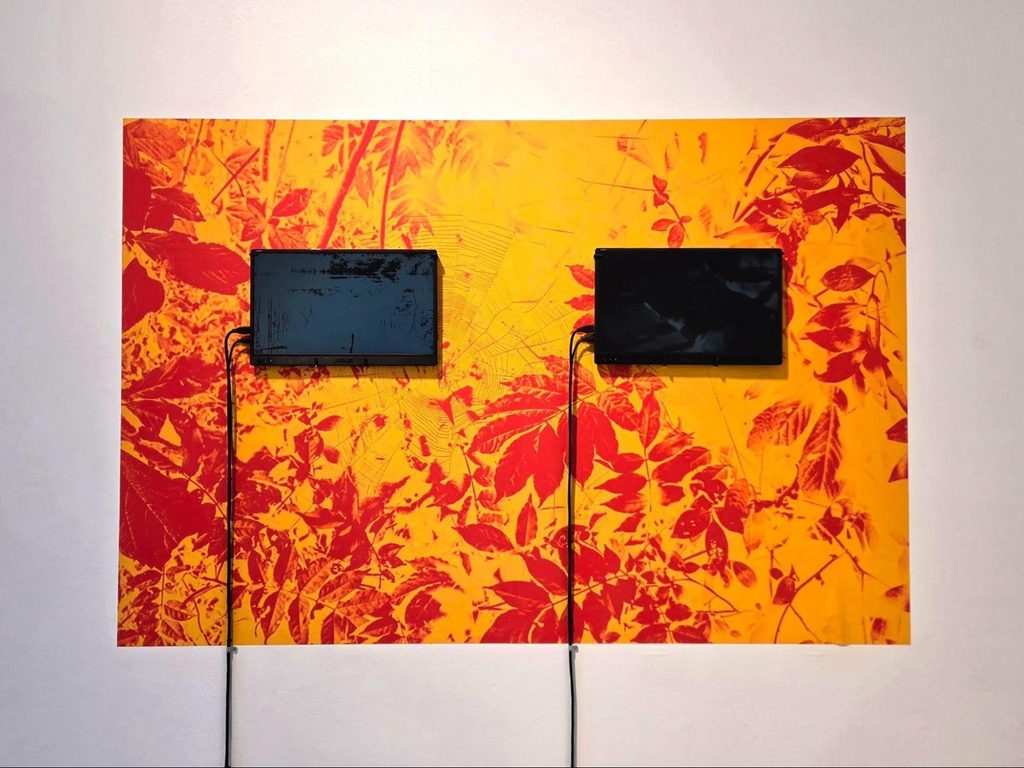
The radiant thermal photo, Second Connections, is hard to miss on such a pale, white wall, and draws you in. With the tiny screens looping a black, monochromatic film, it gives the illusion that, together, the work is moving through the woods at night. Garcia’s work, similar to Eugene Lee’s, explores how memory is constantly shifting and being rewritten. A distinct moment we remember from our childhood can differ from how our parents retell the story.
Latency as a whole is a reflection, both within ourselves as viewers and in how the artists reflect on their own practices and lived experiences. Photography’s nature lies in capturing a moment that cannot be replicated. Each of these artists uses their lens, both literally with a camera and metaphorically as a way of seeing the world, to pursue that fine line between the two.
2026 MFA Photography Thesis Exhibition: Latency at Anna-Maria and Stephen Kellen & Arnold and Sheila C. Johnson Design Center at Parsons School of Design: 66th Fifth Ave and 13th Street, New York. On View through September 17th.
Latency at Parsons features Francis Chiang @francisch24, Nazli Erbes @nazlierbes, Andrew Finch @afinchphoto, Kaityln Garcia @kshootsfilm, Sarah Grey @ess.geezy, Lexi Hide, Jai Jain @jaijain.photography, Aylin Koc @aylinekoc, Madison Lanier @maddie.lanier, Eugene Lee @leeugene_art, He Li @taniraliii , Kyla Liang @kylaliangphoto, Ivo Nagel @ivocnagel, Stephen Yiling Peng @stephen_p10 , Tania Quintanilla @_tqstudio_, Valentina Rangel @graphicsbyv__ , Maelle Rudner-Mercier, Bai Song @baibaibaiei, Leana Spain @leanaspainphotography, Suga Barua @xxivksuga, Jerry Tang @jztang_, Sophia Valentino @svalentinophotos , Yu Wang @yetione886, Hang Yu @yu.7hang, Miraal Zafar @miraalzafar.
Make your tax-deductible donation today and help Art Spiel continue to thrive. DONATE
About the writer: Sara Aparicio is a Queens-based mixed-media artist and writer. She is currently studying for her BFA in Fine Arts at the Fashion Institute of Technology. There, she also contributes to FIT’s newspaper, W27, as both an editor and a writer. Occasionally, she dabbles in writing poems about what occurred in her life. Similarly, the subject of her artwork primarily focuses on creating accurate representations of her Colombian and Puerto Rican heritage, whilst also raising awareness of issues not spoken about through advocacy in the form of paintings, drawings, collages, and sometimes prints. Her poems and artwork have been published in both an edition of Forest Hills Community Building’s newspaper, The Orbit, and SUNY’s literary magazine, Gandy Dancer. Since 2023, her art has been showcased in Free Arts NYC’s annual Youth Showcase. Sara’s most recent exhibition was at a local show with A-VENT-SPACE. You can find more of her artwork on her Instagram page: @sara.aparicio.studio