
Memory is a fickle thing. However, when viewed through a neuroscientific lens, memory is also a biological process. Serena Scapagnini’s artistic practice, her recent Saliency, La Memoria Cangiante (2026) in particular, explores the retrieval of memory in its interdisciplinary entirety. Inaugurated on June 4th as a permanent installation at the Wu Tsai Institute at Yale University, Saliency, La Memoria Cangiante opens a wider reflection on the position of memory, whether as process or personal attachment, in Scapagnini’s work and current projects.
Your work moves across many mediums and geographical locations; however, I’ve noticed a continuous return to painting. What does painting allow you to investigate that other mediums do not? Why was it important that your work at Yale revolve around painting?
My painting is layered; it begins with the making of the paper itself, where I insert metallic blades into the sheets and prepare them with acid to allow the image to embody hyperbolic rarefactions. Only then is the support physically painted. Ink explores the narrative fabric of the work and of memory, seeking the wonder of a memory that is at once individual and collective, where the two inevitably converge. I use mineral powders and pure pigments, applied by hand in a highly volatile manner. Finally, through external lighting, I heighten the transparency of the painting.
This material layering is my method for giving form to an ongoing reflection on memory and perception; one I’ve been developing through more than a decade of dialogue with the Neuroscience, Psychology, and Physics Departments at Yale University. The insights emerging from these shared scientific inquiries flow into my work, which returns to painting, surrendering itself to a medium of greater intuitive eloquence. Painting brings this investigation back to a tactile realm, channeling ideas directly into matter, without mediation.
For Saliency, I explored the formation and reshaping of memories that are mutable in time, and in a certain sense, unreliable. I was fascinated by the divergence between experience and the formation of memory, with its substance and plasticity, persistent gaps and shifting details within its reservoir.
These observations are translated into painting, proposing an activation akin to memorial mechanisms and inviting the viewer to complete an infinite number of figures across the material flow of the blue wave. Inspired by the folds of the hippocampus, the artwork seeks not so much to capture as to offer the viewer’s gaze myriad shifting, salient details from the flowing river of memory.

While Saliency awaits the gaze of any viewer to be activated, your ongoing project, Fugacity (2008–), focuses on the narrative memories of ten specific subjects. Could you share more about the research you undertook for Fugacity?
Fugacity foregrounds a deeply intimate dimension of participation. It brings together ten individuals, primarily living with Alzheimer’s, Lewy body disease, or other dementias, choosing to share their memories, visions, and perceptions across their experiences of memory dissolution. Their stories come from various countries around the world, and these encounters take place with the scientific support of Dr. Carolyn Fredericks at Yale School of Medicine and Dr. Michael Stanley at Tufts Medical Center. The project reflects on the essence of memory, on its substance within the layered nature of the mind, and on the role it plays in our perception of time and identity, through a delicate and respectful exploration.
Fugacity defines a principle in physics: a measure of the tendency of a substance to transition from one state to another. A solid body dissolves into a liquid state, then moves beyond it, transforming into an aerial form. Oil painting restores a sense of weight, a solid, plastic, deceptive, and “real” anchor, while I place the river of memory in a fluid dimension; the soul, rooted in the world, crosses and experiences its different densities of pigment, traces, and light, transforming them into the white space.

In both Fugacity and Saliency, there is quite a bit of visual focus on water and the vessels we use to explore it. Why is water so central to your more recent explorations? Will it continue to thread through your future projects?
I am interested in thresholds, edges, and crossings, and therefore also in the points of contact between different densities as they meet. Aquatic imagery like boats, jellyfish, and vessels of various kinds recur in my work. They play with bordering zones: between form and flow, between image and void—a fundamental element of all my paintings. Water creatures, in particular, inhabit the imagery of my China ink drawings as dark vectors of memory that emerge materially and spontaneously from the more fluid areas of the work. Over the past twenty years, my work has been deeply imbued with aquatic symbolism, where both art and memory arise from the fluctuating, mutable retrieval of life.
In addition, the very process of painting is fluid and autonomous, preceded both by the symbolic language of events and the underwater language of dreams. And its fluctuating, recursive, profound nature is like a dive; an abyss; an inexorable autopoiesis unfolding through its archetypal and eternal figures.
The work is conceived, designed, and executed by layers at every stage, all while maintaining the capacity to manifest itself as despotic and free, and, through ink in particular, as something uncharted even for myself.
From this aquatic dimension, which carries ideas across, come many of my works, both in the projects you mention and in many others currently in progress.
In Fugacity, the gradations within the work create twilight between the different states of aggregation of water. Water is the quintessential dissipative medium. It carries memories that evaporate and condense through time.
In Saliency, the blue wave reflects the competing ideas of transience and permanence that characterize the creation, retention, and decay of memories over time. In the painting, floating images seem to emerge from the very matter of the artwork; a pareidolia, bridging thought and the world.
In my upcoming public interventions, I will return to boats for a series of works around the nature of time.

I’m interested in the various binaries that define your work. Beyond straddling the borderline between Art and Science, you are both an Artist and a trained Art Historian. You also work between two places, languages, and cultures: New York and Rome, English and Italian, etc. What do these binary categorizations look like in your everyday process? What about in your daily life and wider career?
The dialogue between Art and Science, as I’ve come to experience it at Yale, presumes that neither field should be considered ancillary or didactic to the other. I consider scientific inquiry a strong inspiration for my work: fertile, but not at all exclusive. My greatest points of connection with the researchers, faculty members, and scholars working on laboratory experimentation, neuroscience and robotic computation, psychology, physics, and quantum physics always lie on an intuitive level. Within these collaborations, naked, foundational ideas take on the garment of art or the formal rigor of empirical data. Thought contemplates their essence—the mystery itself. Eventually, it discovers the rhythm, the visual harmony of their underlying geometries, much like in the Superposition (2025) project, which draws upon the ability of a particle to exist in multiple states simultaneously as a metaphor for identity, memory, and perception.
In my research, these binary choices are complementary: a cross-disciplinary framework that touches art, art history, and indeed science to contemplate how perception and matter intertwine, and how humans actively construct the worlds they perceive. My life and daily work have, in fact, been enriched by entering into a kind of international “superposition,” as I maintained my studio in Rome alongside two separate studios in the United States for years. I’ve also worked with simultaneous data-visualization software, in synchrony with and thanks to physicists at the Yale Quantum Institute. I’ve painted parts of the works across borders, surreptitiously carrying handmade paper from Fabriano with me through every embargo. I have been able to exhibit and discuss works, ideas, and illusions across different countries and languages, as a spectacular opportunity to re-mesh through a profound clash of positions—not only artistic, but also ethical and political.
What sparked your interest and curiosity toward memory? How do you plan to look toward the future while focusing on memory? What are you working on now?
In my life, there was one person in particular who remembered many things. Opera arias; novels; the history of Europe; loves. I began to wonder where memory goes when the stories are suspended. What its substance might be. I realized that everything has a physical storage, even memory. And so, it all began with gratitude to Michael Higley, a neuroscientist at the Yale School of Medicine, who believed in my work.
My current and forthcoming projects involve new phases of development, both through the continuation of my collaboration with Yale and through a new project with the Swiss Quantum Mission. A series of works will be presented at the United Nations Headquarters in New York in an exhibition that extends these reflections on the mutability of memory across art, quantum physics, and neuroscience. A parallel exhibition will be held at the Italian Cultural Institute of New York, followed by a project at Magazzino Italian Art. In the spring, I will be artist-in-residence at the Boghossian Foundation at Villa Empain.
In addition, I am preparing several exhibitions and site-specific interventions across Europe, including the UK, Switzerland, and Italy, aimed at developing immersive environments that transform viewers from passive spectators into proactive participants within perceptual fields: a process through which both the observer and immanence continuously emerge.
All this talk of memory is making me quite curious. Is there any memory or scene that you return to while you work? Would you feel comfortable sharing any of these?
Throughout the entire process of creating a work, deeply ancient memories emerge. Yet it also happens, especially when I have the privilege of working on portraits for the Fugacity series, that in the studio, as in so many other absorbed moments of the day, a connection is established with the subject of the piece: a recurring thought, a memory of self that somehow passes through the other, a falling in love.
And this ancient, always somewhat surprising aspect of portraiture remains present even when working across oceans, supported by photographs, narratives, and audio, and drawing upon the historical and cultural memory of different places around the world. Even so, when I work on paper, all my thoughts are suspended, channeling only the action of artistic practice. More than a remembering, a forgetting.
Saliency, La Memoria Cangiante, Wu Tsai Institute at Yale University, New Haven, CT, permanent installation curated by Professor Nick Turk-Browne. For more information: [email protected]
Make your tax-deductible donation today and help Art Spiel continue to thrive. DONATE
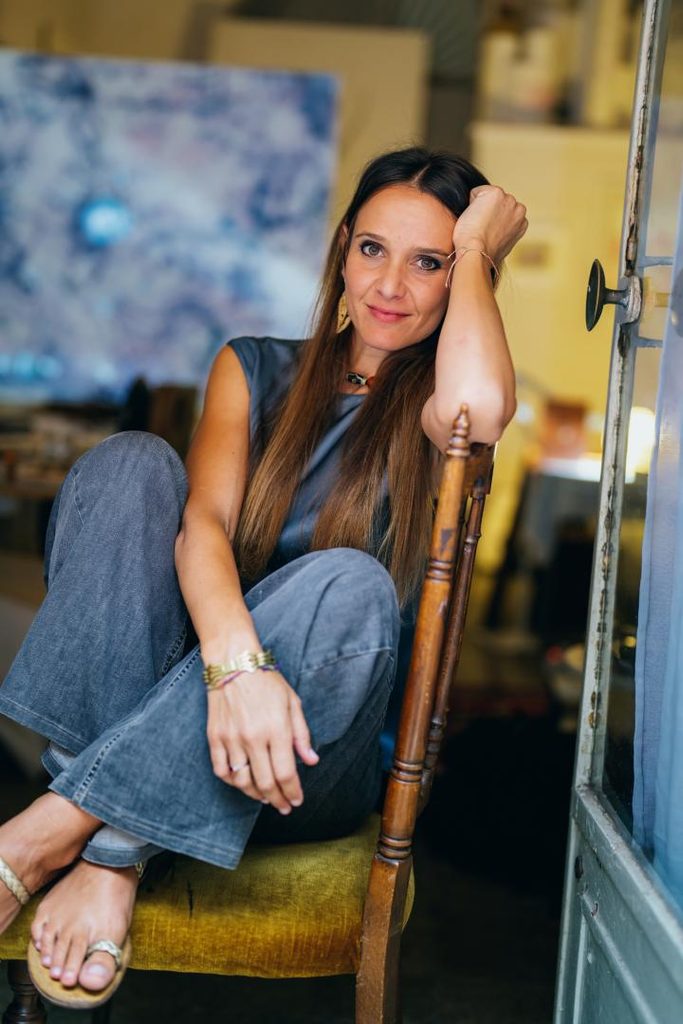
About the artist: Serena Scapagnini (Rome, 1983) is an Italian visual artist and art historian based between Rome and New York. She graduated from La Sapienza University, Rome, with a dissertation in Art Theory, Semiotics and History of Religion (2006), and she received her Master’s degree in Medieval Art History, Iconography and Iconology at the University of Siena (2020). She trained artistically between Paris (Université de Vincennes, Paris VIII, 2005) and New York, where she completed a Master’s Program in Painting and Mixed Media at the School of Visual Arts (2007). She is a Young Fellow of the World Academy of Art and Science. @serenascapagnini serenascapagnini.com
About the writer: Agnese Fanizza is a writer, curator, and architectural historian based between New York and Rome. Her work explores transnational and interdisciplinary narratives of modern and contemporary art and architecture. She holds degrees from Columbia University and the University of St Andrews, and has worked in curatorial roles at MoMA’s Department of Architecture and Design and the Guggenheim New York. @agnesefanizza [email protected]