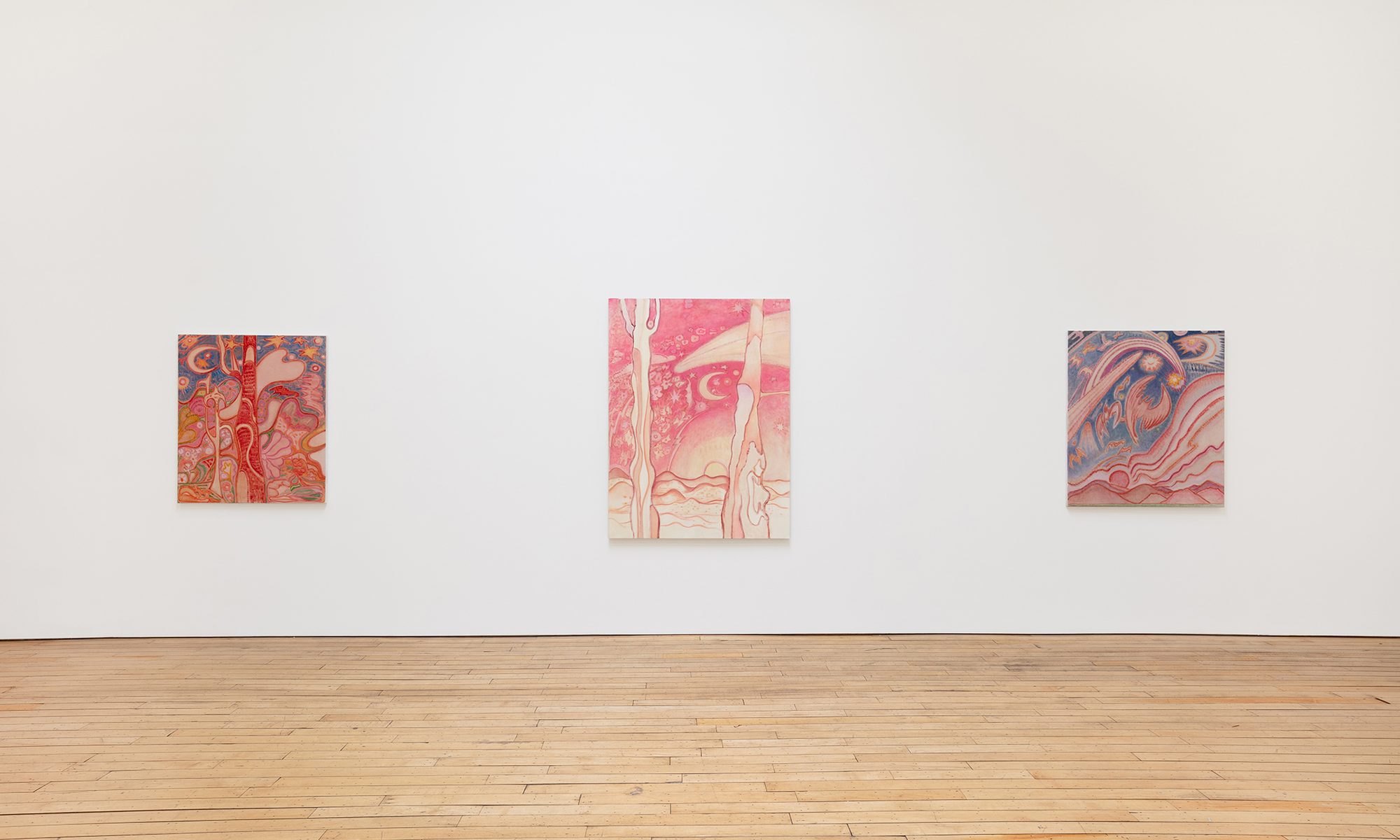
The liminal space between abstraction and figuration—between the defined and the loose, the restrained and the free—is the terrain of Laurie Nye’s first solo exhibition at Uffner & Liu in New York. In her new paintings, which range from intimate, jewel-like compositions to modestly monumental canvases, Nye proposes that everything we see can be two things at once: a flower and a portal, a tree and a cosmic axis, a landscape and a state of mind.
Upon entering the exhibition, the word “nature” immediately comes to mind—not nature as the depiction of a particular landscape, but as the animating force that makes plants grow, rivers flow, clouds drift, and nocturnal creatures take flight. Working in oil on linen and a vivid palette of pinks, greens, ochres, and lavenders, Nye builds environments that feel simultaneously observed and imagined. Her brushstrokes are decisive yet fluid, directing the eye through looping paths that recall a winding river or the movement of air through a tree. Stars, spiderwebs, flowers, insects, and owls emerge throughout, but they rarely become isolated protagonists. Instead, they blend into larger ecosystems in which every element appears connected to—and dependent upon—the others.
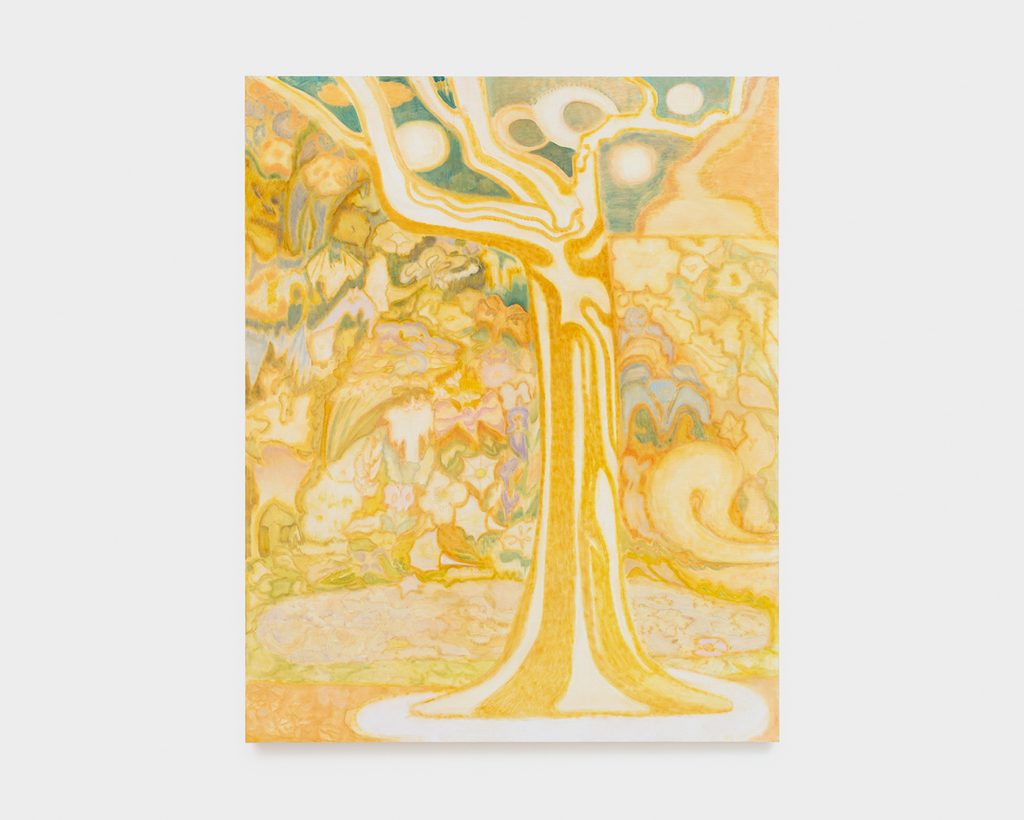
Much of Nye’s work begins in observation: the landscapes around her, memories of growing up in Memphis, and the natural environments she encountered while working in Los Angeles and during a residency in Albuquerque. Yet observation is only a point of departure. In Cottonwood (2026), for example, a pale tree rises vertically through a field of yellow, gold and muted green, its trunk dividing and connecting the composition at once. The painting originated with a cottonwood tree in the garden of Nye’s temporary home in Albuquerque, but the resulting image feels less like a portrait of a specific tree than an embodiment of growth itself. Roots, branches, earth, and sky occupy a single flattened plane, suggesting that what exists above and below ground belongs to the same continuous system.
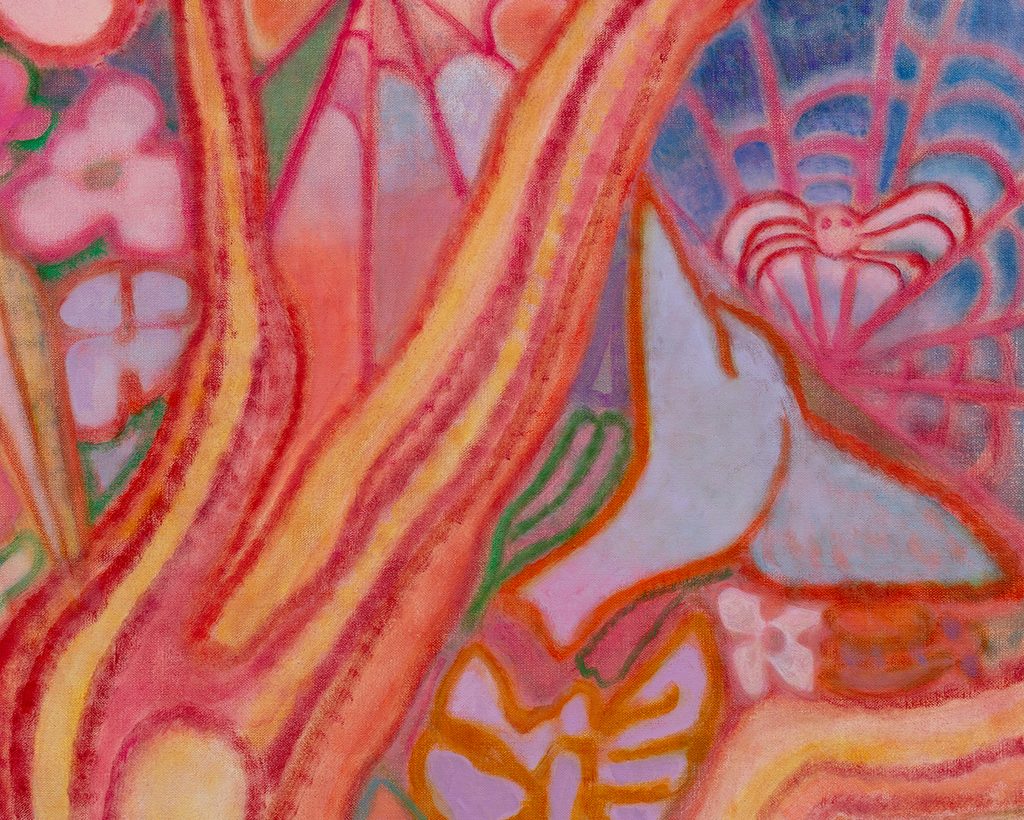
Elsewhere, Nye’s natural forms move closer to an internal or remembered landscape. In Healing pt 1 (2026), a network of deep pink branches encloses flowers, insects, and delicate webs within a densely layered environment. The picture offers no stable foreground or background; its forms overlap, dissolve, and reappear, allowing the painting to be read as both a thicket and a psychological space. As in the work of the Nabis, color does not simply describe the visible world. It establishes an emotional temperature. Nye’s pinks, in particular, can feel nurturing and ecstatic, but also bodily and exposed.
Cosmology and spirituality become especially present in The Astral Plane, for Late at Night and The Battlefield Where the Moon Says I Love You (both dated 2026). In these paintings, Nye’s gaze moves away from the earth and toward a nocturnal universe sprinkled with crescent moons, shooting stars, and winged creatures. Rather than separating the celestial from the terrestrial, she allows them to flow into one another. In the exhibition’s title painting, a rhythmic succession of curved lines sweeps diagonally across the canvas, carrying a group of airborne forms through a dusky pink expanse. The sky becomes active and embodied—a place of motion rather than emptiness.
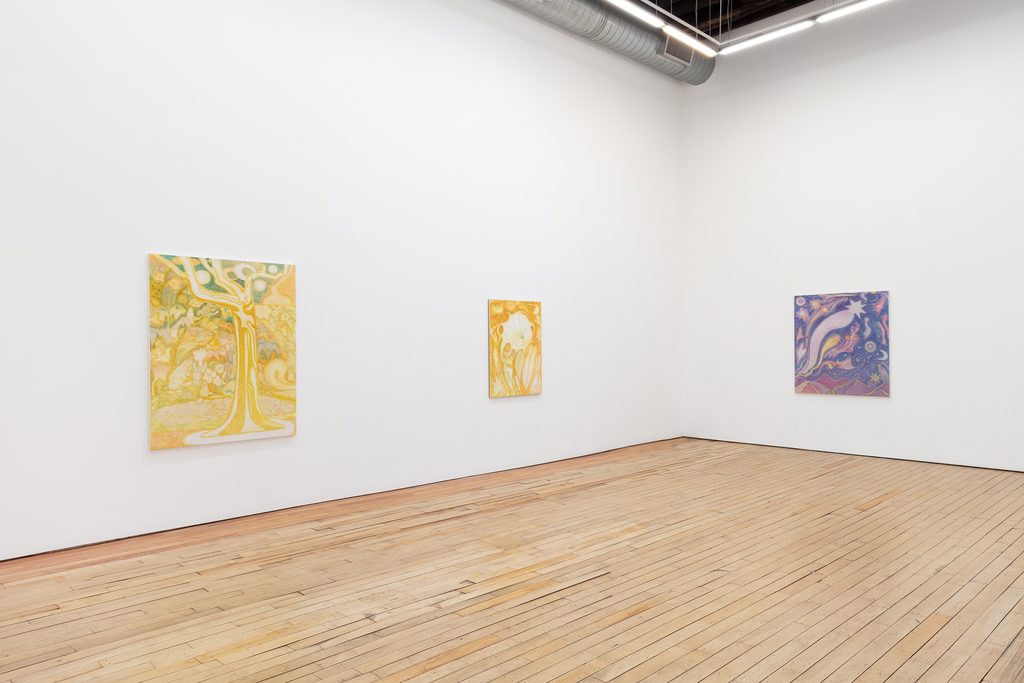
The exhibition takes its title from fellow Memphian Frank Stanford’s sprawling 1978 poem The Battlefield Where the Moon Says I Love You, a work in which memory, myth, violence, and the Southern landscape collide through an associative flow of language. Nye’s paintings follow a related logic. Their imagery accumulates rather than resolves, with one form continually transforming into another. The “battlefield” invoked here is not depicted literally. It is found in the fragile balance between growth and destruction, vulnerability and resilience, and the desire to protect a natural world increasingly placed under threat.
This interconnectedness is particularly evident in The Magic Flute (2026), the exhibition’s largest horizontal painting. Soft passages of pink, green, blue, and lavender form a richly populated habitat in which roots, branches, flowers, and animals commingle. An owl sits quietly within the composition, less as a focal point than as a patient guide through the painting’s labyrinth. The eye circles the canvas, following one line into another without arriving at a single point of conclusion. Nye’s landscapes are not views to be mastered from a distance; they are environments into which the viewer must enter.
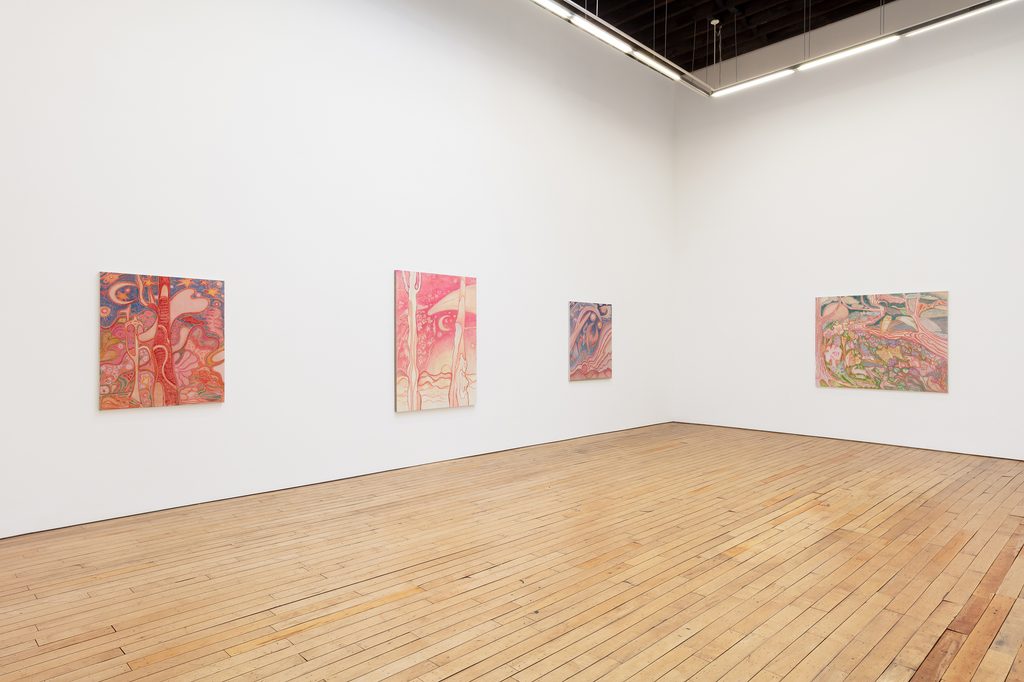
Throughout the exhibition, Nye dissolves distinctions between the microscopic and the cosmic. The interior of a flower can resemble a constellation; a spiderweb can become a map of the universe; a tree can connect the earth to the stars. Her paintings suggest that attention itself—looking closely at a plant, a moth, a cloud, or the night sky—can be an ethical and spiritual act. Nature is neither scenery nor metaphor alone. It is a living structure of relationships, one in which contradiction is not something to be resolved, but a condition of being alive.
Courtesy of Uffner & Liu, New York
Laurie Nye: The Battlefield Where the Moon Says I Love You is on view at Uffner & Liu, 170 Suffolk Street, New York, from September 10 through October 31, 2026. @uffnerliu