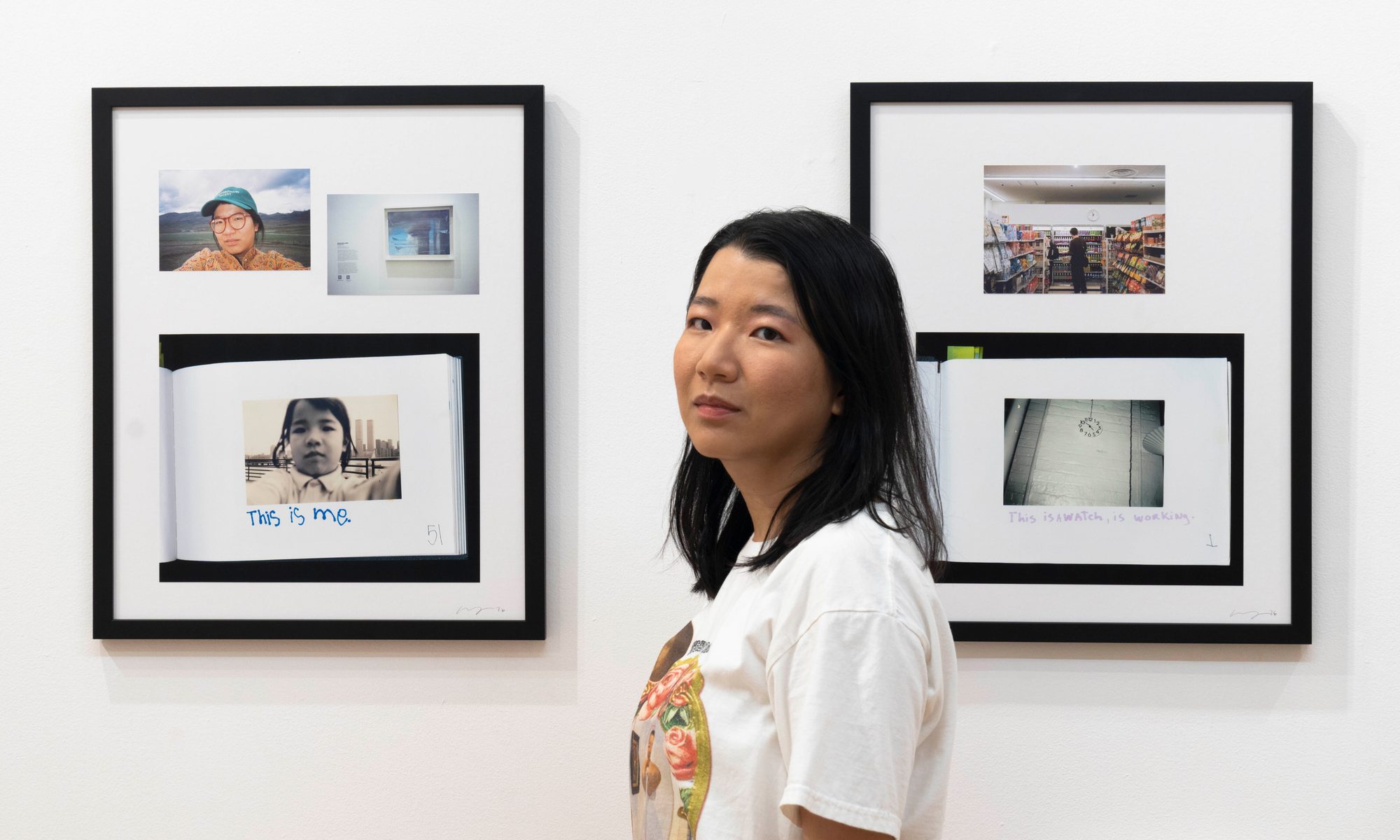
In 1996, a six-year-old child was given a camera and sent out to capture the world through her eyes. She aimed the lens at her father’s back against the Twin Towers, at her own blurred hand, at a sculpture in a museum, at Buddhist drawings on the wall. She had recently arrived in the United States, and the world in front of her was made of curiosity, novelty, and strangeness.
After 30 years, these photographs hung in This is Me Looking, a solo exhibition by the photographer Wen-You Cai, at Accent Sisters, exhibited from August 6 through August 30. The show gathers fourteen sets of images; each pairs a scanned copy of a photograph Wen-You took in 1996 with her handwritten captions, with an image she made between 2025 and 2026. What time did not erase is an ambient sense of wonder and zeal. When Wen-You was invited by artist Diana López to participate in her project El Ojo de… (The Eye of), she treated the camera less as a medium or a tool than as company, a witness to her bold, whimsical exploration of the world. Setting those childhood meanderings beside moments she caught on trips, on walks, and at home, she makes time a highly recognizable presence, something that materializes between the frames. We spoke with Wen-You about the origin of This is Me Looking, how photography has evolved in her personal and artistic life, and what it means to converse with a younger self through tangible creations and association.
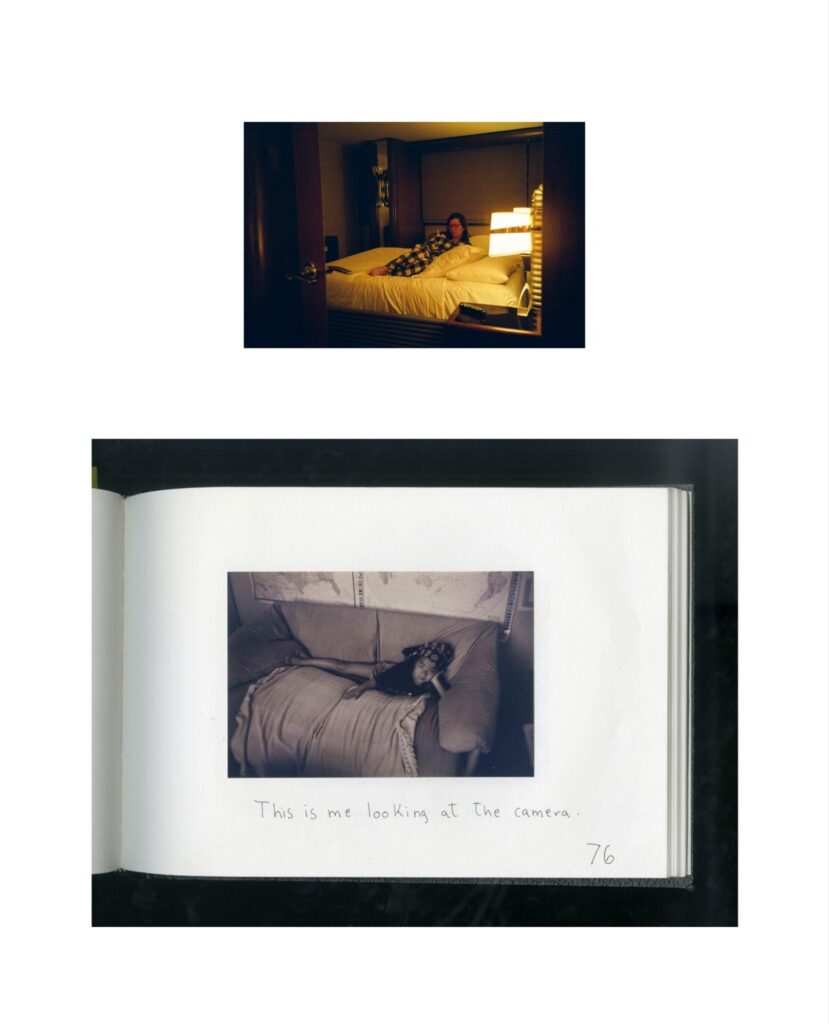
You grew up in an artistic family, and much of your childhood was spent in museums and galleries. You’ve said that you always wanted art to be more functional, and in When You Make No Art, you also wrote about wishing museums offered something the audience can play with rather than just look at. How did that early interest in the tangible shape your work now, and is that sense of interactivity still what you are searching for?
I am always seeking to create something relatable. It probably stems from the desire to connect with others, since I grew up mostly feeling lonely in environments without people my age. The creative language and sensibility honed from my upbringing are something I use to connect with like-minded people.
I think I will always try to find ways to engage with others, whether through tangible forms or more roundabout ways. In the early days of my creative platform Special Special, I wanted to create functional art because I believed that if something served a function, the entry point for appreciation would be stronger. Later, with Special Special’s foray into 4N magazine, we built communities around the challenges of creative migration. In the case of my photography, the subjects are personal, but I hope that through it, people will find some way of relating to them as well. I also make ceramics, and I tend to make vessels that can be used.
Can you walk us through your history with photography? Was it habitual before it was deemed a serious practice, or did it start off as a medium early on? What has stayed constant in your relationship with the camera, and what has shifted?
I was always afraid of turning photography into a serious practice. I have always enjoyed capturing the things that are curious to me and sharing the photos with others. I think sometimes my memory is colored by the images I capture to preserve a moment in time.
After I photographed with Diana López for her project when I was six years old, I didn’t pick up a camera regularly again for a long time. But because of the feedback I got from the adults around me who understood art, I gained a sense of confidence that I was a good photographer. I started learning the technical skills of darkroom photography in high school and college, and had formal critiques that led me to consider photography from a more technical and cerebral perspective. That was when I learned I wasn’t as interested in the technical side, and I wasn’t interested in making the most perfect photo. Instead, I was more interested in how casual snapshots could tell a story through a series of images. This led me to start making photo books in my early twenties, which I’ve continued doing ever since. Even then, I always worked on photography alongside other pursuits. With this exhibition, This Is Me Looking, there’s no more denying that photography is serious for me. I just have to be okay with it being serious on my own terms.

In This is Me Looking, you pair photographs made in the past year with photographs taken at age six for Diana López’s project. Can you share more about what drives these pairings—are they anchored in physical resemblance, or in something more associative and metaphorical? Was there a governing logic you found yourself gravitating towards, and were there pairings you tried but rejected?
I wanted to share photos taken thirty years apart and to match the sensibility of the new photos (taken in 2025–2026) with the old ones (taken in 1996). I made pairings based on physical resemblance in composition and content, while also matching the meaning of the early captions to the newer photos.
I also wanted to visually align particular focal subjects vertically, so the newer photos aren’t all centered in the frame. Visual alignment was really important to me.
Based on the space at Accent Sisters, I knew I could comfortably fit fourteen sets of photos, so I shared the strongest pairings I’d made so far. There are over ninety photos in the album from 1996, and so far none of the recent photos have been intentionally taken for this project. But I’m sure that as I progress, my outlook on taking photos will be influenced by it. There are other pairings that have yet to be shown, and they’ll appear in the book I’m working on with Letra Muerta and in future exhibitions.
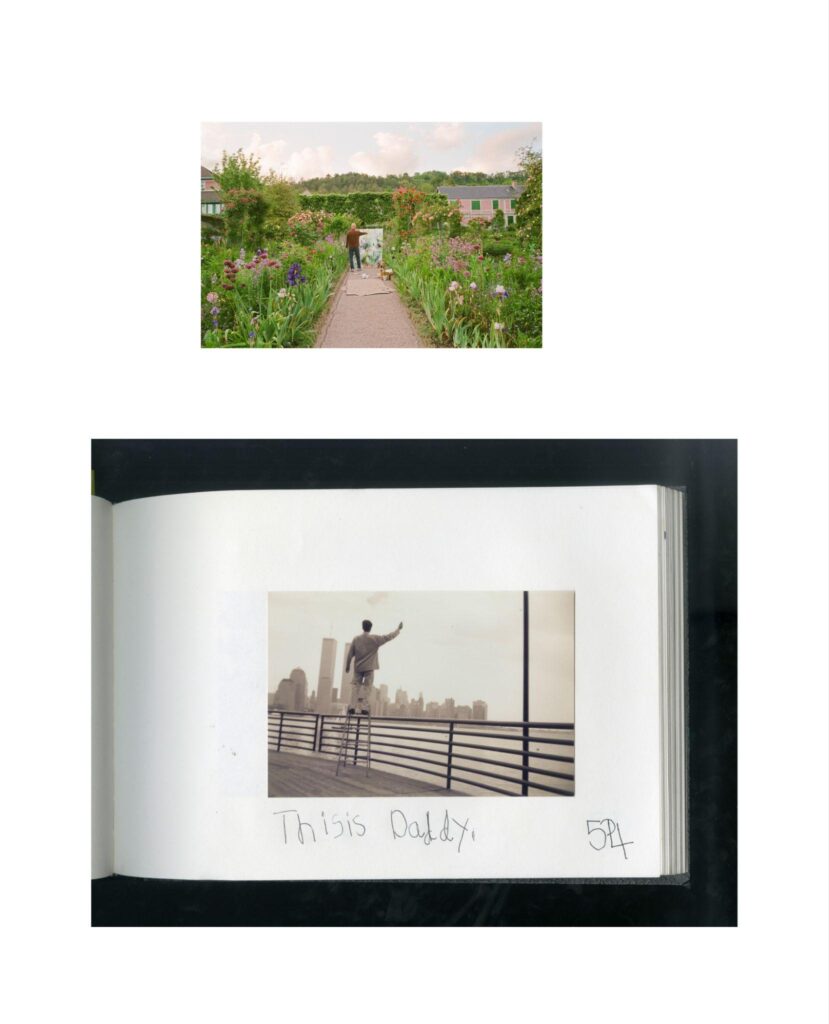
Many of the photographs from Diana’s project frame landmarks, and the images you’ve put beside them were made across Tibet, Tokyo, New York, and Paris. What role does “place” take in your work, and how has moving across countries and cultures shaped your decisions about what to capture and how to capture it?
The photos from 1996 were of fresh, new things I was seeing in the US as a child. I was new to the country, coming from a vastly different place. These days, I don’t take that many photos while I’m in New York because it’s home for me, and it doesn’t feel as fresh. I always take a camera with me when I travel and try to capture what feels fresh and interesting to me. My photos are essentially travel and tourist photos, and maybe not so dissimilar from how I captured the US in 1996. I’ve always wanted to retain that sense of childlike wonder in my photography and in all areas of my creative output.
I also travel with my family for both work and leisure, and I think in many ways there’s a parallel to be drawn between the places my parents took me when I was little and the places we’ve gone recently.

Most of the work in this exhibition, including the title of the show, begins with “This is…”, taken from the handwriting that accompanies the photographs and insists on them as statements of facts. What do you think about the relationship between text and image in your work? And how does the act of naming impact the exchange between language and sight that these works enable?
Starting the text with “This is…” was a prompt Diana López gave me in 1996, so that’s the lineage of the work, tracing directly back to her project and to her trying to understand what I saw and wanted to convey. When she exhibited the photos, they were enlarged, and the titles were typed on wall captions. In the gallery setting, the photos looked really serious. When I looked through the album I made with Diana while I was conceptualizing this show, I realized my relationship to this project lived in the memory and tactility of putting the album together. Many of the pages were written in her handwriting because I was in kindergarten at the time, learning English and how to write. As I learned how to write better, I wrote some of the captions myself. I am sure she helped me with most of the spelling.
This is probably my only work so far that uses my handwriting. I don’t have good handwriting, so I usually avoid using it in my work, but some have told me that my handwriting from when I was six years old is charming.
In 2019, when I wrote captions for my photo book Rooster, Tiger, Sheep by Snake (2019), I don’t think I fully realized I was doing something similar to what I’d done in 1996. That book followed When You Make No Art, which is a written memoir. At the time, I wasn’t sure I could write a whole book again, so it felt easier to fill the pages with photos and captions instead. The truth is, When You Make No Art was originally meant to be a photo book with captions, and it was only in writing it that I realized how many stories I actually had to delve into. Even after having written a full book, writing still feels difficult for me, and the prompt of a caption feels far less daunting.

Across the photographs and the publications, “wonder” surfaces organically and in many forms. It’s interesting that your background reads as both wonderer and wanderer—sculpture, photography, publishing. How do curiosity and exploration play into your practice, as method, subject, target, or something else?
Perhaps many artists could relate to searching for a sense of place in this world through their art, and I think that’s what motivates me through different mediums and modes of work and expression. I tend not to know what I’m meant to be doing, or what the goal of a project is, until I actually do it and feel my way through.
I bounce around a lot. I have a lot of interests, and I’m multidisciplinary in a way that makes it hard to come up with a clean elevator pitch for who I am and what I do. Sometimes I move to one thing to escape another; working in a different medium gives me somewhere else to put my attention when I’ve hit a wall. But I also think different mediums let me approach the same question and desire from different angles. When I’m procrastinating on one project, I can look through my photos for inspiration, or rest my mind and channel my energy into ceramics instead. Over time, moving between them is how I get to better ideas.
I also need to brainstorm a lot and bounce ideas off other people rather than work them out alone. That’s part of why it was important for me to build a creative platform that isn’t just about my own artistic practice, but a communal one, where other people can join in and participate. My curiosity doesn’t stay confined to what I make myself; it needs other people’s perspectives to actually go anywhere.
So maybe curiosity isn’t a method or a subject for me so much as a way of not getting stuck, on my own or in one medium. Exploration keeps me from settling into one outcome and keeps me from having to come to every answer by myself.

In Diana López’s project, each of the four children participants made a self-portrait. Childhood recurs throughout your work and carries a peculiar kind of wisdom: an intellect born from a distance to societal expectation. Do you think of your six-year-old self’s work as something to be in dialogue with now? And how does keeping a personal archive through photography influence what you think about your own upbringing?
For this project, I am collaborating with my six-year-old self. I often find that I was most confident before I was seven years old, and it’s taken a lot of work to regain a fraction of that confidence I felt then. At the time, there was a sense of blindly knowing everything would work out, before I knew anything about this world. As I continued to take photos, my positioning and insecurity in my environment could be felt in the images. They trace where I am and how I feel in those moments. I hadn’t considered revisiting the 1996 album for a project before, perhaps because I needed to develop myself and my voice as an artist first. Ten years ago, I published When You Make No Art, and subsequently started Special Special, where I spent years facilitating collaborations with other artists and hosting their exhibitions and projects. I think revisiting the 1996 album now, thirty years later, when I’ve developed other art projects and become more coherent about what I want to express, is the right time to look back and recognize that confident six-year-old as a peer, and not be intimidated by her.

What does fun look like in your work? And more broadly, what do you think about pleasure as a reason to create, especially in the art world where rigor and impact often prevail in conversation?
I always seek to make work that doesn’t feel hard to make. The process has to be familiar and easy to come by. When it feels like work and is difficult to come up with, it doesn’t yield a smooth outcome. Art is a spiritual practice in a way where the timing and the messaging have to align with what the universe is trying to get me to convey. While I’m thinking through things, alignment is when the flow of the work becomes coherent, in my truest form of expression. But I know how hard it is to come up with an artwork that comes out smoothly; there is a discipline involved in chipping away at something. And I think I do that by always producing in a way that doesn’t feel like work.
Alternatively, from a non-work perspective, the pleasure of taking photos sometimes comes from a desire to capture a fun or beautiful moment.
This exhibition partly stems from a chance encounter with Faride Mereb, who co-directs the publishing house and design studio Letra Muerta with Oriana Nuzzi. Much of your photographs focus on the incidental and ephemeral. How does time enter your work, and when images speak to each other thirty years apart, what do you think happens in that gap?
Faride and Diana connected with me in 2022 on Instagram, when they released Diana’s book on the 1996 project El Ojo de…, but I never considered revisiting this project until my encounter last year with Faride and Oriana at their studio, Letra Muerta, which led me to see my photos from the perspective of somebody else who knew the project well.
Most of my photos weren’t photographed with the intention of being published or used as art. They’re all archival materials that I revisit time and time again to recollect those memories and sometimes see how they could fit into a collection for new projects and ideas. They become subjective triggers for the moments I chose to capture, like journal entries. As I’ve gotten older, my memory has started to fade, and I have to rely more on those photos as evidence of those times.
Recently, I revisited an archive of photos I took when I studied abroad in Rome in college, and I rediscovered a whole tagging system I’d created for over a thousand analog photographs I took across five months traveling around Europe. I had built a People, Location, and Concept archive. I’ve kept doing the same thing in different contexts, which is comforting…I’m essentially still the same person.
As for the gap in time, there are many ways to explain what happens, and sometimes we don’t even really know. But what’s more meaningful is how someone else can resonate with the photos and fill in that gap with their own experiences.
Courtesy of Accent Sisters
About the writer: Cynthia Chen is a writer based in New York City. Her debut chapbook Believing YoYo is the recipient of the 2025 1BR/3BATH Chapbook Prize from Tilted House Press.