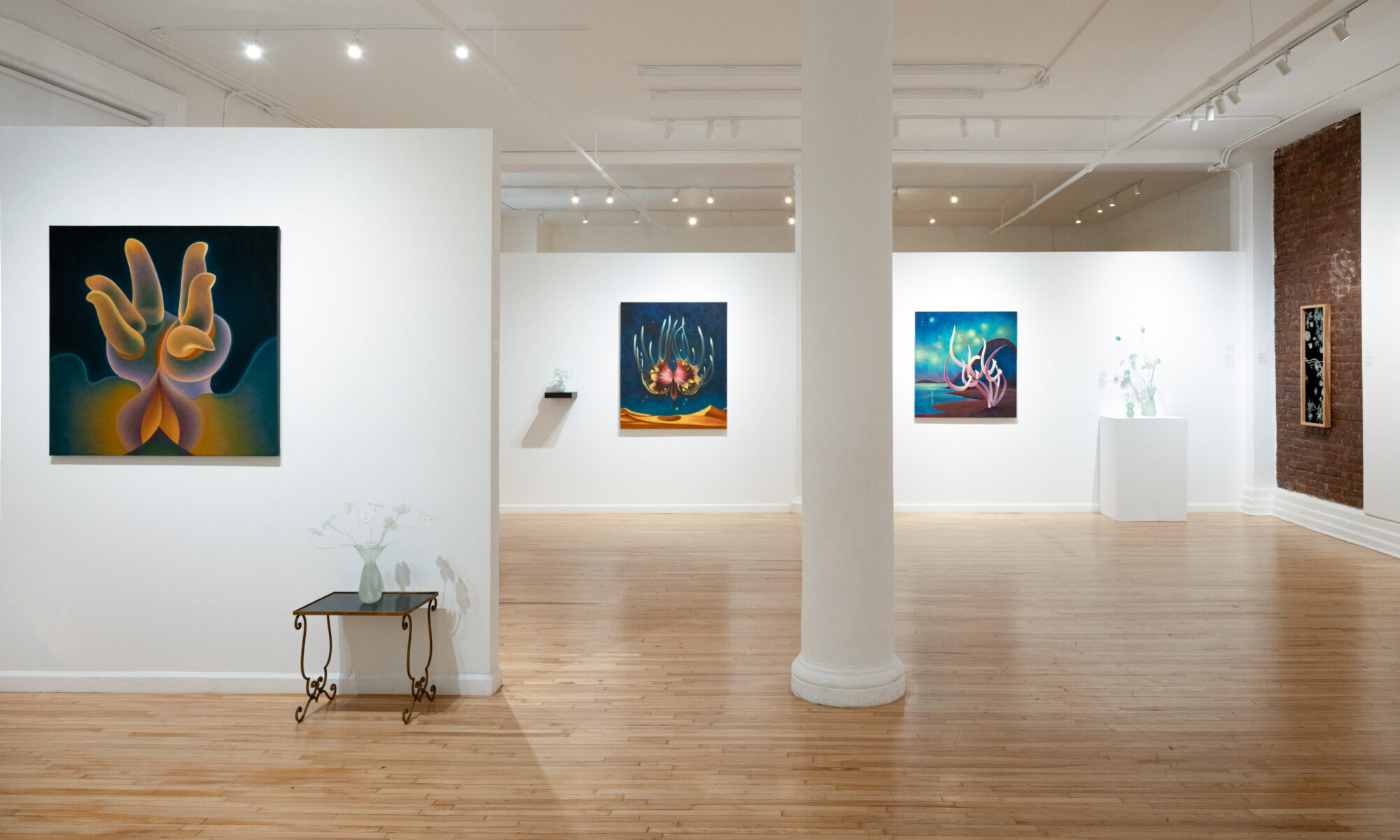
Transcendence, a group exhibition of sculptures and paintings, is curated by Helena Jin and on view at FOU Gallery from July 11 – September 5, 2026. The artists Tianshu Zhang (张天舒), Gloria Fan Duan (樊段晓春), and Tao Xian (陶显) explore the show’s theme of transcendence in vastly different formal ways. Despite Helena Jin’s scholarly background in researching Buddhist art history, the type of transcendence posed by the show is distinctly secular; while some of the artists reference East Asian tradition and symbolism, the “beyond” or spiritual is achieved through individual artistic approaches to color and form.
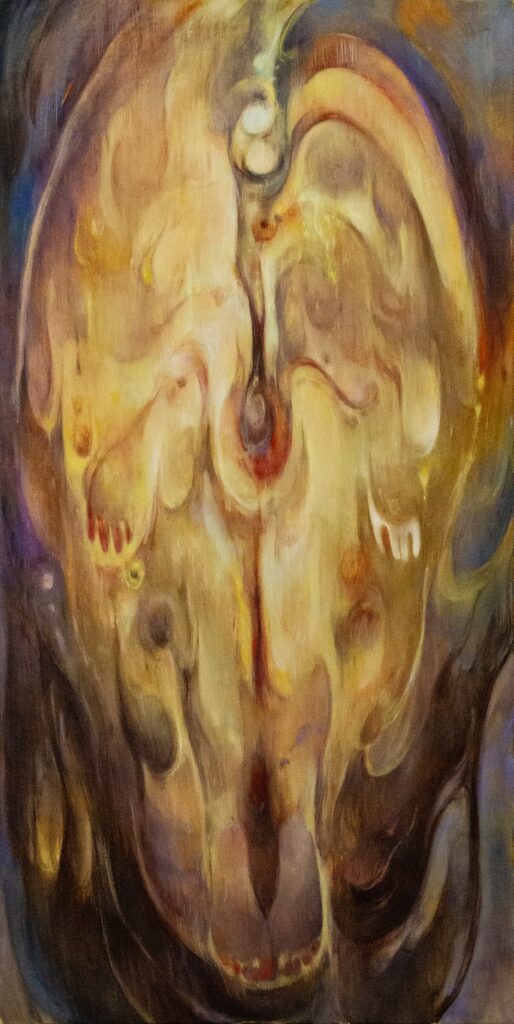
36 x 72 inches ©Tianshu Zhang, courtesy of Fou Gallery
Tianshu Zhang’s colorful, flowing oil paintings nearly all exist at a scale slightly larger than the average human body. Although primarily abstracted, elements of the human body emerge through the layers of paint– whose sheer amount and variation create a sense of constant shifting. Zhang’s paintings feel like the act of examining an opal under light; new colors refract and flicker from different angles of looking. Part of what creates this effect is the mixture of dark, muted washes stacked with colorful dry-brush applications of flame-like brushstrokes. We are reminded of the mesmerizing primal experience of gazing at a hearth– soft, organic, shifting shapes allow the mind to wander, relax, and perhaps even transcend. Pulled into the glow, emergent figures reveal themselves in states of open receptiveness, their palms facing upwards or outwards, their stances tranquil. In Where We Recognize Each Other No.1 (2026), a body emerges from a goopy amber ovoid area surrounded by a darker, opalescent environment; we are reminded of a sort of birth. A central scarlet-colored drop punctuates the center of the suggested figure, breaking the typical boundary between body and surroundings. Zhang’s proposition of transcendence is that of a body that flickers and shifts, submerged in its surroundings yet existing outside of linear time.

In contrast to Zhang’s paintings, which seem to want to leap and melt outside the confines of the canvas, Gloria Fan Duan’s delicate jade-like sculptures are nostalgic attempts to capture and preserve a moment in time. Using monofilament, cast resin, and glass, Duan constructs a distinctly contemporary version of the Japanese tradition of ikebana. Although now largely secular, ikebana originated in the sixth century as a Buddhist form of ritual offering. Undergoing significant transformations over time, ikebana has maintained a belief in the essence of a plant and a reverence for nature. Duan sustains this reverential stance towards nature by mimetically capturing plant forms, even creating life-like water droplets out of resin. The distinctive blue-green color of these sculptures brings to mind both the protective qualities imbued into jade by Chinese culture and a distant icy past or future where these organisms might be preserved due to climate change. These transformed plants seem both to be a botanical archive, as each plant’s English and scientific name is meticulously recorded on Duan’s website, as well as a personal archive of the artist’s travels. For example, the spider lily Hybrid No. 13 (2026), was collected during Duan’s FOU Gallery residency in Tulum. The semi-scientific way in which Duan engages with these natural specimens suggests a desire to know them on their own terms or a total reverence for nature independent of humans.

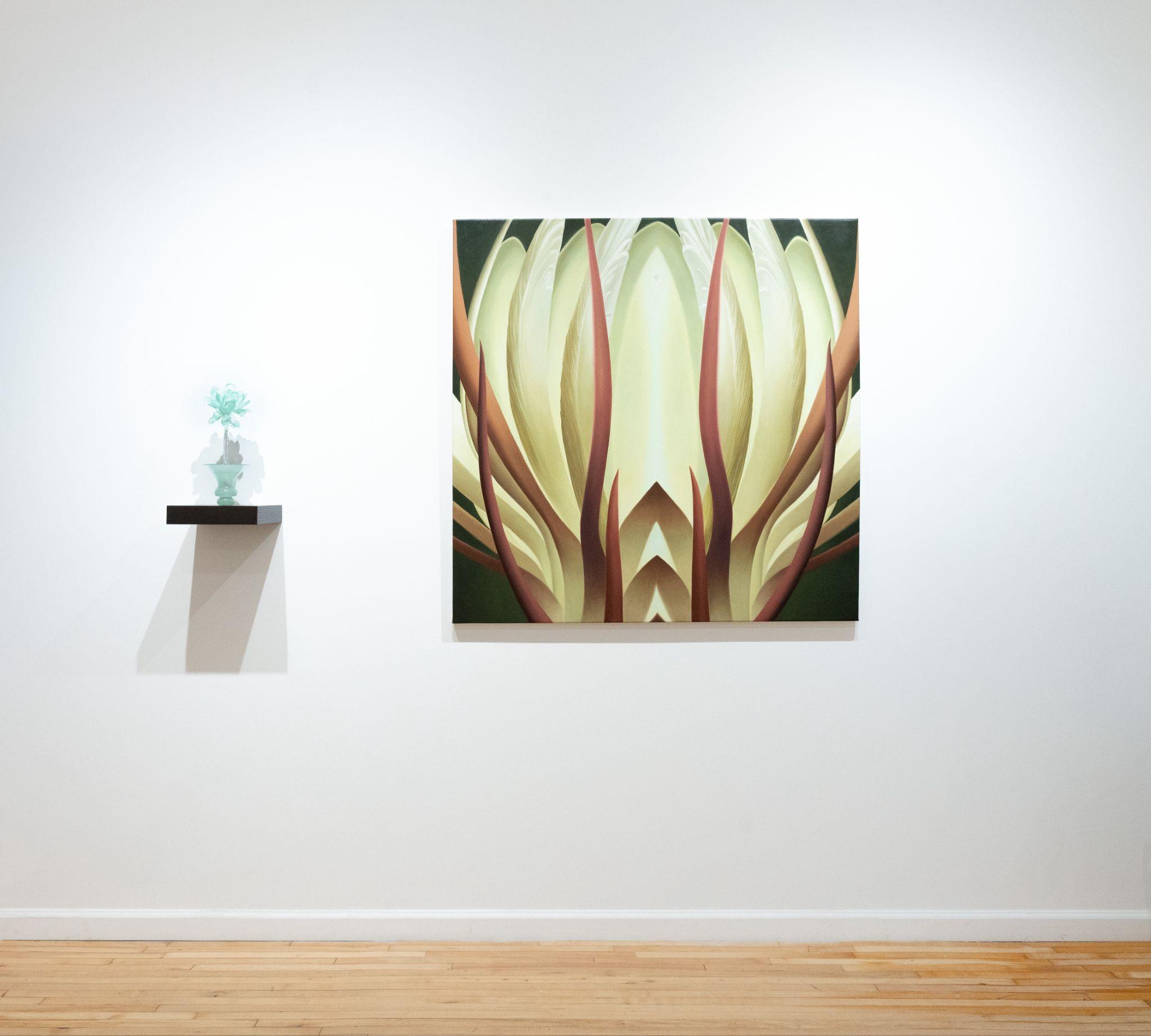
While Zhang and Duan’s work exists almost on opposite ends of a spectrum of abstraction, Tao Xian’s work exists in an in-between state. Tao Xian’s In the Silent Stars (2025) is the most attention-grabbing work due to its central position in the gallery and its instantly recognizable reference to Edvard Munch’s Starry Night (1893), as mentioned in the wall didactics as well. The reference refrains from inviting dialogue about Munch’s psychological intensity or what it means to adopt an expressionist manner but instead reads more like the artist’s personal preference for a particular background. The creature seeks neither to transcend nature in the way that Zhang’s work does nor to revere it in the way that Duan’s does; instead, it indifferently exists inside of its surroundings. The contained brush strokes and illustrative color palette create a technologically generated effect that feels impersonal. Perhaps transcendence here is an escape from the human realm, towards a purely speculative type of imagination. Surprisingly, Tao Xian’s Tempered Light No.1 (2025) appears very different from her other works on view. In this piece, the precise paint application creates a sense of quiet stillness that is complemented by the work’s formal symmetry and glowing-from-within quality. This close-up depiction of a glowing lotus complements Duan’s Hybrid No. 012 (2026), and as Helena Jin explained, together they reference a traditional Chinese entryway that pairs a flower arrangement with a painting. The effect of the work is an experience both subtly intimate and culturally referential.
Oftentimes when we think of transcendent experiences, they are tied to religion or faith. Yet with the decline of religion’s central role in organizing life, these experiences are increasingly becoming secularized. FOU Gallery, founded in 2013, is deeply grounded in the belief in the healing properties of art, a form of secular worship. Why devote oneself to fraught deities when one can instead appreciate the restorative beauty of a spider lily, gaze at an awe-inspiring cascade of gem-like flickers of oil paint, or escape from the human realm altogether?
Courtesy of Fou Gallery
Transcendence, FOU Gallery, 89 Fifth Ave., Suite 701, New York, NY 10003. On view through September 5, 2026, Tuesday–Saturday, 11 AM–6 PM.
About the writer: Ming Chen is a writer and artist born in New York City. She graduated from UCLA in 2024 with BAs in Art and Anthropology, and has since worked across arts administration and public programming, and as a 2026 Summer Curatorial Fellow at Accent Sisters.