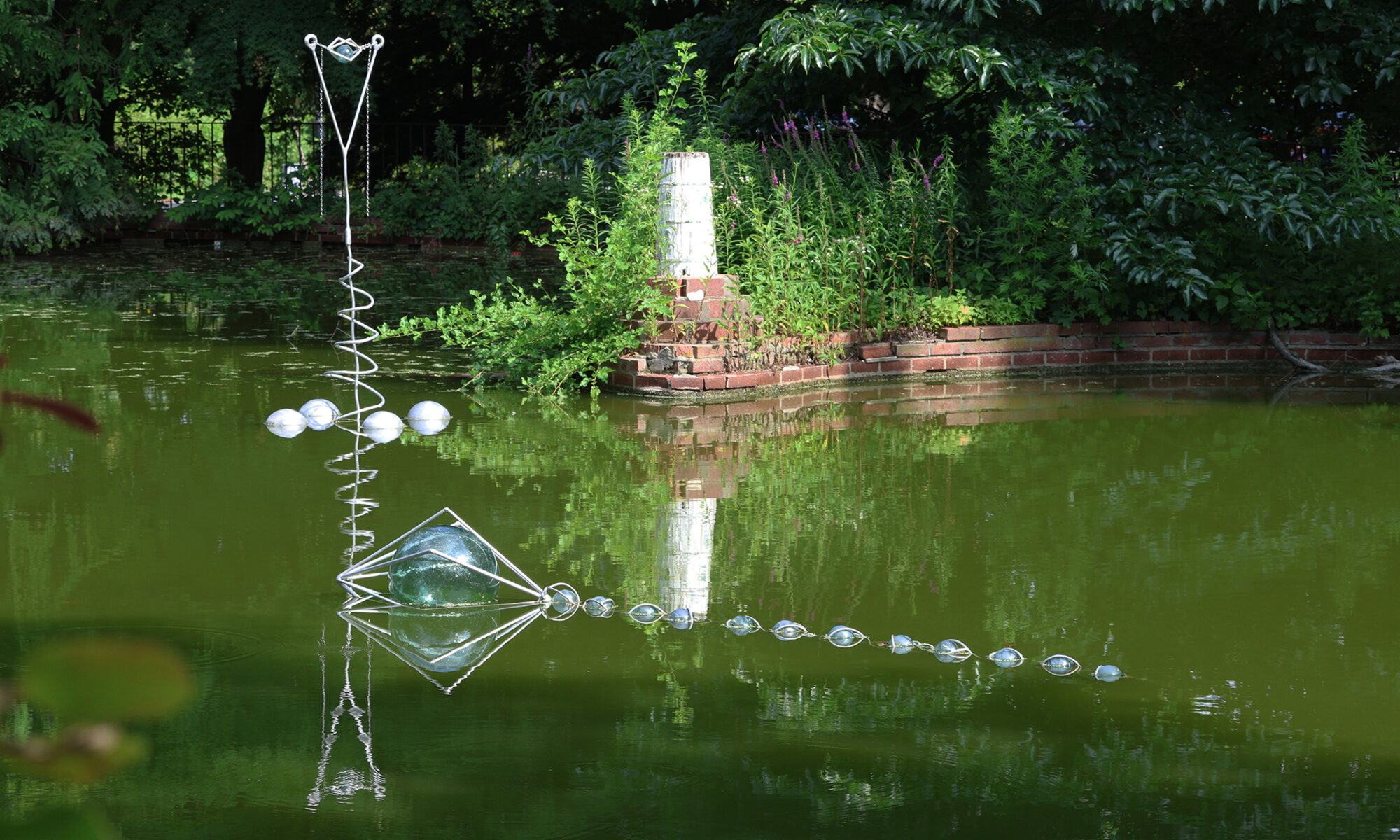
A chance meeting in October 2024 set Serpentine Sibyls in motion. Wandering into the Newhouse Center for Contemporary Art, Daniel Rothbart met its director and senior curator Melissa West, and a shared bond with the late critic and curator John Perreault — who ran the center in the 1980s — opened a collaboration that grew from the main pond to the two reflecting pools beside the Glass House. Rothbart’s floating forms in aluminum and glass, buoyed by salvaged Japanese fishing floats, drift and turn with wind, light, and water, so no two hours look alike. Named by West for the ancient prophetesses and for the serpentinite stone in Staten Island’s own hills, the work holds history and forecast at once, using the climate crisis as its undertow. Sited at a former sailors’ home along a tidal waterway, it runs through September 28 at Snug Harbor. The artist and curator discuss the project’s origins, its shifting forms, and the myth and history beneath the title.
Melissa and Daniel, how did this project begin between you, and how did the back-and-forth between curator and artist shape what finally ended up floating on the water?
The project began with a chance meeting. When I first visited Snug Harbor in October 2024, I was immediately struck by the main pond, which seemed perfectly suited to an installation of floating sculpture. As I walked into the Newhouse Center, I happened to meet its director and senior curator, Melissa West. Our conversation quickly turned to my late friend and mentor John Perreault, who had directed the Newhouse Center during the 1980s. That shared connection to John—and our mutual enthusiasm for the possibilities of the site—became the foundation of our collaboration.
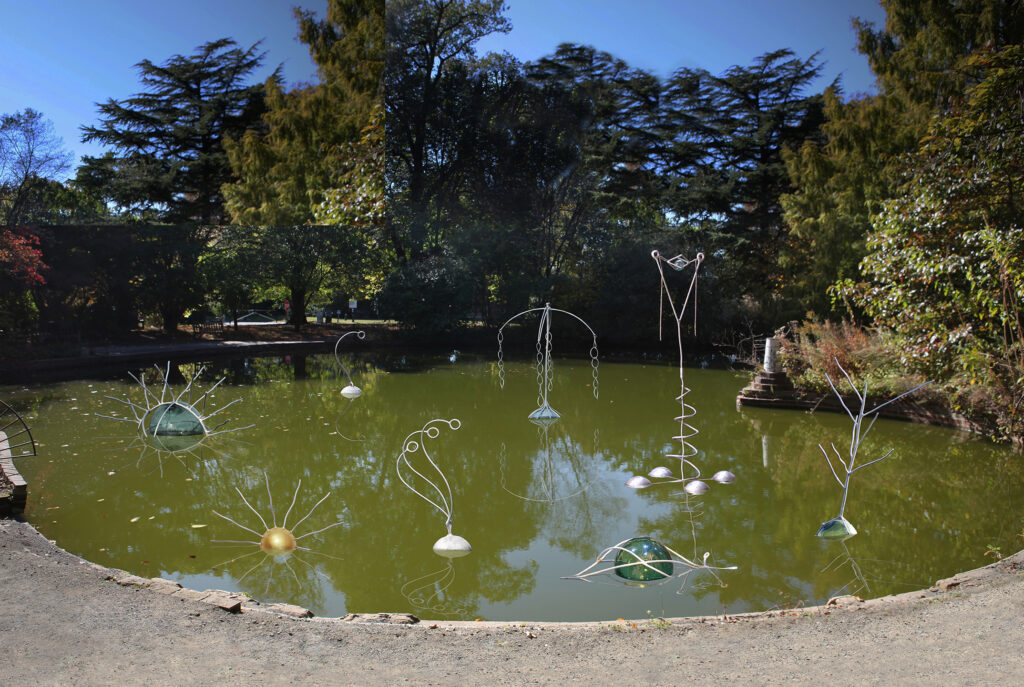
Soon afterward, I sent Melissa a Photoshop rendering showing how floating sculptures might inhabit the pond. She graciously allowed me to float a small sculpture at Snug Harbor so she could experience the work firsthand. Later, Melissa attended GreenBox @ Le Petit Versailles: A Vision for the Future in the Present Tense, an eco-art event curated by Juan Puntes and organized by WhiteBox, where one of my larger floating sculptures was on view. Seeing the work in person helped shape our conversations about what might be possible at Snug Harbor. In 2026, Melissa invited me to realize the project. What began as a proposal for the main pond evolved into an installation that also embraced the two reflecting pools flanking the Glass House.
MW: Daniel’s spontaneous visit to the Newhouse couldn’t have been better timed. We have been eager to expand our public art offerings, and with so many different botanical environments, exploring the bodies of water on site seemed like a natural invitation. Daniel’s connection to John Perreault only enhanced the potential around this project. As we embark on our 50th anniversary celebration over the next year, honoring one of the Newhouse Center’s most prolific curators has been an important goal. We will work with Daniel on a literary event that celebrates John’s legacy, which will take place on the 50th anniversary that Snug Harbor opened its doors to the public (September 12, 1976). It’s incredibly meaningful to work with Daniel on his layered connections to this site and our history.
Throughout the course of the project’s development, we were able to work with Greg Lord, Snug Harbor’ Director of Horticulture. Greg has been with Snug Harbor for over thirty years and knows all of the intricacies of our gardens. It was Greg’s idea to activate the pools near the Glasshouse, which was a wonderful opportunity to create an even more dynamic floating installation. The pools and the pond, situated nearby, now speak to each other through Daniel’s art in a way that they hadn’t done before.
John Perreault played an important role in bringing me to this moment. In addition to being one of America’s most distinguished art critics—he served as chief art critic for The Village Voice during the 1960s—John was also an accomplished studio artist. We began exchanging studio visits in 1998 and quickly discovered a shared fascination with the sea and its symbolic possibilities.
John’s small East Village apartment overflowed with books and his own remarkable artworks. I was especially drawn to his Found Seascapes: thrift-store seascape paintings transformed by tar-black sand gathered from polluted beaches and dripped across the canvases in energetic, Pollock-like gestures. Whenever I traveled, he asked me to bring back a bottle of sand from whatever shoreline I visited. In 2007, I invited him to see the first floating sculpture, which I was developing for an exhibition in Venice. He responded favorably, telling me that I had found a “clearing” in my practice and that I should continue developing aquatic works. Looking back, it feels fitting that a conversation about John at Snug Harbor ultimately led to Serpentine Sibyls floating there nearly two decades later.
The forms are aluminum and glass, and they suggest sea creatures and plant life from some distant past. What are we actually looking at out there, and where did these shapes come from?
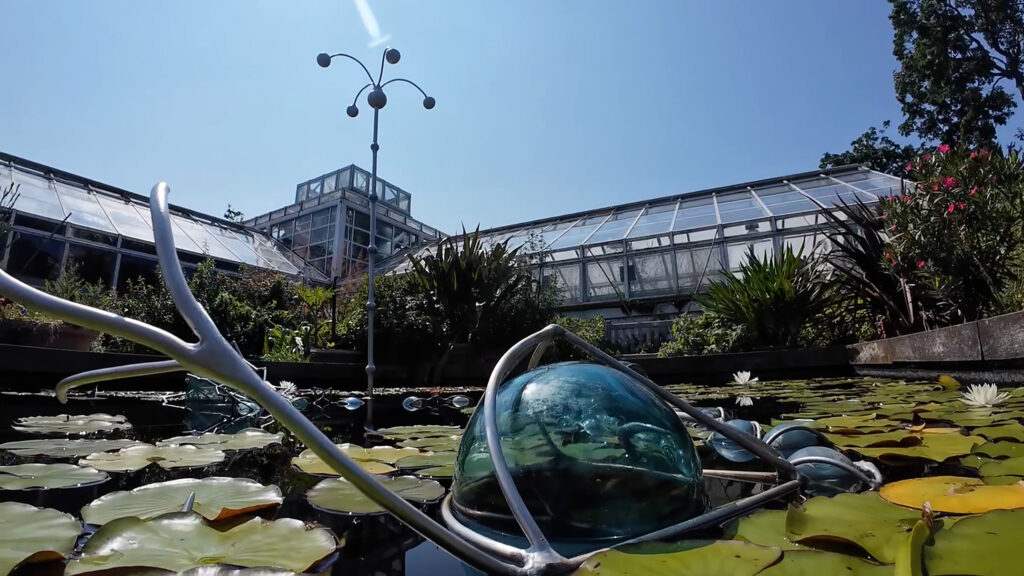
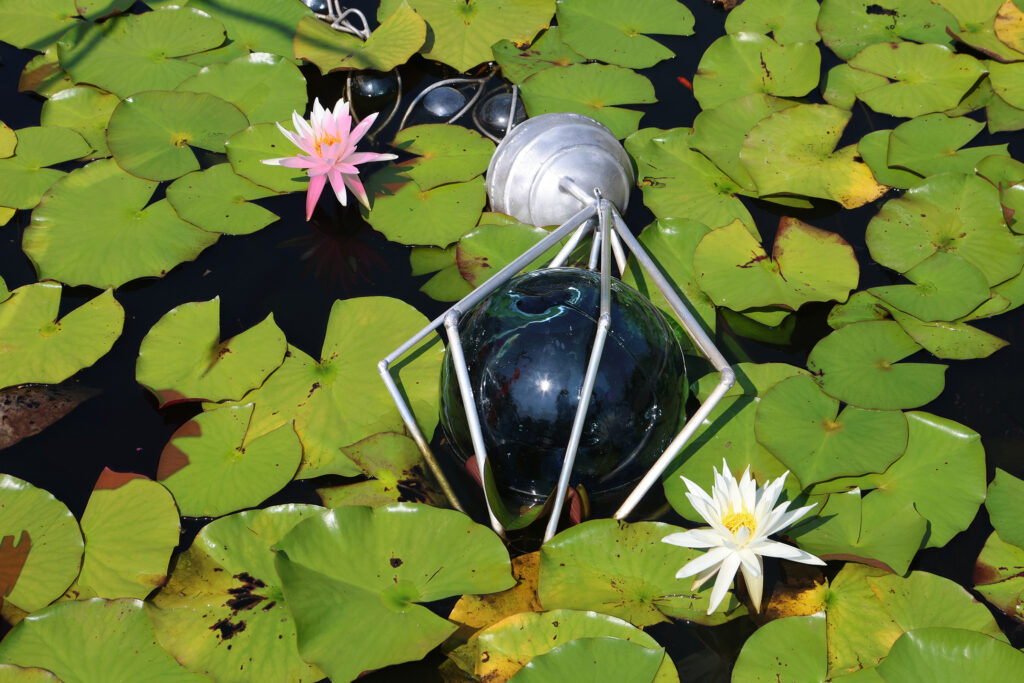
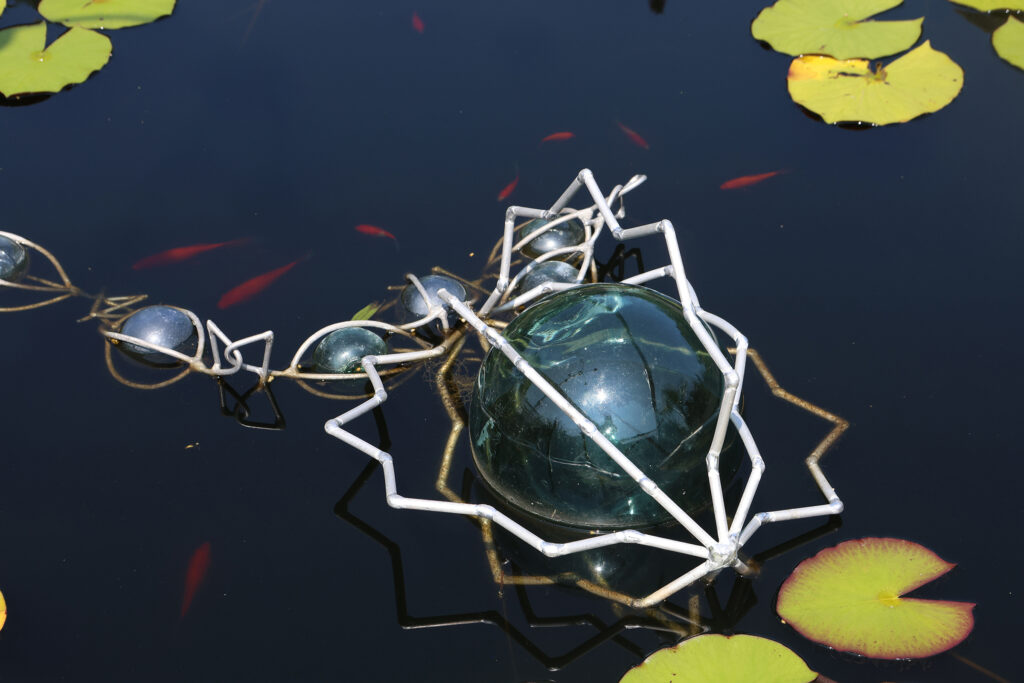
I grew up in Oregon, where Japanese blown-glass fishing floats—having traversed the Pacific Ocean from the Sea of Japan—would occasionally wash ashore. I incorporated many of these floats as buoyant elements in Serpentine Sibyls. Originally blown from recycled sake bottles for reasons of economy, they also embody an unintended ecological ethic through their reuse of discarded materials. As artifacts of maritime labor, they also resonate with Snug Harbor’s history as a retirement home for sailors, linking the installation to the site’s seafaring past.
The floats are also distinctly Duchampian. By carrying air from their place of origin across the Pacific, they evoke Marcel Duchamp’s 50 cc of Paris Air (1919), the sealed glass phial that imports the atmosphere of one place into another. Beyond their conceptual resonance, the floats possess aesthetic qualities. They catch, filter, and transmit light in unexpected ways, producing shifting fields of color that continually transform with the changing conditions of water, weather, and sky.
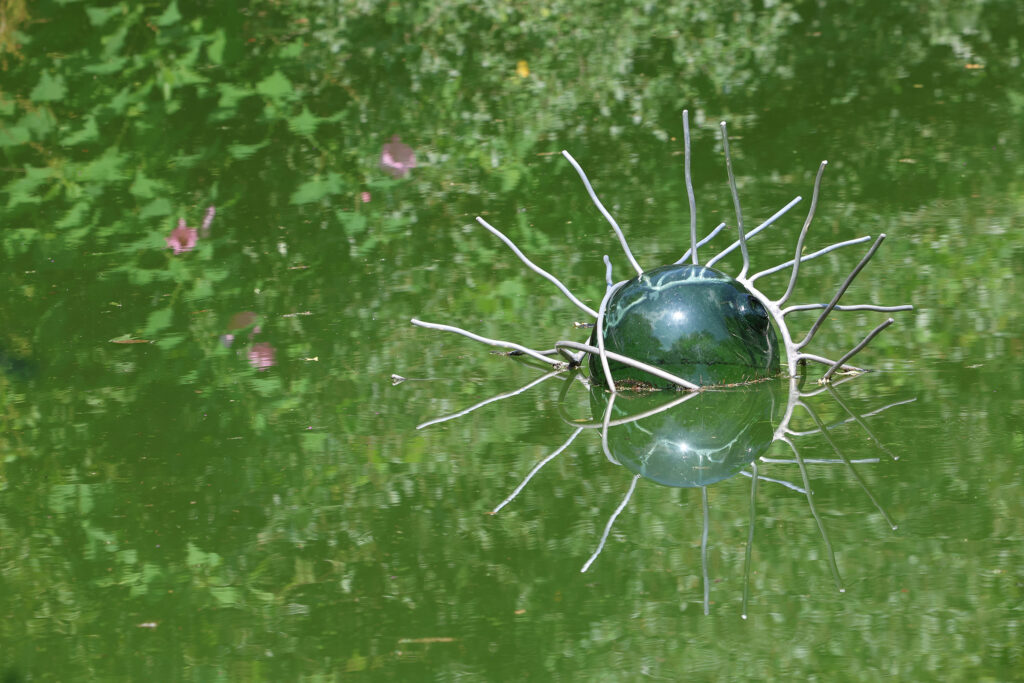
My sculptures don’t have a fixed identity and might evoke jellyfish, seed pods, microscopic organisms, marine invertebrates, or botanical forms, depending on the light, the weather, and the viewer’s perspective. Their warm, biometric forms are subverted, however, by the material out of which they crafted. Aluminum and glass are the stuff of Atomic Age design, airplanes, and rocket ships. In some ways, they could just as easily suggest beings from the future or a distant galaxy.
You’ve said the water isn’t a backdrop but part of the sculpture — the pieces drift and change with the wind, light, and weather. How do these conditions change the sculptures through the day, and how much of that can you predict?
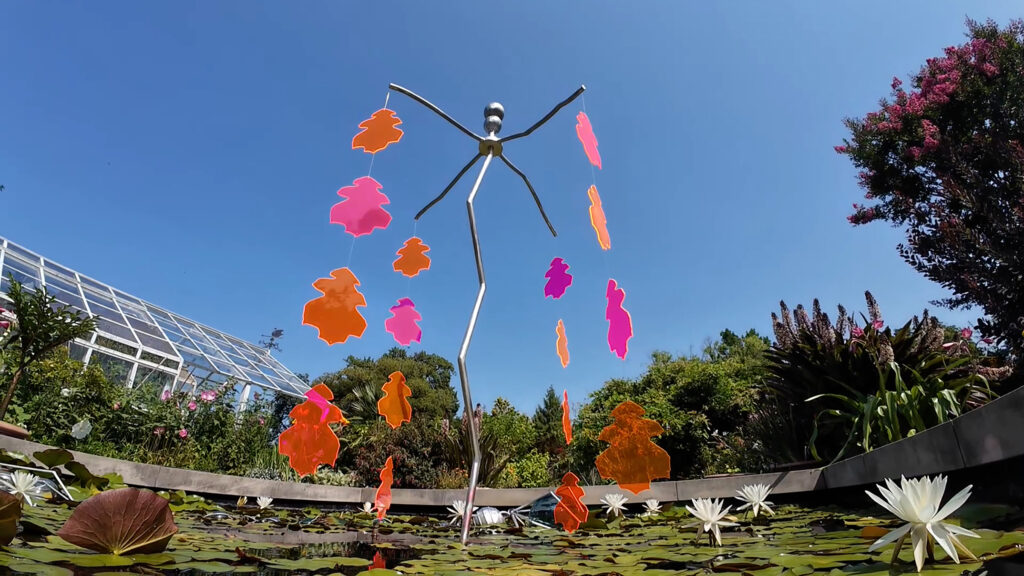
One of the things that interested me most was relinquishing a measure of control. Serpentine Sibyls isn’t a static installation with water serving as its setting. Water is an active collaborator. The sculptures respond continuously to shifting conditions: a light breeze sets them gently drifting, stronger winds alter their orientation, changing light transforms the way they reflect and absorb color, and the surface of the water itself acts as a constantly changing mirror.
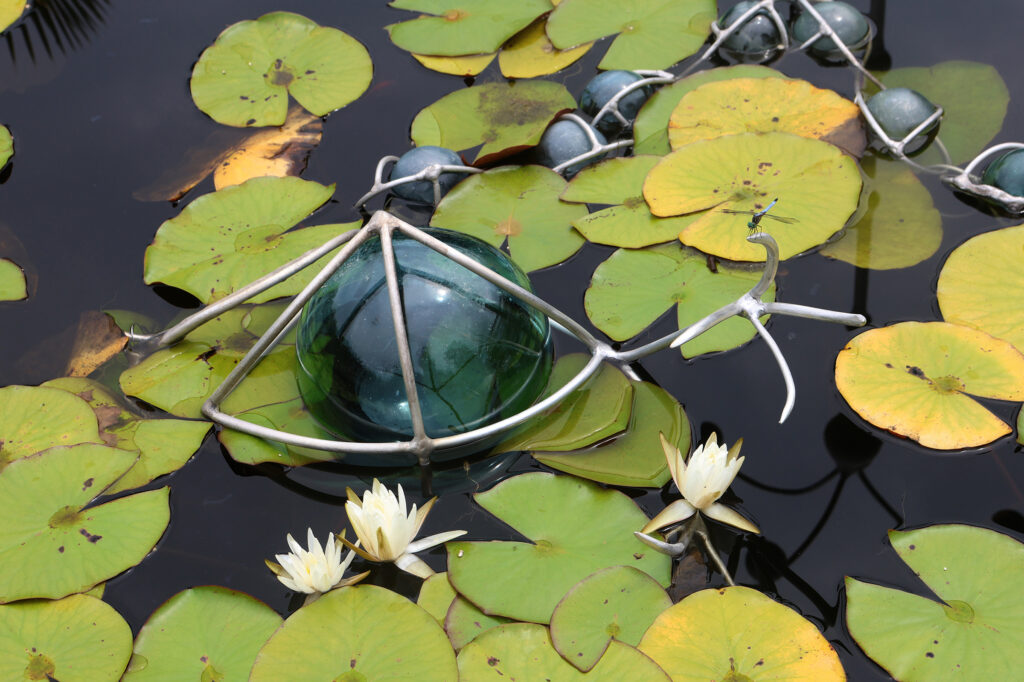
I expected the surrounding ecology to become part of the work but could never have predicted the specific encounters. A painted turtle climbed onto a floating sculpture to bask in the sun and a dragonfly, its wings traced with intricate filigree, delicately alighted on a sculpture, subtly rearranging the composition. Those events can’t be choreographed, but they’re central to the project.
The balance between intention and unpredictability means that a visitor who returns to the pond installation in the morning, at midday, and at dusk is likely to encounter what feels like three different works.
Daniel inserted jpg as a suggestion – landscape orientation around 2500 pixels on the wide side around 2mb
The title points to the Sibyls, the ancient prophetesses consulted in times of crisis. Can you tell the story behind them, and how does it connect to the artwork?
As the project developed, Melissa responded to a new body of work I was creating for Snug Harbor that drew on Greek mythology, and she coined the title Serpentine Sibyls. The name resonated deeply with me. While living in Naples as a Fulbright Scholar in the early 1990s, I visited the cave of the Cumaean Sibyl in the Campi Flegrei, giving the project an unexpected personal dimension. During his years at the Newhouse Center, John championed the work of groundbreaking feminist artists, including Judy Chicago, Nancy Spero, and Gillian Jagger. He also co-curated the first retrospective of Ana Mendieta’s work at the New Museum while serving as visual arts director at Snug Harbor. In that light, it feels especially fitting—and auspicious—that the title invokes feminine wisdom, prophetic vision, and creative power.
MW: The title is also a play on the word Serpentine, which calls attention to the snakelike imagery of some of the floating sculptures. Serpentinite is also the metamorphic rock that makes up some of Staten Island’s hills, which were formed during the last ice age. Serpentinite is a bluish grey in color, which mirrors the color of the floating glass. So the title is looking at the continuum of the past and future; of history and prophecy. Through the sibyls, we can contemplate the climate crisis and hopefully dream up new ways of combating it.
The work was made for this exact place — a former sailors’ home with reflecting pools and gardens, and an art center you’ve noted is often overlooked. What drew you to this setting, and what do you hope it does for how people see Snug Harbor?
Snug Harbor was founded by Robert Richard Randall, a privateer during the American Revolution whose lawyer was Alexander Hamilton, so it is laden with American history. For more than 160 years, Sailors’ Snug Harbor served as a retirement home for “aged, decrepit, and worn-out sailors,” and Thomas Melville, brother of Moby-Dick author Herman Melville, was among its early governors. The complex relationship between the sea and people whose lives depended on it is woven into the institution’s DNA.
Snug Harbor occupies Staten Island’s North Shore along a tidal waterway that opens onto New York Harbor and the Atlantic Ocean, further reinforcing its maritime identity. That history resonates with Serpentine Sibyls. As I mentioned earlier, the Japanese blown-glass fishing floats incorporated into the sculptures once drifted through another working life in the fisheries before becoming part of the installation. They carry traces of human labor, ocean passages, and ecological interconnectedness, while also invoking the ancient Sibyls as guides through uncertain futures.
I hope the installation reframes visitors’ perception of familiar bodies of water, inviting them to slow down, wander, and discover these conversations for themselves. My hope is that Serpentine Sibyls re-enchants the landscape of Snug Harbor, encouraging visitors to leave with a renewed appreciation for this remarkable place. For first-time visitors especially, Snug Harbor often comes as a revelation. Despite remaining under the radar, it is one of New York City’s most historically significant and deeply evocative cultural treasures.
Writing in The Forward, Simi Horwitz described visitors on a brutally hot day splashing themselves with water while walking through work about rising seas and heat — the weather almost acting out the warning. Have you seen the environment take part in the piece in ways you never planned?
Simi captured something that struck me deeply. On that hot and humid opening day, visitors sheltered under parasols and instinctively sought relief by splashing water on their faces, all the while encountering sculptures that reflect on rising seas, environmental instability, and our relationship with the natural world. The exhibition and the weather seemed to be in conversation. It was one of those moments when the work no longer felt metaphorical. The conditions people were experiencing physically became inseparable from the ideas the installation was exploring.
Climate change is often discussed through statistics, projections, and scientific reports, all of which are essential. But art can make those realities tangible in another way by engaging our senses and emotions. When the heat, humidity, and water become part of the experience of viewing the work, visitors don’t simply contemplate environmental change—they inhabit it, if only for a moment. The installation became a place where the boundary between representation and lived experience briefly dissolved.
Melissa, this floats on moving water in historic reflecting pools at a landmarked site — you can’t hang it, light it, or hold it still. What did those conditions ask of you as curator, and why bring Daniel’s work to Snug Harbor now?
Snug Harbor is a truly unique place. It is a historic site with a lot of nuanced spaces. With each project, I am stepping into the world of the work and the artist and figuring out how to translate it into our built environment. For Serpentine Sibyls, because we are working with bodies of water in the gardens, I had to collaborate with our horticultural staff to ensure we were sensitive and cognizant to the needs of those sites. That required a lot of care and conversation, of adapting our plans to the right time of year and the right install methods. Daniel has had experience installing bodies of water before, so we were able to use his embodied knowledge to determine our approach. Because these bodies of water are located within a public park with many visitors of all ages, we also had to address safety concerns in a visible and public way, through our signage visitor services interactions, and through social media.
As a curator, I felt the timing with our 50th anniversary, Daniel’s deep connection to John Perreault, and the urgency of the climate crisis all converged to make this the project we needed to develop for this summer. This summer alone, we’ve experienced wildfire smoke, extreme storms (even on the day of the opening), and heatwaves. The climate crisis is unfolding in big and small ways every day. By bringing this project to Snug Harbor, we’re engaging in an important community conversation around the realities of our time, but also the possibility and the hope that comes with knowing our history. An oracle is symbolic and plays upon our worries and fears, and I feel that this piece suggests that we have the power to write a new future and tell a different story, one of resilience. Opening these dialogues at Snug Harbor is incredibly important to me as a curator.
Serpentine Sibyls: A Floating Sculptural Installation at Snug Harbor by Daniel Rothbart, curated by Melissa West at Snug Harbor Cultural Center & Botanical Garden, 1000 Richmond Terrace, Staten Island, NY 10301.
On view through September 28, 2026. Open daily, 8:00 AM – 6:00 PM. The installation is located outdoors in the ponds adjacent to the Newhouse Center for Contemporary Art and is freely accessible during campus hours.
@thenewhousecenter @snugharborccbg @danielrothbartstudio
Make your tax-deductible donation today and help Art Spiel continue to thrive. DONATE
About the artist: Daniel Rothbart is a multidisciplinary artist and writer whose installations, sculpture, photography, and video explore ecology, memory, mythology, and the cultural meanings of water. He holds a B.F.A. from the Rhode Island School of Design and an M.F.A. from Columbia University. Rothbart’s site-responsive projects have been presented internationally, including RamleAnthropocene at the Center for Contemporary Art Ramle, Israel; Water Clocks and Flotilla in the Hudson Valley, New York; Air de Venise in Venice; WATERLINES at Galerie Depardieu in Nice; and at the Newhouse Center for Contemporary Art at Snug Harbor, New York. Rothbart has also exhibited at the Galleria Nazionale d’Arte Moderna, Rome; the Museum of Contemporary Art Belgrade; Momenta Art; WhiteBox; Exit Art; and Andrea Meislin Gallery. His work is included in public and private collections, including the Artist’s Book Collection of the Museum of Modern Art, New York. He has received a Fulbright Scholarship, NYSCA and NYFA grants, and international artist residencies. Rothbart’s work is the subject of a monograph by Enrico Pedrini.
About the curator: Melissa West is an artist and curator whose work is centered on the relationship between body and place. She curates and creates multi- and interdisciplinary art projects in parks, galleries, historic buildings, and other non-traditional spaces. She has provided financial support, resources, and opportunities to hundreds of artists, cultural organizations, and community partners. A lifelong Staten Islander, West has increased access to the arts for thousands of New Yorkers, creating innovative ways for audiences to engage through unique, site-based experiences. Before joining Snug Harbor in 2015, Melissa directed the grassroots art walk, Second Saturdays Staten Island, where she advocated for arts equity and connected venues and small businesses with artists across the island. She was an adjunct faculty member within the Wagner College dance department from 2022-2024, where she taught dance history and choreography. West was a New York Community Trust Leadership Fellow (2016) and participated in the New York Foundation for the Arts Emerging Leaders program (2019-2020). A recent recipient of the Mertz Gilmore Dance Research Grant from Staten Island Arts (2023-2024), she was a 2023-2024 Co-Fellow for Utopian Practice from Culture Push for her work on the newly launched Shaolin Art Party digital media hub and is a recipient of SIEDC’s 20 Under 40 Leadership Award (2025). Melissa holds an MA in Performance Studies from New York University and a BA in Dance from Hunter College.
About the writer: Etty Yaniv is a Brooklyn-based artist, writer, curator, and founder of Art Spiel. She works in installation, painting, and mixed media, and has shown her art in exhibitions across the United States and abroad. Since 2018 she has published interviews and reviews through Art Spiel, often focusing on underrecognized voices and smaller venues. More about her art can be found at ettyyanivstudio.com and on Instagram @etty.yaniv