Language is having a moment—again—but it no longer behaves as it once did. Words now arrive compressed, automated, endlessly replicated, stripped of duration even as they multiply. Becky Brown has been tracking this condition for years, painting language not as message but as environment: something we live inside, skim through, and increasingly struggle to feel.
In Pleasure Reading, her exhibition at Freight + Volume, words buckle under pattern, dissolve into ornament, or repeat until meaning thins out. Brown’s paintings do not mourn literacy so much as they test its limits, asking what attention might look like when reading itself has become a form of labor—and when pleasure must be wrested back from systems designed to monetize it.
What follows is a conversation about language as material and symptom, about abstraction as a form of resistance, and about humor—gentle, tragic, and necessary—as a way of thinking clearly in public.
Stephen Wozniak: Language has long been central to your practice. How do you collect, test, and ultimately select the words or phrases that enter your work? Are they drawn from overheard speech, personal notes, digital interfaces, bureaucratic language, or somewhere else entirely—and what makes a phrase “stick” enough to warrant sustained visual attention?
Becky Brown: All of the above. I’ve always been a note-taker—jotting down words and phrases that surprise or amuse me, whether they come from books, songs, conversations, or something more ambient. Recently, though, I’ve become especially interested in how communication has shifted in the internet era: text messages jumping across platforms, captions and comments standing in for longer forms of expression, headlines replacing articles altogether.
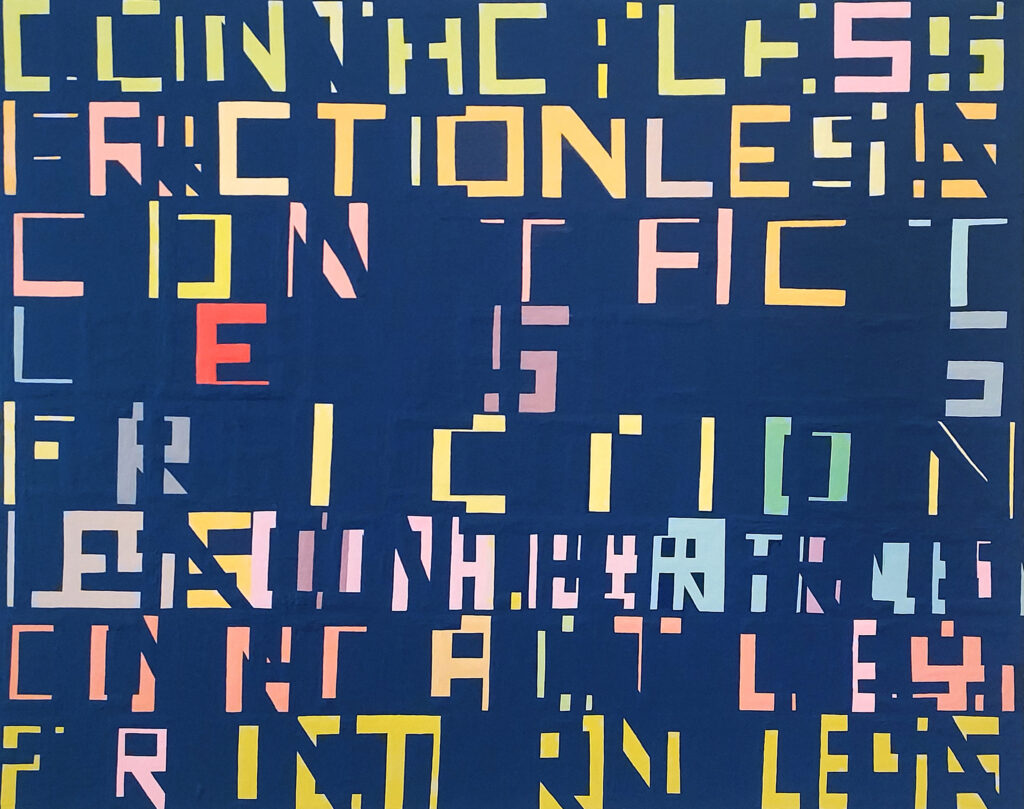
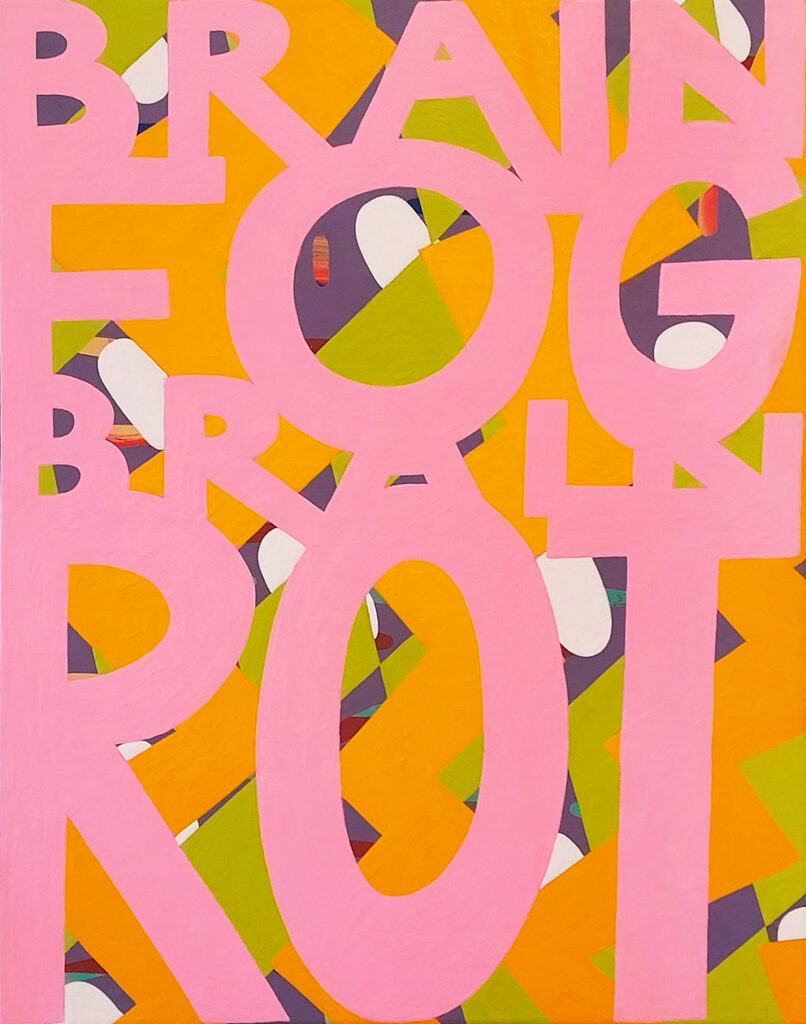
In the new series of paintings in this show, I wanted to see what might happen if I spent a long time with single words or very short phrases from this evolving vocabulary—creator, contactless, brain rot. I have a painting in progress in my studio where the word vibes repeats across the surface, and slop—a term for low-quality A.I.-generated content—is currently at the top of my list. These words feel slippery but loaded, like they’re doing more cultural work than we realize.
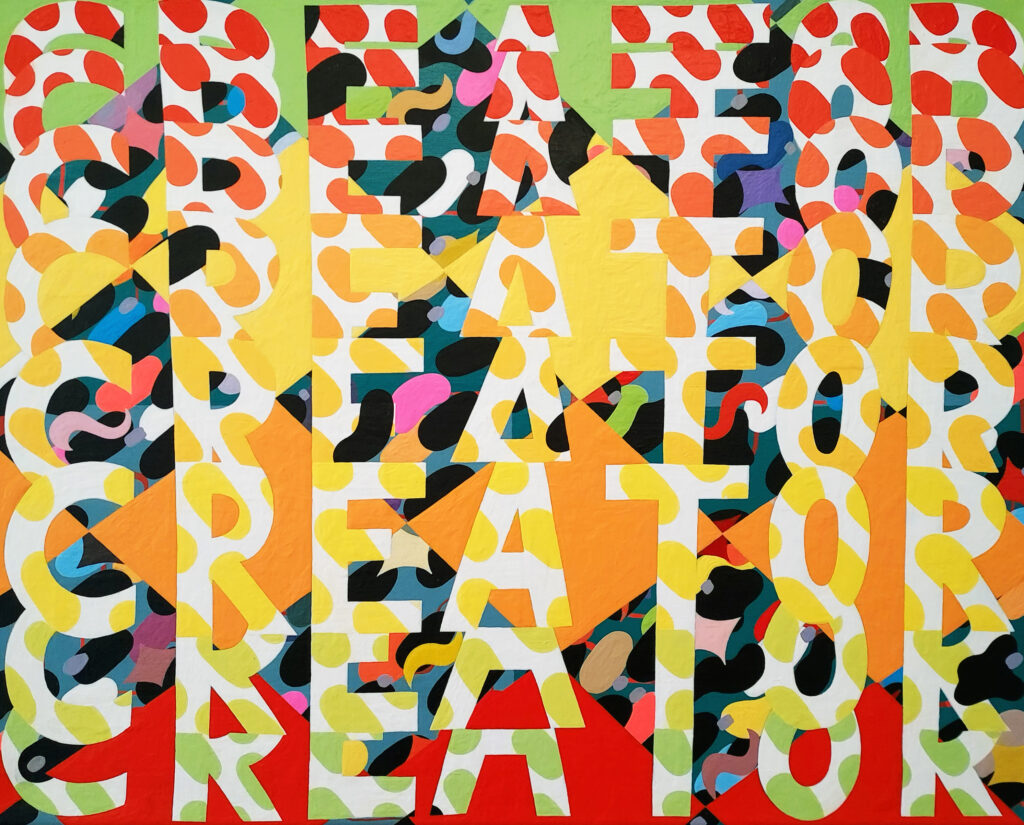
Language has always been a living system—never fixed, always changing—but the speed and strangeness of its mutations online feel unprecedented. At the same time, we’re reading less, skimming more, letting language wash over us faster and faster. Hand-painting these words and embedding them within dense pattern is a way for me—and hopefully for viewers—to slow down and look again.
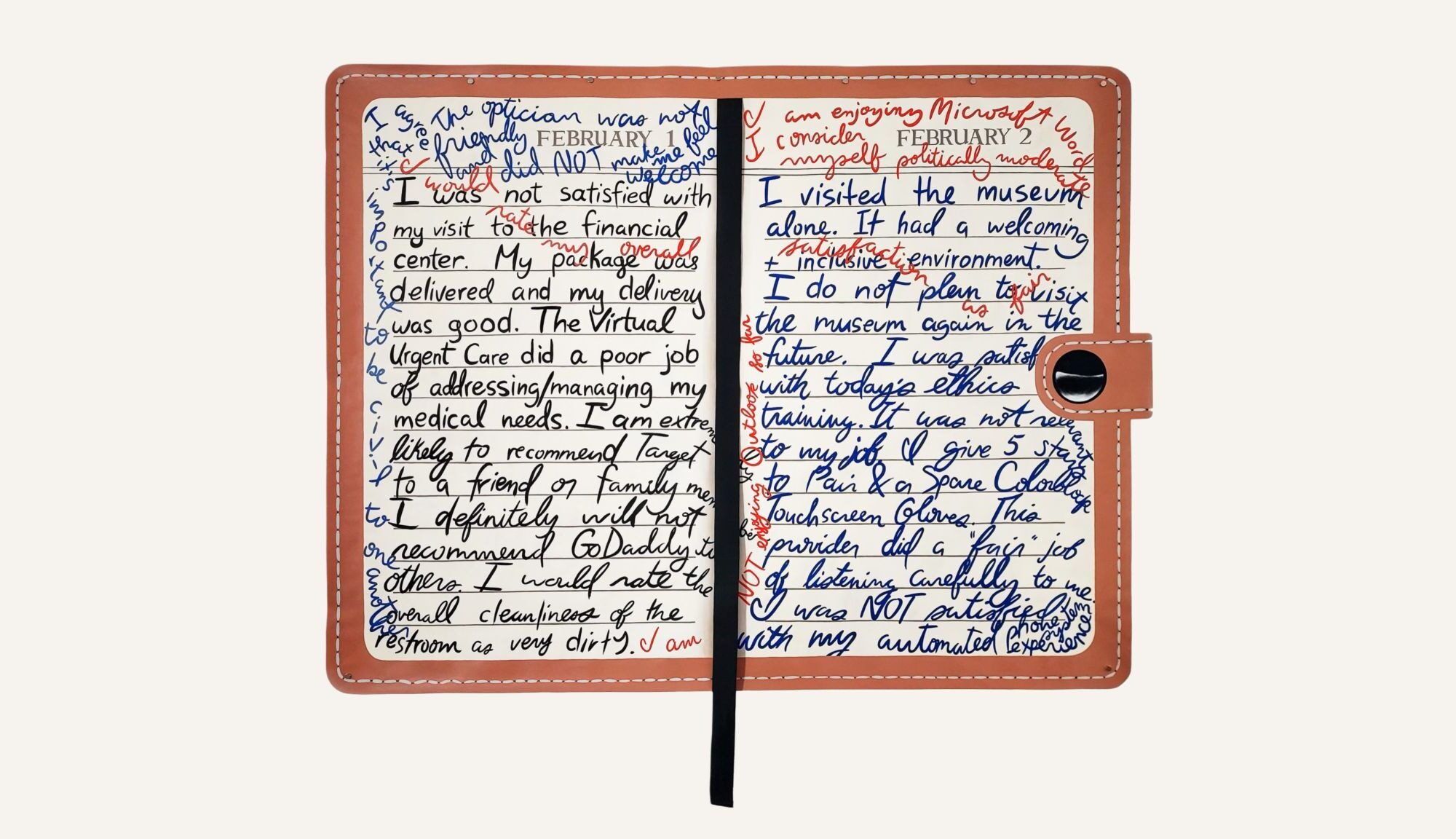
For larger works, I often commit to a long-term collection around a single word or type of communication. My Overall Satisfaction, for example, grew out of years of saving online survey text. Earlier projects focused on automated away messages or the word community. Collecting this way lets me see patterns in contemporary speech by looking across many instances, rather than isolating a single example.
SW: While your work engages shared conditions of contemporary life—especially those shaped by technology and mediation—it also feels rooted in personal experience. How do you navigate the porous boundary between private thought and public address?
BB: This is something I’ve been thinking about a lot, especially now, when so many artists, writers, and cultural workers explicitly incorporate their own lives into their work. I’ve always felt resistant to that impulse—partly because my life doesn’t strike me as especially remarkable. But of course, all artwork reflects the perspective of its maker, whether that’s acknowledged or not.
With the survey-based work, the text is adapted from real surveys sent to me or to friends and family. In some cases, it’s influenced by my actual feelings and experiences—though sincerity is always infused with irony. I’m currently working on a new project about parenting in the digital age that draws even more directly from my life, using data from my son’s newborn days alongside a huge volume of online content. I think I’m becoming more comfortable with this, with the hope that what feels specific to me might resonate more broadly.
If so much art and writing feels personal right now, maybe it’s because the boundary between public and private has become so unstable. Social media brings everyone into everyone else’s homes. Communications that used to be intimate—birthday notes, anniversary messages—are now routinely broadcast. It can start to feel easier to address a crowd than to talk to a single person. Everything happens in public, yet people feel increasingly alone. I don’t have answers, but I try to think through these contradictions in the work.
SW: In earlier works, text often appeared crisply legible, almost insistently so. In this exhibition, some paintings push language toward near illegibility. Can you talk about that spectrum between readability and obscurity?
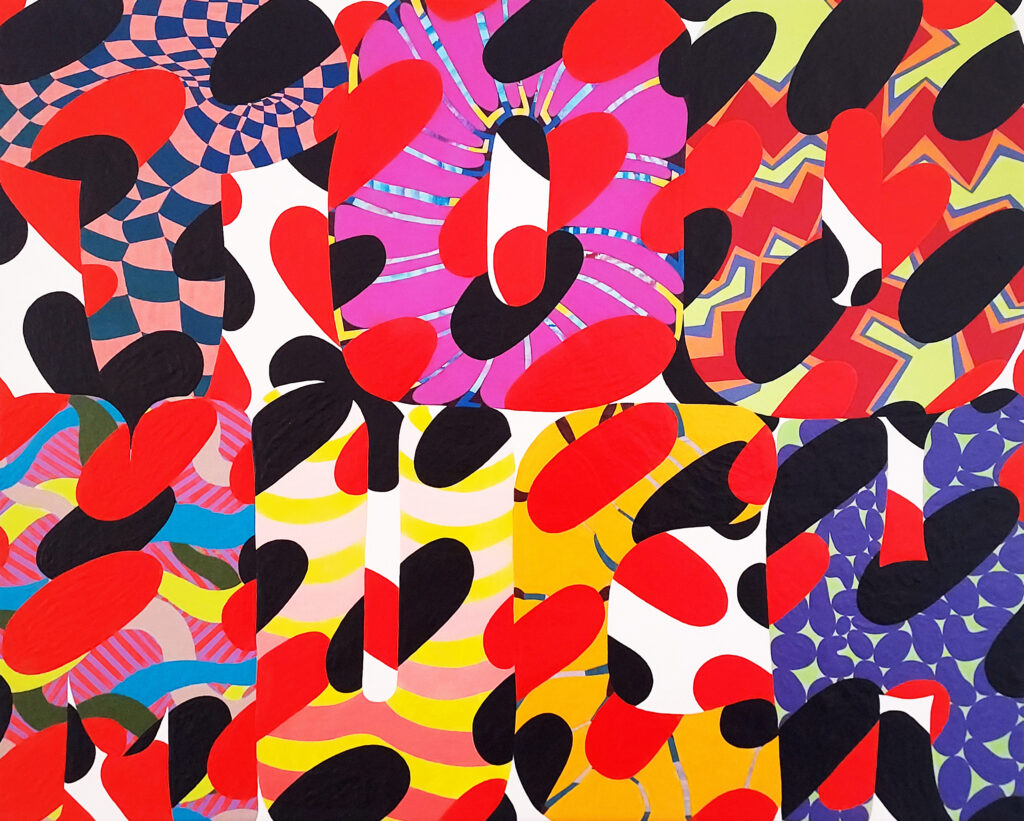
BB: I’ve always been drawn to that spectrum. Glenn Ligon is a hero of mine for the way he explores it within single works—how stencil lettering smudges and darkens until it becomes almost unreadable. My move toward greater abstraction in this series surprised me, which I loved. I’ve always integrated language into formal structures, but here those structures began to overpower the words, and I decided to follow that impulse.
It returns to the idea that too much language can cancel itself out. I started thinking about this years ago while collecting uses of the word community. The more ubiquitous it became, the less it seemed to mean. As a professor, I’m asked to add more and more boilerplate language to my syllabi. They get longer; students read them less. Administrative processes move online, and somehow, there’s more paperwork than ever. We’re inundated with text, yet meaning feels increasingly opaque.
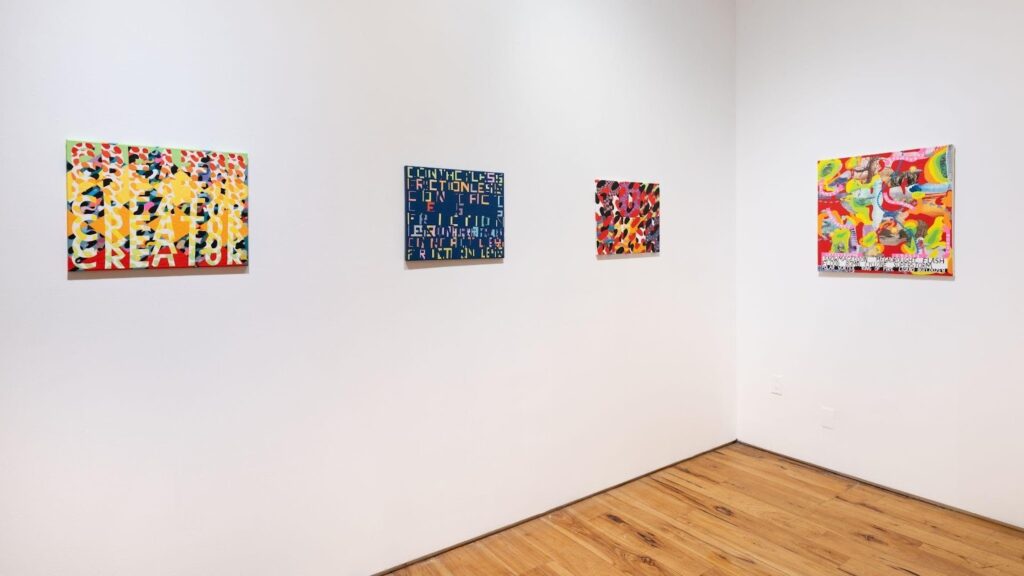
As these paintings developed, the text sometimes seemed to get buried (Too Much) or concealed (Contactless Frictionless). Even when the words remain legible, as in Creator or Brain Fog, they’re intercepted by pattern and competing visual activity. I let myself get lost in that, allowing visual instincts to generate their own logic. For me, that improvisatory process felt like a way to reclaim some freedom of thought—and maybe offer viewers a similar experience.
SW: Discussions of technology, surveillance, and the attention economy are now nearly unavoidable. What writers or artists have been especially generative for you recently?
BB: Indeed, New York Times think pieces on these topics are everywhere, and yet nothing seems to change, which brings us back to that feeling that more words don’t necessarily equal more meaning. The internet offers endless hyperlinks; there’s always another text, another explanation.
Jonathan Crary’s Scorched Earth was one of the clearest and most bracing critiques of what he calls “the internet complex.” I am an admirer of D. Graham Burnett’s writing and “attention activation” work. I’ve just started Claire Bishop’s Disordered Attention, which so far offers a compelling counterpoint—suggesting that fragmented attention might not be entirely antithetical to understanding or connection.
Naomi Klein’s Doppelganger and Jonathan Haidt’s The Anxious Generation feel foundational to how I think about these issues. Fiction and film matter, too: Kazuo Ishiguro’s Klara and the Sun, or recent films like Eddington and Bugonia, which explore these themes with a mix of horror and pleasure.
SW: My Overall Satisfaction feels both tender and sharply satirical. What prompted that work, and how do you think about humor as a strategy?
BB: That piece grew out of my growing collection of online survey text. These surveys have become so ubiquitous, and I was struck by the absurdity of being asked how I felt about buying shampoo at a pharmacy. We’re encouraged to share feelings with automated systems, while many of us struggle to share them with other people. We pour data into screens instead.
And it’s not just corporations. Museums and nonprofits collect enormous amounts of feedback in the hope of being more responsive and inclusive. It’s complicated. I chose an oversized journal format after reading— or maybe seeing an ad for—the “best journaling apps,” all promising to help us capture our inner lives. I worry that these tools don’t actually lead to deeper reflection.
The work becomes a satire of inner life overtaken by consumer logic, as though our consciousness has been trained to speak only in automated prompts. It’s tragic—but hopefully funny, too.
SW: Your work often hovers between sincerity and irony without settling into either. Is that ambiguity intentional?
BB: Very much so. The art that means the most to me lives in that space between irony and sincerity—Andy Warhol, Sex and the City. I think we need both to touch something real. I use the word tragic with a smile because comedy can be a way into the tragedy. If My Overall Satisfaction makes people laugh, I’m thrilled. Humor can open a door to thinking about difficult things. Maybe laughing at the “survey-pocalypse” is the first step toward resisting it. In the time it takes to fill out ten surveys, you could call a friend.
Pleasure Reading at Freight + Volume Project Space, 39 Lispenard Street, New York. On view through February 28, 2026. Wednesday – Sunday, 11 AM to 6 PM.
About the writer: Stephen Wozniak is an art critic, artist, and actor based in Los Angeles who has written feature articles, exhibition reviews, and conducted interviews for Artillery, Observer, Whitehot Magazine of Contemporary Art, The Baltimore Sun, and other publications, as well as critical essays for major commercial galleries and museum exhibition catalogs. Wozniak is also a professional actor who has performed principal roles in Star Trek: Enterprise, CBS’ NCIS: Los Angeles, NBC’s American Dreams, and the double Emmy Award-nominated Beyond the DaVinci Code, among others. He graduated with a B.F.A. from the Maryland Institute College of Art and attended Johns Hopkins University in Baltimore, Maryland. To learn more, go to: stephenwozniakart.com and @stephenwozniakart on Instagram.