Arghavan Khosravi

What Remains: in dialogue with Arghavan Khosravi

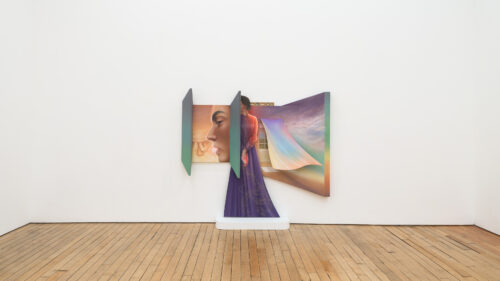
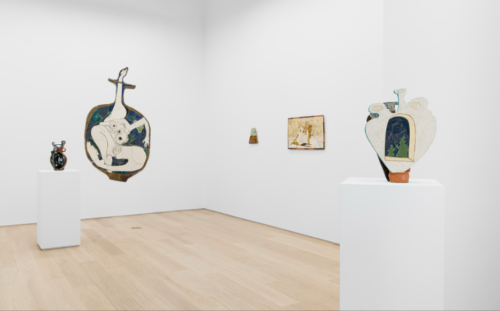
Altarpieces—historically sites of devotion, revelation, and spiritual certainty—become something altogether different in Arghavan Khosravi’s What Remains, currently on view at Uffner & Liu through July 2. The exhibition brings together large-scale wall works, a freestanding sculpture, and an intimate suite of new altar-inspired paintings that continue Khosravi’s ongoing exploration of the forces that shape women’s lives under political, cultural, and religious systems of control. Drawing equally from Persian miniature painting and medieval European iconography, the artist constructs layered worlds where architectural structures become psychological spaces, symbols migrate across histories, and moments of resistance emerge within conditions of constraint. Rather than offering resolution, the works linger in states of suspension—between freedom and captivity, memory and displacement, devotion and doubt.
Gabriela Vainsencher

Basis: Gabriela Vainsencher at Asya Geisberg

At Basis, Gabriela Vainsencher’s second solo exhibition at Asya Geisberg Gallery, the artist continues to explore themes of motherhood, domestic life, the female body, and her relationship with art history as an artist-mother, a figure traditionally marginalized. Vainsencher’s work resonates within a broader context of artists who have embraced domesticity and motherhood as central creative subjects, such as Louise Bourgeois, who explored maternal forms and the body. Vainsencher explains that she chose the title thinking about how early childhood forms the foundation for all experiences going forward, as  having children does to the parent, and also since she finds herself physically becoming a basis or pedestal when her kids climb on her, a familiar experience to all parents of small children.

Helen Frankenthaler, The Moment and the Distance, 2026, installation view

Hum and Song: Helen Frankenthaler’s The Moment and the Distance at Gagosian examined alongside Babara Guest’s writings

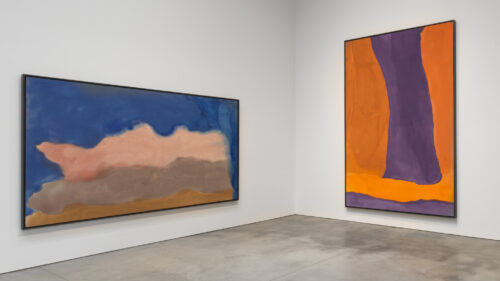
Helen Frankenthaler’s show at Gagosian New York, The Moment & The Distance is a beautiful retrospective survey of her work. The title is inspired by a mid-career essay by Barbara Guest that encapsulates the essence of Frankenthaler’s work. In the  1975 essay Guest defines Frankenthaler’s oeuvre in terms of music. She reflects that while there is beautiful “humming” in Frankenthaler’s early work, over her career it becomes  “song”. As her work matures, Guest argues, Frankenthaler becomes more decisive, methodical and assured in her practice, less spontaneous or reliant on happy accidents. Beyond demonstrating the present moment in the paintings, she walks the effortful distance to “consolidate her terms”.  

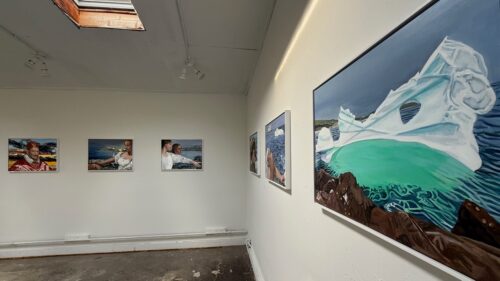
Installation view, Seven Women Chase Icebergs, The Re Institute

Pouch Power Women: with Brenda Zlamany

What starts as an open call and a group text to trusted friends becomes, two years later, an exhibition that feels inevitable. Seven Women Chase Icebergs, on view at The Re Institute in Millerton, NY, brings together seven painters whose friendships span decades and continents: Rome, Skowhegan, Triangle, Braziers. Organized by Brooklyn-based artist Brenda Zlamany — creator of The Itinerant Portraitist and a painter whose practice has long centered on community as both subject and method — the show grew from a month-long residency at Pouch Cove, Newfoundland, where the group painted, hiked, shared meals, and chased icebergs along the edge of the Atlantic. We spoke with Zlamany about friendship as curatorial logic, landscape as psychological mirror, and what it means to build something together at the edge of the world.

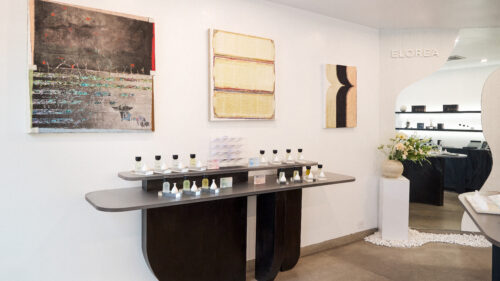
Installation view, Strata of Time

Strata of Time: a burying and unearthing of new discoveries at Elorea 

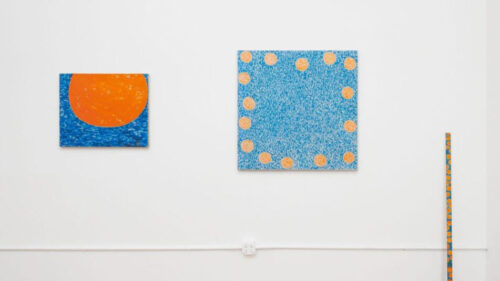
Stepping into the exhibition Strata of Time at Elorea, the focus is not only on the works hanging on the walls but also the fragrances around them as well. With works placed throughout a perfume shop, Herok was given the opportunity to respond to the fragrances surrounding his works. He uses his process of layering to overlay different colors, materials, and experiences of both to mimic the processes the perfume makers used to create their products, as they mix and meld various scents. The works are nicely displayed throughout the space; some works, like Out of Field 5, Out of Field 4, and See You Again, are displayed alongside products, while other walls allow works to stand on their own. This is an interesting exhibition collaboration that grew from studying the products and interviewing store personnel, a process that generated a new body of work carrying as many small details within the surfaces as the fragrances carry within the perfumes. 

Rachael Wren, Invitation

Well, Hell. Beautiful. Mary Shah and Rachael Wren at Rick Wester Fine Art

No one was supposed to say “beautiful.” Oh God, no. Not in the mid-1990s art scene I knew, when I worked at a then-trendy, high-gloss art magazine and beauty had all the social standing of a shrimp cocktail at a theory seminar. Beauty was too easy and too ready to come in smiling and ruin everyone’s severe little mood. A serious work could resist you from across the room. But beautiful? Beautiful was what your aunt said when she had run out of things to say.

Then I walked into Mary Shah and Rachael Wren’s In the Ecstasy of the Sun at Rick Wester Fine Art and thought: well, hell. Beautiful.

Stay Frosty Kingston

No Walls Required: Stay Frosty Comes to Kingston

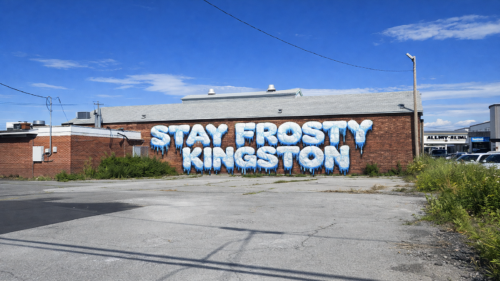
The gallery is a parking lot. The walls are car hoods, trunks, dashboards, and glove compartments. That is the premise of Stay Frosty, the itinerant art project launched by New York’s BravinLee programs that arrives in Kingston this June as part of Upstate Art Weekend, in collaboration with ArtPort Kingston. After a debut edition in Harlem that transformed a parking lot into a temporary neighborhood, Stay Frosty is now on home ground — a community where the car is less symbol than necessity, and where ArtPort Kingston has spent years weaving contemporary art into everyday public life. We spoke with BravinLee’s Karin Bravin and John Lee, and ArtPort Kingston’s Laurie De Chiara, about what brought them together, what they’re building, and why some of the most exciting art right now might be happening in a parking lot.

Lee Sherry, Installation view, Seeing and Recognition

Seeing and Recognition: The Paintings of Lee Sherry

Lee Sherry (1947–2012) showed paintings in New York and Boston through the 1970s and 1980s, moved in the circles of the Language poets, and left behind a body of work that almost no one knew existed. Seeing and Recognition, on view at Field of Play Gallery in Brooklyn through June 28th, is the first survey of her paintings — assembled by curator and artist David McDonough, artist Susan Bee, who was a close friend of Sherry’s in the 1970s, and artist and archivist Zak Vreeland, who acquired works directly from her studio after her death. The show brings together paintings that span decades, from early experiments made in dialogue with minimalism to luminous, layered late work that unfolds the longer you look. We spoke with David McDonough, Susan Bee, and Zak Vreeland about how the show came together, what the paintings do, and why Sherry’s work went unseen for so long.

Your Birth is My Birth at Jane Lombard: Merryn Omotayo Alaka and Sam Frésquez in Dialogue

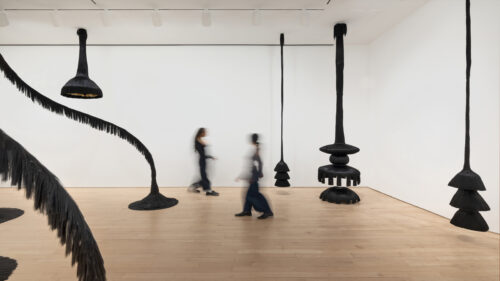
Kanekalon hair, the synthetic fiber of braiding salons and everyday hair care, is the raw material of Your Birth is My Birth, a speculative universe currently taking over Jane Lombard Gallery through June 13th. Artists Merryn Omotayo Alaka and Sam Frésquez have spent nearly a decade building Hairland, a collaborative fictional ecosystem that began with large-scale tassel sculptures in a Phoenix nonprofit space and has grown into a fully realized botanical mythology.

Voices In Minor Keys: 2026 Venice Biennale

In Minor Keys, the central exhibition of the 61st Venice Biennale, arrived with a quiet proposition. The late curator Koyo Kouho envisioned a show that reflects practices requiring time and sustained commitment — some of them lifetime, even generational — and in doing so created a deliberate antithesis to the Biennale spectacle. Drawing almost exclusively on artists from Africa, the Middle East, and the Caribbean, the exhibition is anchored in political concerns — identity, immigration, the environment — yet so many of the works felt personal, while reaching toward art history and even toward Venice itself. What follows is an account of its visual depth and strength.