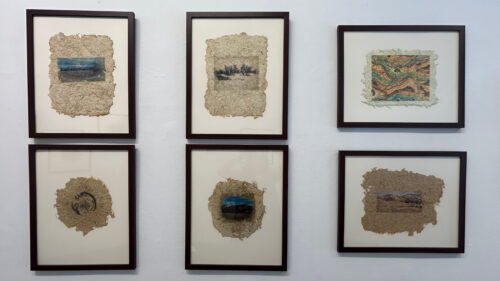
Diego Azzola, Huang Zhe, Installation view of He Spoke To The Birds

Interview for He Spoke to the Birds: Matter, Memory, and Nonhuman Voices

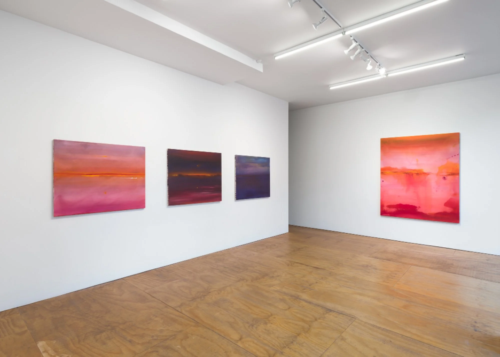
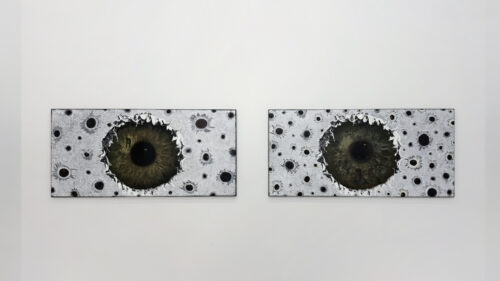
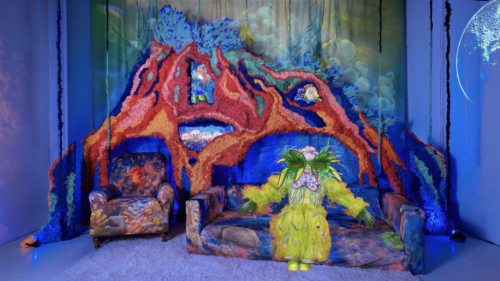
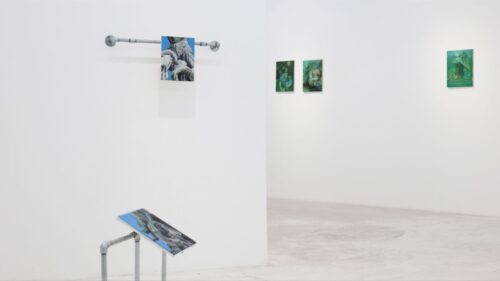
Presented at the AAIE Center for Contemporary Art in Rome, He Spoke to the Birds brings together works by Jeremias Rumpl, Diego Azzola, and Huang Zhe in an exhibition curated by Fanfan Yuxuan Fan. Taking its title from Carolyn Christov-Bakargiev’s reflection on Saint Francis of Assisi and Arte Povera, the exhibition asks what it might mean to listen not only to human voices, but also to birds, ruins, pipes, smoke, and matter itself.
Emelie Stenhammar, How Unexpected

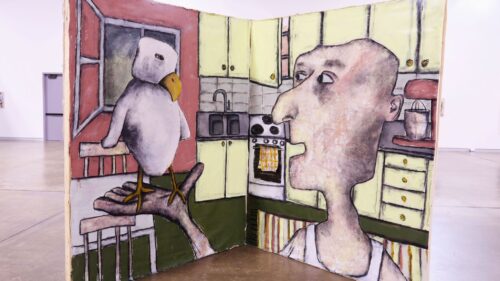
How Unexpected: Encounters With the Divine, Emelie Stenhammar

Emelie Stenhammar’s works echo the aims of Elizabeth Murray to reshape our relationship with painting. Cozy rectangular formats are denied. Twisted Perspective prevails. Both artists’ depictions of domestic spaces reflect a mutual fondness for cartoons and whimsy. Stenhammar paints compelling allegory about the human condition, with a compassionate gaze akin to that of Kathe Kollwitz. 

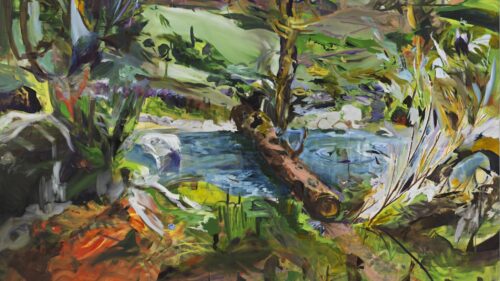
Cecily Brown, Nature Walk with Paranoia

Cecily Brown at the Serpentine: Everything Everywhere All at Once

Entering the first room of the gallery, one is instantly struck by the richness of movement in Cecily Brown’s paintings. Several recent works, drawn from nature walks, centre on the motif of a log laid across a blue stream. This fairy-tale imagery, bordering on kitsch, was borrowed from a jigsaw puzzle Brown was completing at the time. Yet the jagged shrubbery and turbulence surrounding these scenes point towards something darker.

What Remains, What Connects: Tulu Bayar Explores Home Through Material and Memory

In What Remains, What Connects: Stories in Assembly, on view at Amos Eno Gallery, Tulu Bayar brings together two distinct yet deeply connected bodies of work that approach the question of “what is home?” from different perspectives. Together, they reveal home not as a fixed location but as something more amorphous, continually assembled through lived experience, collective memory, and our relationship to place.

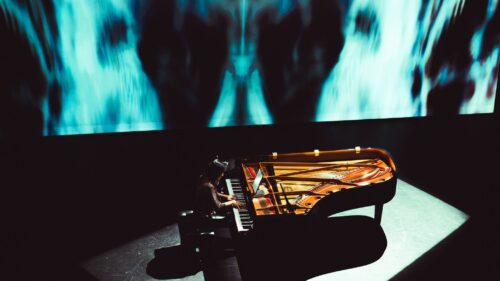
Pianist Clara Yang with visuals by Xuan

The Baryshnikov Arts Center Celebrates 20 Years with Ex Machina

The Baryshnikov Arts Center celebrates its 20th anniversary with a dazzling work that perfectly reflects the institution’s spirit of innovation. Ex Machina, a collaboration between pianist Clara Yang and visual artist Xuan, is not simply a concert, an art exhibition, or a multimedia performance. It is a thrilling encounter between piano sound and painterly images that transforms the stage into a living canvas.

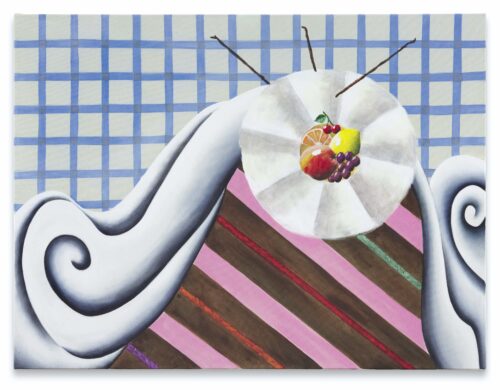
Andreas Schulze, Untitled (Her)

Andreas Schulze’s exploration of color in the cool pastures of cake

In his show Cake (2026) at Sprüth Magers, New York, Andreas Schulze explores the visual effects of saturated color and geometric form, using cake as the setting for his investigation.

In his paintings, Schulze creates an inner three-dimensional universe, which serves as a bell jar. In his imaginary pastures, Schulze creates surreal interiorscapes, built of geometric shapes and flat backdrops of color-gradient skies, juxtaposed with rounded spheres and spirals painted in three-dimensional perspective, with depth and shadow. The pictorial space he builds gives a stage for him to explore various phenomena, in this case, cake, and he does so with a playful seriousness, experimenting with the basic forms and images that make up cakes: candles, frosting, fruit, sprinkles, and layers.

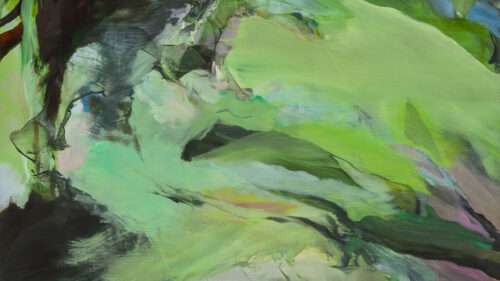
Hollis Heichemer, Come to the Surface

Hollis Heichemer: Transcension over Anthropocentrism and Breakaway into Landscapes

Hollis Heichemer’s solo exhibition at Hollis Taggart titled “moving in stillness” is a profound investigation of existence and the meaning of the world through the study of landscapes and Mother Nature. Is Humanism an anthropocentric perspective that is ultimately flawed and furnishes humanity with the arrogance to destroy the environment and disregard the principles of empathy? How can we overcome the diseased thought that humans have the right to master or exploit nature for profit? And how has the artist found great peace and liberation through her lifelong study of Mother Nature and her generous nourishment and wisdom? Does Heichemer apply the paint purely as a formal exercise of abstract colors and relationships, or does the paint become the flesh of Mother Nature, by the observation of which we can become and live through the painting as landscapes?

Tommy May at Half Gallery

Tommy May: Sammy’s at Half Gallery

Life’s a beach, or maybe it should be if it could only resemble Tommy May’s resplendent scenes of light reflecting on Sammy’s bay beach on the east end of Long Island. Are beach scenes banal? Despite a robust art-historical lineage of beach paintings ranging from Milton Avery to Alex Katz, not to mention myriad others, including Picasso, Monet, and Degas, there’s a tendency to relegate the genre to kitschy decoration, best suited for motel rooms or dentists’ offices. Despite a softness to May’s surfaces that could cross into that territory, the paintings deftly skirt it through their atmospheric intensity and sophisticated touch.

Installation view of Here on and after

Growing After the Embers: A Review of Bùi Thanh Tâm’s Solo Exhibition Here on and after

For a long time, when I was young, I felt distant from the idea of “history.” In textbooks, history always appeared through years, wars, reforms, and changes of political power, as if it were made of events already organized and settled. Yet the history that truly remains in the body often appears in more hidden forms. It may be a silence within family narratives, a memory that one generation chooses to avoid, a recurring pattern in festive images, or a color that seems joyful while quietly carrying a wound. Very often, history continues to exist in another form, lingering in images, bodies, and everyday experience.

Dakota Gearhart: All Matter Is Alive

Dakota Gearhart grew up on a Florida coastline where algae blooms, sewage outflows, and bikini contests share the same shoreline, and her work has been carrying that mix of beauty, decay, and amusement into a much bigger frame ever since. Across animation, sculpture, performance, and sound, she builds video worlds where pixels sing, electricity becomes sentient, and the nonhuman shows up on equal footing with the rest of the cast. Her ongoing animated series Life Touching Life is hosted by Tiffany, a half-algae, half-woman figure who guides viewers through episodes shaped with collaborators — poets, scientists, activists, caretakers — whose lives already reflect the worldview the work is reaching toward. It’s funny, strange, and serious in roughly equal measure, which turns out to be the right register for the worlds it stages.