
Hollis Heichemer’s solo exhibition at Hollis Taggart titled “moving in stillness” is a profound investigation of existence and the meaning of the world through the study of landscapes and Mother Nature. Is Humanism an anthropocentric perspective that is ultimately flawed and furnishes humanity with the arrogance to destroy the environment and disregard the principles of empathy? How can we overcome the diseased thought that humans have the right to master or exploit nature for profit? And how has the artist found great peace and liberation through her lifelong study of Mother Nature and her generous nourishment and wisdom? Does Heichemer apply the paint purely as a formal exercise of abstract colors and relationships, or does the paint become the flesh of Mother Nature, by the observation of which we can become and live through the painting as landscapes?
Certain similarities and influences could be observed, if stretched, between Heichemer’s works and those of Helen Frankenthaler, Richard Diebenkorn, and Zao Wou-Ki, but in fact Heichemer’s oil paintings stand on their own terms as highly original abstractions. Heichemer charts out a self-referential ecosystem of visions and outcomes that communicate and compare with one another. This is to say that the artist invents her own visual language of abstraction that does not reference an external source but her own works. Often, Heichemer’s paintings reject the idea of a center or the need for a grounding orientation, suggesting an upward or downward direction that is usually associated with paintings conceived as landscapes. The space in Heichemer’s abstract paintings is neither Euclidean nor isometric; rather, it is psychological and immersive, composed as if it were zoomed and cropped in a panoramic fashion. Imagine the artist jogging through the hills and the trails around her New England home – the passing foliage and glimmers of light and shadow may be the inspirational starting point for her abstract landscape paintings.
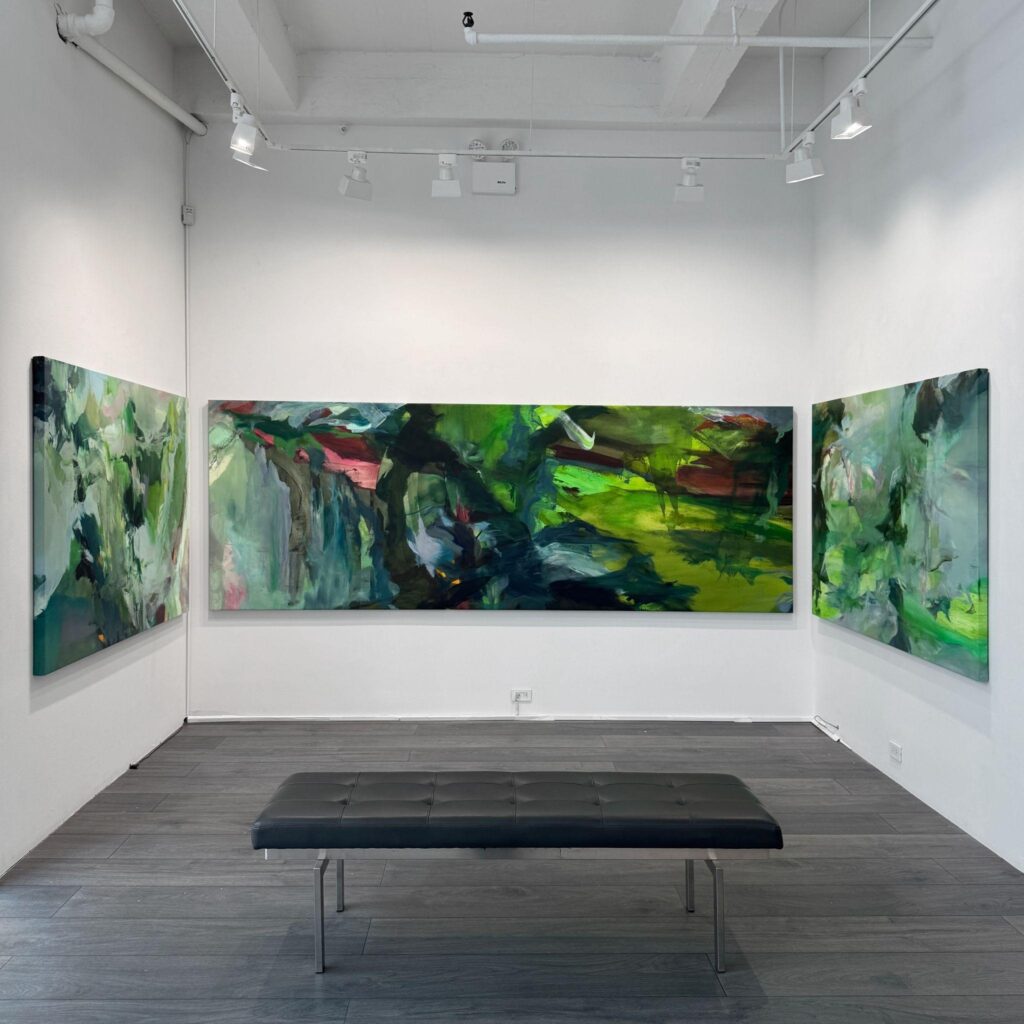
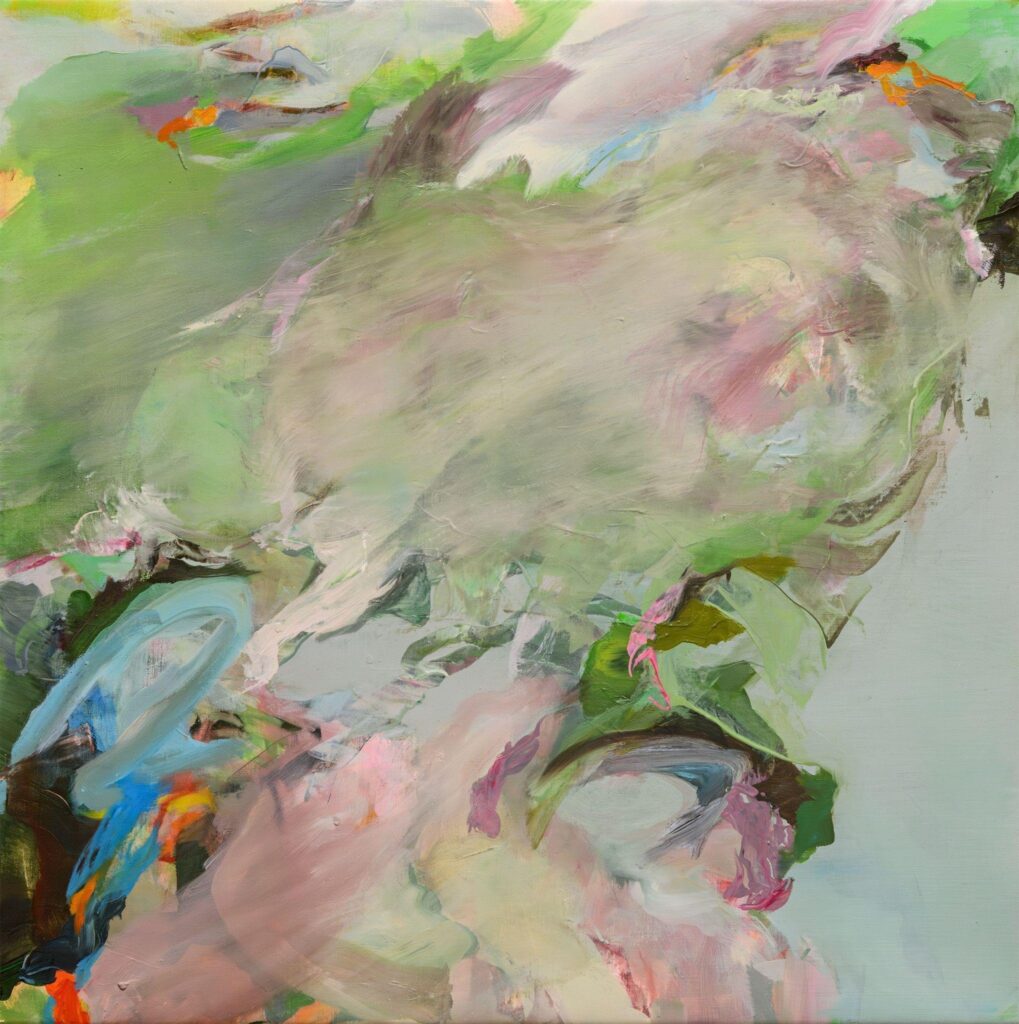
Heichemer’s images are imbued with empathy and understanding that originate from a position of generosity and abundance. There is great thoughtfulness in the playfulness of her strokes and colors, but the work remains in the middle ground, neither fully maximalist nor minimalist. The artist establishes a system of exchange and relationships between the colors and the marks, consisting of thinly glazed washes, abstract, dynamic strokes suggesting a flurry of motion, and the sweet moments revealed by strokes that the artist chose not to paint over.
She is learning to speak the language of the grass and the leaves of the trees that dance in the warm embrace of sunlight as they engage in photosynthesis. She is suggesting an imaginary world or logic, like a physics engine, where the natural and vegetal elements begin to move up, down, and sideways in a dynamic waltz or tango, defying our animal-centric bias that they are just static objects lacking in agency. Perhaps the vegetal life is communicating in a collective dream, in a non-physical, shared virtual realm that we humans cannot access in material reality, but Heichemer sees snippets of this mysterious, spiritual realm through her abstract paintings.
A contrasting trait of animals relative to plants is autonomous movement, situational awareness, and responsiveness. Still, the distinguishing trait of humans is communication through spoken and written language. Words are how humans convey their inner spirit to an external observer, revealing their inner consciousness.
Do animals lack this consciousness or “soul” that is presumed to be exclusive to us humans only, or is this belief a fiction that we humans, in particular those belonging to the Judeo-Christian tradition, made up to justify the daily slaughter of animals for protein? If we can do terrible things to animals just because they are unable to speak and write like humans, imagine what kind of disrespect we have for the plants and corals.
Heichemer appears to decode the language of the vegetal realm in nature through her abstract paintings, in which paint becomes the flesh and the voice of Mother Nature. The sweet moments of abstract colors and patterns become the vowels and syllables of her sweet and encouraging voice. Heichemer discovers that the language of abstraction must reflect on the state of non-being and the validity and the intrinsic substance of the “empty” space or void. In abstract landscapes that reflect on the sublime, such as those of Isaac Aden, the universe manifests its infinite nature as a never-ending expanse filled with ether, in which we can hear the sound of om. However, Heichemer’s paintings are much more intimate, immediate, playful, energetic, and local in scale. The sense of non-being is still conveyed in her paintings as no tangible or identifiable object or symbol masquerades as the “self.” Still, everything merges and disintegrates seamlessly with one another, crossing endlessly between the self and the non-self everywhere simultaneously – the identifiable marker or vector for the self and the non-self are the abstract brushwork and colors themselves.
Like a devoted parent, nature is the mother, who is everywhere in Heichemer’s paintings and nowhere at the same time. And Mother Nature teaches us the importance of empathy and gratitude, the lesson in which we cannot mistake “power” for the power of the individual. The only individual power that Heichemer and Mother Nature agree on is the creative drive. Still, even then, this belief is neither truly individualistic nor humanistic, ideologically speaking, because Heichemer’s paintings reject individuality and the importance of the self, embracing the principle of non-self instead. This alternative ideology, which is not necessarily opposed to humanism and anthropocentrism, comes from a humble and generous place beyond such views.
This belief acknowledges the nature of creativity and genius as a gift from the divine and an external source, rather than as our own manufacture, born of our own hubris.
Like Hilma af Klint, Heichemer has compiled and documented Mother Nature and her language through her abstract paintings in the style of an updated, contemporary Abstract Expressionism. Through Heichemer’s works, viewers can communicate with Mother Nature in the highly controlled language of abstract painting, which also permits accidental discoveries and by-chance revelations. Heichemer’s abstract landscapes constitute an extensive, serial portrait of Mother Nature, through which we finally come to understand her language and sense of being (as non-being and as an infinite concept). Heichemer appears to say to Mother Nature, “Hello, Mother Nature, I feel your presence and understand your love” through the language of painterly abstraction. Ultimately, Heichemer’s works transcend the biases and the limitations of human imagination, rejecting the anthropocentric idea of the self and the hierarchy in the natural world. Through Heichemer’s works, which advance the language of painterly abstraction, abstract landscape paintings arrive at their final destination… a formal exercise that carries a purpose of communication and strong empathy.
HOLLIS HEICHEMER: MOVING IN STILLNESS, Hollis Taggart, 521 West 26th Street, New York, NY 10001. On view through July 10, 2026. Mon–Fri, 11 am–5 pm.
Make your tax-deductible donation today and help Art Spiel continue to thrive. DONATE
About the writer: Chunbum Park, also known as Chun, is an artist from South Korea, where they were born in 1991. They received their BFA in Fine Arts from the School of Visual Arts in 2020 and their MFA in Fine Arts Studio from the Rochester Institute of Technology in 2022, where they changed their pronouns. Born a male, Park likes to cross-dress and depicts themselves as a woman in their paintings. They are the inventor of the ArtBid art auction card game and run the Roundcube Collective (currently merged with the Brooklyn to Gangnam website), where they interview other artists. Park writes exhibition reviews for various print and online magazines, including the New Visionary Magazine. They currently reside in Cliffside Park, New Jersey. @chun.park.7