
Eric Wolf’s works at Abri Mars take us through misty, expansive landscapes. Their ethereality and tranquility pull viewers into new places to explore and settle into. Within Two Waters, Wolf recreates the landscapes he observes directly, using a limited ink palette to bring the pieces to life. Through a combination of controlled and reactive strokes, Wolf uses hard and soft edges to render his figures of nature. While the figures are more abstract- mountains, bodies of water, trees, etc, these works are expanding on the process of plein air, bringing the environment into the works directly. With the gallery’s natural light from the front windows, the darkness of the ink becomes velvety, drawing you in, while the light of the paper glows beneath, pushing outward. This push and pull makes the work feel dynamic and lively.
In hearing about Wolf’s process, it was interesting to discover that he connected greatly with two specific bodies of water, both in Chatham, New York, and Rangeley, Maine, where he would create pieces outdoors. In doing so, he uses many direct processes, often using water directly from these sources to mix with his ink and build upon his pieces. By using the literal water as a resource and focusing on the nuances of these locations, Wolf takes plein air observation to a whole new level. This deep connection to the environment adds another dimension to the works- these works on paper and the landscapes that Wolf creates, illuminate the various structures of nature and transform them into flowing, foundational forms. The stronger, deeper lines in the piece, titled Sonoma Landscape, which build up to create the mountains and the continuous waters flowing below them, not only anchor the forms, but they also meld into each other. Especially in this piece, the water and landscapes appear to merge, as Wolf’s darker ink shapes reflect the mountains in the waters below. Dimensions are melded as light and dark forms become the major focus.
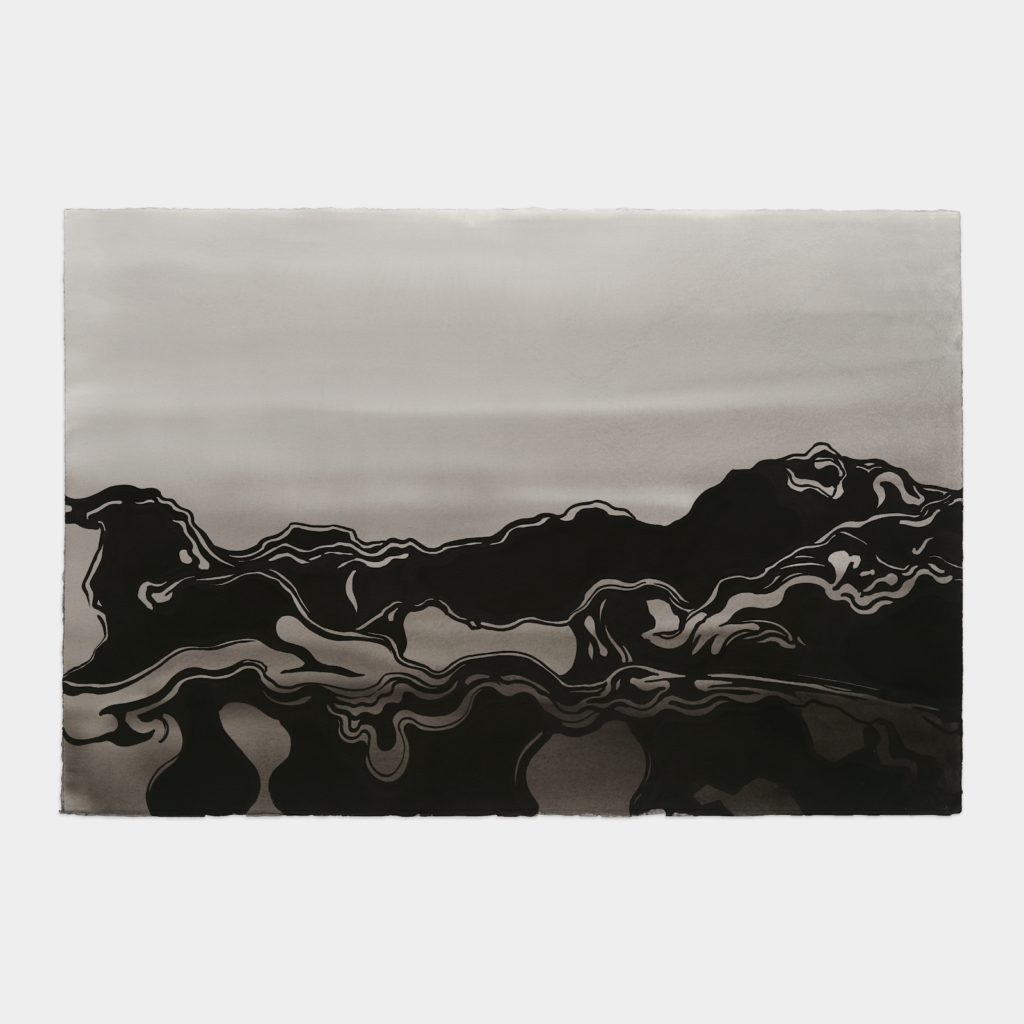
I quite enjoy that Wolf literally works within the environment of his subject. Being amidst the outdoors, with and against the elements, Wolf often works through them, layer by layer. He is reacting to what he observes and what the material he’s working with gives him. With this process, Wolf blurs the lines between the artist and the environment. Through these pieces, Wolf favors depicting the isolation of rainy days. Where foggy environments cover up the minute details and reduce everything to its most essential forms. Mountains become mounds of shadow, with wavy and heavy ink lines depicting the movement of a river in the distance. He curves the ink ever so slightly to let glimmers of the lighter paper show through the thick strokes, as seen below in the piece titled Fog. The vastness of the water in this piece seems endless, lines progressing up the paper, pulling us into the background as more lines seemingly keep appearing.
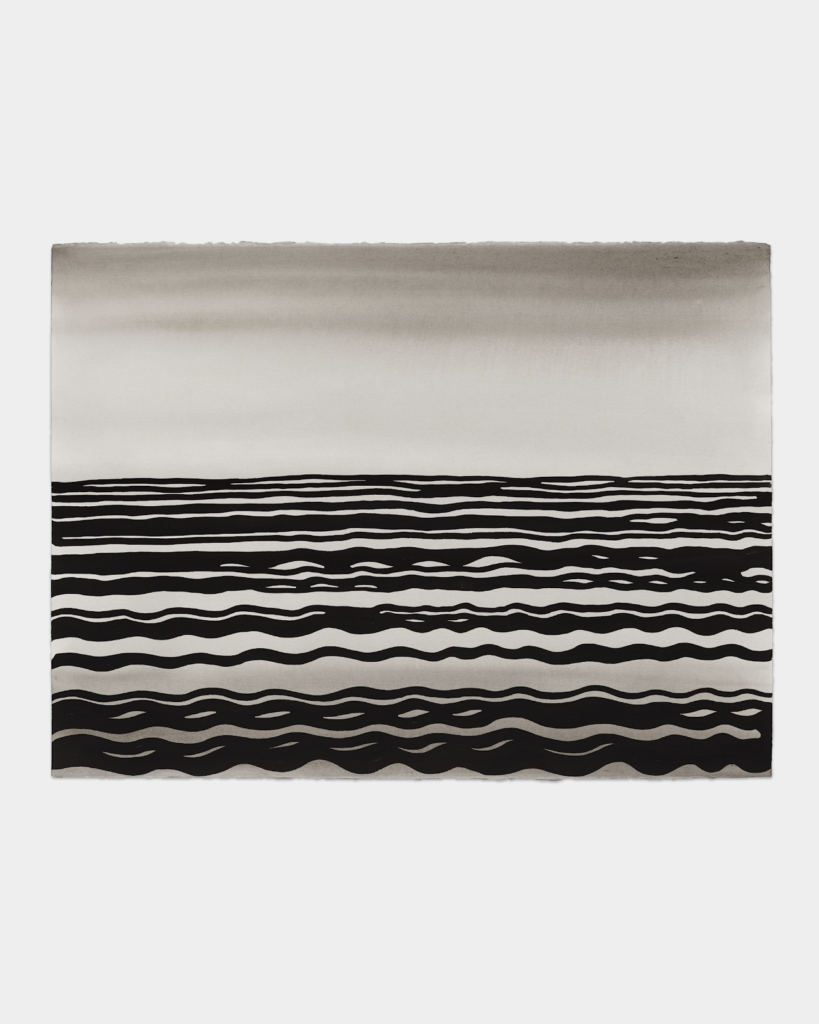
While they are less traditional and more abstract, the forms Wolf creates in the drawings depict what he is observing, experiencing, and how he is reacting to his surroundings. The ink washes lend well to foggy exteriors, allowing light to permeate in select spots where Wolf lets the paper peek through. The fog adds drama and pulls aspects of the environment forward as if it is confronting us (or, in the real sense, confronting Wolf), especially in the drawings depicting rolling, accumulating clouds. Western Sky shows Wolf’s flowing linework and accumulating shapes, building up the clouds as if a storm were approaching along the horizon. While the lines may be simple in form and function, they are poignant and impactful, combined with the gentle grey ink washes in areas of the backgrounds. A feeling of both awe and apprehension emerges as Wolf presents us with a grand view and a monumental unknown all at the same time. We do not know if the storm may be coming our way, or if it is merely passing by, and we get the opportunity to observe it safely from a distance.

At first, upon entering the gallery, I thought many of these pieces were woodcuts, but upon closer inspection, his brushwork mimicked that of a woodblock print. These pieces carry with them printmaking and photographic sensibilities that further evolve the plein air style. Wolf uses a darkroom vocabulary, turning the natural world around him into its foundational contours and values of light and dark. Its energy is captured in his strokes and in the areas where he allows the ink to bleed or follow wet spots on the paper’s surface. Despite containing them in a rectangular register, with an untouched paper border, Wolf still retains the fluidity of the inks. Similar to the rivers he observes and their unending flow, Wolf allows the inks to flow onto the paper and within the forms he creates. Just as water keeps progressing no matter what stands in front of it, Wolf allows the ink to flow rhythmically around areas, following the movement of the water, and creating contours in the process.
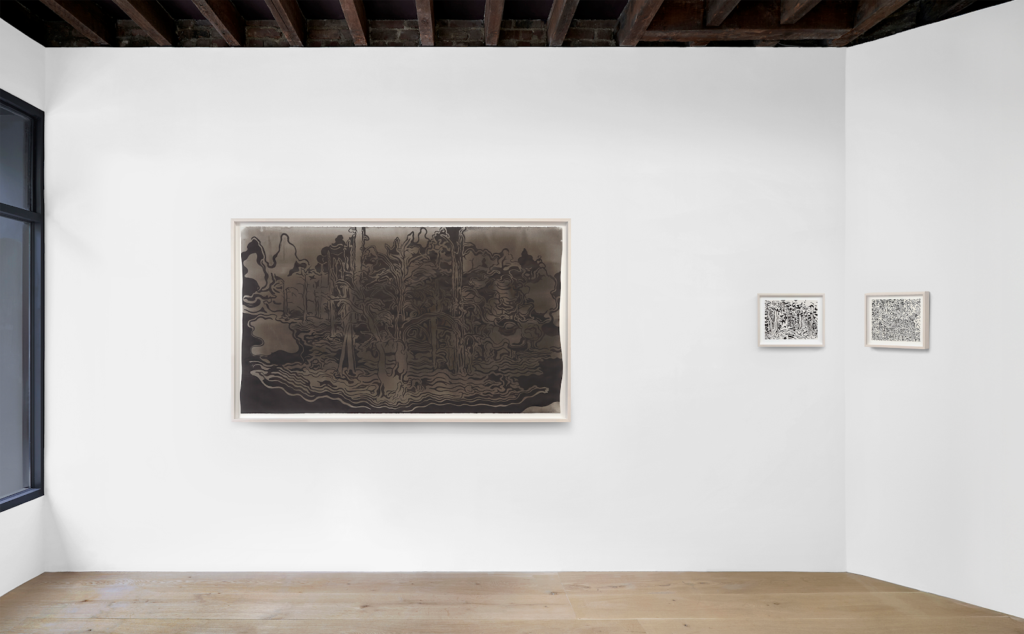
Two Waters offers an opportunity to view the evolution of a Wolf’s works and process over time. As a painter who, for decades, has worked in intimate dialogue with the natural world, Wolf engages deeply with both the world he observes and the materials he works with. It was intriguing to hear that Wolf completes each piece within the day, and sometimes sooner, depending on the outdoor conditions he is facing that day. His process has become attuned to the ebbs and flows of nature, and he works within those natural conditions. The pieces carry with them a freshness and an immediacy, where the combination of abstraction and realism melds into a middle ground to create a new take on an observed space. Wolf evolves the landscape and most definitely makes it his own.
Two Waters, Eric Wolf at Abri Mars, 53a Stanton Street, NY, NY. On view through April 25th, Wed – Sat, 12 am – 6 pm.
About the Writer: Taylor Bielecki lives in Gowanus, where her studio is, and works at Pratt Institute, where she earned her MFA. She also studied at Penn State, where she earned a BA in English and a BFA in Fine Arts. She finished as a finalist in the Kennedy Center’s VSA National Emerging Young Artist program for 2017, where she earned an award of Excellence. She has shown prints internationally in a print exchange in Australia and exhibitions in Dubai, India, and the Glasgow School of Art. She has also shown paintings internationally in Gallery 24N, PhilaMOCA’s juried exhibitions in Philadelphia, Pa., Perry Lawson Fine Art in Nyack, NY, BWAC in Red Hook, and IW Gallery in Brooklyn. Taylor works for Two Coats of Paint, TUSSLE Magazine, and has joined Art Spiel as a contributing writer. @Taylor.Bielecki