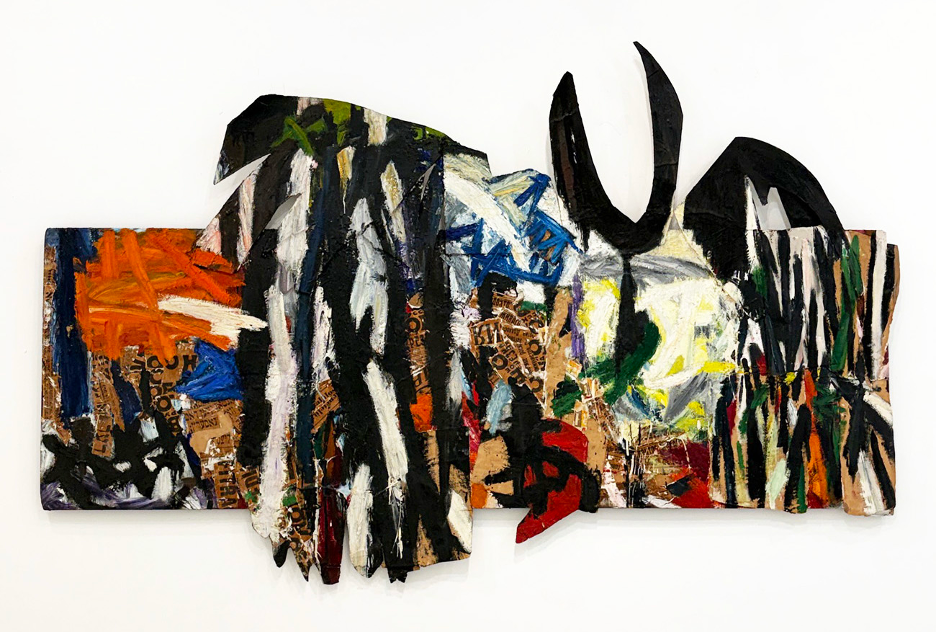
Eric Firestone Gallery, in its continuing support of underrepresented and female artists in the 20th and 21st centuries, has mounted an ambitious and interesting exhibition on now through July 11 at the gallery’s location on Great Jones Street in NYC. The exhibition is devoted to women who worked in abstraction from 1945 to 1979, thus giving the curators a very specific window within which to work.
Continue reading “Women Across America 1945-1979 at Eric Firestone”Hum and Song: Helen Frankenthaler’s The Moment and the Distance at Gagosian examined alongside Babara Guest’s writings
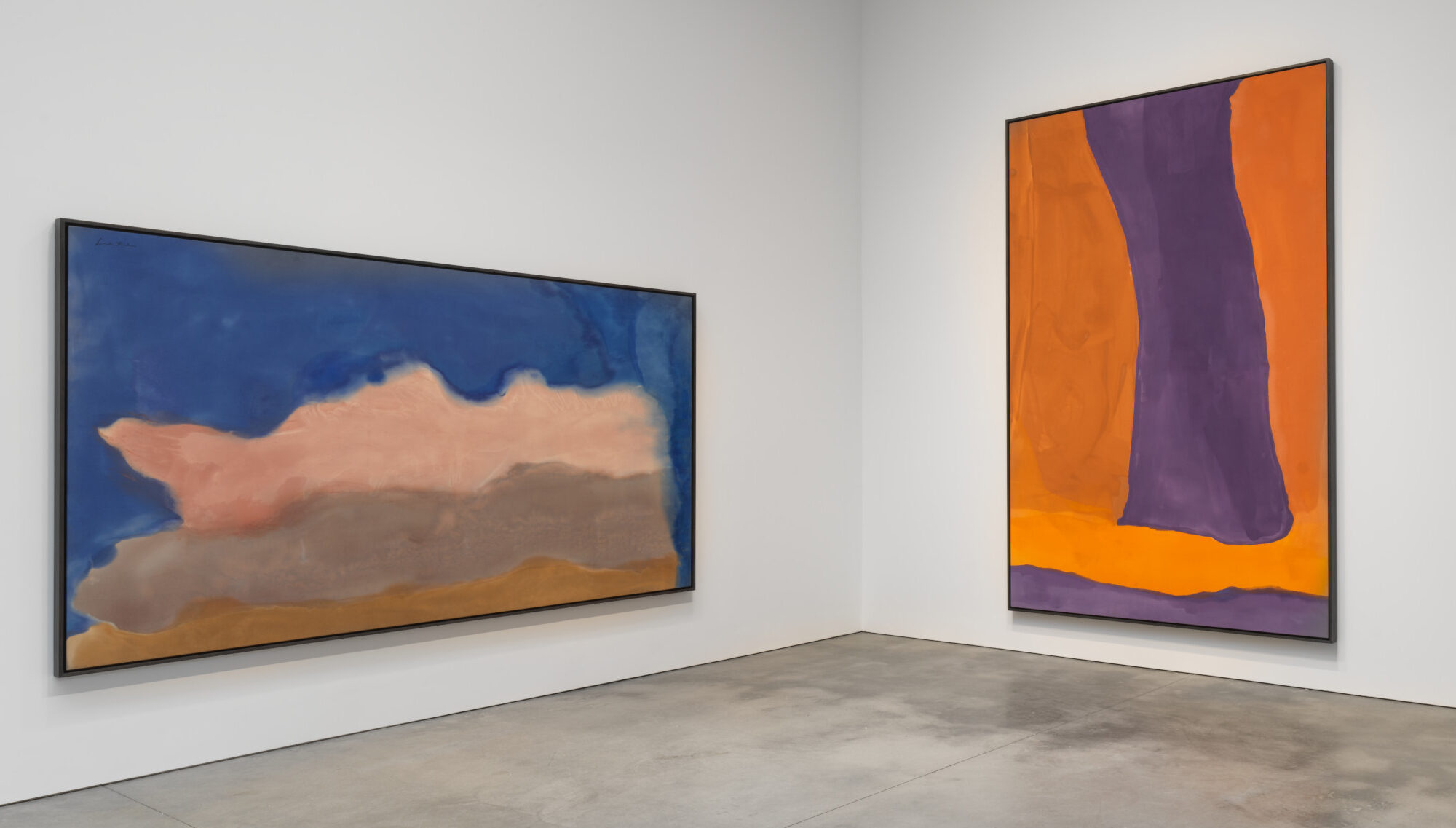
Helen Frankenthaler’s show at Gagosian New York, The Moment & The Distance is a beautiful retrospective survey of her work. The title is inspired by a mid-career essay by Barbara Guest that encapsulates the essence of Frankenthaler’s work. In the 1975 essay Guest defines Frankenthaler’s oeuvre in terms of music. She reflects that while there is beautiful “humming” in Frankenthaler’s early work, over her career it becomes “song”. As her work matures, Guest argues, Frankenthaler becomes more decisive, methodical and assured in her practice, less spontaneous or reliant on happy accidents. Beyond demonstrating the present moment in the paintings, she walks the effortful distance to “consolidate her terms”.
Continue reading “Hum and Song: Helen Frankenthaler’s The Moment and the Distance at Gagosian examined alongside Babara Guest’s writings”Tom McGlynn: This Here at Rick Wester Fine Art

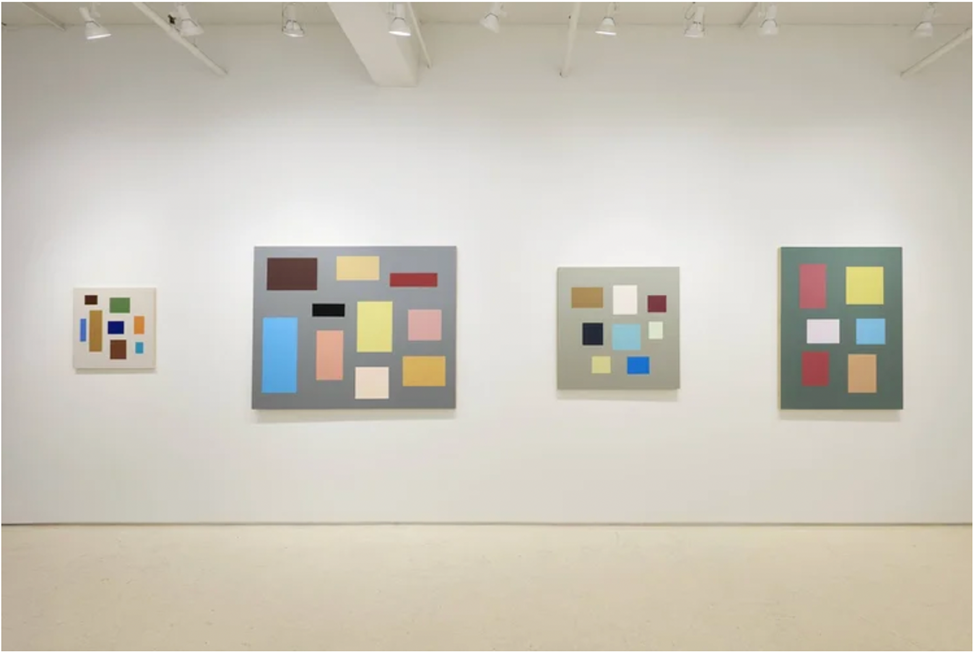
Tom McGlynn continues to grow a decade-long train of thought with a new selection of paintings in This Here at Rick Wester Fine Art. Consistent with his oeuvre, he arrays a selection of color rectangles suspended within various fields of color. An acquaintanceship with the origin of this direction, accompanied by a fresh pair of eyes, will enable a viewer to put aside the parallels with Mondrian, Albers, or even Hans Hoffmann, and see these works anew.
Continue reading “Tom McGlynn: This Here at Rick Wester Fine Art”T.D. Motley: The Art of Farming
In Dialogue

Thomas Motley’s first novel, The Art of Farming: Sketches of a Life in the Country, is rooted in stewardship—a shared responsibility for the earth, animals, and one another. This theme has become more central to his paintings over time, though respect for nature has always been part of his work. His non-fiction writing and lectures on organic farming have also reflected this idea.
Continue reading “T.D. Motley: The Art of Farming”Bascha Mon’s Life and Journey of Dreaming at Tappeto Volante
In Dialogue

The retrospective of Bascha Mon’s paintings at Tappeto Volante offers a focused look at an artist whose career has been shaped by both creative achievements and personal struggles. Mon first gained recognition in the 1970s and 80s, with numerous exhibitions and critical acclaim. However, her trajectory was interrupted by health challenges that led to a long period of seclusion. During this time, she continued to work from her basement studio in New Jersey, expanding her creative vocabulary across various mediums while remaining largely out of the public eye. In recent years, Mon turned to digital platforms like Facebook and Instagram. Paola Gallio, the exhibition curator and gallery co-founder, describes this phase as “dissolving the physical isolation that had once defined her situation.” These platforms allowed Mon to reconnect with the art community and sustain an active, visible presence. Gallio emphasizes that “Mon’s modest basement studio became a metaphor for boundless creative space,” where the constraints of physical isolation were replaced by the limitless possibilities of virtual engagement. For deeper insights into the retrospective, Gallio’s interview with Art Spiel offers further reflections on Mon’s artistic journey and the significance of this exhibition.
Continue reading “Bascha Mon’s Life and Journey of Dreaming at Tappeto Volante”Adam Henry: Parts to a Whole
Opinion

Amongst a burgeoning market of retrograde art practices there runs an undercurrent of artists seeking to establish for art and its practices a new sustainable identity as a means of inquiry. What made his work different was that he was using painting as a platform primarily to explore the subjectivity and semiotics of perception—the polarity between painting as an optical event and a conceptual one. Taking his vocabulary from color theory, systemic and color-field painting, and cognitive science, his work focused on the difference between what a thing (materially) is and what it may descriptively represent. As with those works, Henry in his present exhibition at Candice Madey Gallery rejects at every turn the cult of individual expression, the magical thinking of transcendence, the pervasive appeal of accessibility, and spectacle. Instead with his present body of works, he reasserts his ambition is to use art as a means to engage his audience in speculative thought and self-reflection.
Continue reading “Adam Henry: Parts to a Whole”Whisperings from the Wormhole with @talluts
Midlife Big Bangs

As an artist, have you ever looked around and felt ancient, withered, and uncool? Well, this pep talk is for you, because we’re about to find out how later in life, big bangs can be the bravest and most creative big bangs of all.
Continue reading “Whisperings from the Wormhole with @talluts”Debra Ramsay: Painting Time
Debra Ramsay embraces “beauty” as a core in her work. Throughout her installations and paintings she reflects on the relationship between color, light, time, and place with a minimalist’s impulse and a colorist’s flair. Mara Williams, the curator of “Painting Time”, her recent show at Brattleboro Museum, eloquently describes it as both “reductionist and exuberant.” In this interview for Art Spiel the artist elaborates on her background, ideas, and projects.

John O’Connor Artist Profile: A Voice of His Own

At first it seemed odd to discuss basketball free throws with the artist John O’Connor in relation to his art work. Yet, athletic performance is an important part of O’Connor’s process. He energetically explains how a successful free throw involves magic and science, chance and control, practice and improvisation; themes that John O’Connor has been exploring in his paintings, drawings and sculptures since his formative years as an artist. Continue reading “John O’Connor Artist Profile: A Voice of His Own”