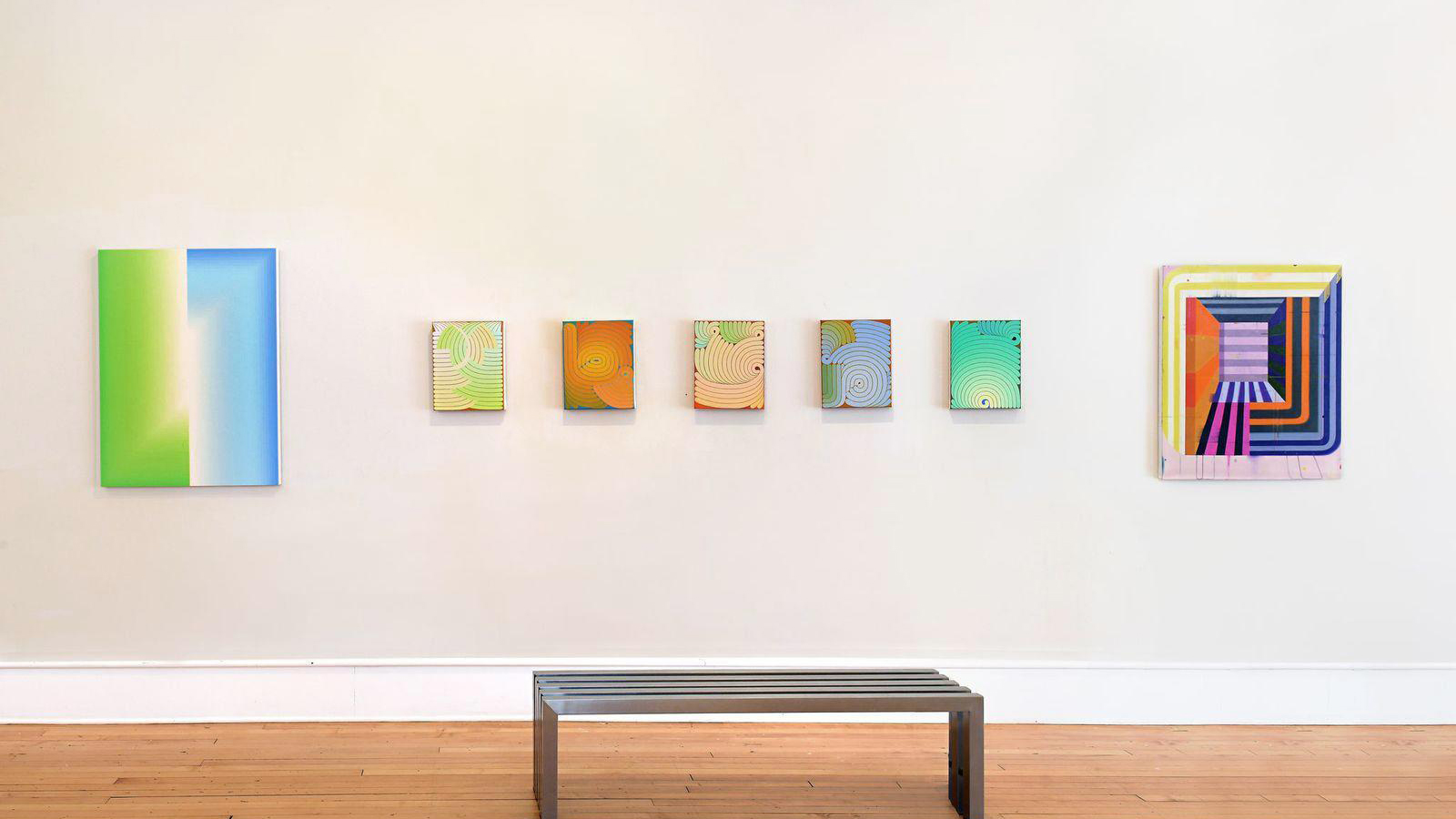
Polychrome, on view at Bernay Fine Arts, brings together paintings by Jenny Kemp, Audrey Stone, and Deborah Zlotsky in an exhibition on abstraction and geometric structure. Across three distinct practices, the artists use color as structure and sensory experience, although each arrives at abstraction through her own internal logic. Here abstraction is a form of concentration, examining the texture of experience: how can attention intensify and shift? How can time accumulate? How can systems hold together and slip apart? Artist Meg Lipke, a long-time colleague and friend of the artists, visited the show and addressed questions for the following conversation.
Continue reading “Polychrome at Bernay Fine Arts”The Sublimity of Simplicity in Dai Ban’s Sculptures
On view at Carrie Haddad Gallery through November 26
Artist Profile

When Dai Ban first traveled from his native Japan to the United States, he was struck by the nonchalant vibrance of American street art. The year was 1985, and although the golden age of graffiti had come and gone, its ethos had indelibly permeated the fine art world. Imagery that had been considered lowbrow just ten years prior became astronomically salable, so long as it decorated a canvas and not a subway car. Ban was bemused by the transformative power of gallery spaces. “Anything you show at the gallery looks like some kind of art,” he observed.
Continue reading “The Sublimity of Simplicity in Dai Ban’s Sculptures”Maggie Nowinski -Drawing (un)limited

Maggie Nowinski, Be Spilled, My Heart, 2021 detail installation view with artist for scale, wHoles are acrylic and India ink on canvas, double sided, installation approximately 20’x30’x10’
About a decade ago, Maggie Nowinski shifted her focus from site specific project-based installation to her studio as the primary site of her work. She made this shift after realizing that her connection to the work had become too fragmented. She needed her studio work to become more accessible and her creativity more meditative. Since drawing has always been at the core of her work, focusing on drawing with limited materials and themes, enabled her to process a lot of the ideas she had been working through in her large-scale installations. “I was craving a way to immediately access creativity, to be in a place where if I had an hour I could walk into my studio and pick up where I’d left off on a drawing,” she says.
Continue reading “Maggie Nowinski -Drawing (un)limited”Todd Bartel: an Omni-coupler

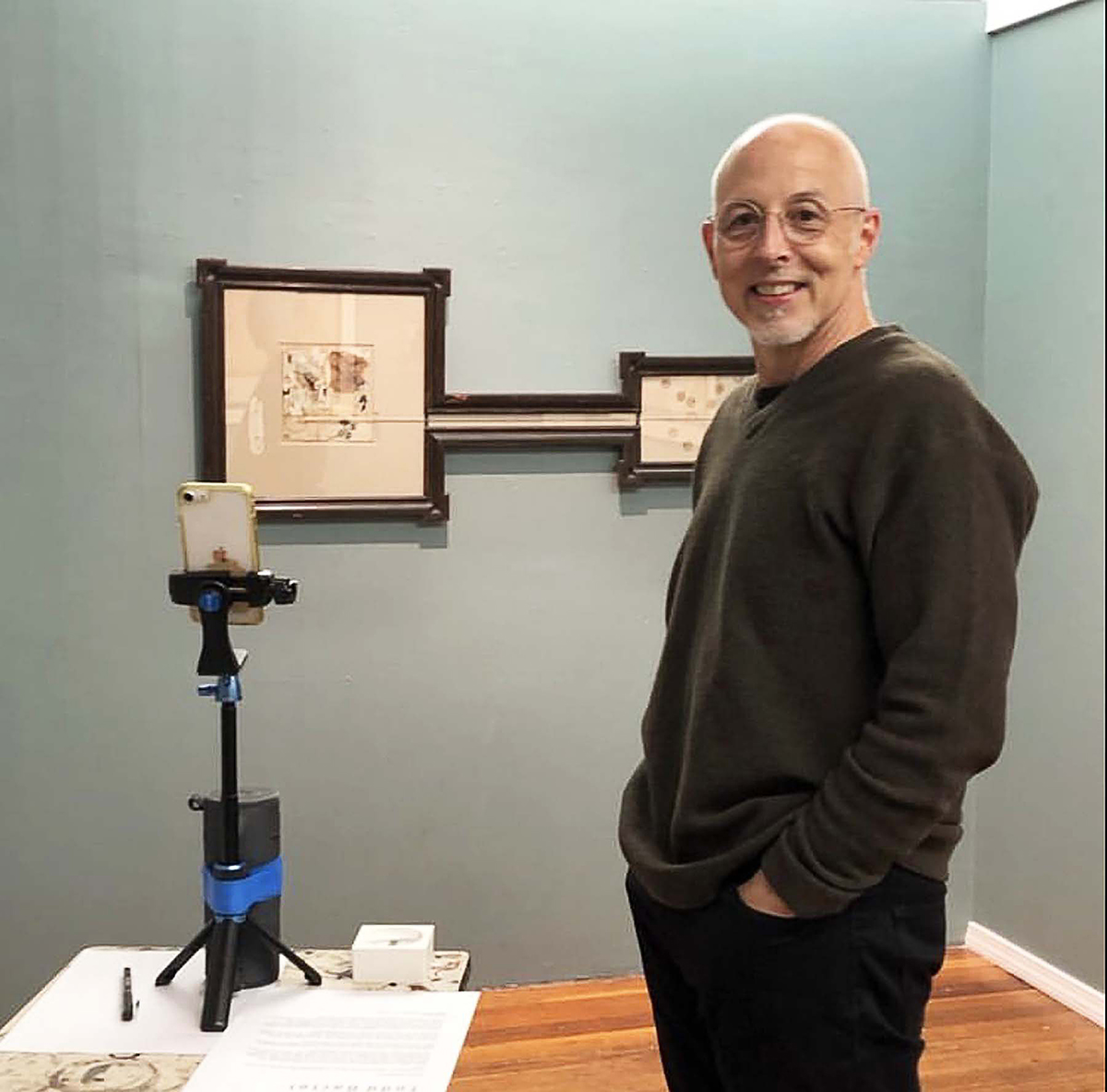
Todd Bartel in front of Pollination of Devonia, (Synterial series), 2002, gallery talk, L(and) exhibition, Room 83, Watertown, MA, photo courtesy of Ellen Wineberg
Todd Bartel came to serious collage because of an assignment he received on the first day of his first class as a freshman at RISD. He recalls the desks were strewn with magazines, and as soon as the course started, Professor Hardu Keck gave the students a prompt, “Create five collages that work with the following sentence: Surrealism is the chance happening of finding an umbrella and a sewing machine on a dissecting table.” Keck did not mention he was quoting Andre Breton, who was quoting Comte de Lautréamont (Isidore Lucien Ducasse). He expected his students to work with the strangeness of visual combination and found imagery. That was Todd Bartel’s introduction to Surrealism and chance coupling. He fell in love with collage immediately, coming up with forty-five collages by the first week. One of the key elements that draws him to collage is that it can involve a vast array of analog and digital technologies. “I consider myself an Omni-coupler,” he says.
Continue reading “Todd Bartel: an Omni-coupler”Artists on Coping: Elin Noble
During the coronavirus pandemic, Art Spiel is reaching out to artists to learn how they are coping.

Working in the studio, March 2020. Photo by Lasse Antonsen
Elin Noble is a nationally and internationally known textile artist and dyer, living in New Bedford Massachusetts. She has spent more than 30 years investigating traditional and contemporary dye techniques, focusing in particular on Japanese itajime shibori (clamp-dye resist). She has lectured and conducted workshops in North America and internationally, most recently in the Netherlands, Hungary, and Japan. Elin has been included in numerous group exhibitions and has had one-person exhibitions at the Schweinfurth Art Center, New York; New Bedford Art Museum, Massachusetts; The Textile Center in Minneapolis, Minnesota; Visions Art Museum, California; and the La Conner Quilt and Textile Museum, Washington.
Continue reading “Artists on Coping: Elin Noble”Artists on Coping: Lasse Antonsen
During the Coronavirus pandemic, Art Spiel is reaching out to artists to learn how they are coping.

Lasse Antonsen in Assens, Denmark, during a residency in 2018, talking about his early years as an art student at the Experimental Art School in Copenhagen
Lasse Antonsen is an artist, art historian, and curator. He was born in Copenhagen in 1947, and attended the Experimental Art School as a teenager. After living in Spain and Morocco, Antonsen studied art history at Copenhagen University. Moving to the US in 1978, he continued his studies at Tufts University. He received an MA in art history in 1985. Antonsen was a researcher at the ICA in Boston, and for 25 years director of the University Art Gallery at University of Massachusetts Dartmouth, where he, among others, presented the work of Ana Mendieta, Frank Stella, Ilya Kabakov, and Nancy Spero.
Continue reading “Artists on Coping: Lasse Antonsen”Susan Carr – Getting Used to Being Uncomfortable
Susan Carr creates playful and bold paintings, sculptures, and everything in between – all characterized by her thick, chunky, and layered painting application. Carr’s work comes from a deep and highly intuitive place, always guided by her vibrant curiosity. The artist shares with Art Spiel what brought her to art, some of her thought process, and exploratory approach to material and form.

Continue reading “Susan Carr – Getting Used to Being Uncomfortable”