
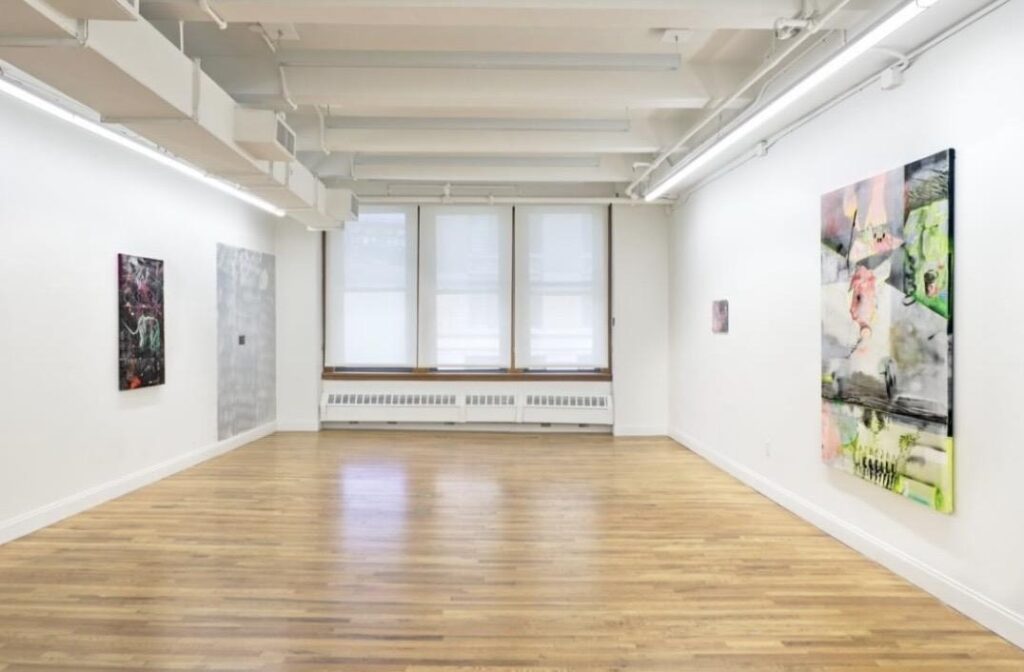
Stepping into the exhibition Without Innocence at RAINRAIN gallery, you are greeted with a plethora of various mediums, ideas, influences, and experimentations. The paintings carry with them several levels of looking, small details to explore, and multiple dimensions within the edges. The photographs set the scene, allowing you to enter another space just as the paintings do, left to explore the worlds that Kawahara creates and builds within it all. The press release introduces a quote from Donna Haraway’s A Cyborg Manifesto, “…we are living through a movement from an organic, industrial society to a polymorphous, information system—from all work to all play, a deadly game (p 28).” This statement lingers alongside my thoughts throughout the exhibition, as I begin to notice more details, connections, and mechanisms that make this exhibition immensely similar to a cyborg in the making. Kawahara takes pieces of the body and fractions of different spaces within the canvas to build something entirely new out of all of these information systems.
Kawahara’s work revolves around activating the senses and allowing viewers the opportunity to visually process multiple surfaces, mediums, ideas, and machinations all at one time. He uses perception and the senses to illustrate how people rely on others or their surroundings to perceive what is around them. How other people view something can influence how we see it, in the case of this work, how the body is perceived. Especially with the arrival of AI, we receive further help in perceiving and communicating, oftentimes with assistance from something that was not created solely on our own, but from an amalgamation of information inputted into a source. This constant flow of input is what interested me in Kawahara’s paintings and photographs. The paintings situate the viewer in multiple subjectivities at once, such as in the piece titled Let’s Devolve, pictured below, where Kawahara seamlessly combines drawing and painting processes into one fluid surface. His figures hover over the surface or next to layers that are scraped into the materials, integrating seamlessly into the space. With multiple mediums upon a found metal surface, Kawahara layers encaustic, oils, and spray paint to create a foundation with which the shell of a figure emerges. It is as if he is pulling out the fine lines from within a darkness, presenting us with a vision that only illuminates fully when you get close enough to appreciate the details of the figures and machines hovering around them.
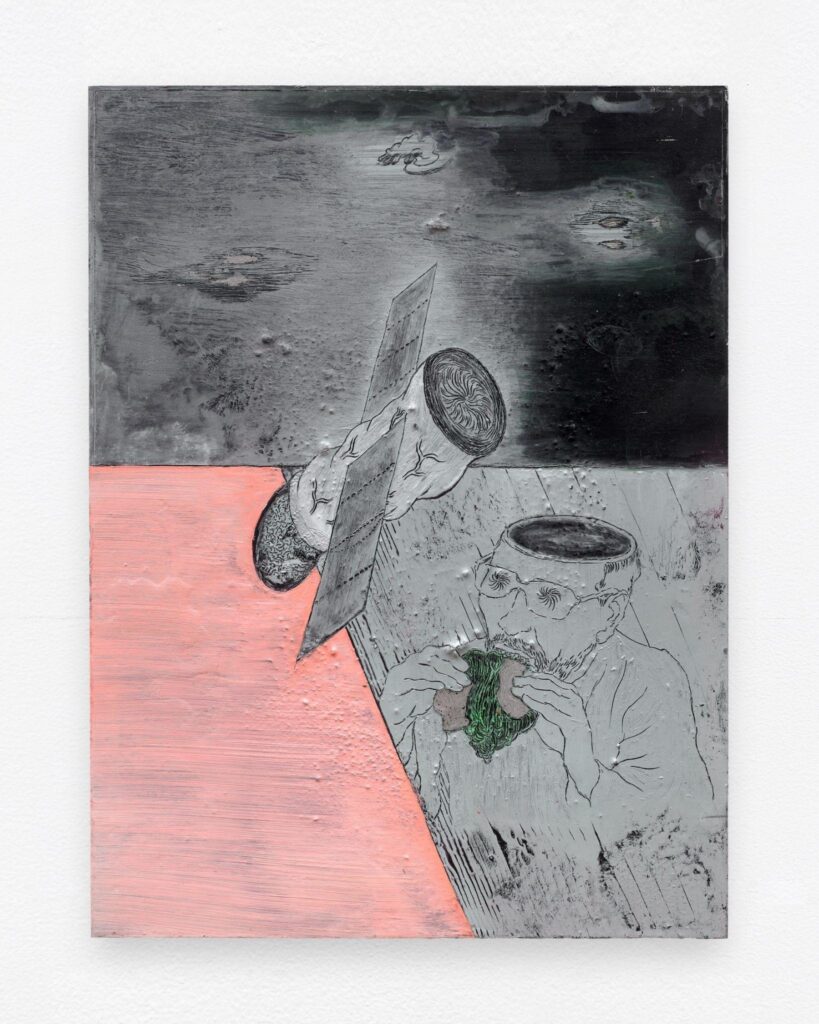
16 x 12 in, Photo Courtesy of the gallery and the Artist
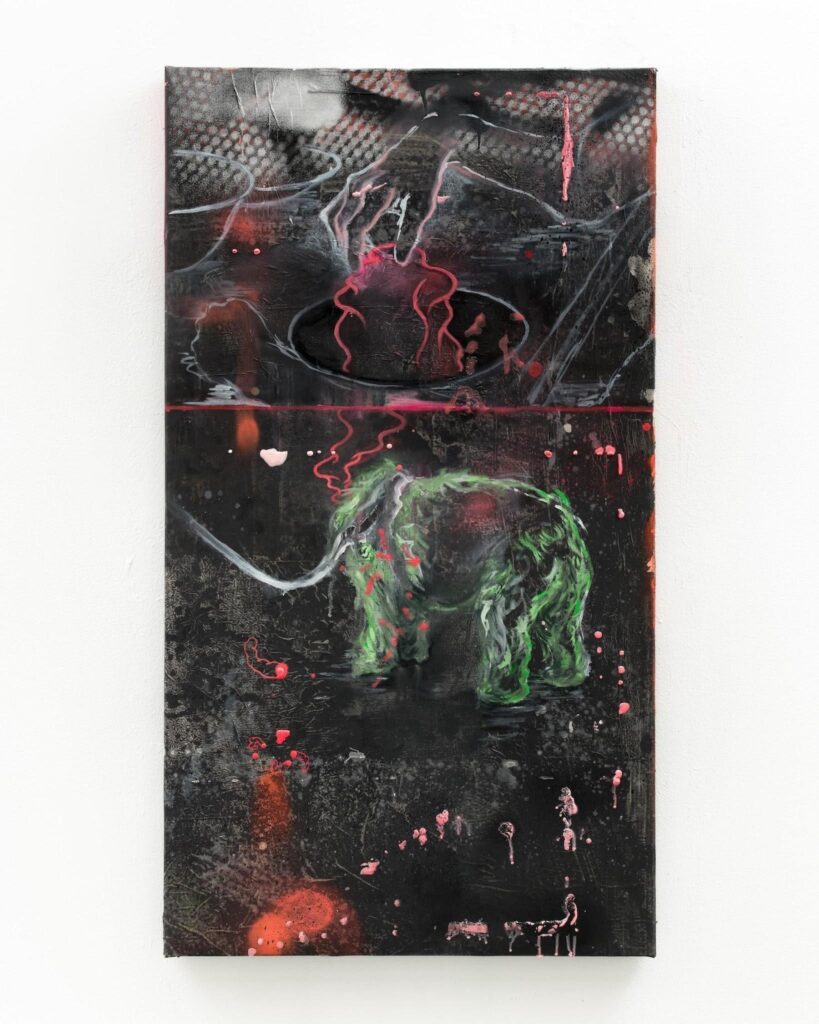
By using the theme of body parts or pieces of humanity repeatedly, Kawahara sees them as a continuation. Each bodily part depicted in the work is not unalive, each continues on existing in a new way. Usually, when a body part is detached from the whole, one would assume it to lose function and life, but within these works, they take on new lives. They become the new figures within the compositions, each still in motion in some way, whether it be hovering, standing, or levitating in between. Kawahara has brought a new perception of life to these forms. While we never see the owner of the hand at the top of the piece titled Loophole, we know something else exists attached to it. Kawahara allows the viewer to fill in the blanks. By using the mammoth, pictured below, a radioactive green glowing from it as it seemingly wades through blackened waters into an unknown space deep within the canvas, life seemingly goes on without a full human figure in sight.
Kawahara’s work is materially diverse, offering us many different spaces and experiences to explore visually. The smaller photoworks offer quick snapshots of scenes in motion, as if we turned to see something in real time. Only we moved a bit too swiftly in hopes of seeing it clearly. The large canvases, such as the one pictured below, titled Cutting Edges, and the stainless steel sheets carrying scraping, stencil use, and spray paint layers, offer a longer read. Kawahara uses many found materials: this experimentation is a way to collaborate with something you do not have control over. Another connection to perception, how it often cannot be fully controlled, and how it can be changed and reestablished. This lack of control allows for spontaneity, surprises, and the artist interacting intuitively with the results. He creates frames and structures within each canvas, using a system of cuts and divisions to make space within the painting and allow his forms and figures to hover over, spill through, or drip in between the edges of a new shape.
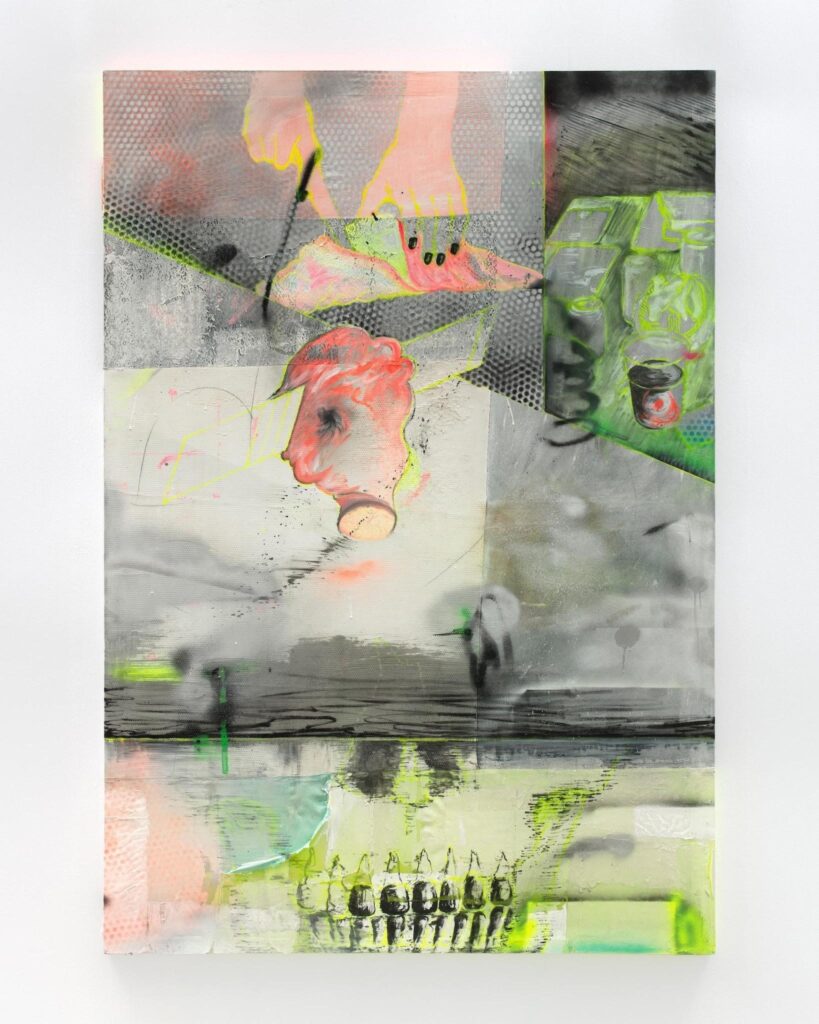
Knowing that he kept images of meat grinders, processors, and slaughterhouses as inspiration in the studio as this work came to fruition brings to mind the parallels to both Upton Sinclair’s The Jungle and JG Ballard’s The Atrocity Exhibition. Sinclair discussed the slaughterhouses, the conditions with which meat was processed, and what the workers went through to process it. Often dehumanized. On the other hand, Ballard discussed the cyborg, assemblage, and how media intake affects people, their perceptions of reality, and how a new reality could be constructed going into the future. This exhibition is taken from both avenues simultaneously as Kawahara pulls these new bodily creations in from the darkness. Disassembled humans made whole once again. Often as glowing forms, using neon against dark backgrounds, Kawahara depicts body parts or openings in the canvases that have been scraped, adhered to, reworked, and assembled. He places new life into both, showing that disassembled edges or cut and dissected organs and body parts can still live on as something entirely new within these pieces.
This exhibition is multilayered and pulls together multiple avenues of perception into one startling grouping. The works draw you in, the grotesque makes you think, and Kawahara makes you rethink your perception of both reality and human existence. He brings the human figures in his works to the edge, overlapping them with experimentations of his own, to bring them into an entirely new future. By devolving the human body, Kawahara is giving it an entirely new life. He is recreating the body, language, and the perception of existence itself as fractions of the human body’s take on new functions.
By studying the means of disassembling, Kawahara reassembles. He creates new amalgamations and forms. He converges the body, language, media, and many other influences into captivating pieces that are multi-layered and multi-faceted. The holes and portals that he creates, with drips guiding our eyes down the canvas, are one of his ways ofKawahara directings our perception. He forces us to rethink the human body, the utility of some body parts, and the way systems we think we know well can evolve into something entirely new. Once you give up everything you think you know, you are free to go even further. Kawahara gives us the opportunity to leave what we think we know at the door, and inside the exhibition, we are free to discover something entirely new about humanity – a new system of thinking.
RAINRAIN Gallery, Without Innocence, Kosuke Kawahara at RAINRAIN Gallery, Lafayette St, Suite 201, New York, NY 10013, On view through June 20th
About the Writer: Taylor Bielecki lives in Gowanus, where her studio is, and works at Pratt Institute, where she earned her MFA. She also studied at Penn State, where she earned a BA in English and a BFA in Fine Arts. She finished as a finalist in the Kennedy Center’s VSA National Emerging Young Artist program for 2017, where she earned an award of Excellence. She has shown prints internationally in a print exchange in Australia and exhibitions in Dubai, India, and the Glasgow School of Art. She has also shown paintings internationally in Gallery 24N, PhilaMOCA’s juried exhibitions in Philadelphia, Pa., Perry Lawson Fine Art in Nyack, NY, BWAC in Red Hook, and IW Gallery in Brooklyn. Taylor works for Two Coats of Paint, TUSSLE Magazine, and has joined Art Spiel as a contributing writer. @Taylor.Bielecki
Make your tax-deductible donation today and help Art Spiel continue to thrive. DONATE