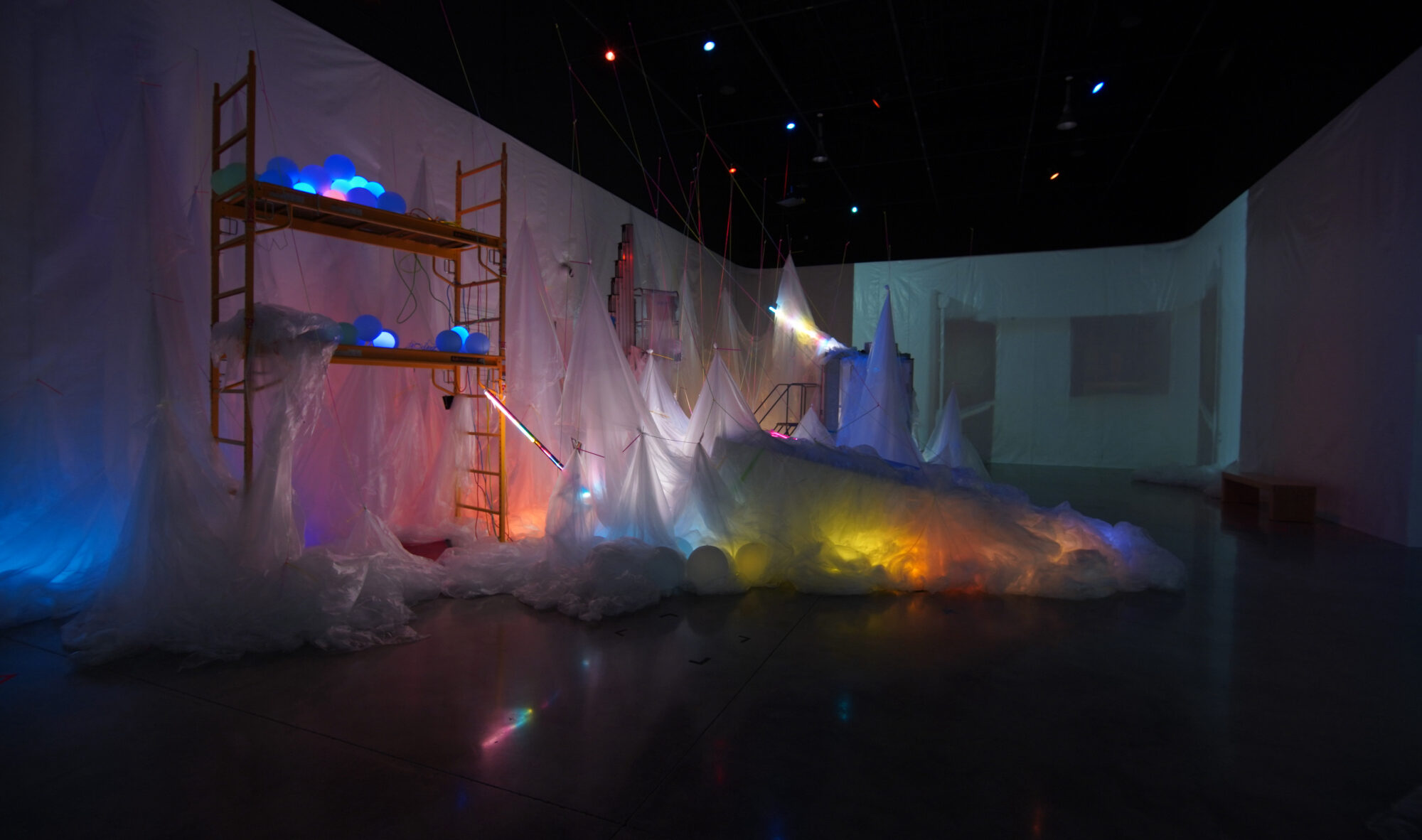
The duo Treizman + Zurilla has created a paradoxical situation at The Frank C. Ortis Art Gallery in Pembroke Pines, Florida. There are no paintings hanging on the walls or sculptures on pedestals; only the remnants of an undefined and colossal event. It is perhaps the belated fulfillment of a premonition that adopts the exhibition space as a medium for art, transforming the White Cube into a site-specific installation.
Stepping into the exhibition Without Innocence at RAINRAIN gallery, you are greeted with a plethora of various mediums, ideas, influences, and experimentations. The paintings carry with them several levels of looking, small details to explore, and multiple dimensions within the edges. The photographs set the scene, allowing you to enter another space just as the paintings do, left to explore the worlds that Kawahara creates and builds within it all. The press release introduces a quote from Donna Haraway’s A Cyborg Manifesto, “…we are living through a movement from an organic, industrial society to a polymorphous, information system—from all work to all play, a deadly game (p 28).” This statement lingers alongside my thoughts throughout the exhibition, as I begin to notice more details, connections, and mechanisms that make this exhibition immensely similar to a cyborg in the making. Kawahara takes pieces of the body and fractions of different spaces within the canvas to build something entirely new out of all of these information systems.
Polly Apfelbaum, Gregg Moore, Pot Shop installation view. Courtesy of 56 Henry
Currently on view at 56 Henry’s 105 Henry Street location is Pot Shop, the gallery’s second exhibition of multimedia artist Polly Apfelbaum and ceramicist Gregg Moore’s joint pottery project. The previous collaboration, Feed Your Head in 2023, presented 100 lavishly glazed mugs in a close grid on a plinth with a corresponding glaze color chart installed nearby. Pot Shop is a clear continuation of the fruitful creative relationship between the two artists, displaying 207 works that each experiment with new shapes and rich color exchanges.
Photo of Pandora’s Cluster showing ancient galaxies from the early universe by the James Webb Space Telescope, Feb 15, 2023, Image Credit: NASA, ESA, CSA, Ivo Labbe (Swinburne), Rachel Bezanson (University of Pittsburgh)
Recently I was watching a guy on TikTok gently freak out about all the revelations coming back from the James Webb Space Telescope. His panic was so relatable because the images returning from deep space only reinforce how utterly minute we Earthlings are in the cosmos. The JWST is so powerful that, looking from Earth, it can sense the heat signature of a single bumblebee on the moon. And, of course, faced with this, he just shrugged helplessly and said, “We’re a total nothing burger.”
A Meditation on Artists’ Residencies, a Dune Shack and the Twilight Zone
Ray Wells dune shack with well pump in the bottom left foreground, Provincetown/Truro 2016, photo courtesy of the writer
Sometimes I find myself scrolling Instagram on a dark day in February or March, just wondering what it would be like to make art in a lighthouse…or in Robert Rauschenberg’s old fishing shack…or in a Florida swamp…or in a small RV in a Utah ghost town…or on an island in Italy. Artists’ residencies are a nice thing to dream about when you feel stuck or in a rut and when life is wearing you down with mundane pressures. Sure, there are the big ones like MacDowell and Yaddo, but those are uber-competitive and hard to get into. There are so many other off-the-beaten-path secret outposts that will happily allow a creative person to try on their lifestyle for a bit. As an artist, it’s so helpful to get out of dodge now and then and hit the road for new sights and sounds.
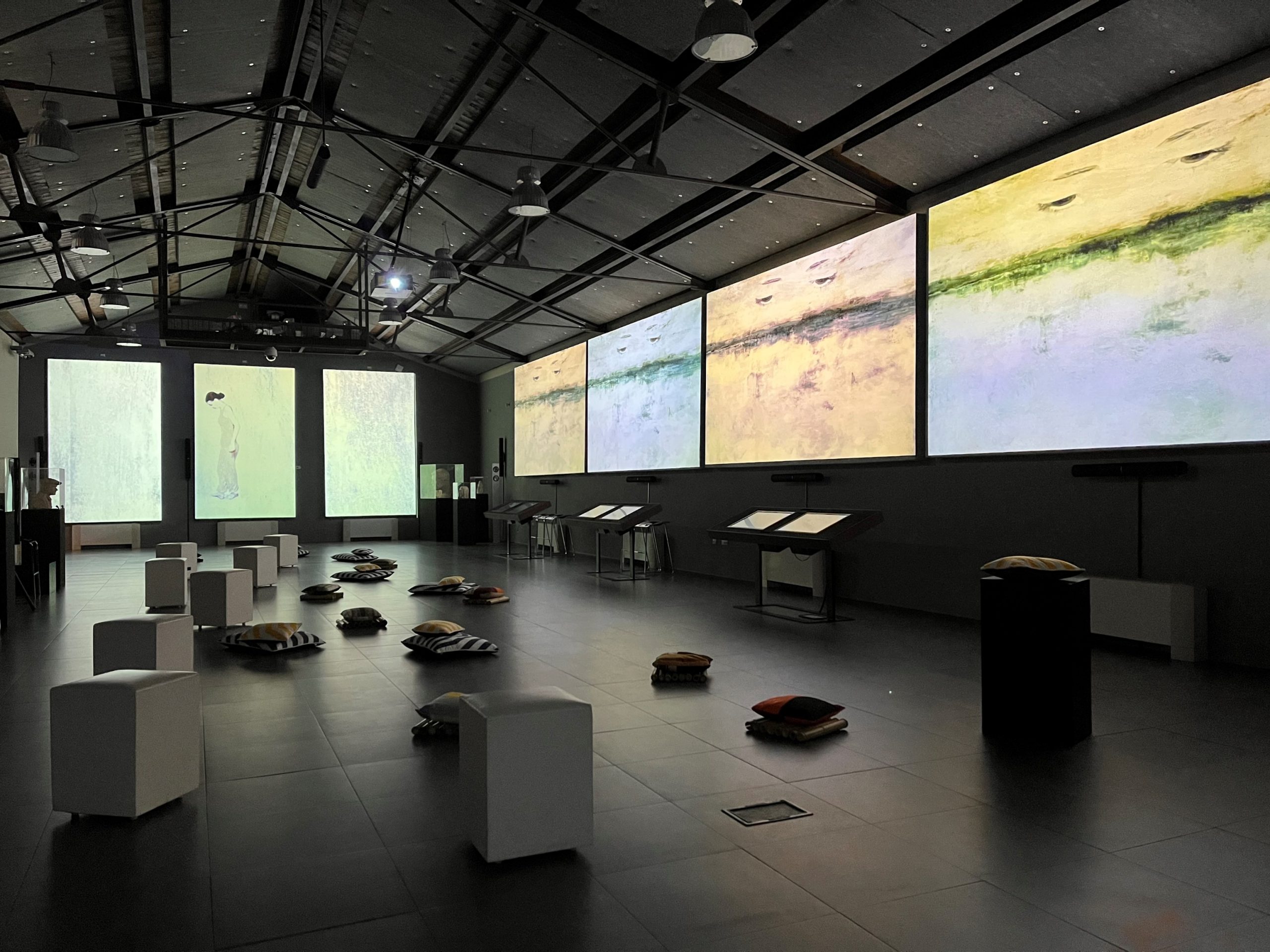
Inner Landscapes | Paesaggi Interiori, a video installation by Angelica Bergamini and curated by Alessandro Romanini and Maurizio Marco Tozzi, marks the beginning of a new season of multimedia work at the MuSA museum in Pietrasanta, a city in northern Tuscany, Italy. This installation artfully weaves together a rich tapestry of visual and auditory elements.
Out of the Vessel, Choreography and Dance : JoVonna Parks. Visual Art and Video Projection: Jeanne Verdoux. Photo: Jeanne Verdoux
The impetus for this series of conversations between a visual artist and a choreographer comes directly from my recent collaborative work with a choreographer as part of Norte Maar’s CounterPointe10. In this unique project a choreographer is paired with a visual artist to create together over two months a dance performance that integrates the two disciplines into a cohesive vision. Here is the conversation between artist Jeanne Verdoux and choreographer / dancer JoVonna Parks.
“There’s always time to do what you really want. When I had children, I worked when everybody went to bed, after 11pm. I would set up at the kitchen table and clean it very well before I would start.”
–Luchita Hurtado
Remember in the darkest, most locked down days of the pandemic, when all of us were stuck within our own walls, and many of us had kids at home too? And we found ourselves having to resort to making work at the kitchen table in between the cracks of work and school. Well, it got me thinking that this was nothing new to the history of making art: a history that wants us to think that its entire timeline is full of swaggering guys in big New York City lofts, hands-on-chins, undistracted by life’s mundanity. But, in fact, the reality of being an artist is rife with personal stories of people who had to make it work. They, like us, squeezed making art in between the oven timer and the kids’ nap, or in between the hours of a demoralizing 9-5. And quite frankly, those artists that find a way to eke through those tough years of limited space and time are the artists that have the swagger that impresses me the most.
Once, my day job was a freelance graphic designer and I worked from home in Brooklyn. My desk was in a corner of the combination living-room-kitchen-dining-room, right next to the TV. I had cable, and while I worked, I would put on Turner Classic Movies because they didn’t play commercials. And those of us who worked from home during the golden age of cable know that the middle-of-the-day commercials were the most depressing.
TCM showed black and white movies from the 30’s, 40’s and 50’s in an unending ribbon of celluloid, one right after the other. And after months of working like this, it began to amaze me how little the films stuck in my head. They just pleasantly wafted into one ear and floated out the other. There were two exceptions, though, that seemed to have the ability to stick: Stanley Kubrick’s 2001 A Space Odyssey and The Bells of St. Mary (starring Casablanca’s Ingrid Bergman as a nun). And this forgettable/unforgettable phenomenon got me wondering: Why those two? Why did they stick and not the hundreds of others that I had watched?
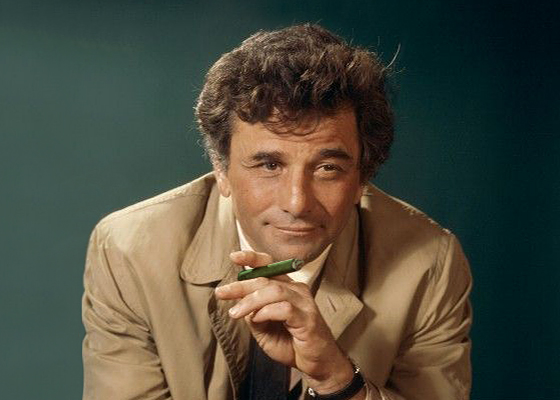
Publicity photo of Peter Falk from the television program “Columbo,” NBC Television
Do you remember how people were bingeing TV shows like The Sopranos or Mad Men during those long pandemic days and nights? Well, I was also bingeing–but on that old television chestnut, Columbo. If you’ve never watched it, Columbo is a detective murder mystery show, but…it’s an anti-whodunnit. The show always opens with all of us witnessing the villain committing the crime (off-camera—which is much appreciated by the squeamish). It’s a unique formula for a detective show because we know right from the get-go who the killer is. The audience watches Peter Falk as Detective Lt. Columbo, guilelessly but cunningly noticing clues, making connections, and solving the case, all the while hilariously pestering the murderer to distraction.