
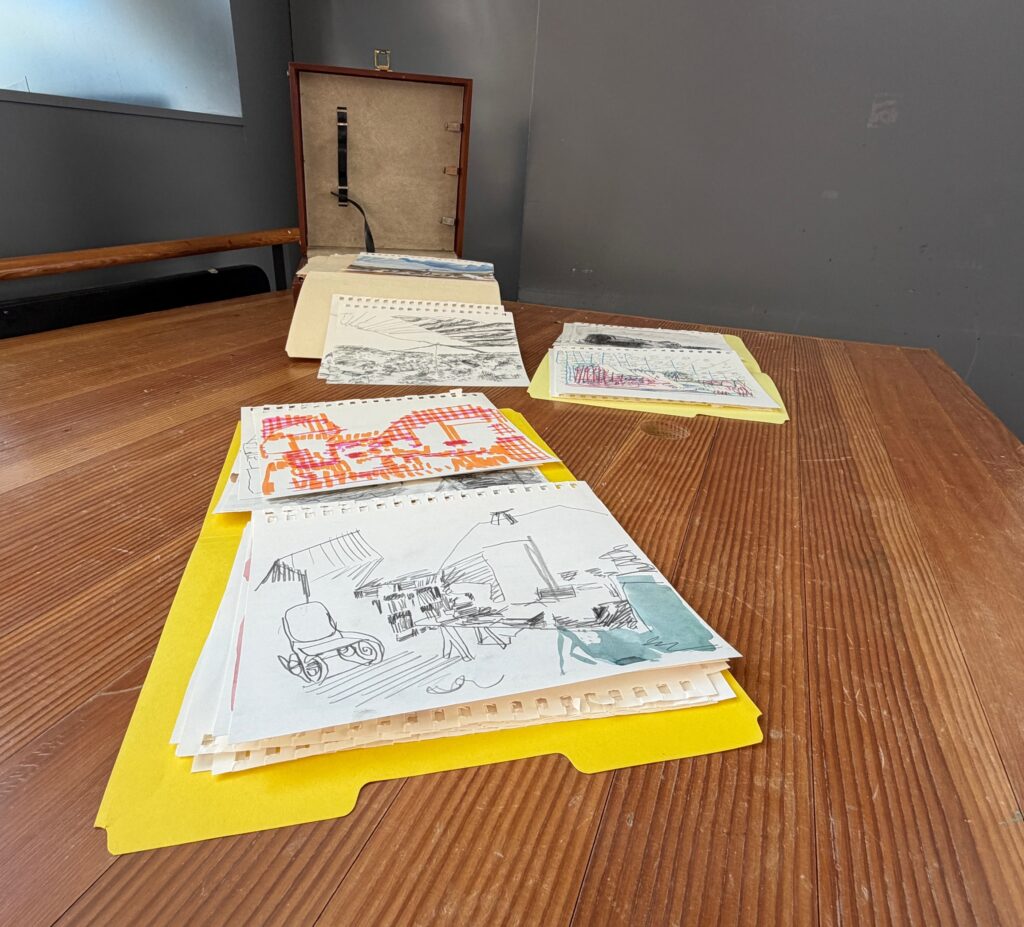
Before his artist talk, Julián Kreimer set a small brown valise on the table and opened it. Inside, folders held drawings on paper, each made in response to a photographic slide from his parents’ archive. The valise was not part of the exhibition; it was the working material behind it, a private archive he had been drawing through for years. Encountering it set the terms for the room next door: Yuyo is what happens when that interior is opened out.
The title is Kreimer’s lifelong family nickname: yuyo, regional Spanish, by way of Quechua, for “a weed.” The word is more useful than it sounds at first. In much of Latin America, yuyo covers a wide range — from the herbs used in mate and folk remedies to whatever sprouts in the cracks: untended, often dismissed, sometimes medicinal. It is a fitting frame for work that grows out of displacement and persists in modest materials: a family transplanted from Argentina in the 1970s, an archive kept in folders and slides, pen on a father’s old letterhead, colored pencil on paper. Like the plant it names, the work is unshowy, durable, spreading, in transformation.
Kreimer’s parents left Argentina in the 1970s and stayed in the U.S. through the 1976 coup that installed a military dictatorship the U.S. would go on to support. Kreimer was born that same year. They worked at the Organization of American States and the World Bank, in human rights law and natural disaster planning. The slides, stationery, and design motifs that appear throughout the show are residues of that life. Kreimer doesn’t reproduce them so much as draw through them, using the archive as prompt and source.
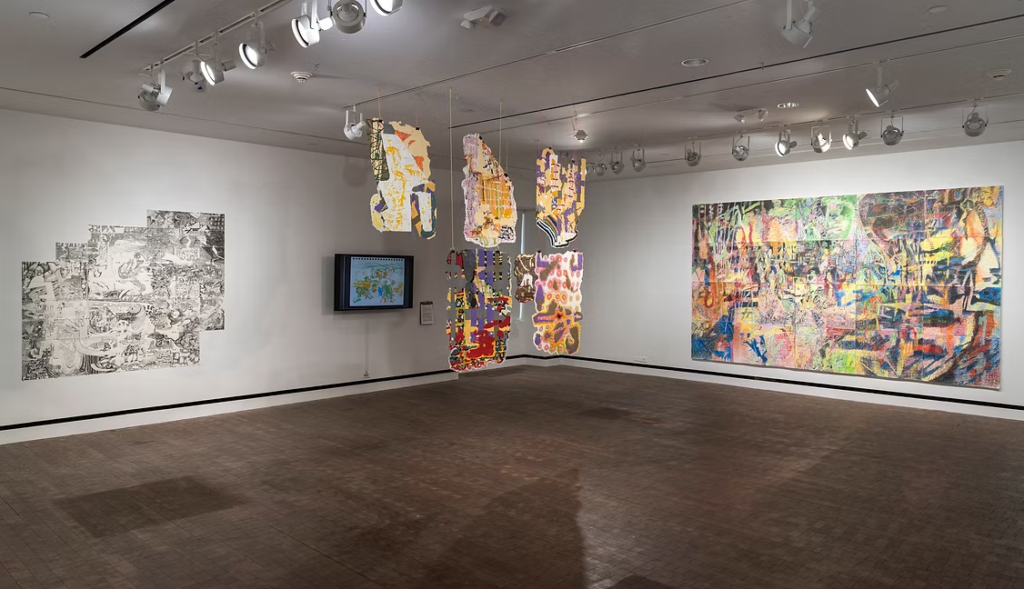
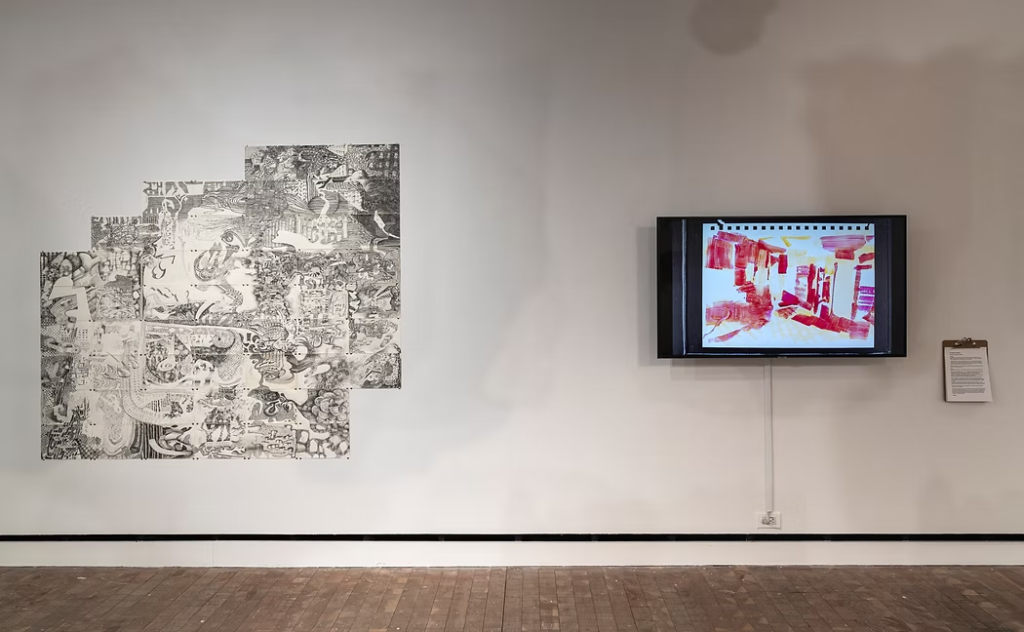
One of the show’s anchors begins on a single piece of paper: his father’s letterhead, kept from the family’s years in DC. Its calligraphic header, a style his father had learned in his Argentinian high school, was one the artist tried but could never learn. From there, Kreimer keeps drawing in pen across fresh sheets, joining them as he goes — the line itself calligraphic, the work developing by accumulation, like automatic drawing, section by section, a map of an interior. La (in)herencia de la última caligrafía del Buenos Aires Nacional (2024) stages a process: a personal hand drawing on top of an institutional trace, building outward from where they meet. The parenthetical “in” destabilizes herencia, toggling between inheritance and its negation, holding transmission and loss together.

The show spans more than a decade. On one wall, four early oil-on-linen paintings from 2015–16 are his most figurative: plein-air observations of construction sites, yellowish raw lumber, and orange tarped scaffolding, where the air around and between things is as charged as the things themselves. On the adjacent wall, four later oil paintings from 2017 reveal a shift: the woods, still painted plein-air, rooted in observation but looser, closer-in.


That attentiveness carries over to the newest work, on the opposite wall. In Woodley Woods (2026), Kreimer enters the close-up passages of the 2017 paintings and opens them out. Across twenty 22-by-30-inch sheets, mounted slightly off the wall and laid edge to edge in colored pencil, an interior forest takes shape: light and shadow in a complex choreography of blues, pinks, oranges, and greens — growth and decay visible at once. The color is vivid, the line alive. A small patch becomes an expanding universe; the drawing holds nine years of looking.

The suspended paper pulp pieces extend this thinking through material. They hang fibrous, breathing slightly with the room’s air. The palette is high-keyed: saturated reds and pinks at one end, browns of bodily fluids at the other. Pulp pools thick in some passages and thins to a translucent membrane in others; fragments of the archive surface and submerge through the layers.
Behind them, a video shows drawings flipping past at varying speeds — some quick, some held — drawn from the slides his parents took across decades of work. Some show people seated around meeting tables, paired with the late father’s voice; others trace urban fragments: buildings, blocks, intersections, paired with the mother’s. Each pairing returns image to source: rights work in those rooms, disaster planning in those streets. Looking back and forth, video to paper, becomes its own pleasure: a fragment in the pulp turns up on the video, a color repeats, an edge missed in one appears in the other.
Two questions run through the show: how memory takes form, and how perception takes shape through looking. Cézanne returned to this in his letters to Émile Bernard, describing painting as the slow, cumulative realization of sensation. What is seen draws on past experience, and fragments begin to connect. Time here gathers rather than passes. The vivid color, the unhurried hand, the pleasure of looking between pulp and video — none of this is elegy. Even the voiceover, recordings of the artist’s late father, refuses that register: he is mid-thought, working through problems, and arrives at a kind of ethic; “projects don’t turn out well or badly. They can be better or worse.” The show is a continuation, not a memorial.
That sense of continuation extends beyond the personal. Kreimer has spoken of his admiration for Dieter Roth, and the kinship runs through the work: Roth’s treatment of time as material, the autobiographical thread, the fragmented accumulation, the use of found and discarded matter as the work’s substance. Kreimer’s materials are also humble: pen, colored pencil, paper pulp, a letterhead. The humility is purposeful. His parents’ work was practical and on the ground, the kind of labor that doesn’t make monuments. The knowledge Kreimer’s art preserves is the kind carried in folders, drawers, and notebooks: the kind that sustains people even when institutions fail them.

The exhibition’s effect is like analysis: fragments attended to, an interior surfacing piece by piece, the personal held next to the political without flattening either. The brown valise from the artist talk has opened into the whole room. Yuyo — the weed, what persists — is the right word for it.
All photos by Cary Whittier unless otherwise indicated.
About the writer: Etty Yaniv is a Brooklyn-based artist, writer, curator, and founder of Art Spiel. She works in installation, painting, and mixed media, and has shown her art in exhibitions across the United States and abroad. Since 2018 she has published interviews and reviews through Art Spiel, often focusing on underrecognized voices and smaller venues. More about her art can be found at ettyyanivstudio.com and on Instagram @etty.yaniv
Julián Kreimer Yuyo at Sarah Lawrence College’s Gallery at Heimbold Visual Arts Center, on view through May 8, 2026.