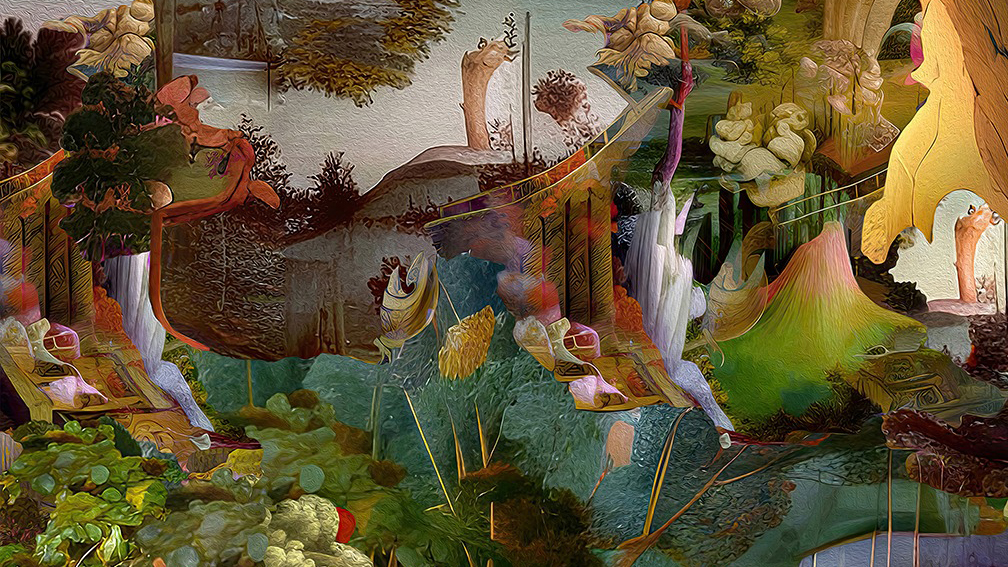
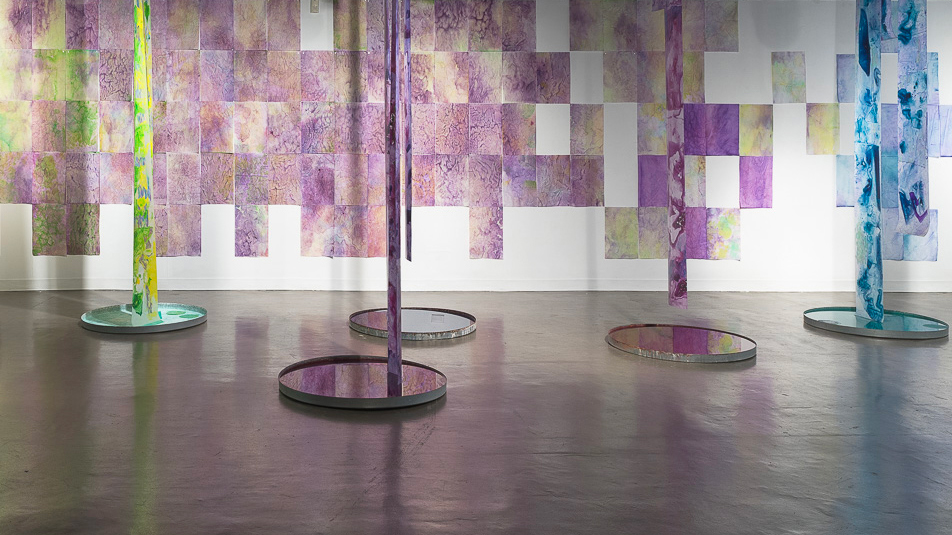
Trained as a photographer, Carol Bouyoucos has spent the last several years pushing past the camera’s claims to truth—folding her own images into AI systems, digital layering, and the slow accidents of computational misreading. The landscapes that emerge read as propositions about what nature might become once human authorship loosens its grip.Her recent work, increasingly ambitious in scale and mythic in register, marks a notable departure from the botanical and landscape series that established her vocabulary. In this conversation, she speaks about the terrain that shaped her eye, the painters and visionaries whose company she keeps, and the strange logic of making images in a moment when both ecosystems and pictures behave less and less predictably. What follows is a portrait of an artist thinking out loud about control, instability, and the worlds that emerge when she relinquishes both.
Continue reading “Carol Bouyoucos: Eden After Us”Sound Art for the Ecological Turn by EndGrain at SMFA Boston
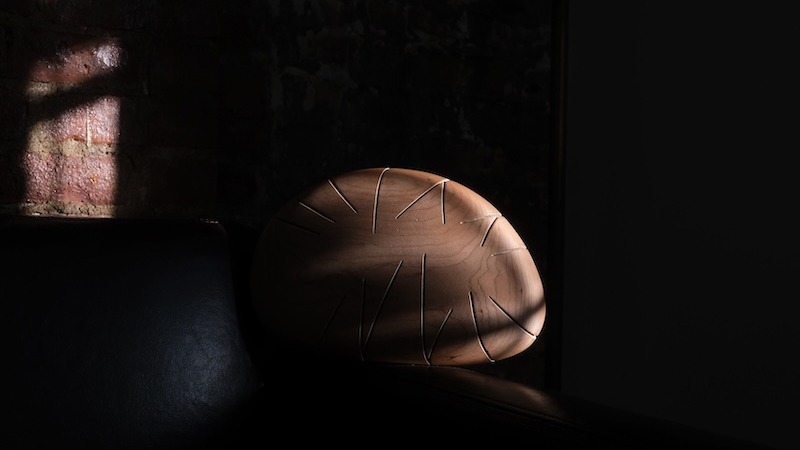
What can sound art contribute to the ecological turn? When the Taiwanese sound artist Huichun Yang described her process as getting to know the entire life of the tree that became her instrument, she had my attention. The entire creative arc of her process is rooted in reverence toward materials. Yang selects the wood, sculpts it into an arbrosan—an instrument first introduced to the world in 1996—and plays it by directly sensing its surface with her hands, using gestures that evoke repair and tending.
Continue reading “Sound Art for the Ecological Turn by EndGrain at SMFA Boston”Jaynie Crimmins: Busywork at Garage Art Center
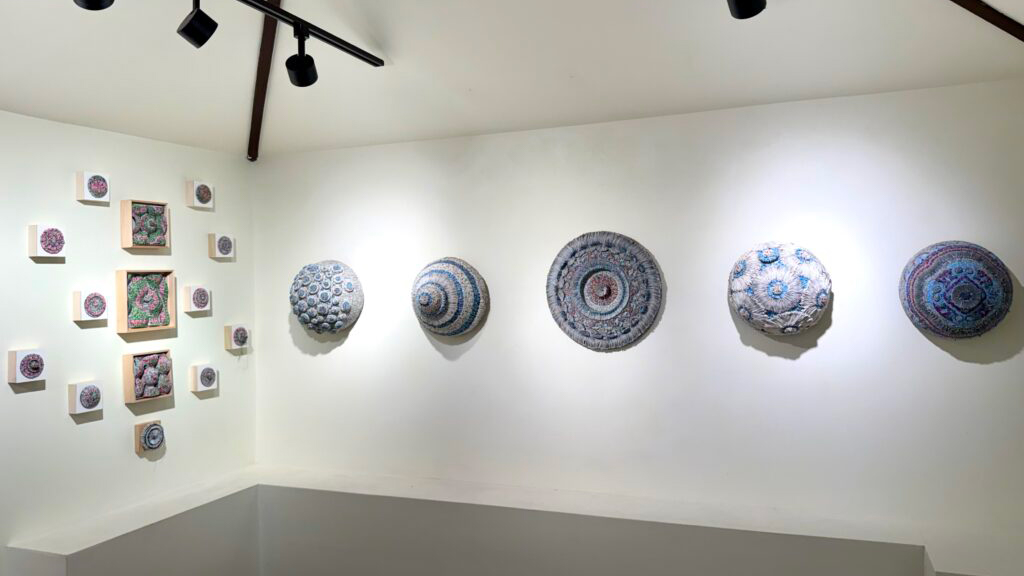
Jaynie Crimmins’s Busywork turns junk mail, catalogs, and security envelopes into exquisite objects: cones, ovals, and circles arranged across the walls, the larger pieces standing alone and the smaller ones mounted on panels. The show fills Garage Art Center, a converted garage in a Bayside house, now a clean, narrow gallery. The work asks for close looking, and the room is built for it.
Continue reading “Jaynie Crimmins: Busywork at Garage Art Center”Carol Diamond in her studio: Go Ahead, Make Me
During a studio visit with Carol Diamond before her upcoming exhibit, Carol Diamond: Go Ahead, Make Me (Equity Gallery), our discussion of her recent sculptures elicits the term “Janus heads”–not because she makes two-headed portraits, but because each dynamic work encapsulates a battle of competing forces that hint at varying degrees of figuration and diverse human backstories.
Continue reading “Carol Diamond in her studio: Go Ahead, Make Me”Philadelphia Artist Studio Visits: Deirdre Murphy 2026
I met Dierdre Murphy for our studio visit at Rolling Hill Park on one of the first true days of spring. She strode up the forested lane with a bright smile, and I followed her to a yellow cottage nestled among the trees and many meandering hiking trails. Bathed in the sound of tweeting of birds, Murphy explained her long history of working with the Lower Merion Conservancy both as a volunteer and as their Climate Artist-in-Residence. There, she has created several site-specific works, including a spectacular mural translating bird migration data into bright organic shapes.
Continue reading “Philadelphia Artist Studio Visits: Deirdre Murphy 2026”Floating in Three Acts- Keren Anavy at SUNY
Floating names a state of suspension, between sinking and surviving, between grief and the body’s refusal to stop. In Keren Anavy’s landmark solo exhibition, Floating in Three Acts, this condition is both subject and structure. The exhibition is built the way floating feels: without firm ground, without clear direction, with the question of outcome left open.
Continue reading “Floating in Three Acts- Keren Anavy at SUNY”Yuko Oda – Decaying into Bloom
Yuko Oda’s recent exhibit, Decaying into Bloom, currently on view at the Brodigan Gallery at the Groton School, located west of Boston, seduces with beauty and delivers a gut-punch from the moment you enter. It is the best kind of artistic experience: being pulled in by the sensuality of the materials, then hit hard with the poignancy of the message. Living things have always had to adapt to new conditions, and Oda imagines for us some ingenious possibilities.
Continue reading “Yuko Oda – Decaying into Bloom”Eric Wolf’s Two Waters: Nature, Observation, and Exploration at Abri Mars
Eric Wolf’s works at Abri Mars take us through misty, expansive landscapes. Their ethereality and tranquility pull viewers into new places to explore and settle into. Within Two Waters, Wolf recreates the landscapes he observes directly, using a limited ink palette to bring the pieces to life. Through a combination of controlled and reactive strokes, Wolf uses hard and soft edges to render his figures of nature. While the figures are more abstract- mountains, bodies of water, trees, etc, these works are expanding on the process of plein air, bringing the environment into the works directly. With the gallery’s natural light from the front windows, the darkness of the ink becomes velvety, drawing you in, while the light of the paper glows beneath, pushing outward. This push and pull makes the work feel dynamic and lively.
Continue reading “Eric Wolf’s Two Waters: Nature, Observation, and Exploration at Abri Mars”The 15th Shanghai Biennale: Does the Flower Hear the Bees?
Botany, I read in Zoë Schlanger’s bestseller The Light Eaters: How the Unseen World of Plant Intelligence Offers a New Understanding of Life on Earth, is full of groundbreaking discoveries these days (Schlanger 2024). We now know that plants have cellular conduits that allow propagation of electrical charges, that some plants release chemicals in the air to alert neighbors of insects, and that evening primrose increases its nectar’s sweetness when it senses the frequency of the hum of bee wings. While such plant-feeling, plant-talking, and plant-listening are not sustained by the same biological apparatus as ours, the functional parallel is apparent. Perhaps it is time to broaden our understanding of intelligence.
Continue reading “The 15th Shanghai Biennale: Does the Flower Hear the Bees?”Call Of The Mountain
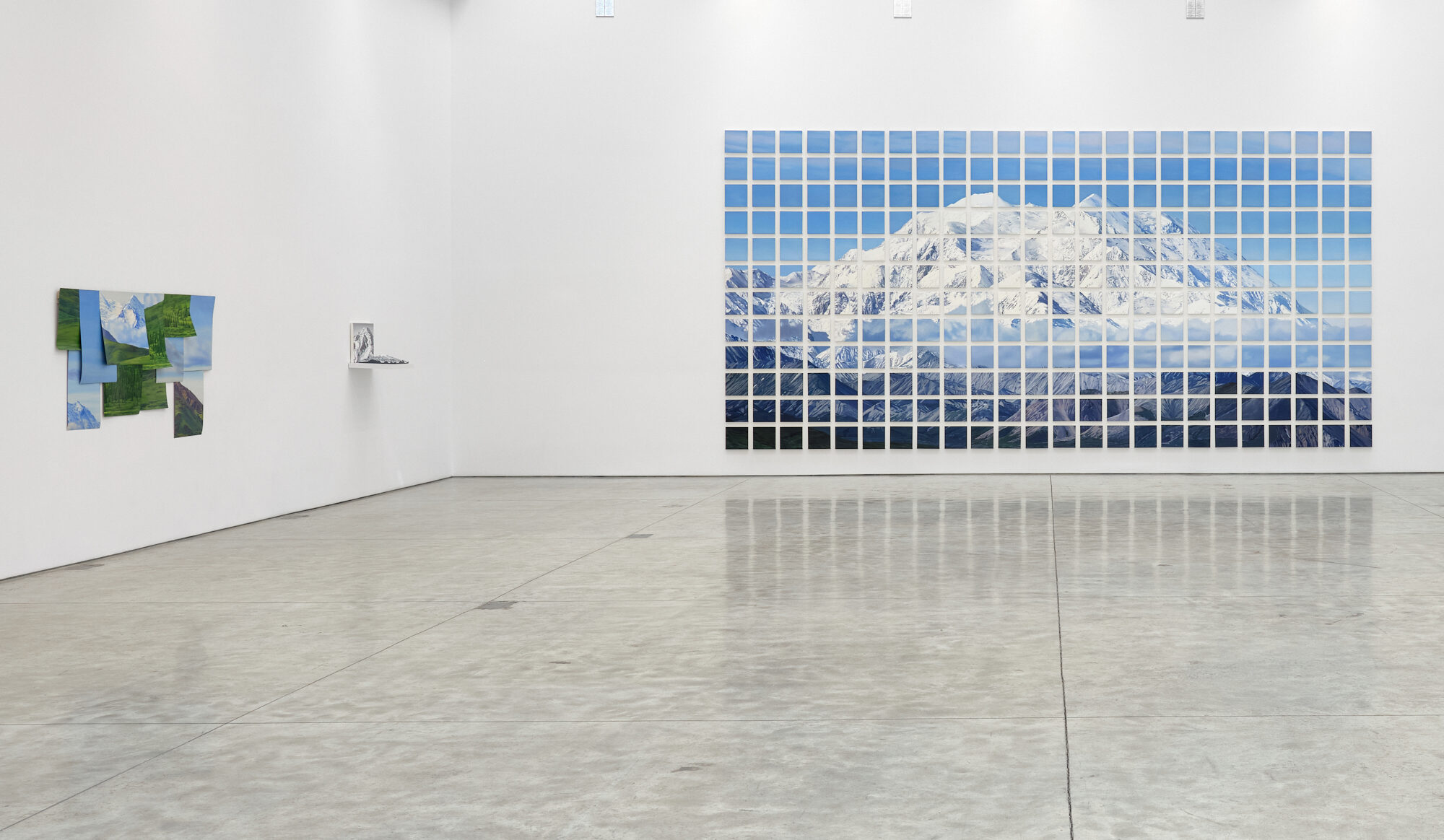
In Cynthia Daighnault’s exhibition at Olney Gleason, the walls are covered with different versions of the same subject: Denali, the tallest mountain in North America. A natural wonder and a national treasure at risk, Denali has lost over 60 percent of its glacier mass, and rising temperatures have accelerated permafrost thaw and disrupted local ecosystems, directly affecting the wildlife that depend on it. The paintings in this exhibition preserve their likelihood like the sculpture of the last three rhinos (by Gillie and Marc, now installed at 441 Ninth Avenue), but this documentation of endangered species contains an underlying criticism of American megalomania, without escaping the artist’s own American identity and ambitions. A big, beautiful white thing, Denali’s demise mirrors the nation’s uncertain future and the accumulative effect of its past.
Continue reading “Call Of The Mountain”