
Yuko Oda’s recent exhibit, Decaying into Bloom, currently on view at the Brodigan Gallery at the Groton School, located west of Boston, seduces with beauty and delivers a gut-punch from the moment you enter. It is the best kind of artistic experience: being pulled in by the sensuality of the materials, then hit hard with the poignancy of the message. Living things have always had to adapt to new conditions, and Oda imagines for us some ingenious possibilities.
According to Oda’s statement, she creates works on paper and sculpture that explore “a speculative, post-human future, where organisms self-destruct, adapt, and intertwine.” Oda’s large immersive pieces with human-sized insects and flowers question our perceived superiority over nature. She invents moments where plants and animals mutate or hybridize. For example, a fungus might cause a beetle to sprout a peony from its horns, or grass might grow on ladybugs to migrate to better lands.
Oda melds Japan’s deep artistic traditions with contemporary concerns. Working with Japanese mineral pigments and brushes, she explores the panic and inevitability of a world changed by human intervention. In one of the works, an exquisitely rendered Japanese spiny lobster grows tiger lilies out of its antennae. Oda asks us to suspend our human sensibilities and accept it all, because we are also part of nature.
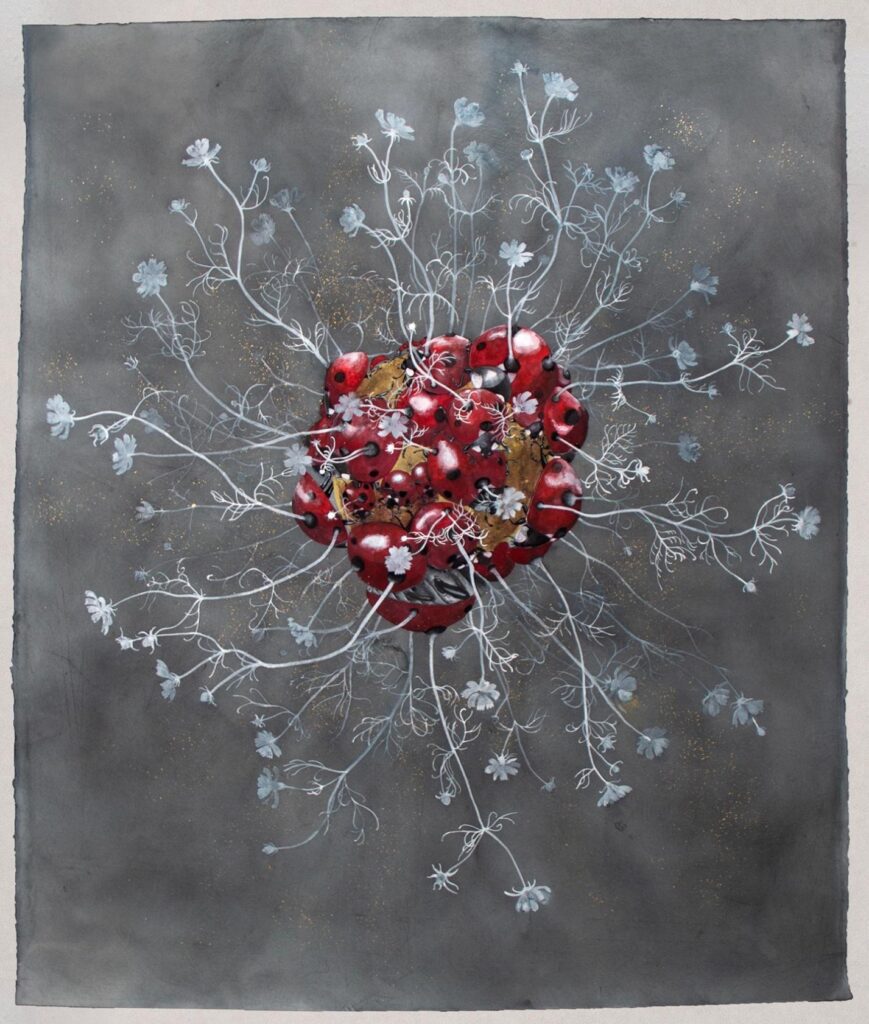
In Protection, a 50-inch work on paper combining traditional painting and gold leaf, Oda writes: “ladybugs congregate to survive, huddling, eating, hibernating, mating, and protecting each other from prey. In this piece, plants grow from the bodies of the ladybugs, providing another layer of protection. The form can feel monumental like a planet and tiny like a molecule, perhaps even resembling a familiar virus.”
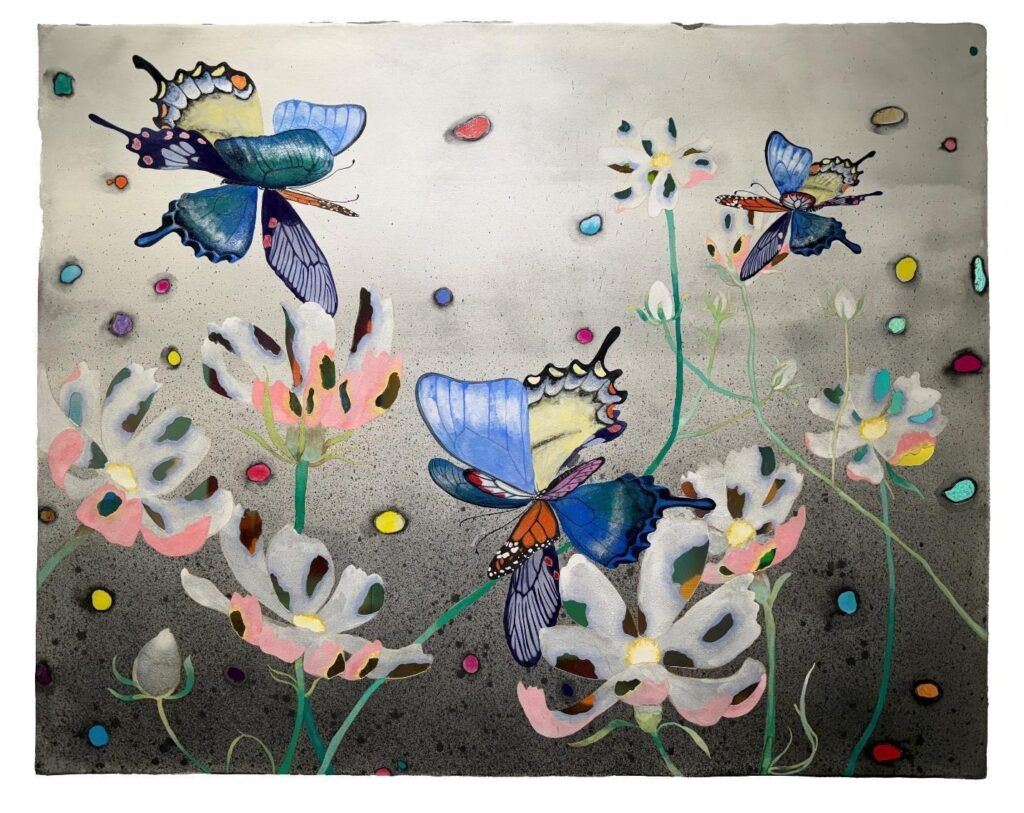
In Garden of the Future Past, Oda plays ingeniously with unusual combinations of materials. Paper is glued to a heavy sheet of glass so that light seems to emanate from parts of the flowers. Hybrid butterflies with multiple wings, mash-ups of familiar species, hover nearby.
The Brodigan Gallery at Groton School is open to the public and exists to educate its students by showcasing outstanding New England-based artists. As part of her exhibition, Oda has created an exciting participatory component for the students. They are invited to draw their own examples of “improbable” species adaptations, inspired by a collection of images of plants, fungi, and insects.
Oda grew up in Japan but moved to Manila when she was 8 and returned to Tokyo at 12. Now she makes Boston her home, where she is a professor of art at the University of Massachusetts, Lowell.
Decaying into Bloom, at Christopher Brodigan Gallery, The Groton School, 282 Farmers Row, Groton, MA. On view through May 10, 2026.
About the writer: Adria Arch is a Boston-based sculptor and painter who has been awarded residencies at Ragdale Foundation, Vermont Studio Center, Virginia Center for the Creative Arts, and Sanskriti Foundation in Delhi. Her work is included as a permanent installation at Google headquarters in Boston, and she is in the collections of the DeCordova Sculpture Park and Museum, Fidelity Corporation, and the Federal Reserve Bank of Boston, among others. Arch has shown at Boston Sculptors Gallery, Brattleboro Art Museum in Vermont, and the Danforth Museum in Framingham, MA. Her work was recently featured at the San Luis Obispo Museum of Art in California and the Boston City Hall Atrium Gallery. Her newest work is on view in Adria Arch: Anti-Gravity at the Distillery Gallery, South Boston. @adriaarch