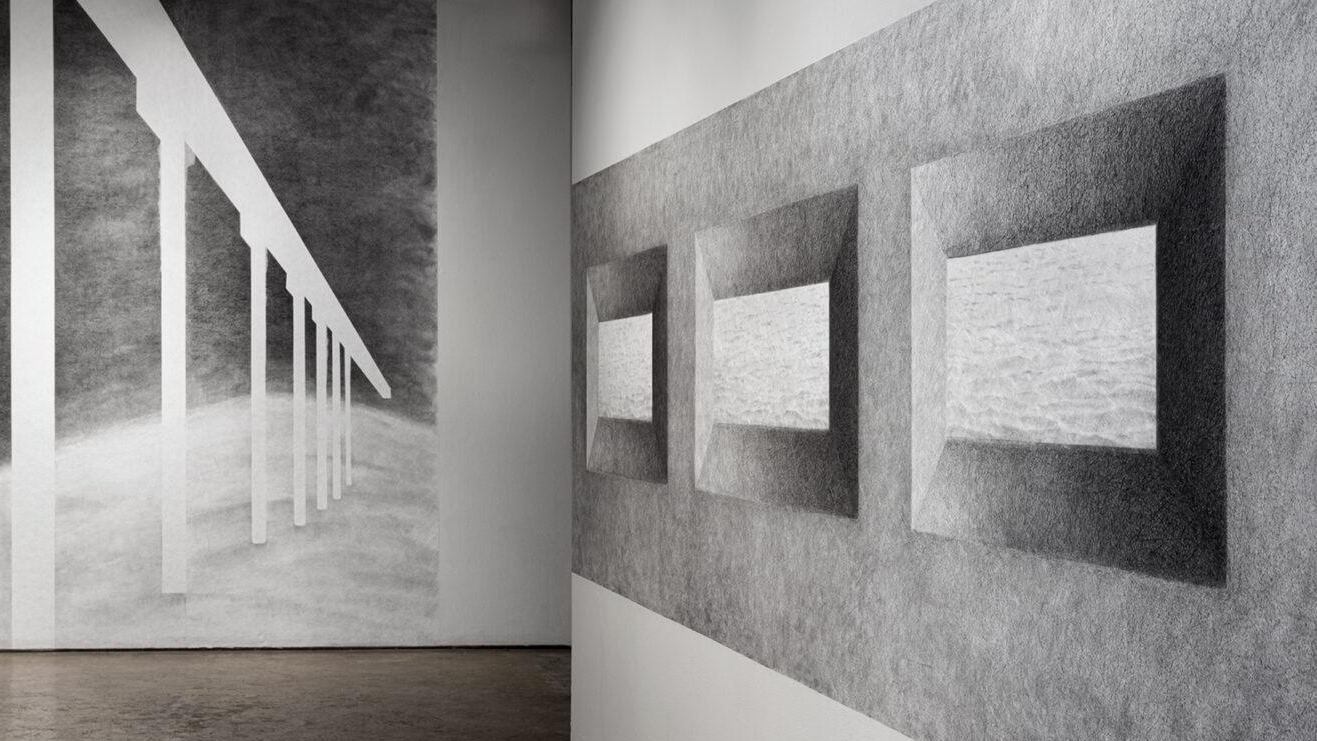
The space in Smack Mellon’s back gallery welcomes you as Kate Teale’s exhibition, Vanishing Points, fills the room, bringing the history of Dumbo into the space. Teale expands space itself through her studies of edge, architecture, and place. The work is a seamless connection of drawings adhered to the walls using Tyvek, making the illusion of space and the real blur into one. The gallery is transformed into a combination of several places, and as visitors turn, they adjust to each new location, finding details offering hints of the places Teale wants us to wander into.
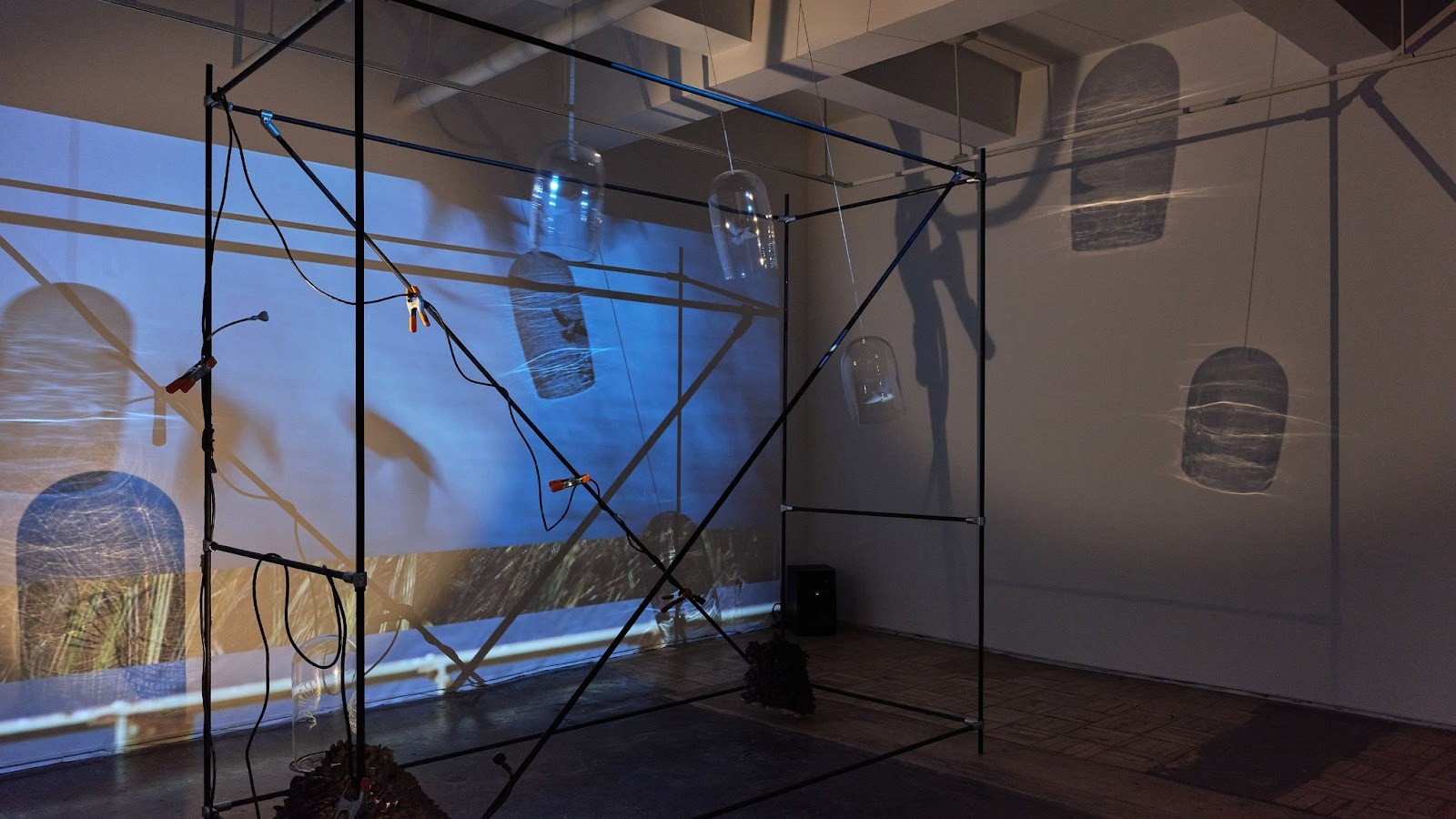
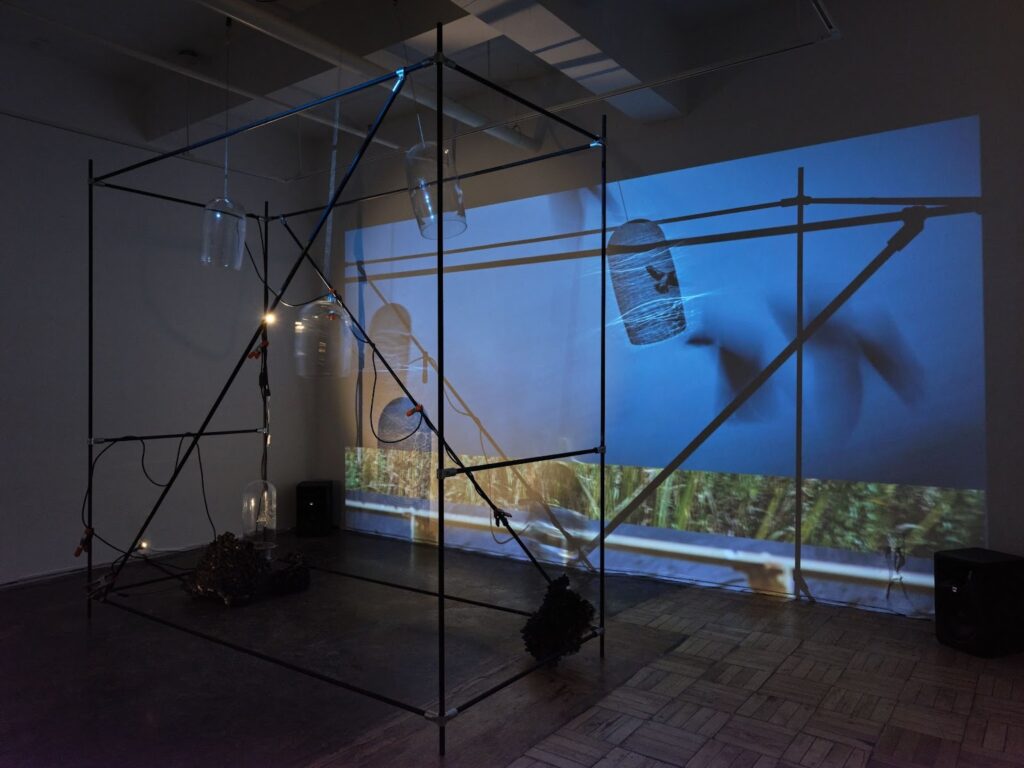
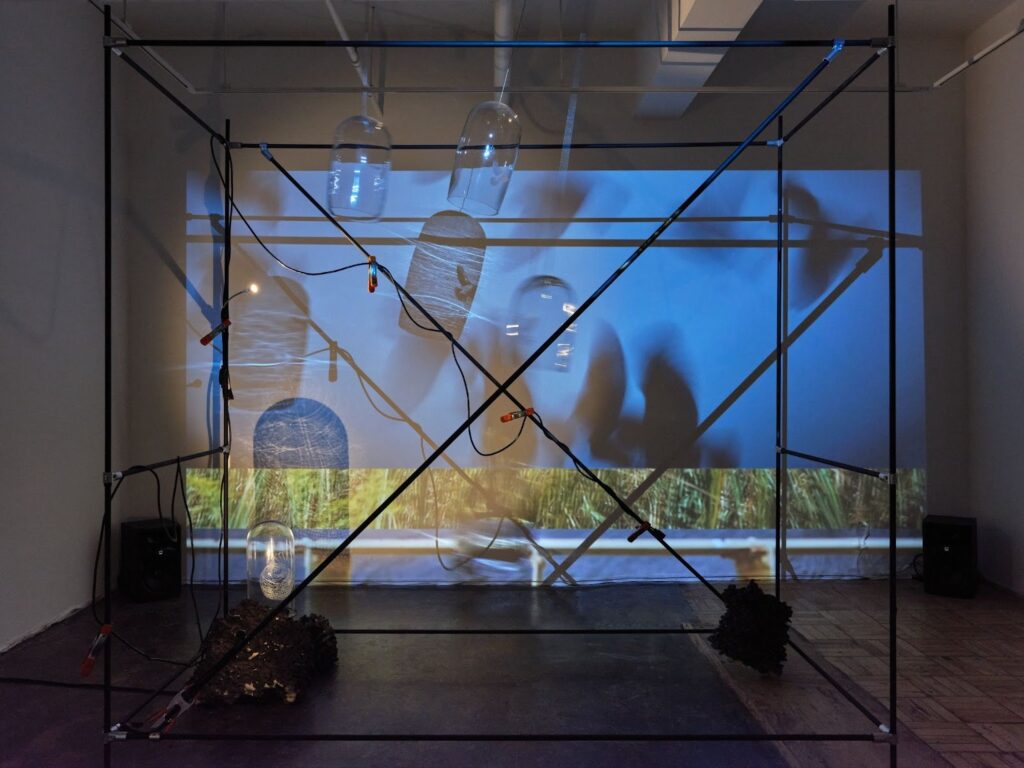
Alice Pixley Young’s Still Life takes shape in semi-darkness at A.I.R. Gallery as an immersive meditation on ecological time, stratified and shadowed by industrial residue. Installed as a multisensory environment of video projection, sound, industrial scaffolding, and glass bell jars, the installation places viewers in a space where remediation and damage coexist. Suspended from tall black scaffolding, the glass containers move like dimly illuminated pendulums, casting shadows across the walls and establishing the installation’s temporal pulse from the outset.
The work’s rootedness in place is central. Young’s studio is located on an Ordovician fossil bed near a nuclear Superfund site in the Rust Belt. Her exhibition in Brooklyn hints at another Superfund site, the Gowanus Canal, linking two contaminated landscapes across geography. The central video shows horizontal strata in constant motion. Below the upper dusky blue sky, you can travel slowly through narrow moving bands — grasses and wildflowers filmed at the Fernald site in southwest Ohio — creating a lateral sense of passing through a remediated landscape. Alongside it, a thinner strip shows water seen from a bridge, evoking an industrial waterway shaped by contamination and cleanup. The cross sections are clean-cut and suggestive, tinged with a bluish monochrome.
Exhibition view, Alice Pixley Young, Still Life, 2026, A.I.R. Gallery, Brooklyn, NY. Photography by Matthew Sherman
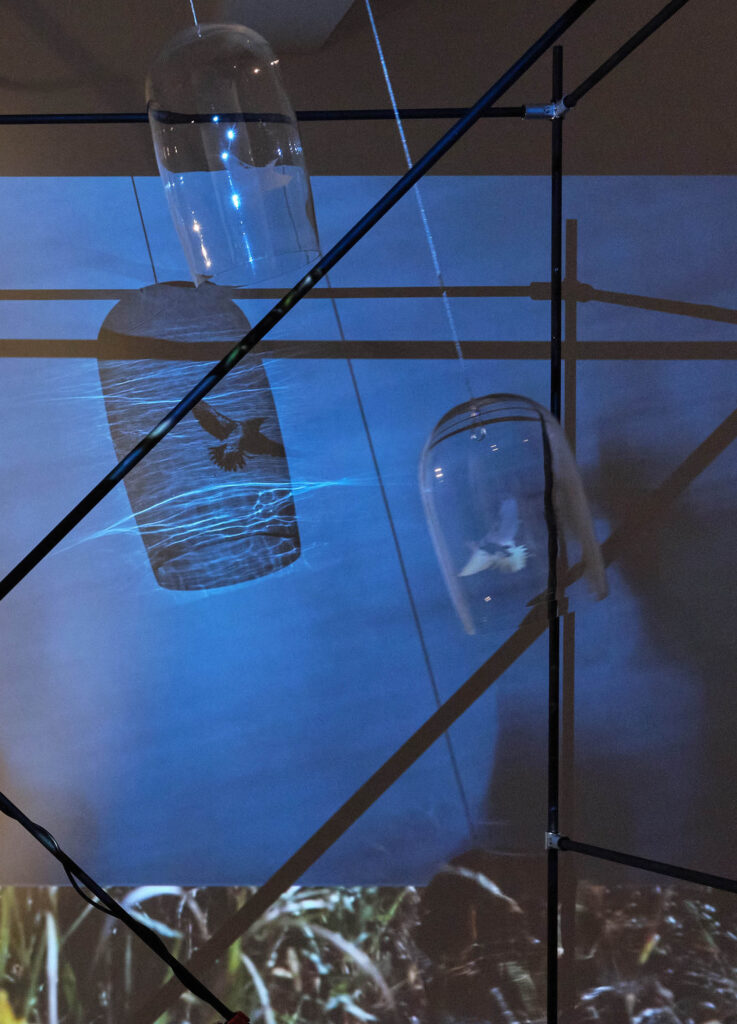
Birds enter through sound and sight. The birds’ calls, recorded by the artist, continuously shift and reorganize, gradually overtaken by industrial noise. They suggest a tough migration. The suspended glass bell jars are engraved with imagery of Eastern Meadowlarks (one of the bird speciesin population decline). The glass pieces swing slowly like pendulums of grandfather clocks, casting moving bird shadows across the projection, encapsulating past, present, and future. These dome-shaped transparent jars are recognizable as decorative containers used to showcase collected specimens, typically placed on a safe shelf. In Young’s installation, they lose their ground, engraved on, and swing side to side hypnotically. Here, these fragile containers of life also signal warnings, becoming what she calls “active image-makers.” I can imagine those glass jars holding the souls of vanished birds. The birds’ blurred wings flicker as their cries reverberate through the space, at times piercing, at times distant.
Alice Pixley Young, Detail, Still Life, 2026, A.I.R. Gallery, Brooklyn, NY. Photography by Matthew Sherman
The birds’ imagery appears in motion, blurred and only partially formed, more hinted at than fully seen. The birds seem to move as if traveling between sites, from Young’s Rust Belt landscape toward Brooklyn’s Gowanus Canal, some vanishing along the way. The black scaffolding structure stands before the screen, geometric, imposing, and bare. It interrupts the projected space, holding the blurred flight behind it in tension with containment. Objects, shadows, and projected imagery fold into one another. The present physical space bleeds into its layered past, reaching toward an unknown future. The disappearing birds, the scientific monitoring of contaminated landscapes, and the broader theme of environmental time link seamlessly. Or as the artist says, the projection reads like a “cross-section connecting atmosphere, land and contaminated infrastructure.”
As projected forms lengthen and shift, they spill beyond the screen and into the room, animating the gallery with a haunting beauty that is eerie, grim, but not yet fatalistic. Still Life does not settle into elegy. It resists the stillness implied by its title. It operates as a poetic wake-up call.
Exhibition view, Alice Pixley Young, Still Life, 2026, A.I.R. Gallery, Brooklyn, NY. Photography by Matthew Sherman
Alice Pixley Young: Still Lifeat AIR, 155 Plymouth Street Brooklyn, NY 11201.On view throughMarch 15, 2026. Wed–Sun, 12–6 pm
About the Writer: Etty Yaniv is a Brooklyn-based artist, writer, curator, and founder of Art Spiel. She works in installation, painting, and mixed media, and has shown her art in exhibitions across the United States and abroad. Since 2018, she has published interviews and reviews through Art Spiel, often focusing on underrecognized voices and smaller venues. @etty.yaniv
Natalie Moore grew up in San Diego, California, and spent many summers in Norway with her mother’s family. Although she has lived in New York for much longer, the dramatic Californian and Norwegian landscapes remain a lasting influence. Climate and ecology have also become more present in her work over the last decade, as the climate crisis worsens and governments and corporations continue to minimize the effects of carbon emissions, pollution, water use, and chemical waste.
In 2023, multidisciplinary artist Bonny Leibowitz’s world shifted when she stumbled upon an active demolition site in a shopping center in Richardson, Texas. She described the landscape as “both horrific and beautiful” – a scene of destruction and chaos situated right in the middle of the inner city Dallas suburb. Braving the sweltering Texas heat, Leibowitz made multiple trips to the site, photographing it extensively and collecting pieces of debris from the wreckage that would later comprise her series Adventures in Plunderland.
Installation view. Photo courtesy of Martina Tanga
Curator Martina Tanga had been reflecting on the ideas behind Learning With Trees – Artists for Climate and Environmental Solutions long before the exhibition took shape. In 2022, she read Ben Rawlence’s The Treeline, a book tracing how the Boreal forest is shifting under the impact of climate change. That reading sparked the idea that trees could serve as a highly accessible and disarmingly effective way to approach conversations about climate change.
Desert Forest: Life with Joshua Trees is a revelatory compendium—part elegy, part manifesto—centered on that spiky, iconic sentinel of the Mojave Desert. Assembled by scientists, historians, and artists, this is no ordinary nature book. It’s a multi-vocal chorus, grappling with ecological fragility and political urgency, yet always rooted in some primary form of awe. The Joshua tree becomes muse and metric, measuring our numerous planetary trespasses. Published by Inlandia Institute—in tangent with the past eponymous art exhibitions at MOAH in Lancaster and Hey There Projects in Joshua Tree—Desert Forest is a dazzling interdisciplinary work, arresting in both imagery and intellect. In many ways, it’s a bittersweet love letter to a disappearing biome—written in science, art, and memory.
Reception for Invasive Species in Cornell University’s Mann Library gallery
Hovey Brock’s show, The Invasive Species, in collaboration with Cornell’s Eco Arts features a series of paintings that focuses on how the climate crisis in general and invasive species in particular threaten the forests of the Northeast—an outgrowth of his Crazy River project that focused on the climate crisis in the Catskills. The paintings have phrases or questions that have been obsessing Brock for some time.
Pathways of migration, transit, turbulence, and foundational knowledge lead us across the city through three boroughs that speak to time and reflection. Through the slightest gestures cleverly calculated by the selected artists, we can trace symbolic movements as indicative of something greater and inherently profound. This lineup is a reminder to delve into one’s humanity and to mine for empathy and change. These themes are as relevant today as they were long ago, and it’s important to acknowledge the work of artists who are using their talents to envision an equitable world for all. Let us carry forth this mindset so that the present we build is a true path forward towards a more mindful future.
Artist Adriane Colburn lived in San Francisco for over twenty years. That time was formative—personally and creatively. At the same time, she maintained a consistent presence on the East Coast. She’s from Vermont and has always spent summers there, with a lasting connection to that part of New England and its relationship to the land.
Installation view: Alicja Kwade: Telos Tales, Pace Gallery, New York, 2025. Photo courtesy of the gallery
It’s a rare joy to encounter immersive installations that truly activate space and affect the viewer both intellectually and viscerally. This spring, three standout New York exhibitions— Alicja Kwade at Pace, Anastasia Komar at Management, and Pierre Huyghe at Marian Goodman—do just that. Each exhibition envelops visitors in an environment that challenges the senses and pushes the boundaries of perception, while decentering the human’s place within it: Komar contemplates the primordial origins of life and the interconnectedness of all living things; Huyghe imagines a collaborative ecology where humans, animals, machines, and artificial intelligence co-create new realities; and Kwade abstracts away the human almost entirely, leaving behind only our systems for measuring and making as the scaffolding for a parallel, perhaps post-human world.