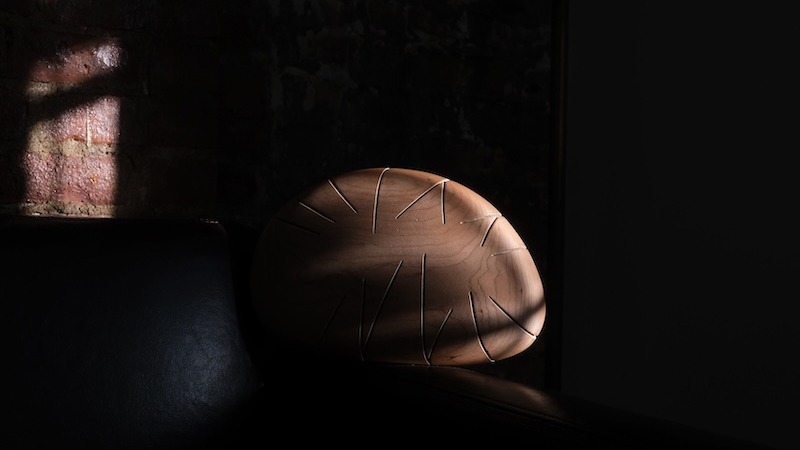
What can sound art contribute to the ecological turn? When the Taiwanese sound artist Huichun Yang described her process as getting to know the entire life of the tree that became her instrument, she had my attention. The entire creative arc of her process is rooted in reverence toward materials. Yang selects the wood, sculpts it into an arbrosan—an instrument first introduced to the world in 1996—and plays it by directly sensing its surface with her hands, using gestures that evoke repair and tending.
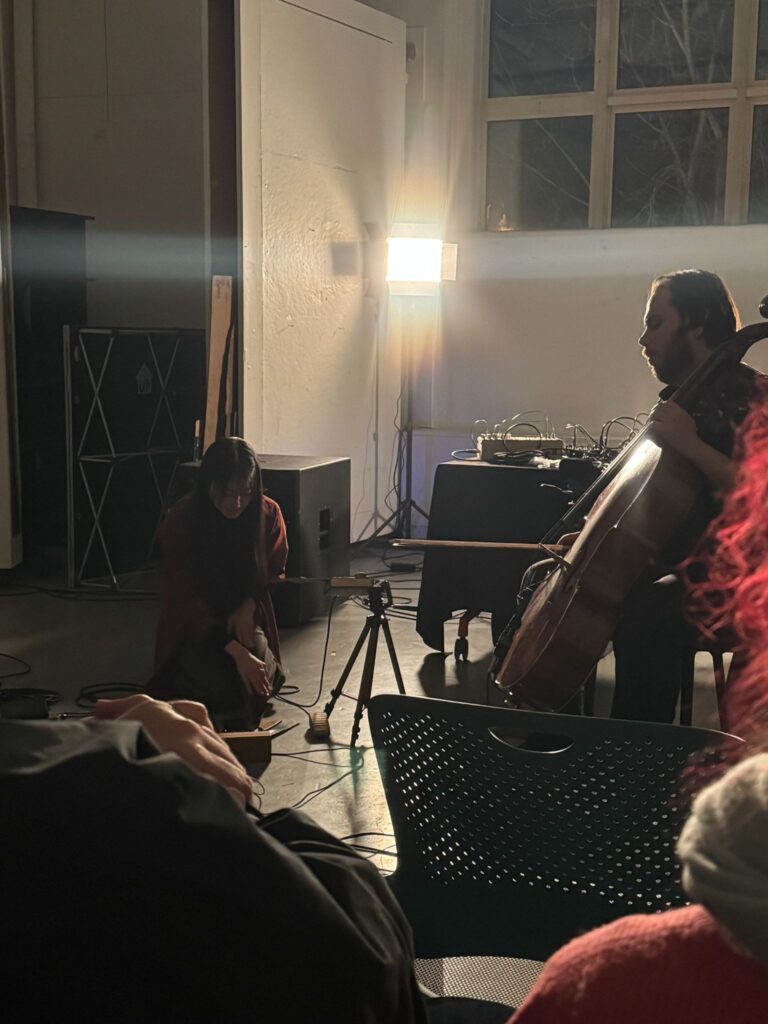
She and Jacob Sokolov-Gonzalez, an artist and composer, performed at the SMFA drawing studio in Boston on April 7. The non-hierarchical premise that materials can and do collaborate with humans was evident in their recent performance as the musical duo EndGrain. The concert was organized by Non-Event, a Boston-based concert series specializing in experimental music. The Subwoofer Duo also performed.
While sound is the primary concern, the concert provocatively engaged the aesthetic disciplines of sculpture, movement, and performance. The subtlety of EndGrain’s attention aligns with current New Materialist practices by recognizing the wood’s innate intelligence. Their performances are not just a collaboration between humans – they treat the instruments as beings rather than tools. Their approach excavates the essence of their instruments beyond mere note-playing, through friction, gestures, and repetition.

To begin, Huichun knelt on the ground, bending her body into a small zone where her instrument and a DIY midi controller sat beside Sokolov-Gonzalez and his cello. In an interview, she said, “The instrument is really leading—it’s like an anchor for my body.” Her hands moved smoothly across the wood, as though comforting a small creature. With focused persistence, she coaxed unexpected sounds and frequencies.
The performance was improvisational and exploratory, with each choice by Yang and Sokolov-Gonzalez made in response to each other’s sounds, breaths, and gestures. The musicians played their instruments with studious exploration. Two strings broke on the cello, and Sokolov-Gonzalez kept playing, as though that were to be expected. Yang said the first time she heard him play the cello that way, she heard the tiny points of friction between the string and the bow, and the material of the cello, rather than musical notes.
When they practice, she follows the movement of his body, hears his breath, notices the different rhythms, and then experiences her own body differently. “I apply different pressure, then different types of friction, gestures that will bring out the most complicated or simple sounds.” Her performance excavates parts of the tree’s life, such as long dark nights swaying in a storm, owls huddled close, and lovely sunny days, with squirrels jumping from branch to branch.
Yang says that when she plays the arbrosan, she feels its temperature and recognizes it as another body. She wakes it up, aligning with Jake and the cello. She senses the moisture between her palms and the wood, then starts to play. Her hands glide and rub the instrument with long, smooth motions, and then, later, smaller moves, as though juggling a tool to see how it works, producing a strong rumbling effect. With a slight ripple, the sounds move from ancient to futuristic.
She observed that with the current prevalence of technology, “we are losing the opportunity to be an animal.” With these instruments, Endgrain performs as two bodies connecting and moving in creative tension. The musicians take turns leading and following, like a dance. That rhythm constantly, subtly shifts. At one point, the lightness of the cello’s sound emerged as though I were daydreaming it.

The following descriptions came to me during the performance:
A photocopy of what the ocean sounded like 100 years ago.
Fireflies meeting sandpaper.
The worst-ever dentist visit.
A train whistle sounds in the distance at a remote little village train station.
The sound between each dial of an old phone.
Bells, like messengers, amplify the sound from the cello’s strings.
Squeaks that one might associate with a humorous moment become eerie when the note is held persistently.
The final act of EndGrain’s performance was participatory. Sokolov-Gonzalez shared little plastic squeakers with the audience, and like an ad hoc, disorganized chorus, we pressed them to accompany their sounds.
The performance created a container of time and space for the audience. Yang compared playing as Endgrain to passing through a tunnel. In the dark space, one can only see light at either end, and the sound inside the tunnel is so resonant and powerful that one can feel all of it, and even tiny sounds reverberate with a slight movement. Being inside the tunnel is like being in a world where the entire space vibrates beneath all of these rocks and mountains. This created space offers an alternate time, temperature, space, and light. The way sound reflects is different, but she can still see the connection between the tunnel’s entrance and exit. She forgets, then remembers this world, knowing right where she stands.
EndGrain, the experimental music duo of Taiwanese sound artist Huichun Yang and composer Jake Sokolov-Gonzalez, performing at the School of the Museum of Fine Arts at Tufts University Drawing Studio in Boston on April 7, 2026, presented by Non-Event.
- The Arbrasson was invented in 1996 by José Le Piez, a magician and sculptor based in Bordeaux. In 2023, Daniel Fishkin met Le Piez and studied the instrument’s construction. In 2025, Huichun Yang learned to build Arbrassons from Femi Shonuga-Fleming in Providence, who was an apprentice of Fishkin at the time.