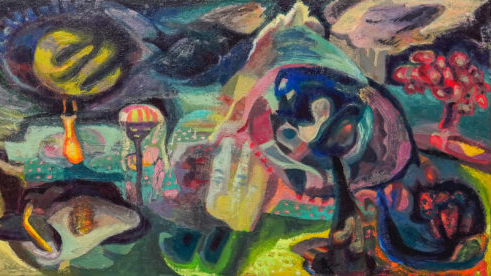
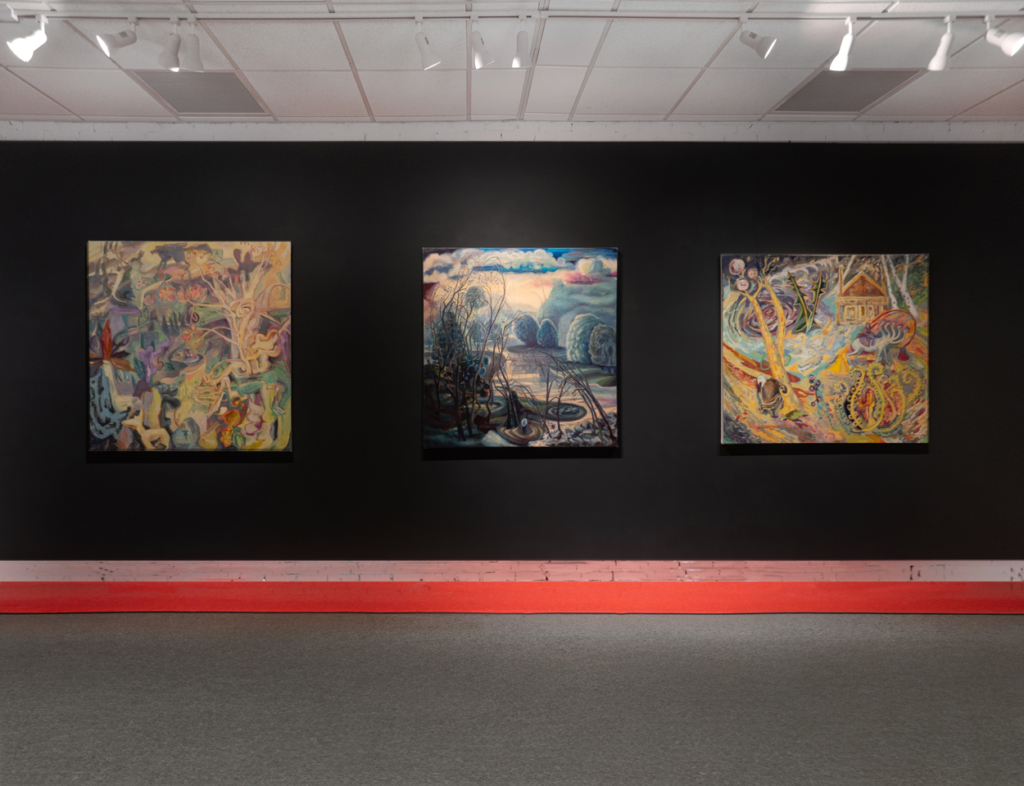
Opium Dreams, the exhibition of Laurie Fader’s pictures at the Susan Moremen Gallery, is an update of the artist’s bold transition from oil sketches of Umbrian hillsides to a psychological map of contemporary insecurities and vulnerabilities. She addresses our economic, political, and ecological ructions with exuberant irrationality, improbable scale-shifting, and a highly personal landscape vocabulary. Surreal humor and fantasy are her touch points, rather than anguish and despair.
Her metaphors are primarily floral, but Fader’s gardens are pre-Edenic: they come before the Hebrew God and evolution set the pace and sorted things out. There are memories of Renaissance art here, but these primordial wildscapes are a negation of the hortus conclusus, the private, meditative, cloister-like spaces that symbolized Mary’s virginity and were a mainstay of Quattrocento devotional painting.
No meanings, orientations, or identities are fixed on Fader’s terrain. Plants are freed from rooting in soil. Mountains double as seedpods, gourds, or skulls. Animals meld into their surrounding environment and may morph into other creatures. Blossoms become heads or fists, stems double as muscled arms, and a dog does double duty as an anteater. The impact is a little like Anne Enright’s response to Tintoretto: “one glance and you are tipped into the place of everything all at once: salvation, desecration, high drama, crowds, limbs, drapery, so much writhing.”
Why are Fader’s pictures so compelling? I believe the union of painterly surfaces, invention, and stagecraft drives engagement.
A lot emerges from the making of these pictures; Fader’s automatist approach is studied. She flourishes the joinery of her paint surfaces. The brushstrokes vary from sure and emphatic to hazy scumbling. An open interlace builds shapes and outlines, and piling up multihued dashes and swipes keep the surface energized. The artist is like a weaver using multiple threads to twist in different colors and textures, constructing forms and their contours with a wide variety of markings. Distinctions between foreground and background are minimized. Certain color chords recur, especially blue violet/yellow: Fader works through a wide range of values and intensities, using light/dark and bright/subdued color contrasts to dramatic effect. The eloquence of the artist’s touch provides a groundwork for her narratives. She is a master of the minimal amount of paint required to conjure up a wide-ranging bestiary of vestigial presences with the barest of holds on pictorial existence.
The viewer is witness to the work of art finding itself: culture is conversation, and its resolution is left in our hands.
Fader’s provocative inventions are by no means neutral or detached from the current American crisis. Upraised fists, often guised as blossoms, signal resistance. An eagle with a crutch stands for the nation’s wounded state. Galactic swirls filling the skies are reminders of global warming. Two fingers of an upraised hand can be reread as the double-mouthed, pursed lips of an oversized monumental head topped with a militaristic lightning streak.
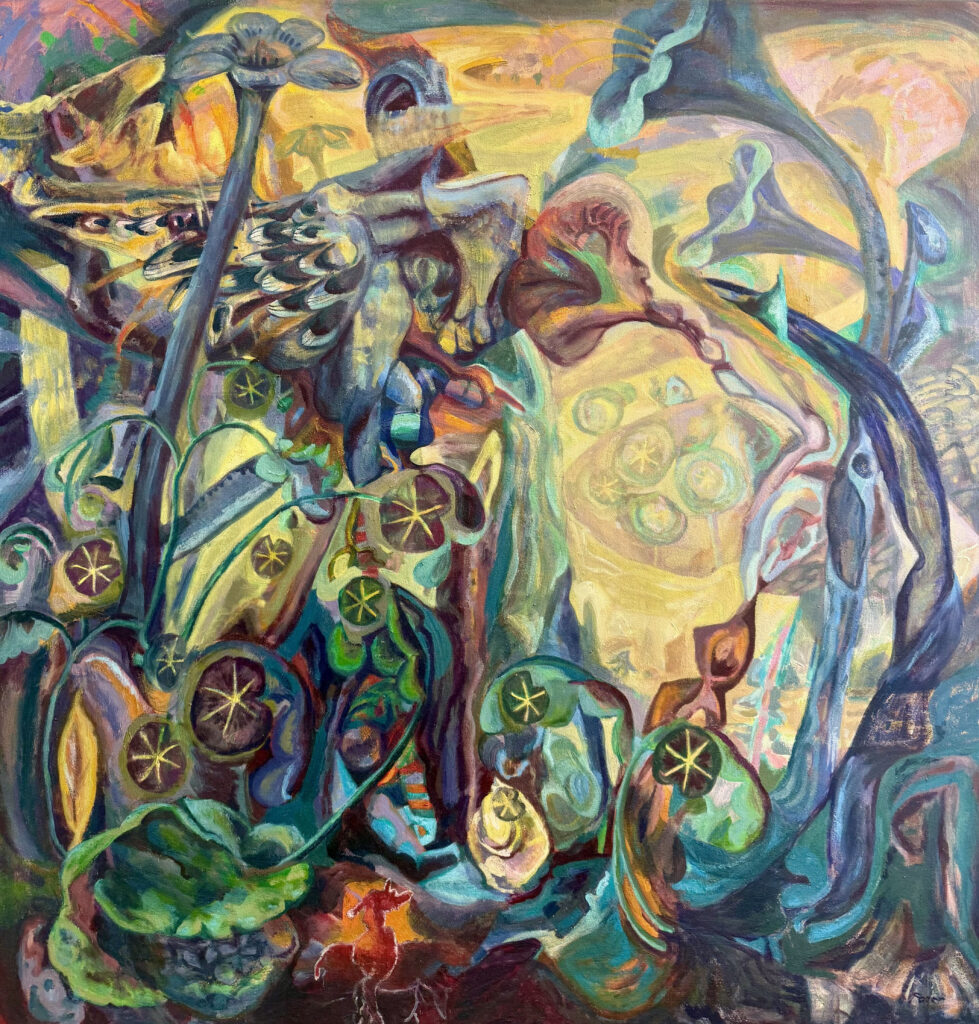
The later image appears in a horizontal painting entitled Luminaries. The painting provides a characteristic example of Fader’s inventiveness. Phosphorescent beings glowing beneath a starry night sky are reflected in a sea. Among the artist’s devices in this painting are a tall plant with a human foot, a tailless alligator with a hairy snout, a legless horse, and a lion-faced moon being scratched by the hand of a plant stem arm. A frond with red and blue-white stripes curls protectively over a blossom personage. There are three images of women: a green creature with blonde hair and green eye shadow, a plant stem girl with a striped saucer hat, and a blonde woman with smeared makeup seemingly associated with the double-mouthed man. The green creature’s mouth tentacles are embracing an avocado, certainly spoiling it for anyone else who might want a bite. Fader lays out a variety of roles – witnesses, villains, victims, dreamers, and inhabitants of a disordered natural world. The frond furnishes just barely enough clues to suggest that this protective waving leaf could be interpreted as an American flag. The struggle, then, is laid out and is ongoing.
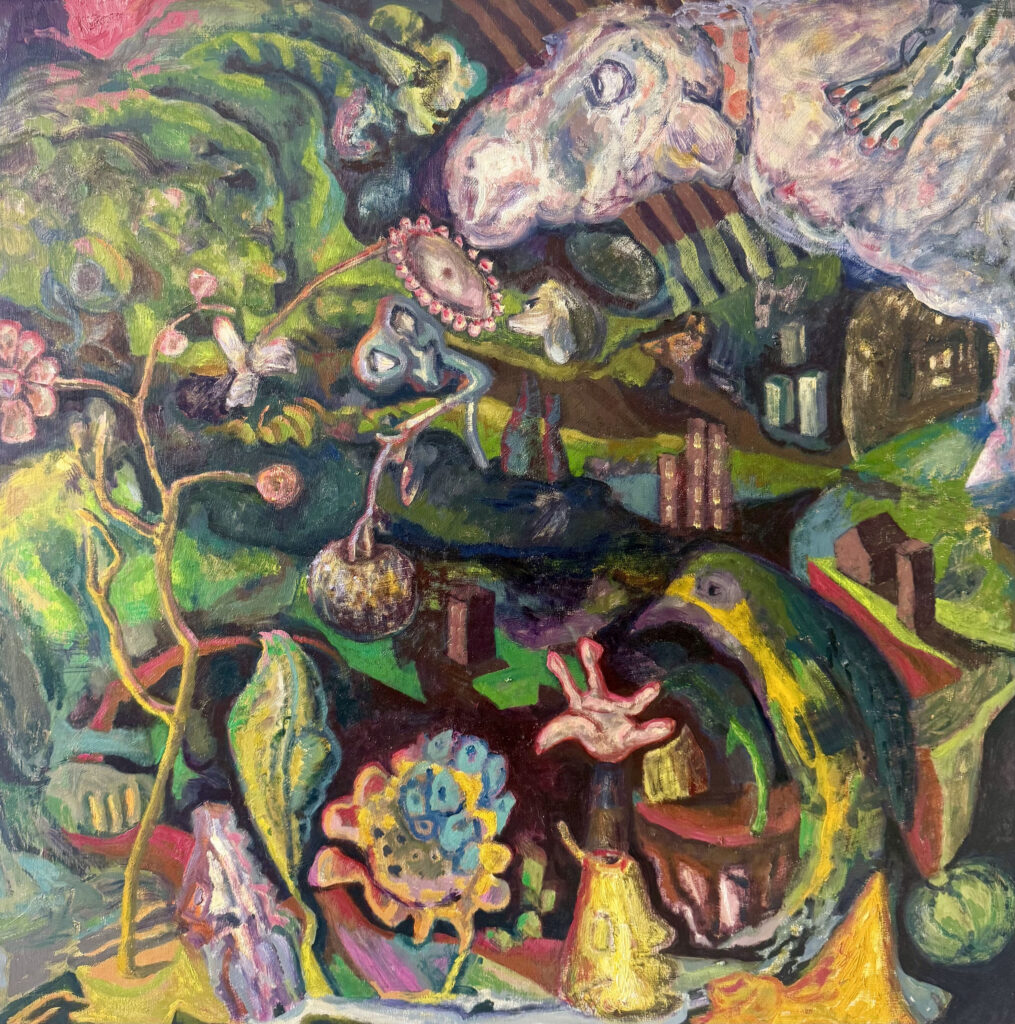
Besides the painterly authority of Fader’s execution and her Boschian/Brueghelian invention, her stagecraft is superb, and more cinematic than theatrical. In Pink Sky, a close-up of an airborne giant sheep intrudes on a multi-perspectival aerial shot that includes a yellow tree on its own plot of land, a foreground still life, a middle distance occupied by buildings in Uccellian perspective, as well as three leatherbound books plausibly offering a source for this fantasy. The extended image features abrupt changes in vantage point from near at hand to a wide shot. Strong contrasts of light and dark and hue saturation reinforce the illusion of cinematic movement. Incidents chronicle a disjointed plot: angry plant heads confront the curious sheep, who counters with his accompanying two stern-looking dogs, one with a tadpole body. A green and yellow bird with a conjoined fish witnesses the encounter, while below a whistling teapot’s steam suspends a splayed hand of protest. That the teapot should have a window and a large mouth is hardly surprising in this context. Towards the center of the painting is the head of a bird with a pained expression, who extends a plant stem arm ending in a puffball.
Unresolved tensions between benign and malevolent outcomes recur in every painting: a pathway leading from the past to the future is interrupted by a muscular pit bull with the menacing grin of a politician; the Virgin of the Ascension is threatened by a menacing dog; are the sleeping figures underground bogeymen or hermits? Franz Marc-like horses are a recurring motif, and they extend the tenuous possibility of assimilation into a harmonious paradisical world.
Motifs proposed and cancelled parallel the larger disputatious oppositions in most of the paintings. Fader asks how to exist in a society that has swept away sanctuaries and discarded to oblivion many endangered species. And is the natural world itself alien and distant in the second quarter of the twenty-first century? How to return? These questions are held in suspension as the viewer navigates these mutant habitats.
All photos courtesy of Andy Llanes Bulto
Make your tax-deductible donation today and help Art Spiel continue to thrive. DONATE
About the writer: Peter Morrin studied art history at Harvard and Princeton University. He taught art history and critical and curatorial studies at Vassar College, Emory University, and the University of Louisville. He was Curator of 20th-Century Art at the High Museum of Art and Director of the Vassar College Art Gallery and the Speed Art Museum.