At 33 Bleecker Street, history does not politely vacate.
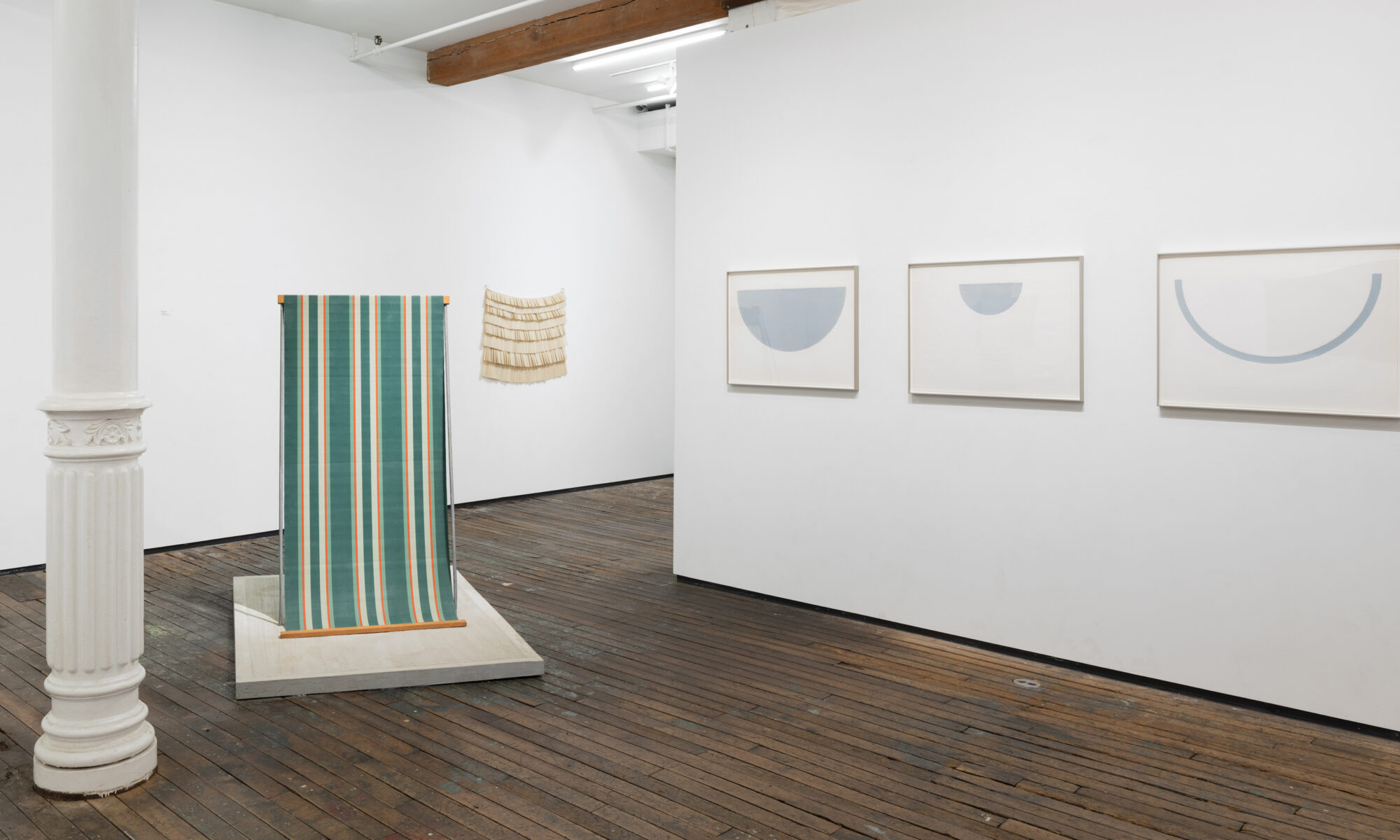
In the 19th century, Herman Melville grew up at this address, long before the current building rose here in 1900. A century later, Joel Shapiro kept an early studio in the building before moving on to larger quarters. This winter, the ground-floor gallery Zürcher has been restaging a 1972 exhibition titled 13 Women Artists. Museum curators made the trip to NoHo. Emails arrived from outside the city asking for more time.
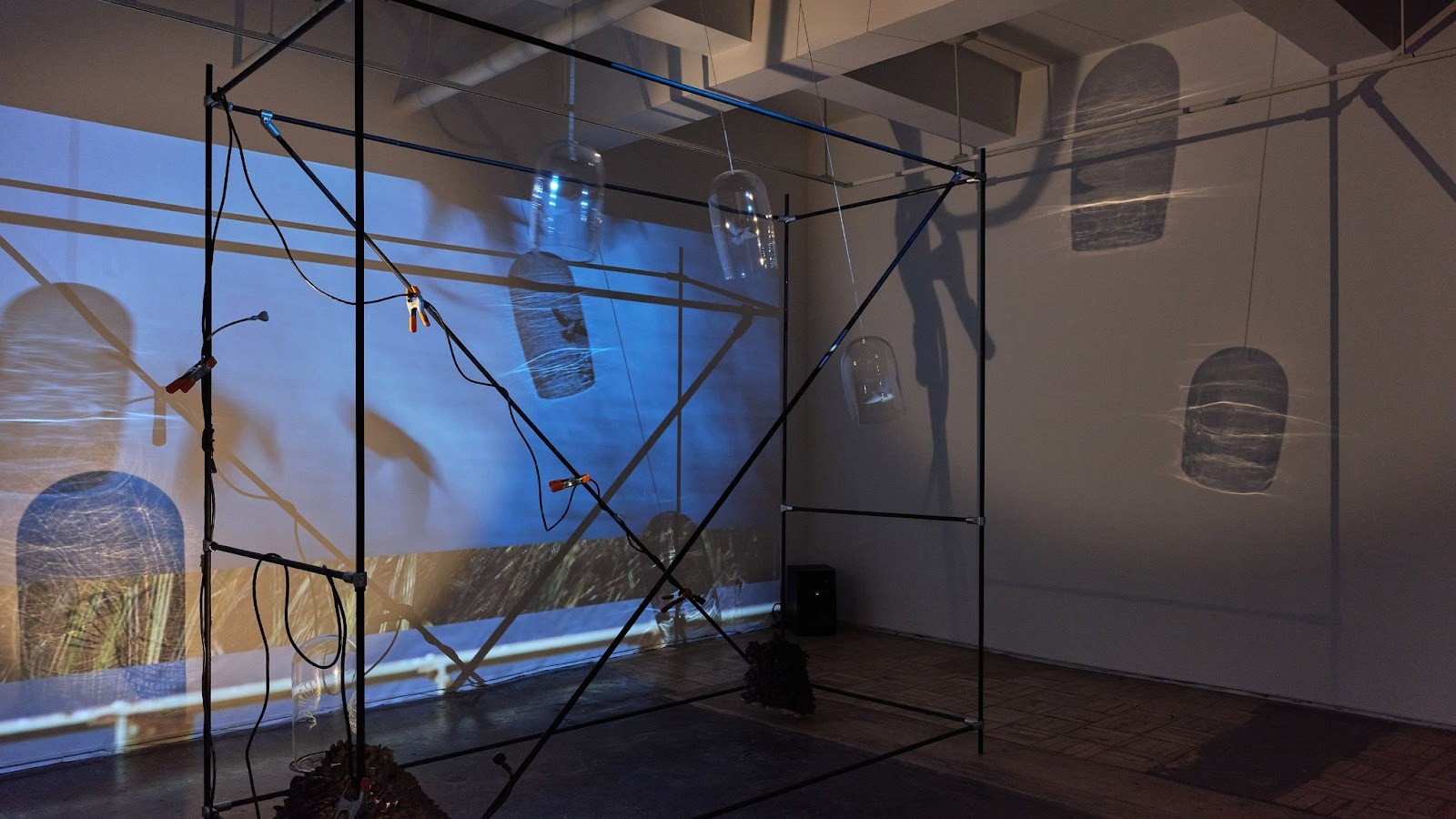
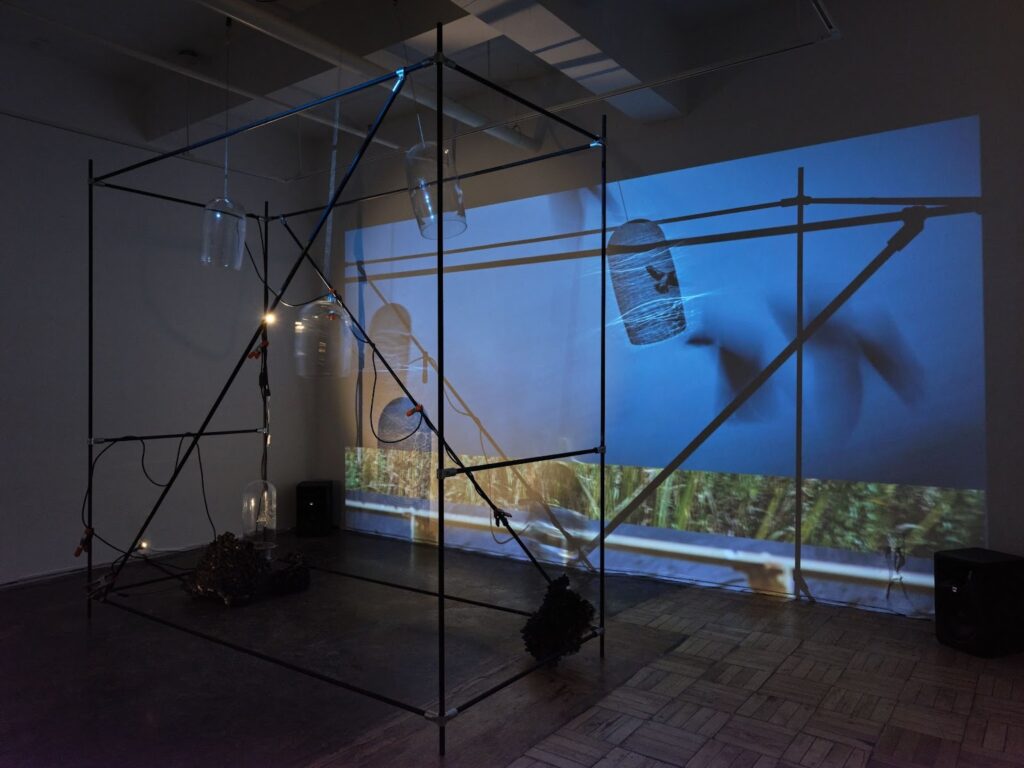
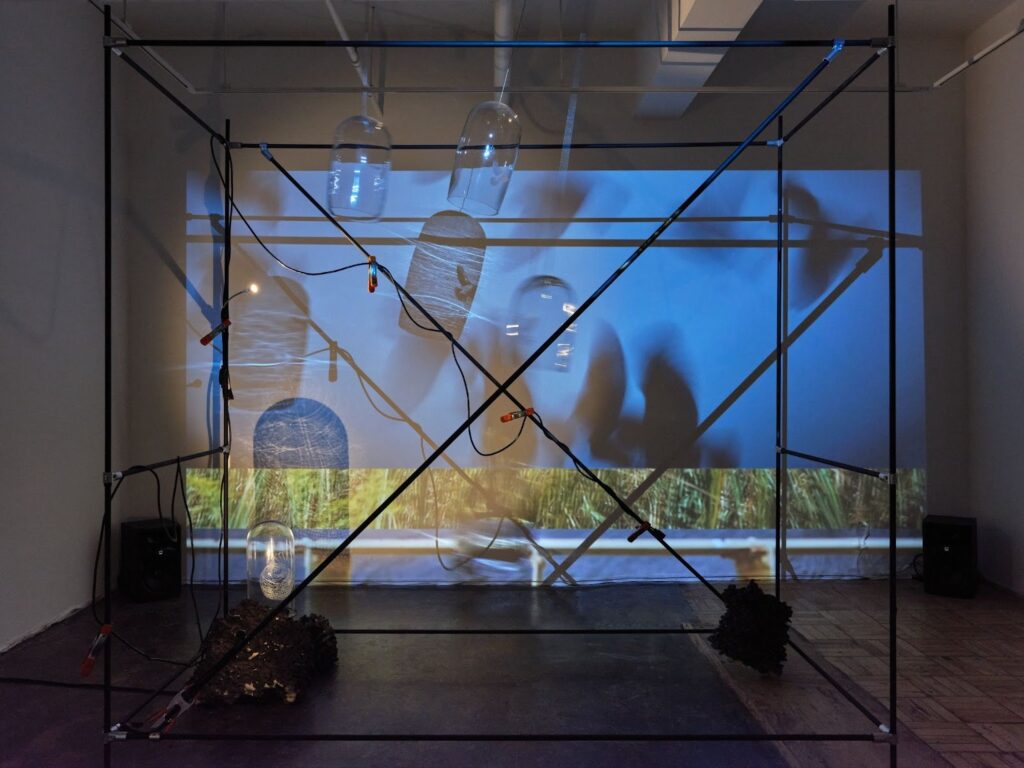
Alice Pixley Young’s Still Life takes shape in semi-darkness at A.I.R. Gallery as an immersive meditation on ecological time, stratified and shadowed by industrial residue. Installed as a multisensory environment of video projection, sound, industrial scaffolding, and glass bell jars, the installation places viewers in a space where remediation and damage coexist. Suspended from tall black scaffolding, the glass containers move like dimly illuminated pendulums, casting shadows across the walls and establishing the installation’s temporal pulse from the outset.
The work’s rootedness in place is central. Young’s studio is located on an Ordovician fossil bed near a nuclear Superfund site in the Rust Belt. Her exhibition in Brooklyn hints at another Superfund site, the Gowanus Canal, linking two contaminated landscapes across geography. The central video shows horizontal strata in constant motion. Below the upper dusky blue sky, you can travel slowly through narrow moving bands — grasses and wildflowers filmed at the Fernald site in southwest Ohio — creating a lateral sense of passing through a remediated landscape. Alongside it, a thinner strip shows water seen from a bridge, evoking an industrial waterway shaped by contamination and cleanup. The cross sections are clean-cut and suggestive, tinged with a bluish monochrome.
Exhibition view, Alice Pixley Young, Still Life, 2026, A.I.R. Gallery, Brooklyn, NY. Photography by Matthew Sherman
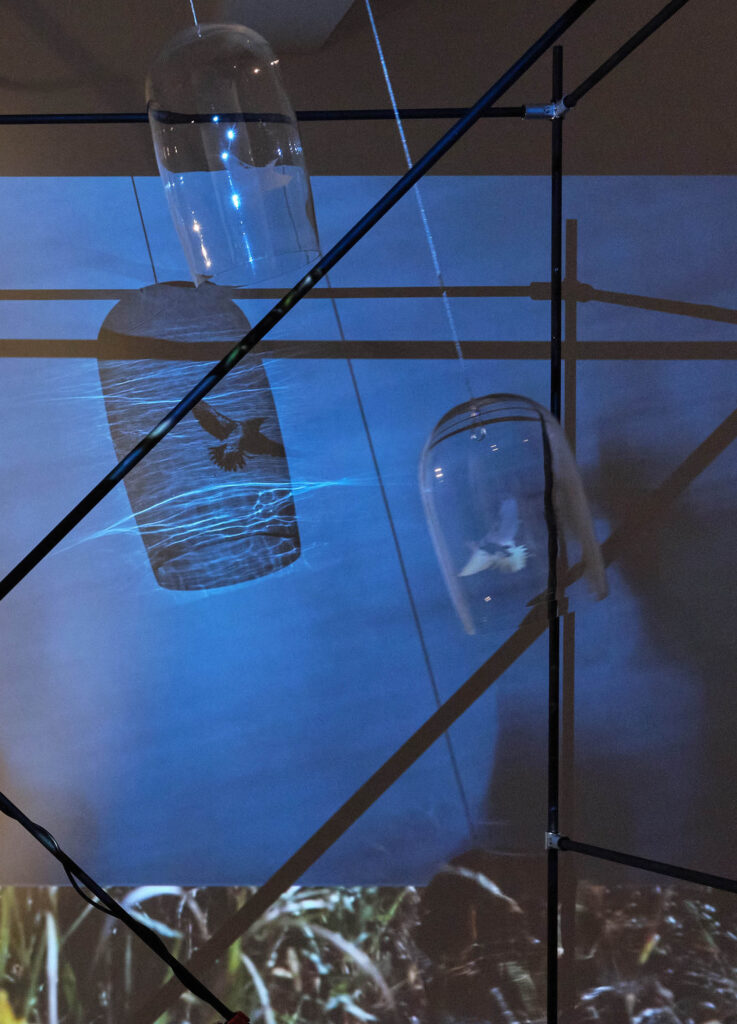
Birds enter through sound and sight. The birds’ calls, recorded by the artist, continuously shift and reorganize, gradually overtaken by industrial noise. They suggest a tough migration. The suspended glass bell jars are engraved with imagery of Eastern Meadowlarks (one of the bird speciesin population decline). The glass pieces swing slowly like pendulums of grandfather clocks, casting moving bird shadows across the projection, encapsulating past, present, and future. These dome-shaped transparent jars are recognizable as decorative containers used to showcase collected specimens, typically placed on a safe shelf. In Young’s installation, they lose their ground, engraved on, and swing side to side hypnotically. Here, these fragile containers of life also signal warnings, becoming what she calls “active image-makers.” I can imagine those glass jars holding the souls of vanished birds. The birds’ blurred wings flicker as their cries reverberate through the space, at times piercing, at times distant.
Alice Pixley Young, Detail, Still Life, 2026, A.I.R. Gallery, Brooklyn, NY. Photography by Matthew Sherman
The birds’ imagery appears in motion, blurred and only partially formed, more hinted at than fully seen. The birds seem to move as if traveling between sites, from Young’s Rust Belt landscape toward Brooklyn’s Gowanus Canal, some vanishing along the way. The black scaffolding structure stands before the screen, geometric, imposing, and bare. It interrupts the projected space, holding the blurred flight behind it in tension with containment. Objects, shadows, and projected imagery fold into one another. The present physical space bleeds into its layered past, reaching toward an unknown future. The disappearing birds, the scientific monitoring of contaminated landscapes, and the broader theme of environmental time link seamlessly. Or as the artist says, the projection reads like a “cross-section connecting atmosphere, land and contaminated infrastructure.”
As projected forms lengthen and shift, they spill beyond the screen and into the room, animating the gallery with a haunting beauty that is eerie, grim, but not yet fatalistic. Still Life does not settle into elegy. It resists the stillness implied by its title. It operates as a poetic wake-up call.
Exhibition view, Alice Pixley Young, Still Life, 2026, A.I.R. Gallery, Brooklyn, NY. Photography by Matthew Sherman
Alice Pixley Young: Still Lifeat AIR, 155 Plymouth Street Brooklyn, NY 11201.On view throughMarch 15, 2026. Wed–Sun, 12–6 pm
About the Writer: Etty Yaniv is a Brooklyn-based artist, writer, curator, and founder of Art Spiel. She works in installation, painting, and mixed media, and has shown her art in exhibitions across the United States and abroad. Since 2018, she has published interviews and reviews through Art Spiel, often focusing on underrecognized voices and smaller venues. @etty.yaniv
Outcropping, Erica Stoller’s recent solo show at A.I.R. Gallery, which ran through November 10th, utilized cardboard cuttings, formerly boxes, and packaging, as its exclusive material. When walking through the gallery, one noticed the show has three sections– a corner piece that covers two walls, floor to ceiling, a grid of individual cardboard compositions hung on the wall and a third “sandwiches” station that allowed viewers to pick up layered cardboard batches. Proceeds from the sale of the “sandwiches” go to Feeding America. An interesting survey of installation art—a site-specific installation, painting-like works on a wall, and an interactive piece. Stoller often works with space in curious ways. In Item # 25-033, her 2022 solo show at A.I.R. Gallery, she created a single wall-to-wall installation using Manilla rope and elastic bands. The rope cut through the gallery space, creating framed planes between ceiling pipes, wall hooks, and the floor.
During the Coronavirus pandemic, Art Spiel is reaching out to artists to learn how they are coping. This interview includes questions by both Art Spiel and Cultbytes as part of an Art Spiel x Cultbytes content collaboration.
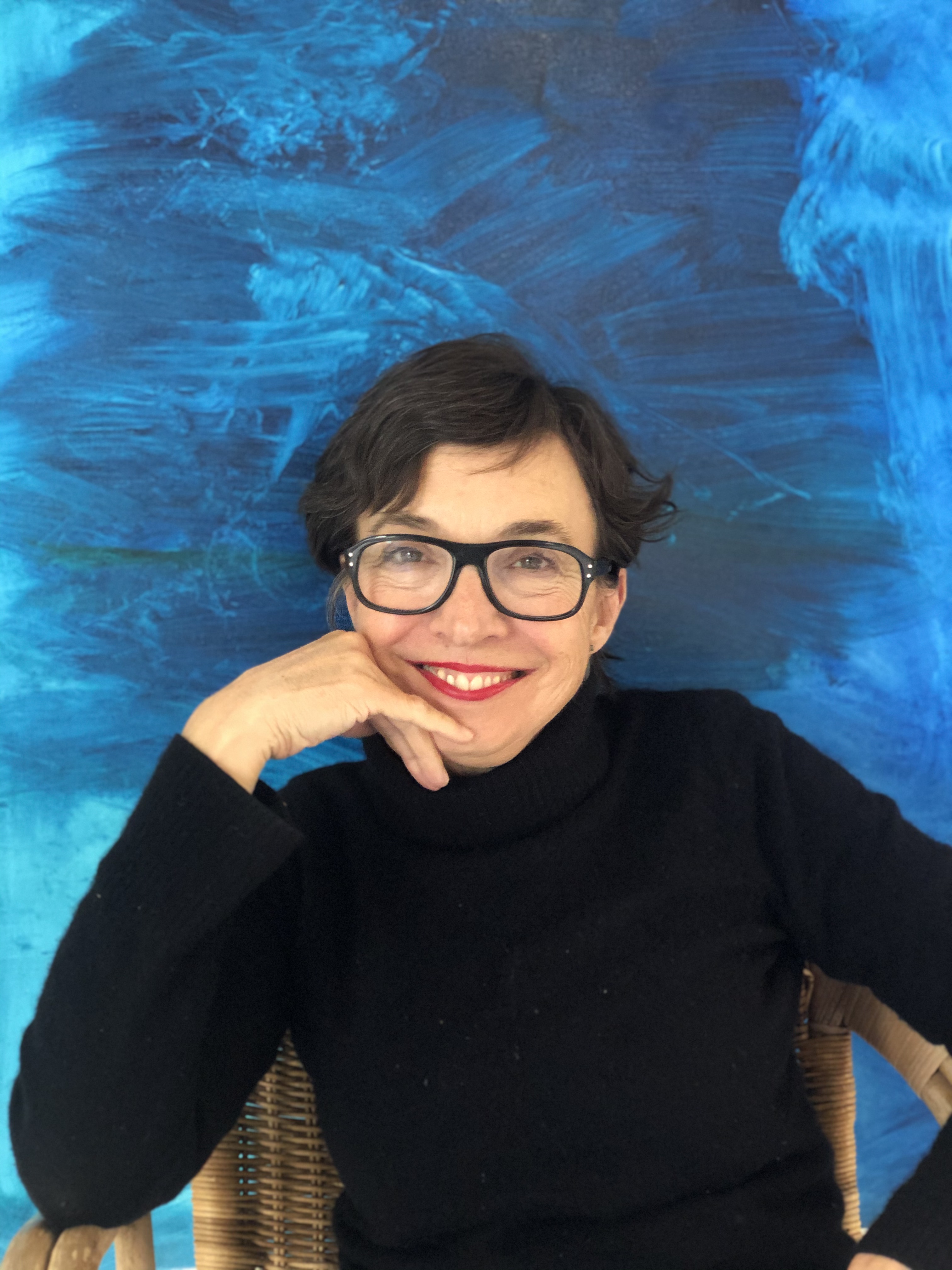
Jane Swavely. Photographed by Peter Leece. All images courtesy of the artist if not otherwise stated.
Jane Swavely is a painter based in New York City. She studied at Boston University and the School of Visual Arts and was the recipient of a Ford Foundation Fellowship. Previously represented by CDS Gallery, she is currently a member of A.I.R gallery.
During the Coronavirus pandemic, Art Spiel is reaching out to artists to learn how they are coping.
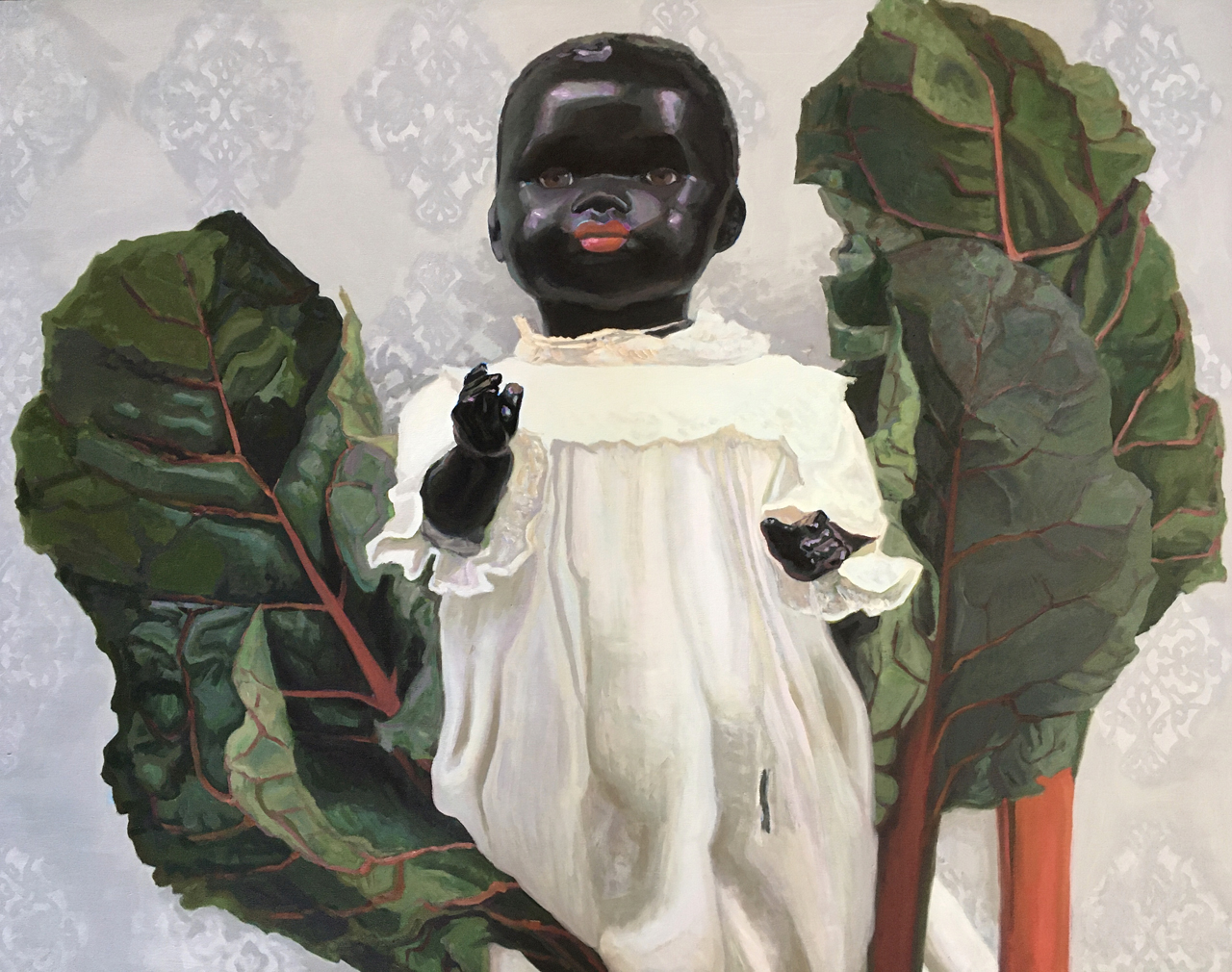
Selfie With Swiss Chard, 2020
JoAnne McFarland is an artist, poet, curator, and independent publisher. She is the Artistic Director of Artpoetica Project Space in Gowanus that exhibits work exploring the intersection of visual art and literature. She is the former Exhibitions Director of A.I.R. Gallery in DUMBO. She has exhibited her artwork nationally and internationally for over 30 years, and is the author of ten poetry books, chapbooks, and libretti. Her most recent curatorial project, co-curated with Sasha Chavchavadze, is SALLY, a multi-venue, muti-year exhibition that showcases lost histories of women artists and philosophers, and contemporary artists whose work exemplifies passionate inquiry.
The roots of a tuft of wild grass pulled up from the ground form an intriguing network of living fibers, interlaced with earth. This tenacious nest is a fitting visual for the perennial phenomena of women’s grass roots art collectives found around the world. Springing forth in the ‘70s collectives such as SOHO20, Artemisia, Women’s Building, Guerilla Girls, Las Damas de Arte, and WARM have provided support and opportunities for women not otherwise readily available in the staunchly patriarchic art world. In the subsequent decades women’s art collectives have proven to be a fertile, popular and diverse multi-purpose force, although unfortunately mainstream institutions have under-acknowledged their impact. Art Historian Kathleen Wentrack, PhD, observes, “[The] numerous exhibitions devoted to feminist art in the last decade or so [devote] little attention to collectives, and [there is] a lack of historical studies of collectives and their influence on contemporary art practices, which continue to be influential to the present day.” This exhibition, “Slečny od maliarskeho stojana,” which translates as “Ladies of the Easel,” presents an opportunity to document the origins of a thriving women’s art collective called LP (formerly known as Lady Painters) founded in 2015 by Jenn Dierdorf and Kelsey Shwetz in Brooklyn, NY. When conceiving of the show, curator Juliana Mrvová used LP as a resource for selecting work. Paintings by Dierdorf and Shwetz, among others, are included in the exhibition, which is presented from June to November 2019 in four cities in Slovikia: Bratislava (the capital), Banská Bystrica, Trebišov and Rimavská Sobota. As an early and on-going member of LP, I’m pleased to have the opportunity to interview Dierdorf and Shwetz about their motives and goals for the LP collective.
Anne Sherwood Pundyk is a painter and writer based in Manhattan and Mattituck, NY. She stains, crops and sews unstretched canvas to construct her work calibrating the interplay of spontaneity and control. She is a proud member of LP.