
Maria Gil Lucientes paints in the slim margin where a system starts to come undone. She begins with a constraint, a single color, a periodic screen, a piece of medical gauze, then lets the materials misbehave. In Pareidolia, gauze shifted by air becomes the suggestion of a face. A Spanish-born painter who studied mathematics, physics, and computer science before a decade in tech, Lucientes brings a system-builder’s discipline to a practice that hinges on chance. Here, she reflects on the path from science to painting, the dialogue between control and surprise in her process, and the new Moiré series taking shape in her studio.
You trained in Math, Physics, and Computer Science. You also describe painting as a “quiet passion since childhood.” How do you see the relationship between all these?
For me, mathematics, physics, and art are deeply connected. In mathematics and science, we strive not only to find the proof or explanation that best captures the truth, but also the most elegant and direct one. I am drawn to the search for beauty that can emerge within strict rules and limitations. That same impulse guides my work as an artist. I try to work within self-imposed constraints, whether in materials, color, or process, to arrive at something essential. As Stravinsky wrote in Poetics of Music, “Everything that diminishes constraint, diminishes strength.”
Visual art has always felt as natural to me as breathing. As a child, before I could fully read, I was captivated by the images in books. They conveyed stories and emotions with a directness that words often could not, and I was constantly drawn to them. Although I eventually studied mathematics, physics, and computer science because they came naturally to me, making art remained a quiet but constant presence in my life.
Looking back, I realize that these paths were never separate. My scientific background shaped the way I think about structure, systems, and processes, while art gave me a space for intuition, ambiguity, and discovery. Only recently did I decide to devote myself fully to art, recognizing it as the path that feels most deeply aligned with who I am.
You spent a decade in the tech industry before turning fully to painting. What can you tell us about this shift – was there a particular moment that you can recall, or was it a gradual process?
The shift was gradual rather than sudden. Even while working in the technology industry, I was always making art: drawing, painting, and reading about artists and their work. Art was a constant presence in my life, quietly shaping the way I saw the world.
One challenge of having art as such a constant presence is that you do not always recognize it as a possible profession. Because mathematics, science, and technology were the fields in which I felt comfortable, I followed that path for many years. But over time, I found myself devoting more and more energy to art: thinking about ideas, experimenting, and making work whenever I could.
There was not a single defining moment. Rather, art gradually occupied a larger and larger space in my life until it became impossible to imagine not giving it my full attention. Looking back, I realize that the shift was less a change in direction than an acknowledgment of something that had always been there.
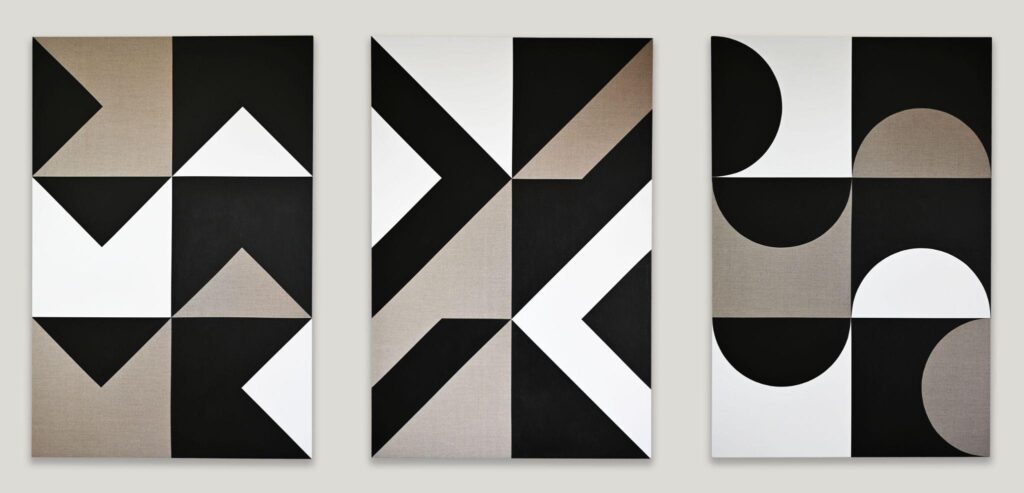
You use airbrush and acrylic on linen and paper to make “precise yet spontaneous” compositions. What can you tell us about the relationship between precision and spontaneity in your process?
Precision is central to my work. By imposing limitations on myself, whether in technique, materials, or composition, I rely on precision to explore the possibilities within those boundaries. At the same time, chance plays an equally important role. I believe that complex patterns in nature often emerge from the interaction between simple rules and unpredictability, and the same principle guides my process.
I begin with a system or set of constraints, but once I start working, I allow the materials to introduce variation. The movement of air, the shifting of fabric, the superposition of layers, or slight changes in alignment can all produce unexpected results. These moments of spontaneity are not interruptions to the process, but an essential part of it.
What interests me is the dialogue between control and surprise. The process is never entirely predetermined or impersonal. Through observation and intervention, I decide which accidents to keep, which to discard, and when a work has reached its final form. It is in that space between rigor and intuition that the work comes alive.
You say that your work describes a space “where geometry and figuration coexist.” How is it reflected in your work, and what are you aiming to express with it?
For me, the line between abstraction and figuration is very subtle. Many of the same questions and challenges exist in both. I am a self-taught artist without formal academic training, and over time, I have explored both realistic and abstract approaches. I completed the Charles Bargue Drawing Course and experimented with the sight-size method, while reading extensively about abstraction. Interaction of Color by Josef Albers, for example, was especially important to me. Because of this, moving between the two has always felt natural, and the distinction between them often seems less clear than it is usually presented.
I am also interested in the relationship between different scales. The micro and the macro can reveal very different aspects of the same subject, but what fascinates me most is the space in between. When does the micro become the macro? When does a form shift from abstract to figurative? Is that transformation in the image itself, or does it happen in the mind of the viewer?
Much of my work inhabits that middle ground. The compositions remain abstract, but they often allow the suggestion of figures, faces, landscapes, or other associations to emerge. I am interested in creating a space where geometry and figuration coexist, where neither is fully resolved, and where the viewer is invited to move back and forth between the two.
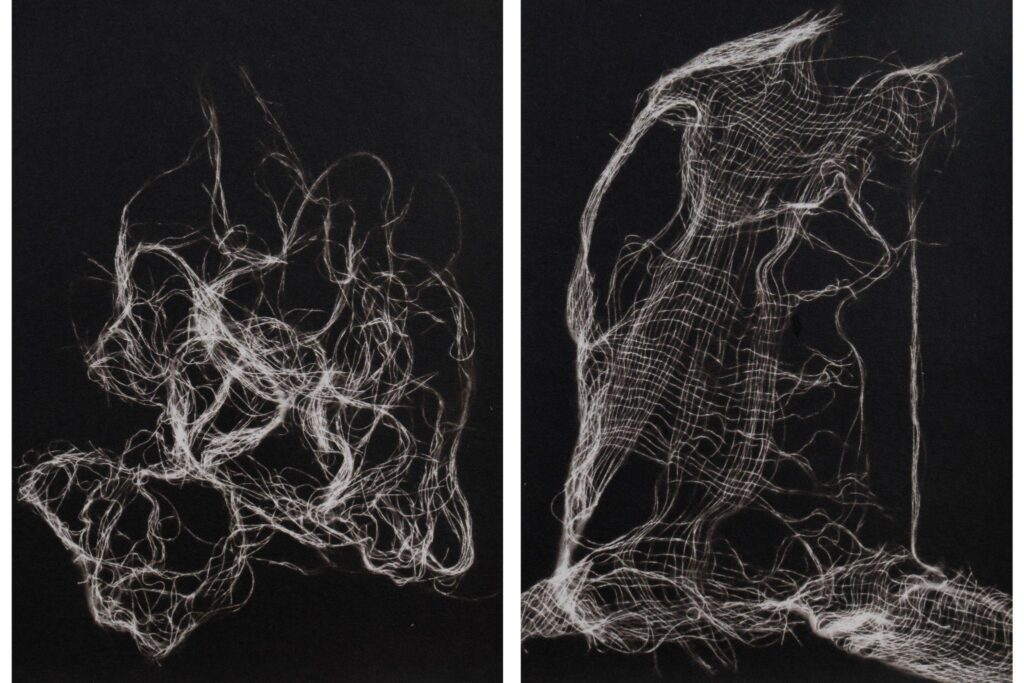
The Pareidolia works on paper particularly attracts me. Pareidolia is a psychological phenomenon in which the brain perceives familiar patterns (such as faces or figures) in ambiguous forms. What draws you there, and how does each of these pieces evolve?
These works inhabit the transitional space between abstraction and figuration, which I find endlessly fascinating. I have always been intrigued by the experience of looking at clouds and seeing shapes and stories emerge within them, and creating this series feels very similar. I am drawn to the moment when an abstract form begins to suggest a face, a figure, or a presence, without ever fully resolving.
For the Pareidolia series, I worked with an airbrush and a single color, focusing on negative space. I used medical gauze as a fabric resist, manipulating it in ways that resisted control: even the slightest movement of air would alter its position. At times, I completely deconstructed the gauze and reassembled it, allowing chance to shape the composition.
Each piece evolves through a dialogue between intention and unpredictability. The forms are never imposed in advance; rather, they emerge gradually through the process itself. What interests me is that different viewers often see different things. The work remains abstract, yet it opens a space where hidden figures and associations can appear. Over time, the series has grown to nearly fifty works, though only a selection is currently on view.
I have to ask about the name. Your maternal family is from Fuendetodos—the birthplace of Goya, and you carry the Lucientes surname. Francisco de Goya y Lucientes. How present is that in your consciousness as an artist?
I was born in Spain, where painting is deeply woven into the culture. Exposure to art begins early, and it becomes almost part of everyday life. Carrying the surname Lucientes is therefore something I have always felt conscious of, especially knowing that my maternal family comes from Fuendetodos, the birthplace of Goya. We like to think of ourselves as his descendants.
Goya has long been one of the artists I admire most. What moves me is not only the power of his work but also the way he was able to reinvent himself repeatedly throughout his life. From the Caprices to the Black Paintings, his art is deeply personal, experimental, and psychologically complex. It feels both rooted in its own time and remarkably contemporary.
I do not feel the connection as a burden or an expectation, but rather as a source of inspiration. The qualities I admire most in Goya, his courage, independence, and willingness to explore new territory, are values I hope to honor in my own work.
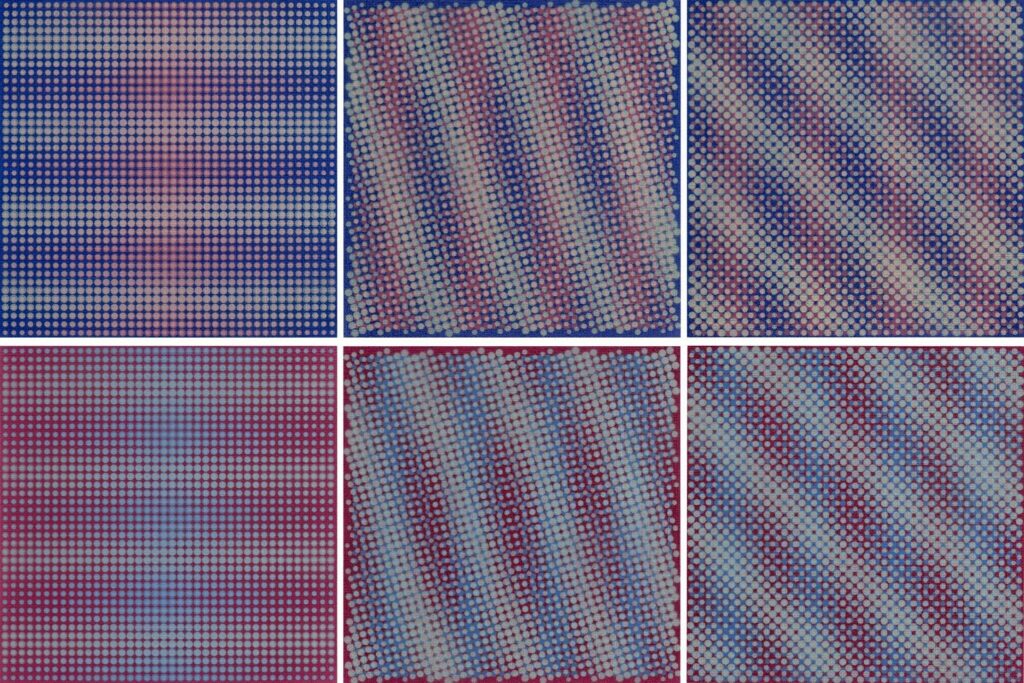
What are you working on these days?
Lately, I have been working on a new series titled Moiré. The works begin with periodic screens that I design and laser-cut myself. Then, I use them as stencils for successive layers of airbrushed paint applied at different angles, allowing the overlapping structures to generate patterns that could not exist in any one layer alone.
What interests me is the way a very simple system can produce something unexpectedly complex. As the screens shift in relation to one another, small grids begin to expand into larger bands, rhythms, and fields. Changes that are almost imperceptible can transform the image entirely, creating new relationships between micro and macro form. The interaction of different colors also produces optical effects and polychromatic moirés that seem to vibrate and change as you look at them.
I am drawn to the tension between the logic of the system and the instability of the result. Although the process is carefully controlled, slight variations in angle, scale, and color can lead the work in unexpected directions.
This series has already begun to lead me toward other ideas and directions that I would like to explore. My practice is constantly evolving, and I often find that one body of work naturally opens into the next. What interests me most is following those connections and continuing to push them further. There are still many things I want to create, and that sense of possibility is what brings me back to the studio every day. It is in that space of uncertainty, discovery, and continual change that I feel most at home.
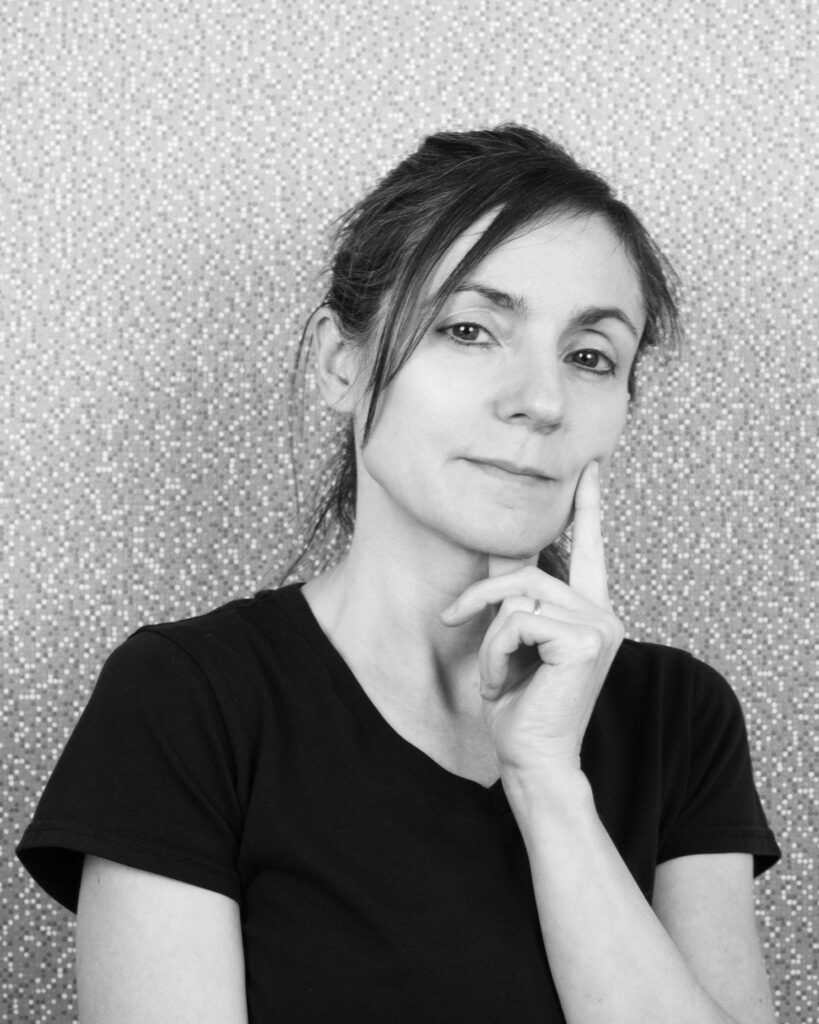
About the artist: Maria Gil Lucientes is a Spanish-born artist living and working in San Marcos, Texas. She studied Mathematics in Spain and later earned a Master’s degree in Computer Science from Stanford University. After a decade working in the technology industry in California, she turned her full attention to visual art, which had remained a quiet but constant presence throughout her life.
Her work explores the space between structure and intuition, where geometry and figuration coexist. Chance plays a central role in her practice, guiding an exploration of how order emerges through patterns, repetition with variation, and a deliberate restraint of materials. Her compositions balance analytical thinking with a quiet sense of openness and visual harmony.
Inspired by science, her work reflects an interest in interconnected systems and the underlying structures shaping natural and human-made environments. Through a variety of techniques, she develops layered compositions guided by process, embracing an experimental approach that bridges technology and painting. @mgl.artiststudio
About the writer: Etty Yaniv is a Brooklyn-based artist, writer, curator, and founder of Art Spiel. She works in installation, painting, and mixed media, and has shown her art in exhibitions across the United States and abroad. Since 2018, she has published interviews and reviews through Art Spiel, often focusing on under recognized voices and smaller venues. More about her art can be found at ettyyanivstudio.com and on Instagram @etty.yaniv
Make your tax-deductible donation today and help Art Spiel continue to thrive. DONATE