HIGHLIGHTS
During this season, art spaces across Philadelphia step up to demonstrate the voices of underrepresented communities as the city prepares to celebrate the semi-quincentennial of the signing of the Declaration of Independence. While institutions and sports fans are celebrating, artists take this moment to reflect on America’s 250 years, and how definitions of liberty, equality, and justice have evolved beyond what the Founding Fathers drafted.
At Philadelphia Magic Gardens, painter Santiago Galeas utilizes his training in traditional portraiture and landscapes to create powerful and luminous works depicting first-generation and immigrant queer Latinx Americans. At the Clay Studio, ceramicist Roberto Lugo unveils a dynamic living space that blends historical pottery with contemporary pop culture, while uplifting the Black and Boricua stories of North Philly. At Taller Puertoriqueño, visual and movement artist Hagudeza Rullán-Fantauzzi connects the history and cultural significance of Puerto Rico’s flag to her personal journey of body autonomy. Each of these artists speaks for liberation for queer, Black, and immigrant communities in their work, reminding us that liberation is an ongoing battle, and we must prioritize protecting the people who are currently under attack by policies brought by the current administration. None of us is free unless we are all free.
Entre Raíces y Alas: Works by Santiago Galeas at Philadelphia’s Magic Gardens +
+ @phillymagicgardens
On view through July 26
Curated by Chelsey Luster
Featuring Santiago Galeas
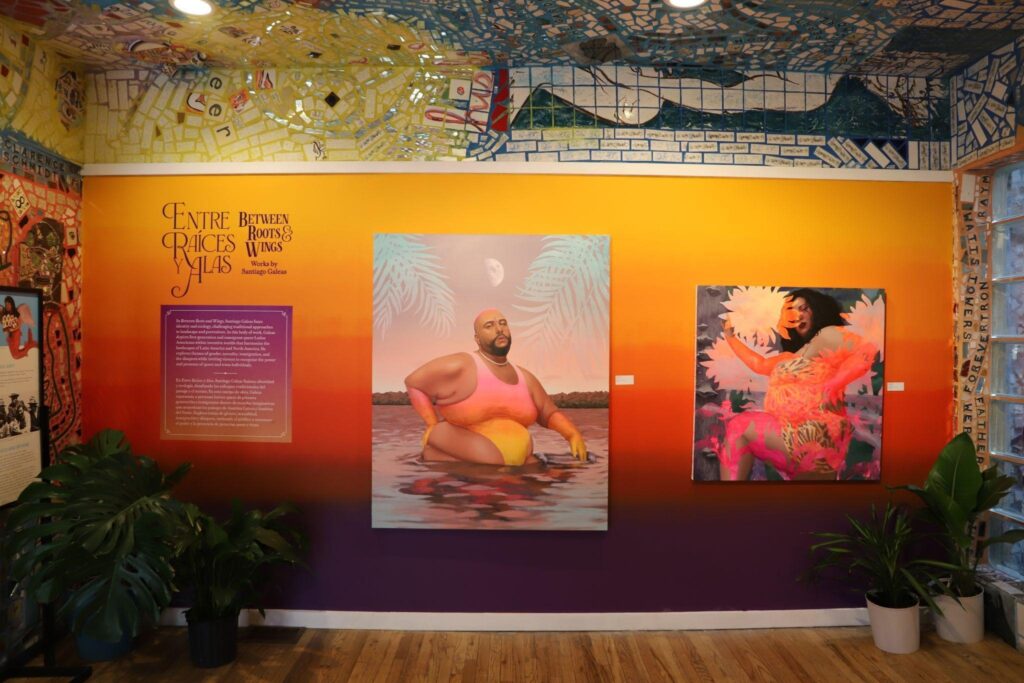
In this standout exhibition, Santiago Galeas carefully depicts queer and trans folks, present in their fluidity among vibrant, bucolic landscapes. They stand proud in their brown skin, posing in calm waters and thriving gardens. A signature of Galeas’ paintings is his overlaying of silhouettes, such as palm trees and aloe plants, to add a bit of mysticism in his natural world. His choice of large leaf shadows taps into the feeling of sitting outside and looking up through the sunlight breaking through the tree canopy (a feeling many Philadelphians are currently experiencing as our tree-lined streets are full in bloom). In his specific portrait style, Galeas caresses the paint to form his figures, depicting high cheekbones and soft lips, showing how he prioritizes care throughout the process. Although the current administration tries to threaten same-sex marriage laws and gender-affirming treatments, Galeas stands firm in saying that these identities deserve to be celebrated, and in particular, people of color. In tandem with the queer community, Galeas also celebrates his identity as a Latine artist. He brings a queer lens to the Latine feeling of always being in two spaces (aqui y alla) culturally; however, I see the work as a positive spin on being fragmented. The intersectional characteristics of the individuals are what make them powerful and deserving of being heard. Their magnitude is enhanced by Galeas’s penchant for color, shown in glowing botanicals and gradient skyscapes. In a note from curator Chelsey Luster, she highlights this second motif by orchestrating a sunrise/sunset gradient on the gallery walls, adding to the theme of transformation and rebirth in a liminal space. The portraits on display are complemented by small painted silhouette studies of stark contrast, like a loud, inviting purple against a soft, blooming pink. It’s a feast for the eyes in terms of hue, but also symbolically with religious icons. By adding some elements of spirituality, Galeas reframes the powerful hand of conservative politics surrounding traditional Latin American mentalities. This is blatant in the piece “Somos Nuestra Salvacion”, featuring a tattooed woman posed in front of stained glass windows with saints. This painting calls for community by saying that the people are the salvation, and we take care of each other.
American Crib: What’s Happening at The Clay Studio
+ @theclaystudiophl
On view through July 5, 2026
Featuring Roberto Lugo
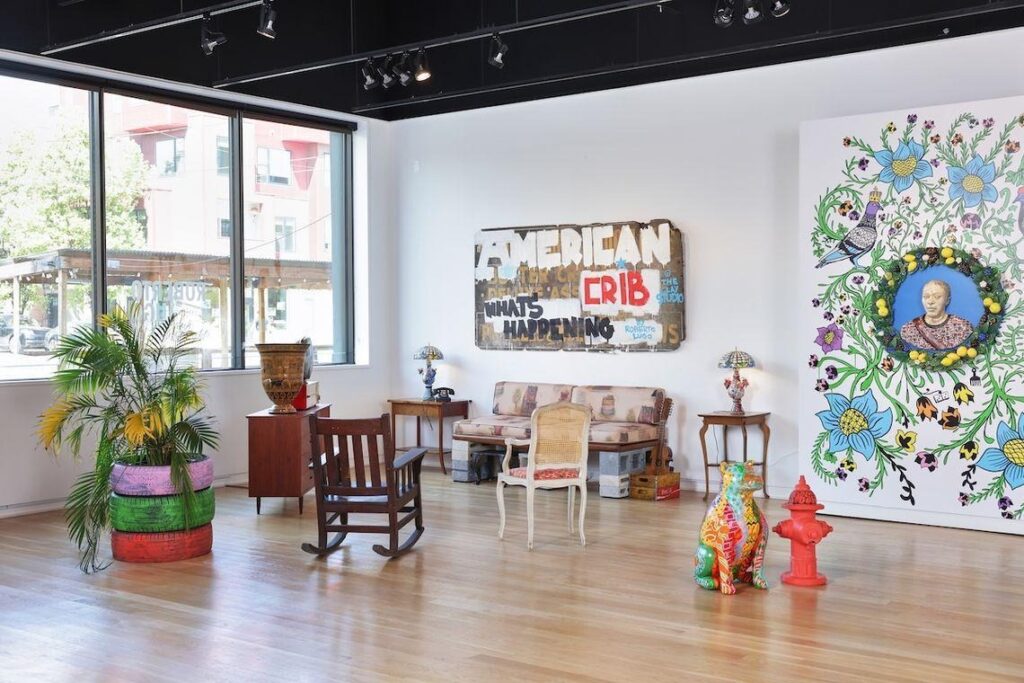
This exhibition, “American Crib: What’s Happening?” presents a new image of America designed by the resilient immigrant mentality. Roberto Lugo takes over the main gallery by arranging together glazed sculptures, homeware vessels, patterned wall-coverings, and a specific installation of makeshift seating. Lugo stages his environment as an equalizer of social, economic, and cultural hierarchies, like a dinner table with mismatched chairs. Regardless of background, the city forces populations to co-exist and help each other make sense of political push and pulls, especially in times when the country feels divided. To combat this, Lugo chooses to uplift the culture of his city, like music and graffiti. Milk crate basketball hoops are on display alongside elegant furniture-sized vessels sporting icons like Questlove and Biggie, creating a conversation on cultural preservation and urban inequality.
Although Lugo is hailed for his monumental ceramics, the champion of the exhibition is the Philly-Rican lens of his neighborhood in installation form. Milk crates as chairs, a stack of tires as a planter, and cinder block furniture nod to the Latin American immigrant mindset that everything can have a second life, even after its original use. Instead of throwing things away, Latinos prefer to create something new out of everyday objects, a mentality cultivated from having to work harder to create a life in the United States. The installation work underlines the resilience Lugo sees in his community, in a time when immigrants are being persecuted by the current administration.
I spent the most time thinking about the makeshift dinner and domino tables set flanked by mismatched seating arrangements, not unlike the setups you’d see on the sidewalks or in a corner lot. It becomes a symbol of equality where a stack of milk crates, a seat designated for members of the hospitality industry, has the same purpose and authority as an elegant, upholstered French colonial chair. The installation, along with his massive ceramic vessels, demonstrates Lugo’s upbringing and the cultural icons that influenced him. He also includes other homewares like a lamp, a kettle, and bookends to let visitors feel at home.
Mi Isla y Yo at Taller Puertorriqueño
+ @tallerprl
On view through June 6, 2026
Featuring Hagudeza Rullán-Fantauzzi
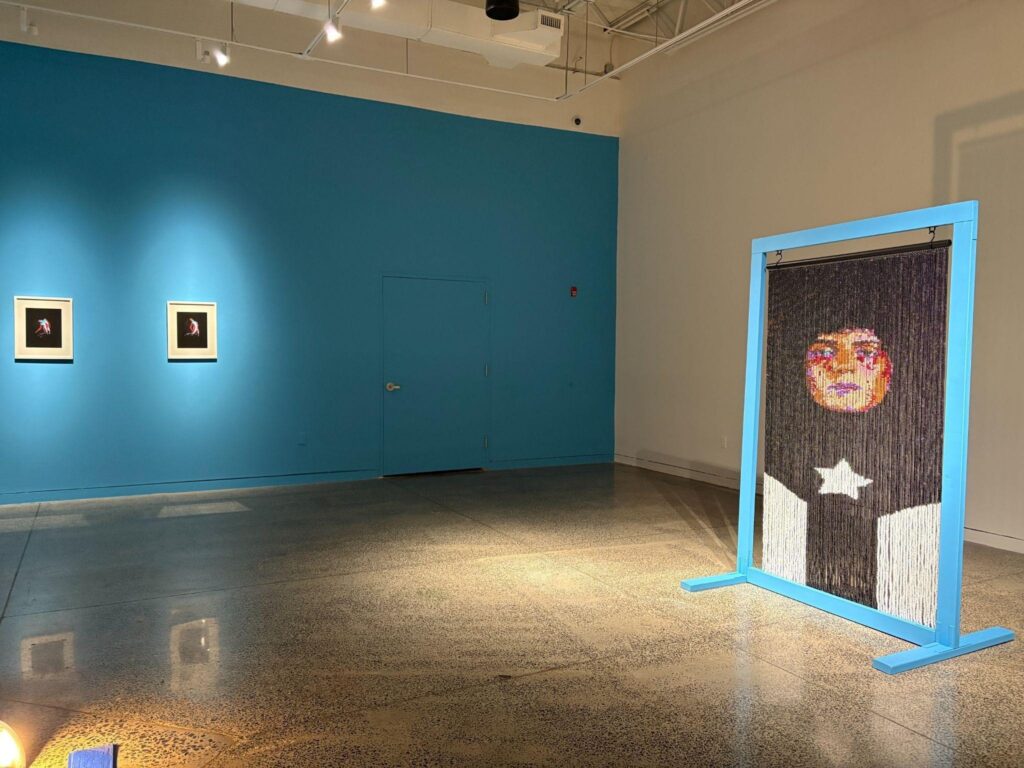
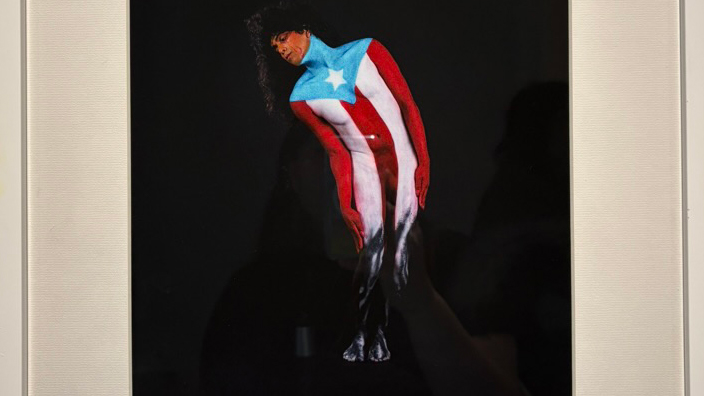
Hagudeza Rullán-Fantauzzi is an artist who proudly shows all facets of her identity in her work, primarily through depicting her own body shown in multiple mediums. Rullán-Fantauzzi uses photography, video, dance, and sculpture to draw a parallel between the island of Puerto Rico’s fight for sovereignty and the artist’s personal journey as a trans woman. Upon walking into the main gallery, it is obvious that Rullán-Fantauzzi made intentional decisions regarding the display that support the themes in her work. The gallery is coated in a soft sky blue, instantly recognized as Puerto Rico’s original flag color, which at one point was illegal to own or display between 1948 and 1957 under the Gag Law (Ley de la Mordaza). In the present day, this flag is now used as a symbol of resistance, and sets the exhibition’s tone as ready to speak against oppressors throughout history. Rullán-Fantauzzi embodies her home country’s story in a series of photographs conveying movement and struggle, informed by the artist’s experience as a choreographer. In full body paint, from the neck to the toes, Rullán-Fantauzzi’s form becomes the true Puerto Rican flag, rising up from a landscape of ash and darkness. What was once just an object has become a symbol of the people, as they are currently in a battle of being citizens to an administration that doesn’t support them as a country. Despite the ongoing obstacles, Rullán-Fantauzzi believes there is a future where autonomy can be achieved, shown in her beaded tapestry, En las Manos de America, watching over the gallerylike a triumphant guardian. Rullán-Fantauzzi reminds us that visibility can be an impactful form of resistance, as we continue to pass down our language, culture, and history for generations to come.
About the writer: Jessica Aguilar is a writer and arts professional from Prince George’s County, MD. She holds a Bachelor’s in Art History from Tyler School of Art and Architecture, where she fell in love with the murals, mosaics, and wheatpastes of Philadelphia. She was a 2023-2024 participant of the Arts Writing Incubator at The Black Embodiments Studio in Seattle, WA, with a published essay in A Year in Black Art. She is a regular contributor to Art Spiel and has been published in several art publications across the U.S. Guiding both her writing and creative processes are interests in nostalgia, identity, and gender expression through Latine perspectives. She aims to make the art world accessible to all communities while working at Paradigm Gallery. Her studio and casual exhibition reviews can be found on her Substack. @jesswiththe_mess