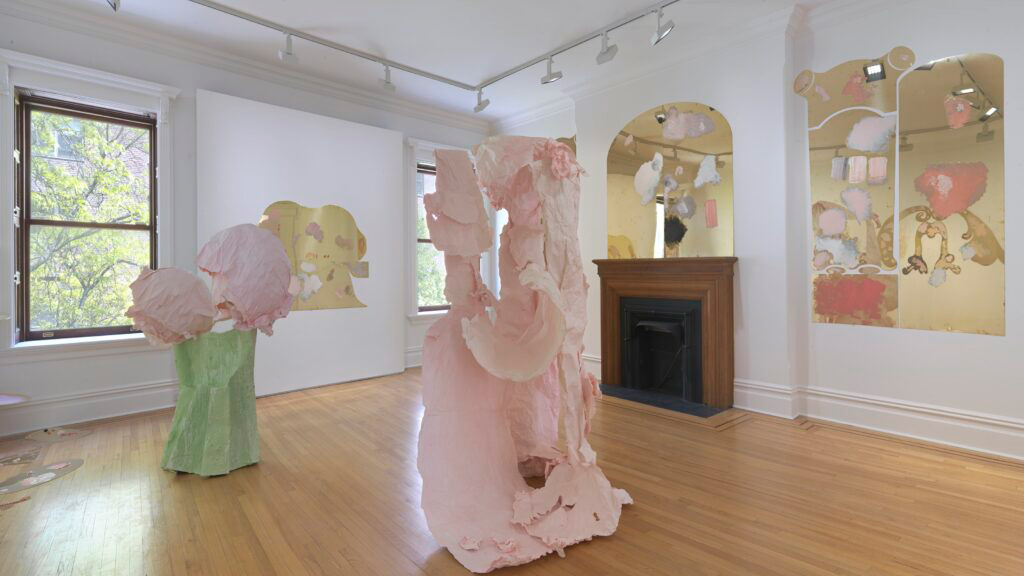
Karla Black presents her first show in New York City since 2016, and inaugurates Rodder’s expanded Upper East Side gallery space.
Karla Black is a canonized Scottish artist known for working with basic art materials like plaster, paper, and chalk, alongside beauty products like bath bombs, rouge, Vaseline, and lipstick, all in shy pastel colors to create womb-like, abstracted dreamscapes. At Rodder, she creates a site-specific installation, painting Rococo silhouettes in light hues on mirrors as well as constructing monumentally delicate, scented sculptures that glide through the space, chiming in on somatic echoes of the building’s historical narrative, and celebrating feminine beautification rituals.
Rodder operates from the fifth floor of a building on East 80th Street, just a corner from the Metropolitan Museum of Art and a block from Central Park. The building was erected in 1889, as America’s elite began to build mansions along Fifth Avenue in the bloom of the Gilded Age. This was, and still is, a neighborhood for New York’s high society, and this five-story rowhouse, replete with its dark wooden floors, tall frieze-decorated ceilings, and elegant stairwells, shivers with stories from a bygone era. The ghosts of cocktail parties and ballrooms are astoundingly within fingers’ grasp, heightened by the very real remnants of the 2026 Met Gala still freshly littering the adjacent street as the show opens.
Black’s site-specific installations exude a deep loyalty and connection to a place. She deeply surveys and inahbits it with powders in a way that is reminiscent of fingerprint dusting. At crime scenes, dusting reveals latent prints of suspects quietly waiting on railings, surfaces, doorknobs, tables, drinking glasses, and nightstands. Not dissimilarly, Black quietly sprinkles layers of pastel-colored plaster powders carefully sieved through sugar strainers to create works that, in essence, unveil a clandestine spirit of a space. It is in this vein that Karla Black created her site-specific work at Rodder.
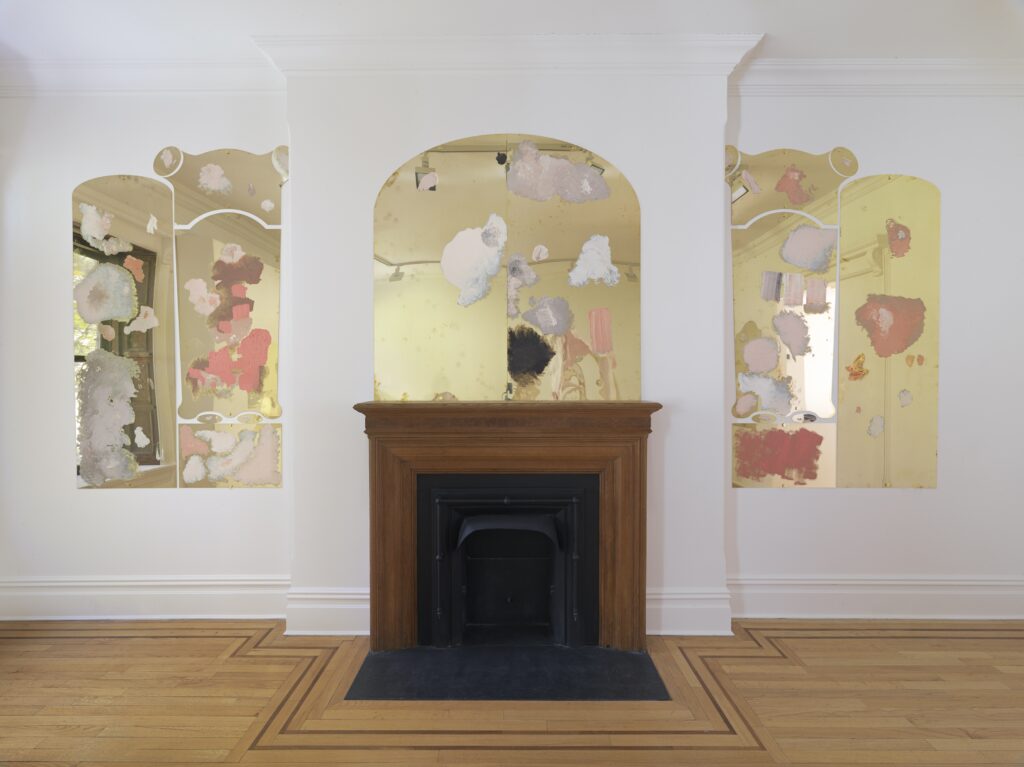
For Black’s show, the gallery’s main street-facing room is hung with multiple postmodern giltwood-style Baroque mirrors. The entirety of each mirror, including the scalloped, flourished edges, is cut from smooth, golden reflective solid brass. On the many mirrors, the artist paints playfully buoyant, lush abstract marks that appear to dance around the room. A proud, cloud-like ice cream-scoop form in tender peach, intimate pink, and rose quartz floats on the mirror atop the fireplace in Ornament In the Hundreds (reason surfaces), 2026. On the same rounded-top square-set mirror, several other expressive, fluffy clouds appear in rainy grays, silhouette and cavernous blacks, and deep chocolate browns. On the right-hand side of the mirror, a thick pink impastoed smear of striated gossamer pink draws the viewer in to inspect it, as they may when testing lipstick shades across their forearm. Around these textured oil-painted forms breathes the golden surface, exposed for the viewer to find their own blushing face revealed in between the fluffy apparitions.
On the left of the mantelpiece is another postmodern mirror, floor-to-ceiling. Here, once more, cloud forms and thick swatches float in gradating pinks of scaling transparencies, some allowing a peek of the mirror behind, while others sit stubbornly opaque, obscuring its surface. The amalgamation of abstracted moving forms on the golden plane creates an image that can, at a slight stretch, resemble Baroque silhouettes: fine ladies with tall gray powdered wigs adorned with berry colored wildflowers, cocoa colored fox fur scarves, rouge, faces dusted in pale mauve, nectarine and coral ball gowns, rosewood and toffee colored hats, and pebble gray feathers in their hair. This figuration is merely suggested, ever so slightly, and can be easily overlooked, as this may be the closest to representation Karla Black has ever forayed.
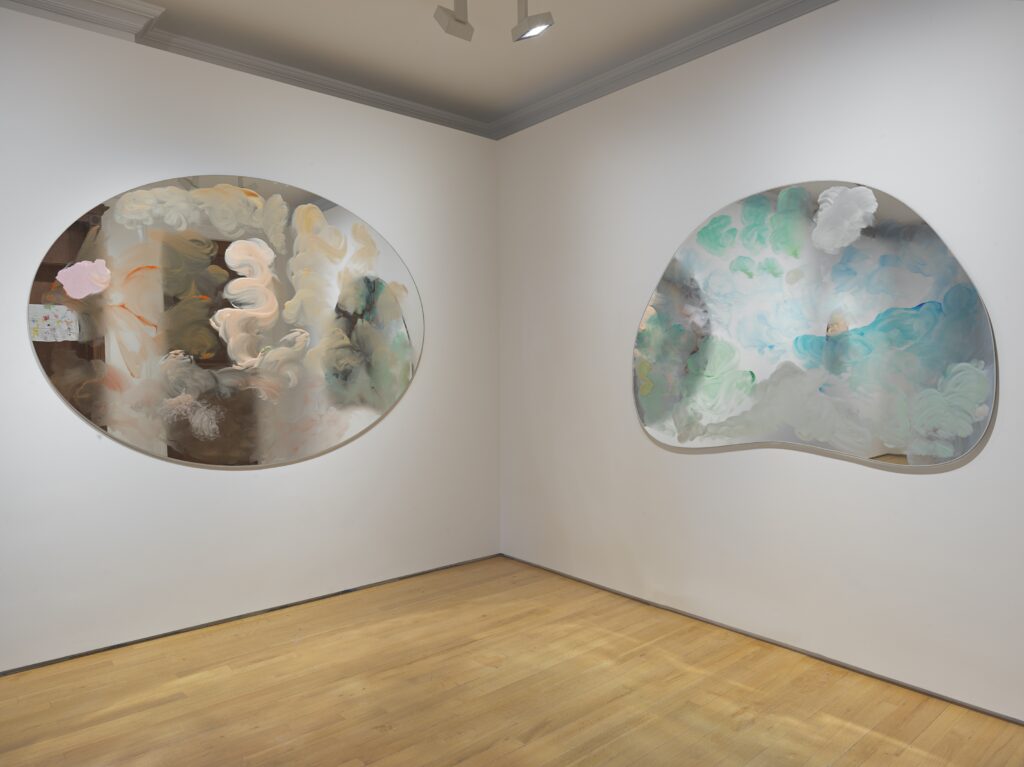
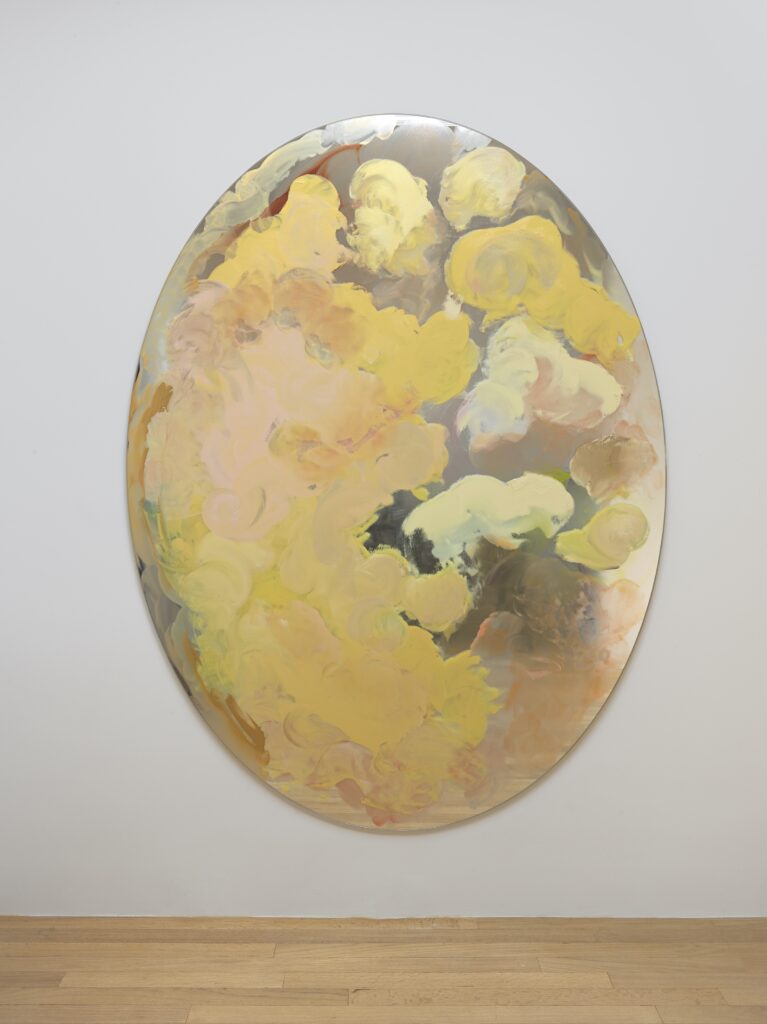
A few large oval mirrors from a different series, Looking Glass, 2026, boast a less restrained expressive style, where textural transparency and composition are the main painterly questions at hand, explored with a mix of glass paint and oil paint on mirror. Smooth smoke-like brushstrokes snake in endless ‘S’ forms from bottom to top of the mirror, at times obscuring the viewer’s self-reflection completely, at other times exposing it, and at still other times smudging and blurring it. One mirror plays with hues of tangerine, fair nude, and latte, and another with dusky aqua, atomic blue, and bluefish as ringlets of these hues swirl across the piece. In this turquoise work, Looking Glass (know to hold), 2026, the mirror is shaped like a painter’s palette, with watercolors dancing across it, revealing a smoky self to ourselves in its center.
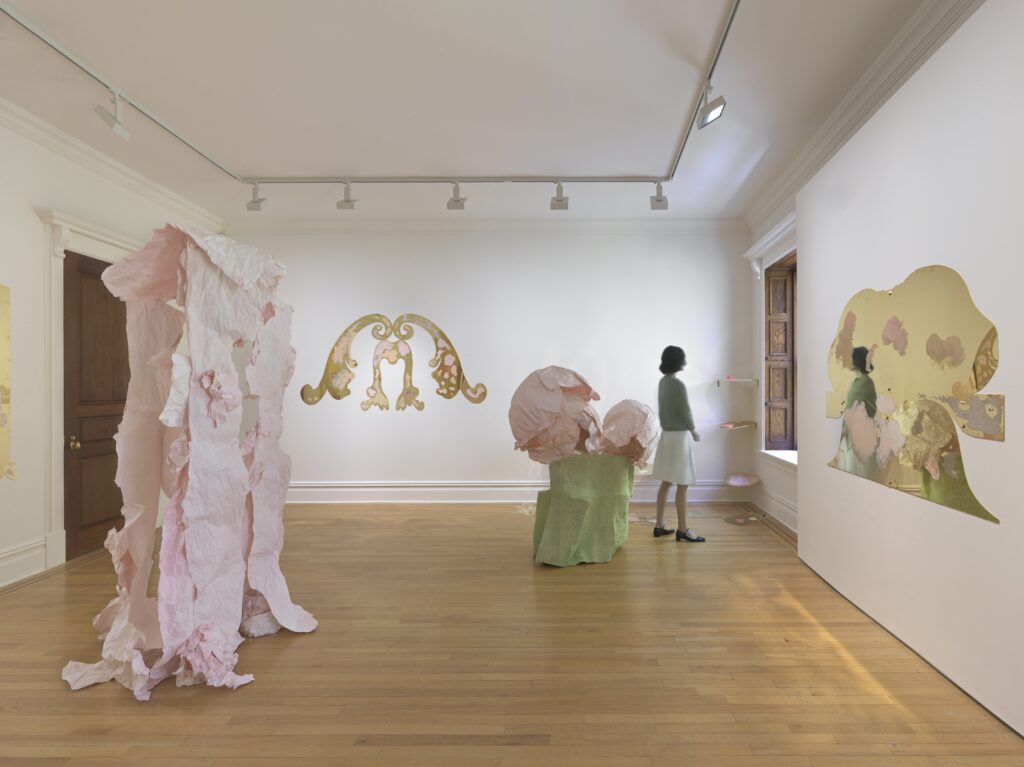
In the middle of the room stand two paper sculptures. They appear brave and vulnerable in their rising, elegant forms. One such piece, Nature at the Court, 2026, is made of cartridge paper, watercolor ink, plaster, and feather dusters, nonetheless. The fair pink piece cascades down, spilling onto itself, weak, exposed, strong. It is implicitly a contradiction of terms, and that’s what makes the piece successful. Feather dusters within it hold it together, a ridiculous choice of structural boning, and one that reminds the audience of the strongly feminine underpinnings of the show. Language of Worlds, 2025, perhaps the oldest work in the show by this incredibly prolific artist, depicts a deliciously textured duo of layered, creamily feathered, ice-cream-like peonies growing out of a thickly plastered chunky pastel green stalk.
Nature in the Court, 2026, alongside a similarly tall sculpture in the back room, Theatrics End, 2026, made of a polythene dust sheet, depict beatific dancers, and thus allow the viewer to ground themselves in the ballroom setting. Looking at the show as a whole, there are two layers of a party being presented. One is of a luxuriously indulgent soirée. Adding to this is the sprawling floor piece Ornament In the Hundreds (decorative rate), 2026, presenting a platter-like array of pinkish paint piped like frosting, smeared like makeup swatches, caked, and drizzled as sakura pink powder appears like, well- coke -on mirrors, alongside cutely dished angel and flower-shaped bath bombs. These party hors d’oeuvres are presented to us as a rich buffet atop mirrors placed horizontally on the ground, and others that hover like trays out of the walls.
The underbelly, preparatory side of the party, is the second layer. A woman getting ready for a party is just as joyful as the party itself: picking out clothes, bathing, perfuming, dressing, and applying makeup. All that is here, not separate from the celebration. The back room of the gallery boasts an imposing built-in walnut wall-to-wall bookcase. On its shelves, Karla demurely splays out little Gucci compact mirrors, painted with dabs of painted dots in saturated rainbow colors on their insides, like demented little candied makeup kits. Along these shelves, too, Karla poses Lush bath bombs: a few peach-shaped bath bombs, a spherical bath bomb in shimmery béchamel with a deep guava rose poetically peaking out of its insides, and two globular bombs, one marbled in taffy pink and breezy green, and another in bluish diaphanous white, patterned with cotton candy pink stars. These spheres, artworks in themselves, are laid carefully on drizzled trails of rose-bisque pink powder, and shyly demarcated with undulating ornate waves of icy blue and flushing pink toilet paper.
The series is titled Prepare Regularly for Lazy Visits, 2026, hinting at intimate social gatherings and the societal expectation that women prepare their bodies and homes for their guests. The scent of soap gently fills the room, bringing an olfactory dimension to Black’s all-engulfing installation. This dimension is carried further by a piece on the wall: the stubs of three lipsticks in fuscia, blushed jam, and fair peach are embedded into thick Vaseline blobs tinted in creamy apricot and guava sorbet hues smeared on the wall, creating deeply textured site-specific wall sculptures. On the other side of the same wall, three more, larger circles of crystal-blue and shimmery glazed pink Vaseline dollops embed lipsticks and hold threads of silver and gold party streamers, and a crumpled sheet of silver leaf that lazily dangles beneath them like a used Kleenex.
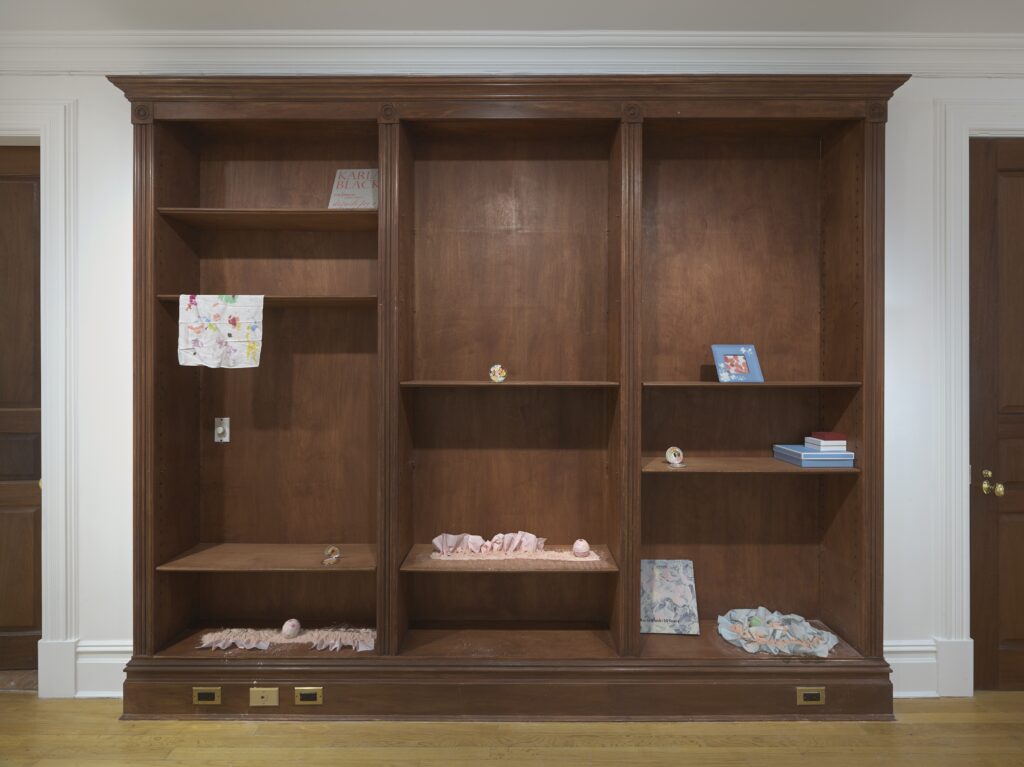
Black is compelled to create works that hold the potential of something to happen, intimations left raw like cake ingredients barely inside a bowl, perhaps near an oven, maybe not quite in the bowl but casually sprawled around it in a room that resembles a kitchen, simply to signify “cake.” Karla takes particular interest in making works that “civilize of the drives,” which she describes as creating an impetus to act, while simultaneously demanding that we control our impulses. Here, plaster suggests something firm but remains raw; petroleum jelly invites touch and smell; bath bombs call to be dropped and fizzed into the tub; lipstick and caked pigment beg to be smeared, tasted; paper, pathetically propped, asks to be kicked or destroyed. Every element demands to be touched, loved, caressed, held, sniffed, and played with. Yet we must resist.
The tension between playful desire and restraint animates the show and adds a profoundly social side to it. In the opening, an array of excited and elegant collectors, art dealers, and artists parley amongst the fragile sculptures. A swarming party of tens of individuals fills Rodder to the brim while maneuvering carefully through its two spaces. Despite the chaos, each person present is experienced enough not to touch, destroy, or intervene in the breathtakingly breakable art. It becomes a social game that is at once dangerous and thrilling, with most of the collectors being women who are truly delighted by the wonderfully expressive pinkness of the show.
Black conjures a world of aristocratic decorum and feminine excess in her Rodder show that seduces while insisting on etiquette. The result is a body of work that is at once sensuous and disciplined. In Karla Black’s hands, powder, paper, lipstick, and plaster become instruments for staging exquisite pastel drama of wanting something deeply, and choosing, for social benefit, not to intervene too much, but instead to enjoy longing. In Karla Black’s dreamy, Wharton-esque reality of rigid etiquette there is a lot of blushing pink joy that while following the outlines of certain rules, leaves a lot of room for playful freedom and imagination.
Note to the reader: the writer, in researching and writing about the show, enjoyed using color names from the Pantene color chart, and from a joyful combination of makeup color names of brands sold at Sephora, where the writer wandered for an hour hoarding color names like ‘fair nude’, ‘tangerine’, ‘blushed jam’ and ‘honey gleam’.
Karla Black at Rodder May 5 – June 18, 2026 @rodder.nyc
About the writer: Sivan Lavie is a poet, arts writer and visual artist based in New York City. Sivan published chapbooks with Inkfish Studio and Earthbound Press, and her criticisms, poems and short stories appear in Whitehot Magazine, Art Spiel, Hobart Pulp, SPECTRA Poets, SUDS Zine, KEITH LLC, Happy Apples Press, Kids of Dada and Avenir Magazine. @s.i.v.a.n.w.o.r.l.d