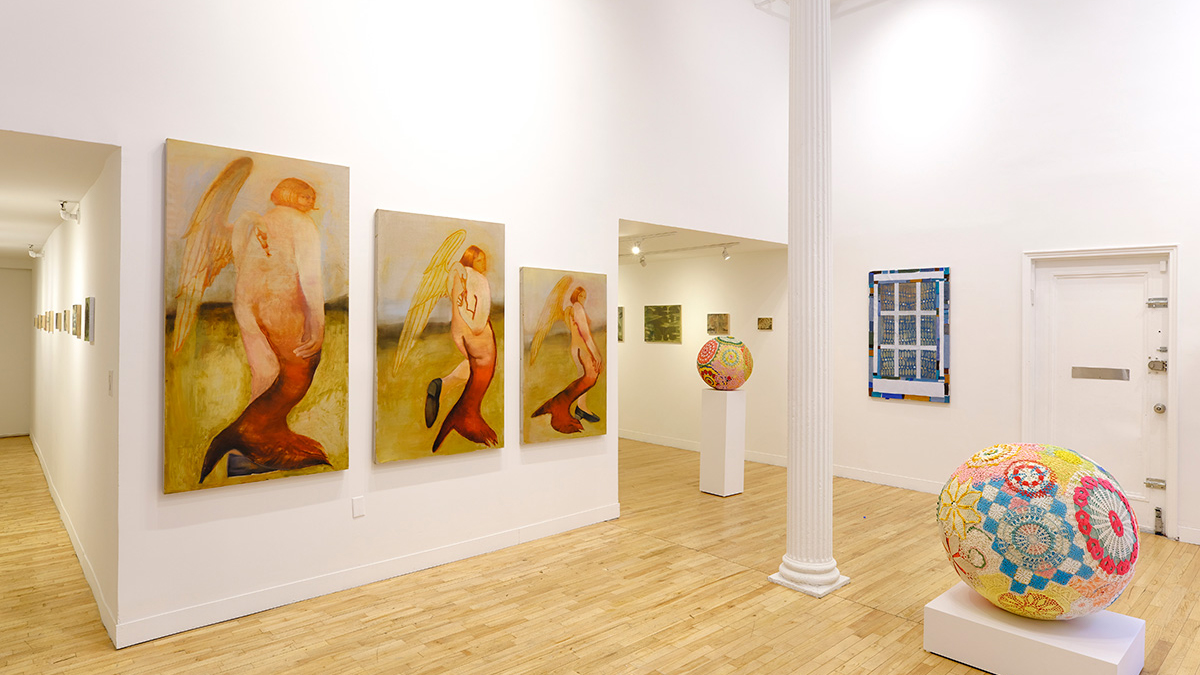
Before his artist talk, Julián Kreimer set a small brown valise on the table and opened it. Inside, folders held drawings on paper, each made in response to a photographic slide from his parents’ archive. The valise was not part of the exhibition; it was the working material behind it, a private archive he had been drawing through for years. Encountering it set the terms for the room next door: Yuyo is what happens when that interior is opened out.
Continue reading “Yuyo- Julián Kreimer at the Sarah Lawrence Heimbold Visual Arts Center”Cynthia Pareja Dubin at the Oyster Point Hotel
The Artist in Residence program at The Oyster Point Hotel was launched in 2020 and curated by Ellen Martin, with the support of Kevin Barry, the hotel’s President. Its premise is straightforward: contemporary art belongs not only in galleries but in the spaces where people actually live, rest, and move through their days. Each year, a selected artist’s work inhabits the hotel’s guest rooms, common areas, and the fabric of the place itself, encountered by thousands of visitors during their stay.
Continue reading “Cynthia Pareja Dubin at the Oyster Point Hotel “Floating in Three Acts- Keren Anavy at SUNY
Floating names a state of suspension, between sinking and surviving, between grief and the body’s refusal to stop. In Keren Anavy’s landmark solo exhibition, Floating in Three Acts, this condition is both subject and structure. The exhibition is built the way floating feels: without firm ground, without clear direction, with the question of outcome left open.
Continue reading “Floating in Three Acts- Keren Anavy at SUNY”Ariel Willmott on Building Community Through Art in DUMBO
As Cultural Affairs Director at Two Trees and the Walentas Family Foundation in DUMBO, Ariel Willmott plays a central role in the neighborhood’s cultural life — overseeing initiatives including DUMBO Open Studios, Smack Mellon, the Sharpe Residency, and Two Trees’ studio subsidy program. Ahead of DUMBO Open Studios weekend, we spoke with her.
Continue reading “Ariel Willmott on Building Community Through Art in DUMBO”Tobias Pils: Shh at Mumok Vienna
Tobias Pils’s paintings do not give themselves up quickly. It took me two long visits to begin to grasp his extensive solo exhibition at Mumok, curated by Manuela Ammer across two floors and ten years of work. The show traces a practice rooted in personal experience and daily life, charting a shift from floor to easel painting and revealing how drawing and painting remain in constant dialogue throughout. The layout rewards sustained attention and makes the changes over time visible. I viewed the exhibition in reverse, starting with the floor of Pils’s most recent works.
Continue reading “Tobias Pils: Shh at Mumok Vienna”Spirit in the Flesh at Utopia
Spirit in the Flesh is on view at UTOPIA in Kingston, the gallery, bookstore, and studio space founded in 2025 by Lucia Cote. Curated by Saul Chernick, the exhibition brings together sculpture, painting, and works on paper by Courtney Puckett, Ben Pederson, and Chernick. The show treats art as a way of being, shaped by imagery rooted in intuition and dreams and carried into physical form through sustained attention to process. In a climate of constant noise and unrest, the works lean toward beauty, curiosity, and play. Curator and artist Saul Chernick tells us more about the exhibition and the venue.
Continue reading “Spirit in the Flesh at Utopia”Women Sculptor Group: In the End, Everything Gives
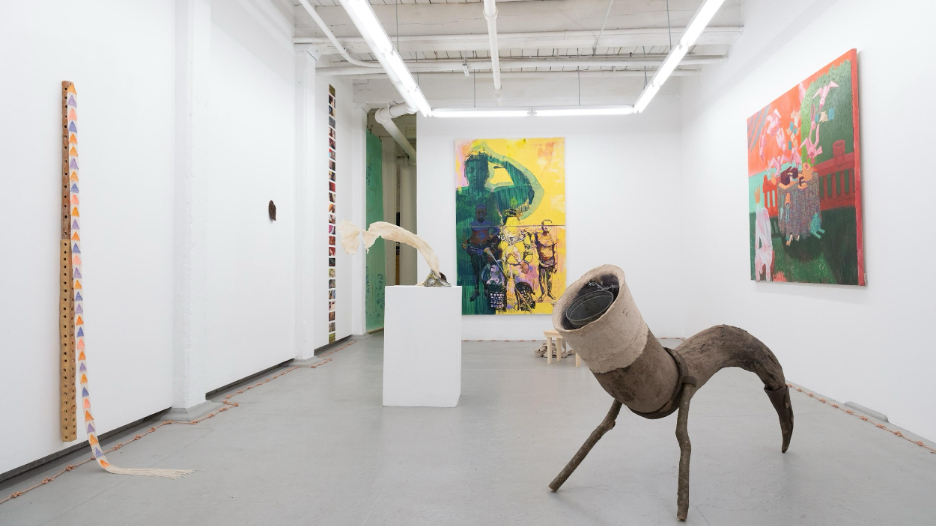
At Silver Art Projects, In the End, Everything Gives brings together more than thirty artists from the Women Sculptors Group (WSG), a New York–based network of women-identifying and non-binary sculptors that now includes over 350 members. Installed within the residency spaces at 4 World Trade Center, the exhibition carries the energy of a working community—artists connected through an ongoing commitment to sculpture and material inquiry.
Continue reading “Women Sculptor Group: In the End, Everything Gives”Alice Pixley Young: Still Life at AIR
Alice Pixley Young’s Still Life takes shape in semi-darkness at A.I.R. Gallery as an immersive meditation on ecological time, stratified and shadowed by industrial residue. Installed as a multisensory environment of video projection, sound, industrial scaffolding, and glass bell jars, the installation places viewers in a space where remediation and damage coexist. Suspended from tall black scaffolding, the glass containers move like dimly illuminated pendulums, casting shadows across the walls and establishing the installation’s temporal pulse from the outset.
The work’s rootedness in place is central. Young’s studio is located on an Ordovician fossil bed near a nuclear Superfund site in the Rust Belt. Her exhibition in Brooklyn hints at another Superfund site, the Gowanus Canal, linking two contaminated landscapes across geography. The central video shows horizontal strata in constant motion. Below the upper dusky blue sky, you can travel slowly through narrow moving bands — grasses and wildflowers filmed at the Fernald site in southwest Ohio — creating a lateral sense of passing through a remediated landscape. Alongside it, a thinner strip shows water seen from a bridge, evoking an industrial waterway shaped by contamination and cleanup. The cross sections are clean-cut and suggestive, tinged with a bluish monochrome.

Birds enter through sound and sight. The birds’ calls, recorded by the artist, continuously shift and reorganize, gradually overtaken by industrial noise. They suggest a tough migration. The suspended glass bell jars are engraved with imagery of Eastern Meadowlarks (one of the bird speciesin population decline). The glass pieces swing slowly like pendulums of grandfather clocks, casting moving bird shadows across the projection, encapsulating past, present, and future. These dome-shaped transparent jars are recognizable as decorative containers used to showcase collected specimens, typically placed on a safe shelf. In Young’s installation, they lose their ground, engraved on, and swing side to side hypnotically. Here, these fragile containers of life also signal warnings, becoming what she calls “active image-makers.” I can imagine those glass jars holding the souls of vanished birds. The birds’ blurred wings flicker as their cries reverberate through the space, at times piercing, at times distant.

The birds’ imagery appears in motion, blurred and only partially formed, more hinted at than fully seen. The birds seem to move as if traveling between sites, from Young’s Rust Belt landscape toward Brooklyn’s Gowanus Canal, some vanishing along the way. The black scaffolding structure stands before the screen, geometric, imposing, and bare. It interrupts the projected space, holding the blurred flight behind it in tension with containment. Objects, shadows, and projected imagery fold into one another. The present physical space bleeds into its layered past, reaching toward an unknown future. The disappearing birds, the scientific monitoring of contaminated landscapes, and the broader theme of environmental time link seamlessly. Or as the artist says, the projection reads like a “cross-section connecting atmosphere, land and contaminated infrastructure.”
As projected forms lengthen and shift, they spill beyond the screen and into the room, animating the gallery with a haunting beauty that is eerie, grim, but not yet fatalistic. Still Life does not settle into elegy. It resists the stillness implied by its title. It operates as a poetic wake-up call.

Alice Pixley Young: Still Life at AIR, 155 Plymouth Street
Brooklyn, NY 11201.On view throughMarch 15, 2026. Wed–Sun, 12–6 pm
About the Writer: Etty Yaniv is a Brooklyn-based artist, writer, curator, and founder of Art Spiel. She works in installation, painting, and mixed media, and has shown her art in exhibitions across the United States and abroad. Since 2018, she has published interviews and reviews through Art Spiel, often focusing on underrecognized voices and smaller venues. @etty.yaniv
Still / Moving at San Luis Obispo Museum
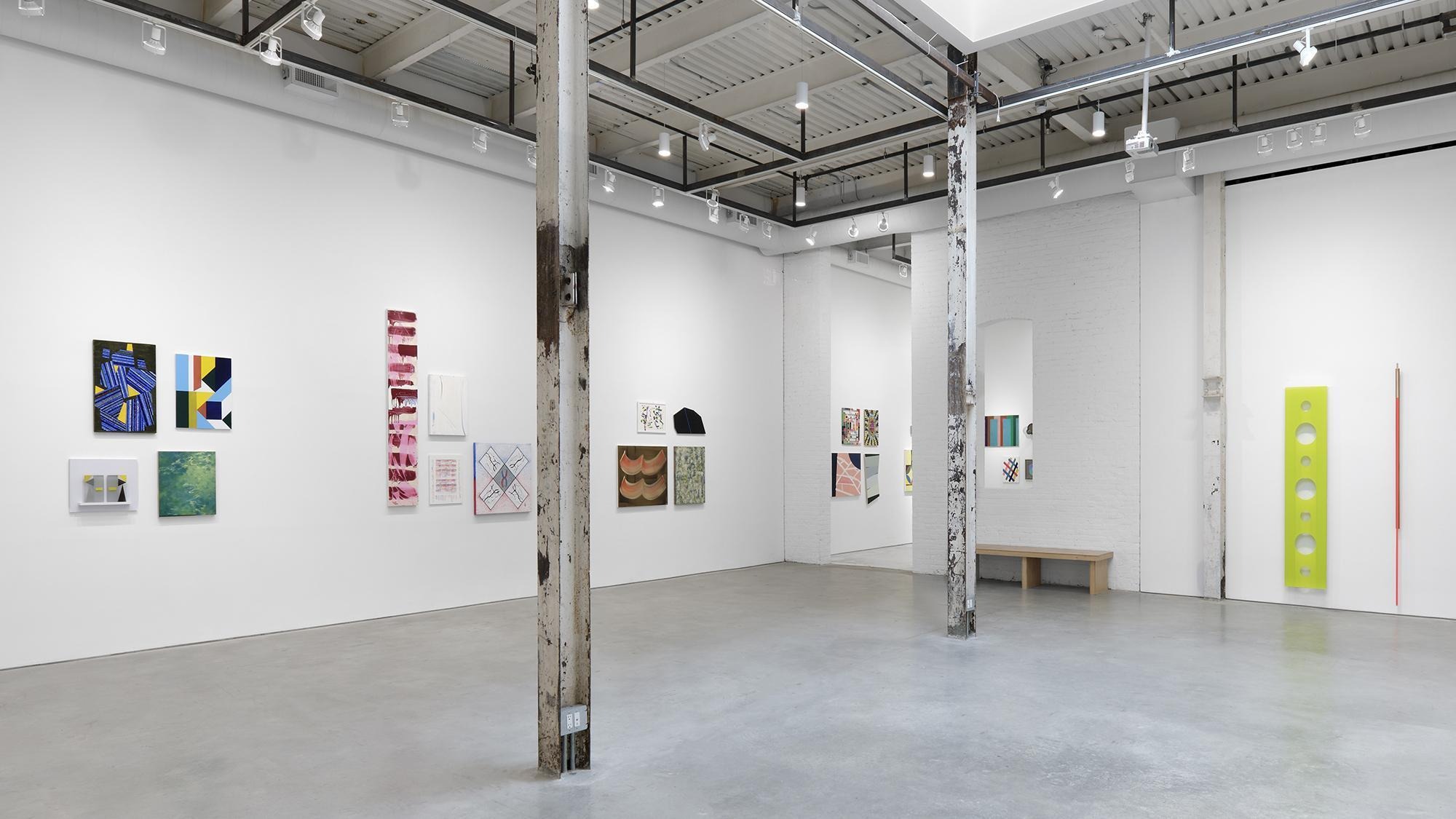
In Dialogue
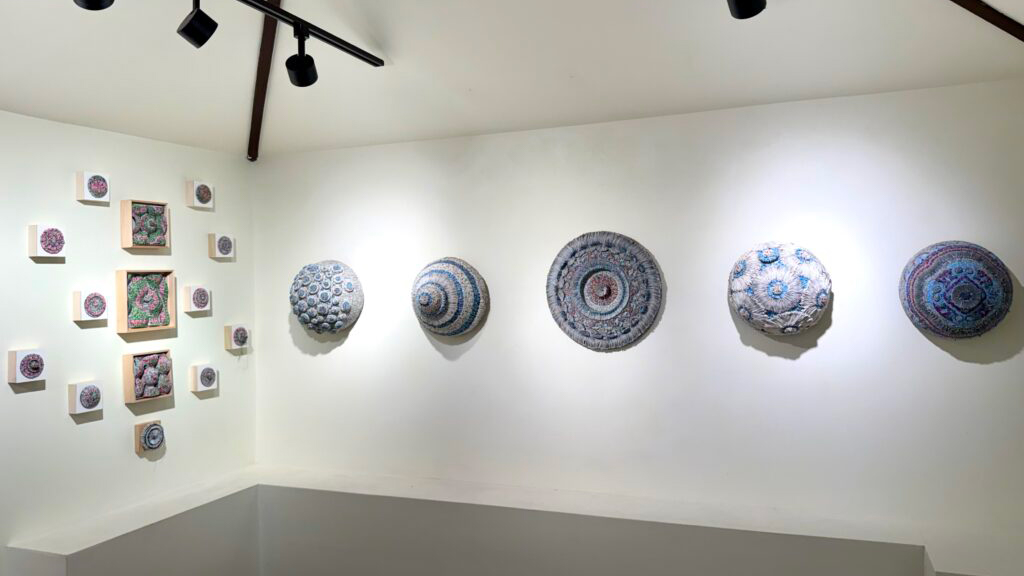
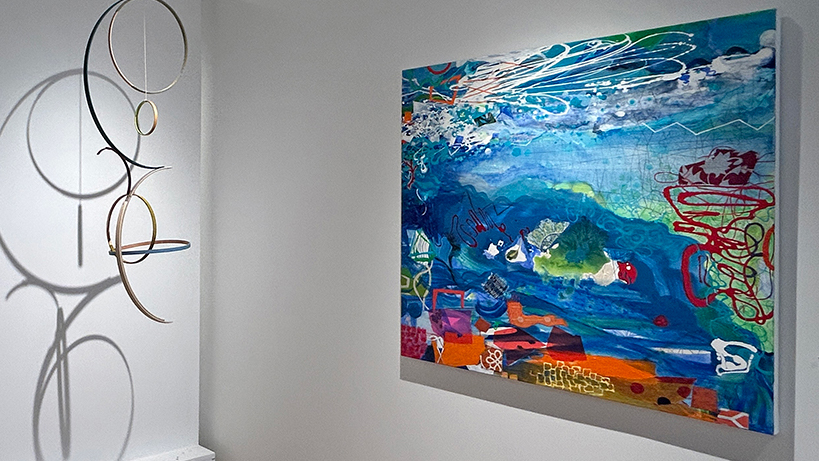
Adria Arch and Keith Wiley had never met before working on Still / Moving, their exhibition at the San Luis Obispo Museum of Art. Living on opposite coasts—Arch in Boston and Wiley in Atascadero—they developed the project from afar, connecting through shared images, ideas, and a common interest in movement and form. In the exhibition, Arch’s bright paintings and hanging shapes reach outward with color and rhythm. Her flowing, curving forms feel energetic and playful, as if they are moving through the air. Wiley’s portal-like sculptures draw viewers closer. Built from small marks and quiet details, they invite pause and careful looking, with openings that pull you inward. Emma Saperstein, the exhibition curator, discusses her curatorial vision and reflects on the museum as a venue for this project.