
Borges once described a fictional Chinese encyclopedia that classified animals into categories so incompatible — beings that belong to the Emperor, embalmed ones, those that look like flies from a distance — that the whole idea of classification begins to feel like a kind of absurd fiction. Nancy Bowen’s first solo exhibition at Nunu Fine Art invokes exactly that suspicion: that the dictionary, the archive, the great pre-internet repositories of everything, are not neutral records but constructions, and that constructions can be dismantled, embellished, and made to mean something new.
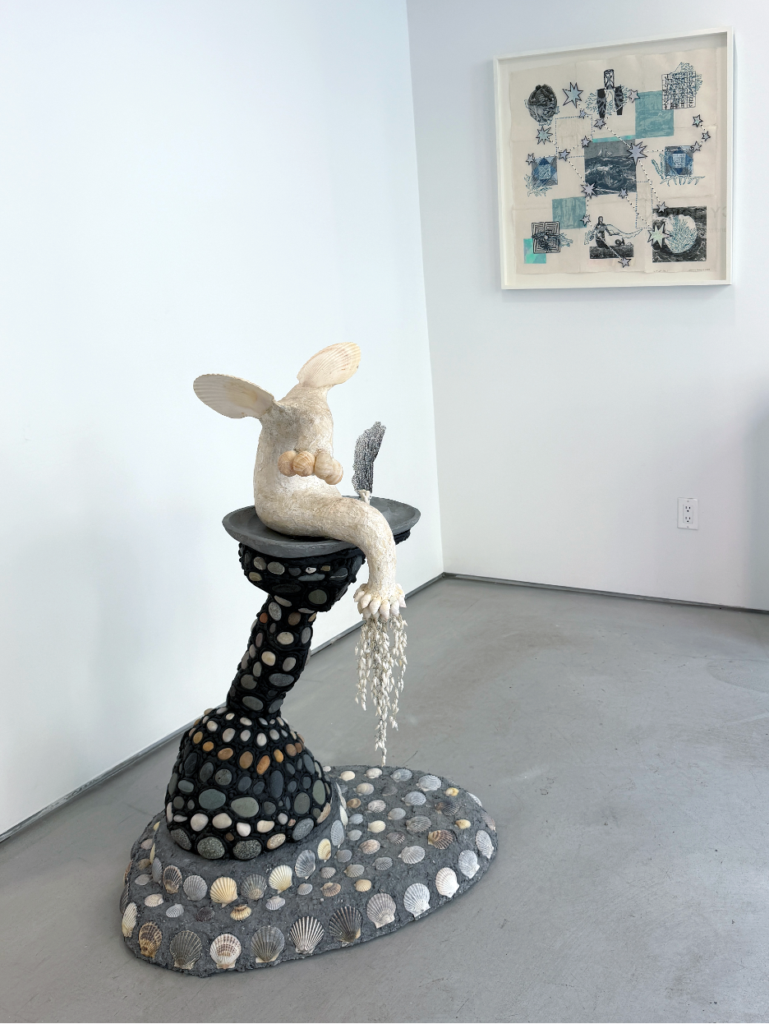
You enter to find From the Deep (2024), a ceramic White Venus encrusted with coral and shell, sitting on an elongated oval base conjuring a fountain. The references are layered and immediate: birth, classical myth, the sea, the female form as origin. Yet this Venus has donkey ears, a metastasized foot for a mouth, a compact torso, and legs that splay into medusa feet — a nymph-donkey hybrid emerging from a deep, dark seabed. Next to the seated figure, a seaweed sprouts, thin, intricate, and delicate. The sculpture suggests the emergence of life forms with all their wonder and absurdity.

And then you turn to the wall.
Lost at Sea 1 (2023) is a 27-by-28-inch collage centered on a black-and-white illustration by Walter Paget from an 1899 edition of Robert Louis Stevenson’s Treasure Island, portraying a crouched figure in a boat, adrift, with an approaching sailboat visible behind. Is he about to be rescued, or left to perish? All possibilities coexist. Vignettes referencing this central scene multiply outward in gridded squares and ovals: a fragment of the dark waters, a diagram in an indecipherable script, a ghostly image where the stranded protagonist may have been saved. The grid suggests a formal rule, broken in places, but still presenting a visible order. Comic-strip stars sparkle around the central figure, scattered like fatalistic data points.

The two-dimensional collages that make up half of Bowen’s body of work look, at first, as if they belong to an entirely different artist, until the shared language becomes visible: the same delight in ornament and accumulation, the same insistence on transforming received material into something new. Flat, gridded, framed — Bowen’s collages operate through rule and system, until they don’t.
Since 2015, Bowen has worked with early and mid-twentieth-century dictionaries found in her parents’ home, removing individual pages for each letter of the alphabet, collaging them together, overlaying the sheets with geometric patterns, glitter, and gouache. Words like “naked,” “obeisance,” “taboo,” and “zeal” surface within a composition without imposed rhyme or narrative. While viewers may instinctively search for a hidden message, Bowen emphasizes visual rhythm and association over literal reading; yet, amid a shifting political climate, certain selections have begun to resonate differently, with social and political concerns surfacing through a process shaped as much by intuition as by circumstance.

Bowen’s process combines digital and handmade. What registers on the surface appears insistently analog — the trace of a hand everywhere — still, underneath, the logic is almost computational: rules applied in layers, one system over another, producing a visual cacophony that a viewer can choose to decipher or simply inhabit. These works are encyclopedic in the Borgesian sense: they contain multitudes, but the order they impose is their own, eccentric and alive. The dictionary, Bowen seems to say, was always already the internet — a dream of total knowledge, cross-referenced, illustrated, and shot through with the biases of its moment.

In conversation with Gerda Krivaite for Our Culture earlier this month, Bowen described working on sculptures and collages simultaneously, each in dialogue with the other. Standing in the gallery, this rhythm becomes legible. The collages give us the world as data: generalized, gridded, archived. The sculptures give us what that data cannot hold: a body, individualized, a procession.

The ceramic figures move through the space like characters in a carnival or a Dionysian procession. Most of them are overtly female, breasted, arms multiplied like a Kali of creation and destruction; Sentinel (2024) is draped in beaded sashes and edged with porcupine quills; Venus Again (2022) carries on her thin, crumpled neck a vagina-like shell, her hyperbolic curves echoing an ancient terracotta fertility goddess. They can be imagined as words from the dictionary made flesh: stepped off the page, taken on a body, and began to march. They flirt with surrealism, recall the bulbous female forms of Louise Bourgeois, gesture toward Indian goddess iconography, and yet remain resolutely Bowen’s own — hybrid, tactile, animated by material.
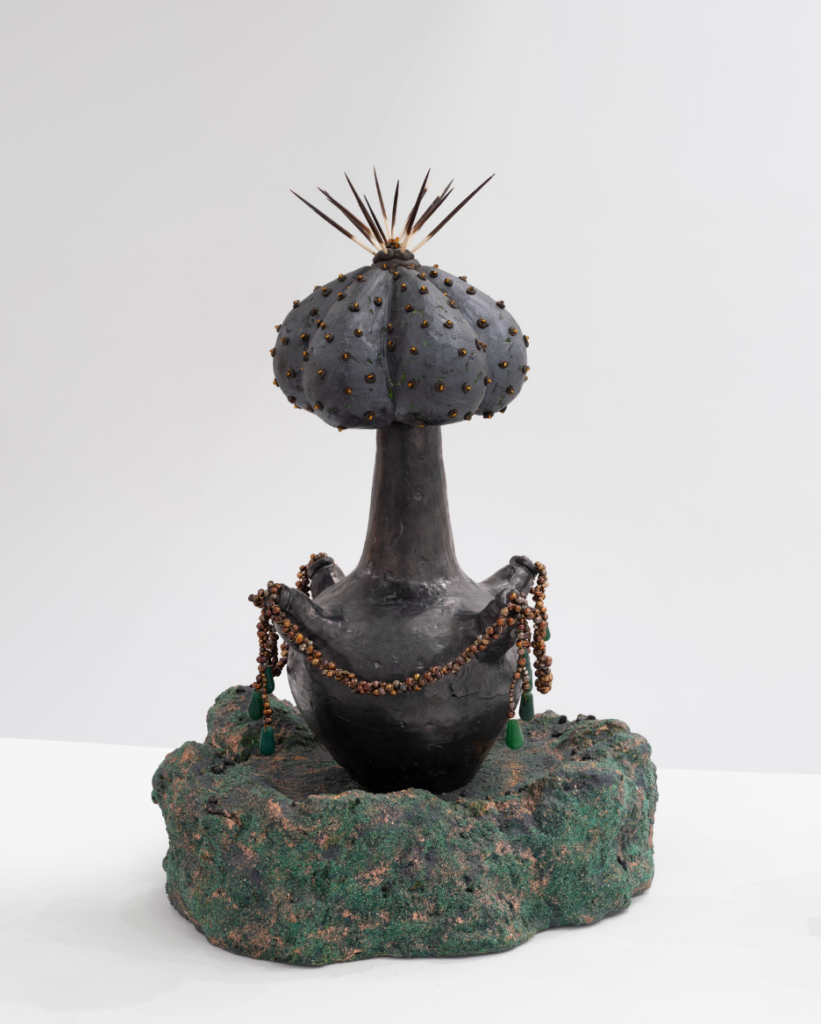
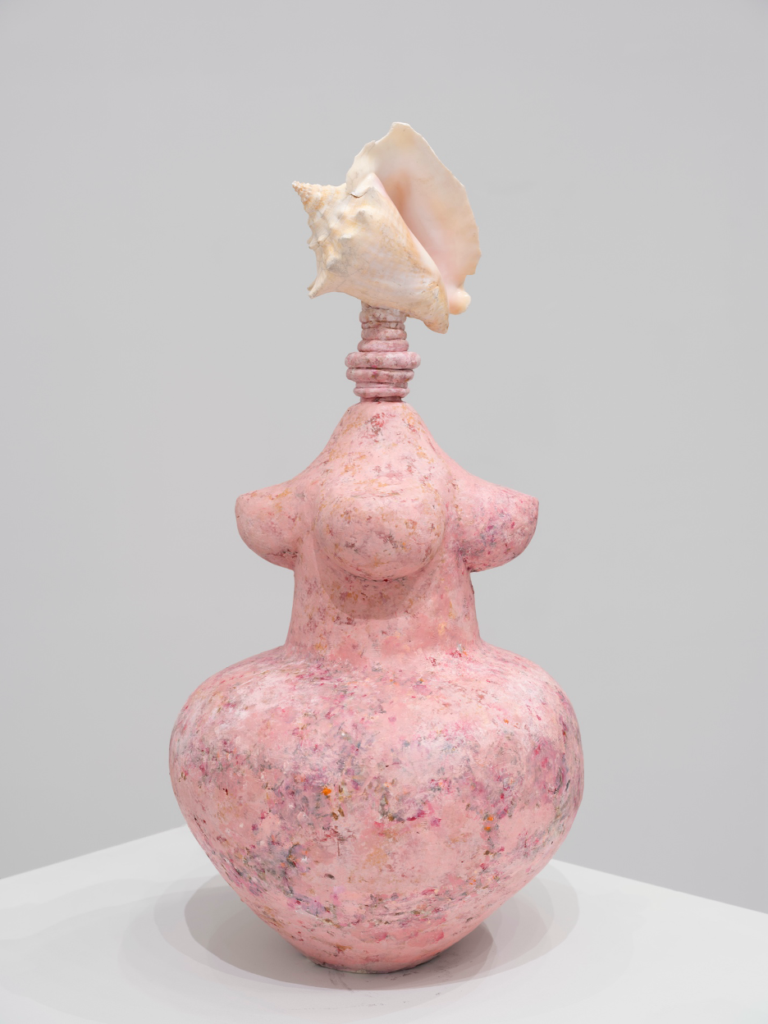
None of these materials arrives without history. Bowen learned beadwork from her grandmother, an Edwardian woman of great creativity whose gifts were channeled into socially acceptable domestic crafts. The beads in these sculptures are, in some sense, inherited and transformed — strung on wire and woven like baskets, now functioning as bold structure while embracing decoration. There is a lineage here, too, in the Pattern and Decoration movement of the 1970s, which Bowen encountered through her feminist teachers as a student, a movement that reclaimed ornament, craft, and surface as serious artistic territory.
That inheritance shows in her unabashed use of glitter and embellishment: decoration as argument. The coral and shells are both symbolic and indexical, pointing back to the sea, to the origin story the Venus announces at the entrance. Working with the sensibility of an “artist-archaeologist,” Bowen excavates, recombines, and repurposes her materials to subvert long-held narratives around the female body, craft traditions, language, and history. There is something both forensic and tender in how she handles her sources.

What the show ultimately offers is two ways of holding the world: the encyclopedic and the embodied, and the insistence that neither is sufficient without the other. Bowen moves between A and Z and finds everything in between: the body the dictionary forgot to include, the myth that outlasts the archive, the joke that cracks the archive open, the grandmother whose creativity could not be classified but was passed down anyway, bead by bead.
Make your tax-deductible donation today and help Art Spiel continue to thrive. DONATE
All photos courtesy of Nunu Fine Art Gallery unless otherwise indicated.
From A to Z and the Bodies In Between, Nancy Bowen at Nunu Fine Art, 381 Broome Street. On view through July 25.
About the writer: Etty Yaniv is a Brooklyn-based artist, writer, curator, and founder of Art Spiel. She works in installation, painting, and mixed media, and has shown her art in exhibitions across the United States and abroad. Since 2018, she has published interviews and reviews through Art Spiel, often focusing on under-recognized voices and smaller venues. More about her art can be found at ettyyanivstudio.com and on Instagram @etty.yaniv